Coverage Calculator · India 2026
How Much Tile Adhesive Do I Need? Coverage Calculator for Marble & Tile Projects
To calculate adhesive correctly, you need more than project area. Bed thickness, trowel notch, slab size, substrate flatness, back-buttering and wastage can change consumption dramatically. This guide shows contractors and homeowners how to estimate DUSH adhesive bags without relying on misleading headline coverage numbers.
Bag Quantity Formula
Step 1: Convert project area to m² if needed.
Step 2: Divide total m² by verified m² per bag.
Step 3: Add your project wastage allowance.
Step 4: Round up to full bags.
1 m² = 10.7639 sq ft | 1 sq ft = 0.092903 m²
Quick Coverage Table
DUSH APEX Example: How Many Bags for Common Project Sizes?
The table below uses the verified APEX TDS coverage and includes a 10% example wastage allowance. It is an estimating example—not a substitute for measuring actual site consumption.
| Project Area | Area in m² | 3 mm Bed @ 6 m²/bag | 3 mm Bed @ 5 m²/bag | 6 mm Bed @ 3 m²/bag | 6 mm Bed @ 2.5 m²/bag |
|---|---|---|---|---|---|
| 100 sq ft | 9.29 | 2 bags | 3 bags | 4 bags | 5 bags |
| 500 sq ft | 46.45 | 9 bags | 11 bags | 18 bags | 21 bags |
| 1,000 sq ft | 92.90 | 18 bags | 21 bags | 35 bags | 41 bags |
| 2,500 sq ft | 232.26 | 43 bags | 52 bags | 86 bags | 103 bags |
| 5,000 sq ft | 464.52 | 86 bags | 103 bags | 171 bags | 205 bags |
Why Headline Coverage Can Mislead
Why You Should Not Multiply “4 sq.m/kg” by a 20 kg Bag
Current DUSH product pages publish headline coverage figures such as 4 sq.m/kg for APEX and 3–4 sq.m/kg for ERA. Those values are useful product-page indicators, but contractors should not automatically multiply them by bag weight for procurement unless the exact basis, bed thickness and test method are clear. [2] [3]
The APEX technical sheet is more specific because it links coverage to thickness and trowel size: 5–6 m² per bag at 3 mm and 2.5–3 m² per bag at 6 mm. That is much more useful for site estimating. [1]
Use this hierarchy for quantity calculation:
- Best: measured mock-up consumption on your project.
- Next best: current TDS coverage at the required bed thickness/notch.
- Use cautiously: generic product-page coverage number.
- Avoid: random internet “one bag covers X sq ft” claims with no thickness or trowel stated.
Step 1 — Measure Area
How Do You Measure Adhesive Area Correctly?
For floors, multiply room length by width and add separate areas such as landings or corridors. For walls, calculate wall width × height and subtract major openings only when they are large enough to materially affect quantity. Add skirting, staircase risers, window reveals and returns separately.
Example
A 20 ft × 15 ft room is 300 sq ft. If the same project has 40 running ft of 4-inch skirting, that adds about 13.3 sq ft. The adhesive area is therefore roughly 313.3 sq ft before any other details.
For multi-room projects, calculate each zone separately. This is especially important when different DUSH products are used in different areas—for example OMNI inside, ERA under large slabs and APEX outside.
Step 2 — Choose the Correct DUSH Product
Why Product Selection Comes Before Bag Calculation
Quantity cannot be calculated correctly until the product is selected. A contractor should not estimate 100 bags of OMNI and later discover that half the project uses oversized slabs requiring ERA or exterior marble requiring APEX.
| Application | Best-Fit DUSH Product to Review | Quantity Note |
|---|---|---|
| General interior wall/floor marble or tile | DUSH OMNI | Use latest OMNI TDS consumption for exact format |
| Large-format/heavy marble or porcelain | DUSH ERA | Expect larger notch/back-buttering and higher consumption |
| Suitable exterior marble/natural stone | DUSH APEX | Use current APEX TDS thickness-based coverage |
| Rapid exterior vertical cladding | DUSH APEX INSTANT | Confirm current TDS and project method |
| High-rise façade | DUSH VOLT | Adhesive quantity is only one part of total façade system |
| General interior alternative | DUSH LITE | Use only within latest approved range |
| PINNACLE specification | DUSH PINNACLE | Verify current TDS and bag size before estimating |
Step 3 — Bed Thickness
How Much Does Bed Thickness Affect Adhesive Quantity?
Bed thickness is one of the biggest consumption variables. DUSH APEX’s technical sheet states approximately 1.2 kg/m² per mm of thickness as a general consumption reference. [1]
Using that reference, a nominal 3 mm bed consumes far less than a 6 mm bed. In practice, actual consumption still varies because the final collapsed bed is influenced by trowel notch, substrate flatness, tile back profile and back-buttering.
Step 4 — Trowel Size
Why Does Trowel Notch Size Change Coverage?
A larger notch leaves more adhesive on the substrate before the ridges are collapsed. This is often necessary for large slabs, but it also means one bag covers less area.
The APEX TDS links a 6×6 mm notch with the 3 mm / 5–6 m²-per-bag example and a 12×12 mm notch with the 6 mm / 2.5–3 m²-per-bag example. [1]
Do not choose a small notch merely to increase theoretical coverage. The purpose of the adhesive is to support and bond the tile or slab, not to maximise square metres per bag.
Step 5 — Back-Buttering
How Much Extra Adhesive Does Back-Buttering Use?
There is no universal percentage because the back-butter coat thickness varies with the slab and installation method. But it definitely increases total consumption because adhesive is applied to both substrate and slab back.
DUSH ERA specifically tells installers to back-butter large slabs for full coverage. This should be included in the quantity estimate because adhesive is applied to both the substrate and slab back. [3]
Step 6 — Wastage
Should You Add 5%, 10% or 15% Wastage?
There is no single correct wastage percentage for every project. A well-managed small interior floor on a flat substrate may have relatively low loss, while a large-format project with multiple mixes, back-buttering and site interruptions may need a more conservative allowance.
| Example Allowance | When It May Be Reasonable | Important Note |
|---|---|---|
| 5% | Very controlled project with measured consumption | Only when site method is proven |
| 10% | Common estimating example for normal procurement planning | Still verify with mock-up |
| 15% | Complex large-format/exterior project or uncertain site conditions | Should not hide poor workmanship or bad substrate |
The tables in this article use 10% only as an example, not as a DUSH universal requirement.
Large-Format Calculator
Why Large Marble Usually Needs More Adhesive per Sq Ft
Large-format slabs often require a larger notch, back-buttering and tighter substrate-flatness control. These measures improve support and reduce hollow spots, but they also increase adhesive consumption relative to smaller tiles on a very flat floor.
DUSH ERA is the best-fit DUSH product when large-format/heavy slab support is the main requirement. Its current page specifically highlights full coverage, anti-lippage and the need to back-butter large slabs. [3]
For a large-format quantity estimate, collect:
- Slab dimensions.
- Slab thickness and approximate weight.
- Substrate flatness.
- Trowel notch size.
- Required collapsed bed thickness.
- Back-buttering method.
- Measured kg/m² from a mock-up.
Wall Calculator
Do Walls Use the Same Adhesive Quantity as Floors?
Not necessarily. Vertical work can use different trowel sizes, panel weights and back-buttering methods. Exterior vertical cladding may also require more stringent coverage than a small interior wall tile.
For suitable general interior walls, review OMNI. For rapid exterior vertical cladding, review APEX INSTANT. For high-rise façade work, review VOLT within the complete engineer-approved system.
Always calculate each wall zone separately instead of combining all wall and floor areas into one average bag count.
Project Examples
How Many Bags for 500, 1,000 and 5,000 Sq Ft?
Using the APEX TDS as a transparent example and adding 10% example wastage:
- 500 sq ft: approximately 9–11 bags at the 3 mm coverage range, or 18–21 bags at the 6 mm range.
- 1,000 sq ft: approximately 18–21 bags at 3 mm, or 35–41 bags at 6 mm.
- 5,000 sq ft: approximately 86–103 bags at 3 mm, or 171–205 bags at 6 mm.
These examples demonstrate why a procurement manager should never approve a large adhesive order until the installation thickness and trowel method are confirmed.
Complete DUSH Range
Which DUSH Product Should You Calculate?
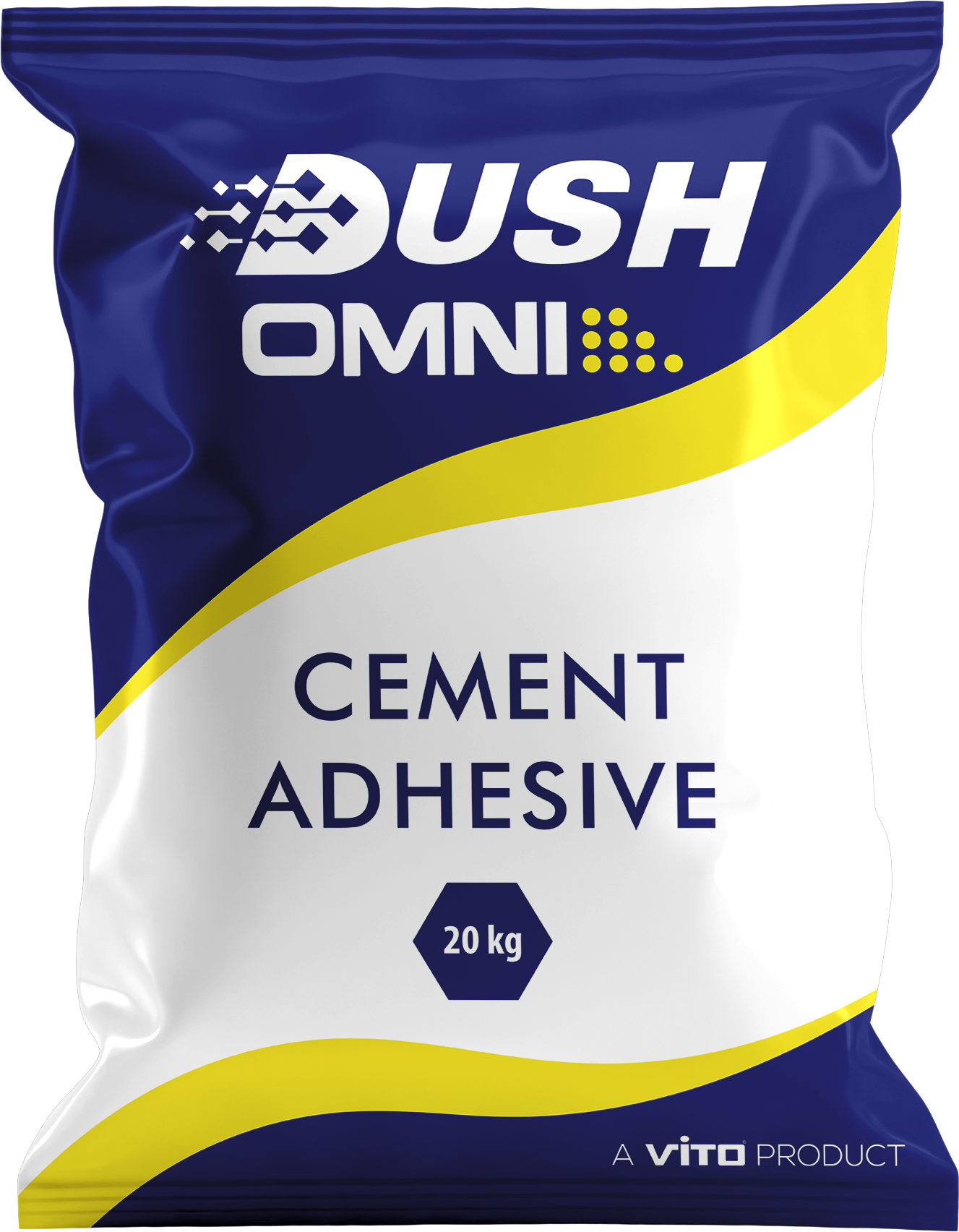
DUSH OMNI
Best-fit DUSH starting choice for suitable general interior wall/floor marble and tile. Use the current OMNI TDS or project mock-up for bag quantity.
View OMNI →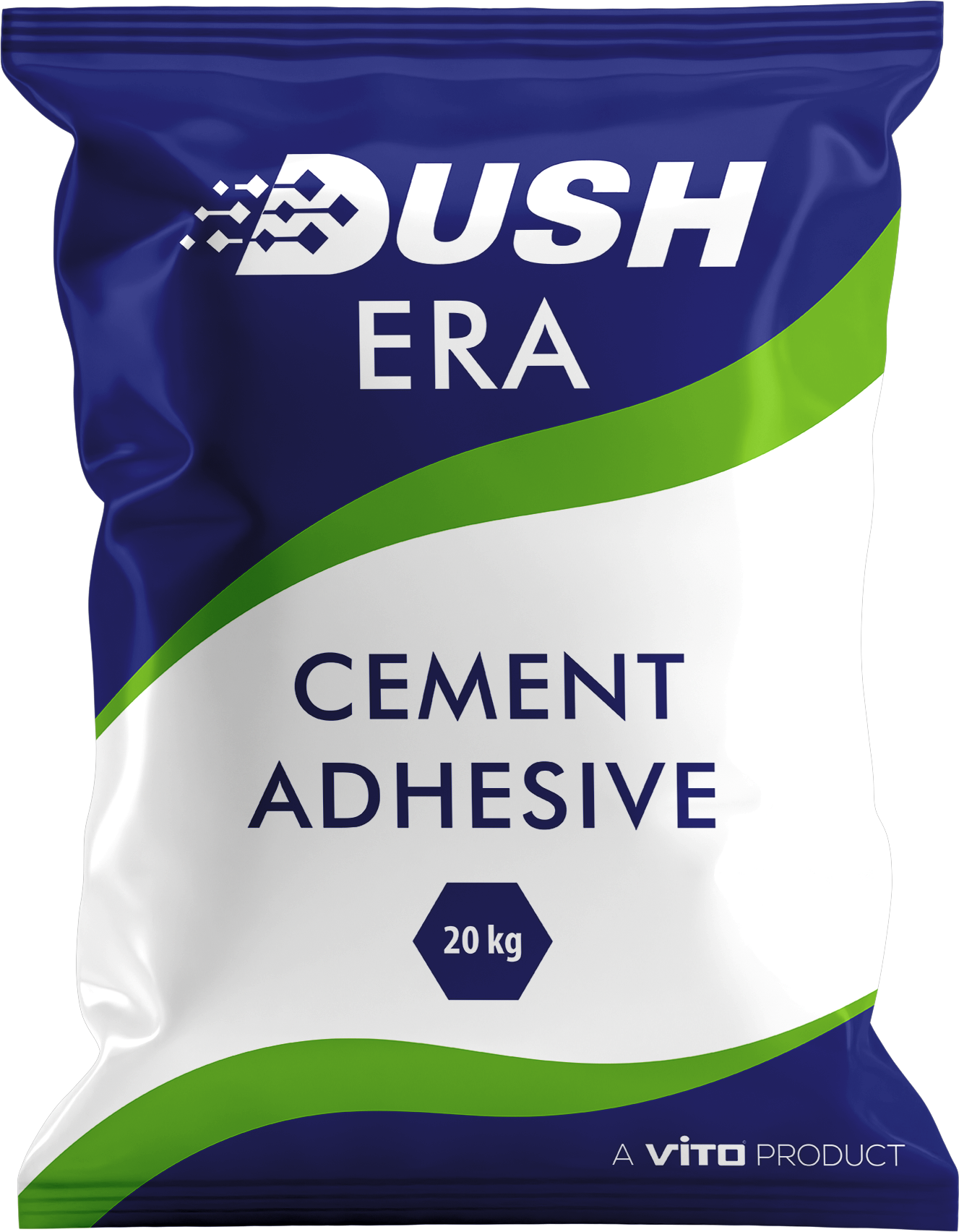
DUSH ERA
Best-fit DUSH product for large-format/heavy slabs. Expect higher consumption where large notch and back-buttering are required.
View ERA →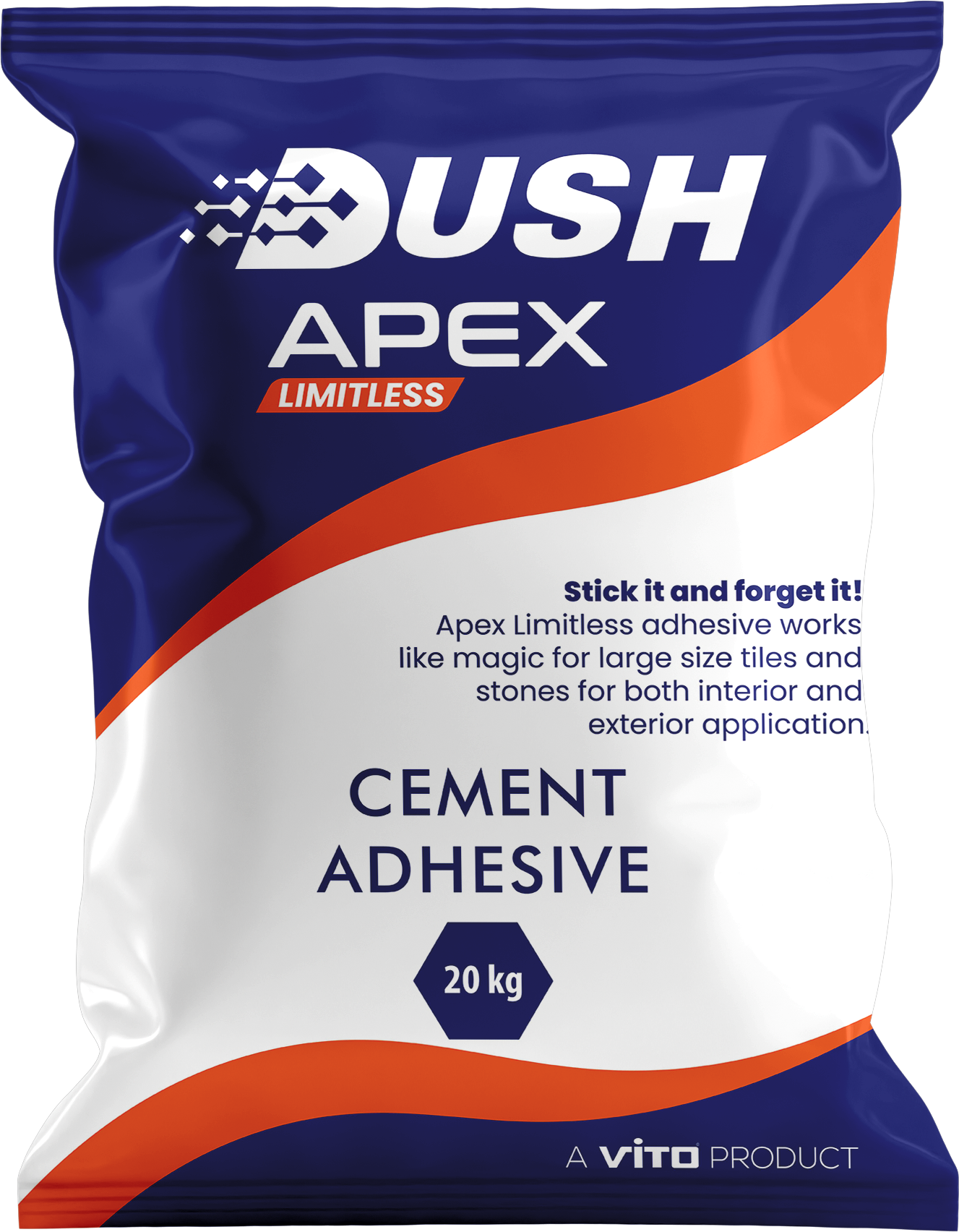
DUSH APEX
Best-fit DUSH general exterior marble/stone choice. Current TDS provides transparent thickness-based coverage examples.
View APEX →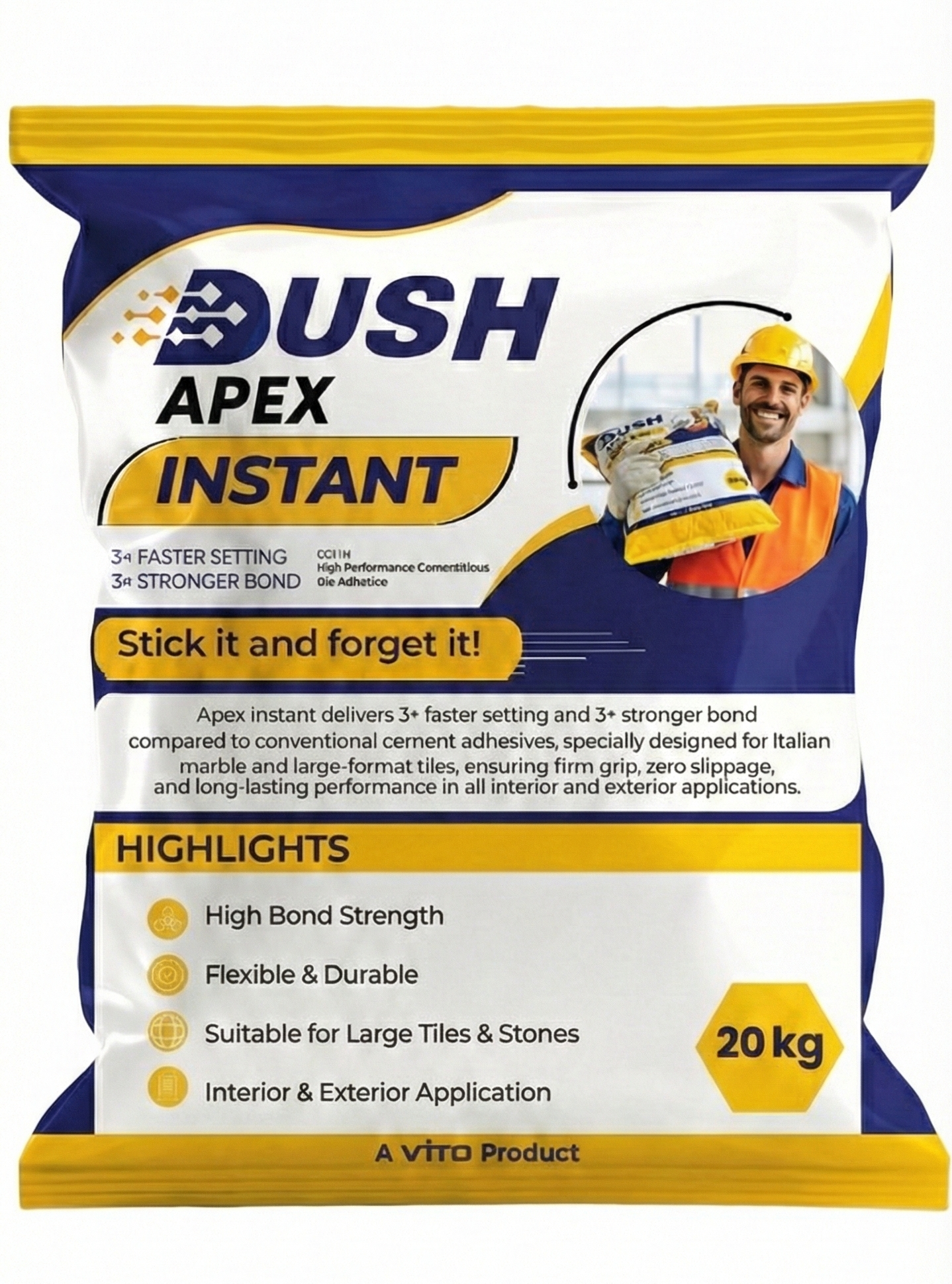
DUSH APEX INSTANT
For rapid exterior vertical cladding. Use the current APEX INSTANT TDS rather than borrowing APEX coverage figures.
View APEX INSTANT →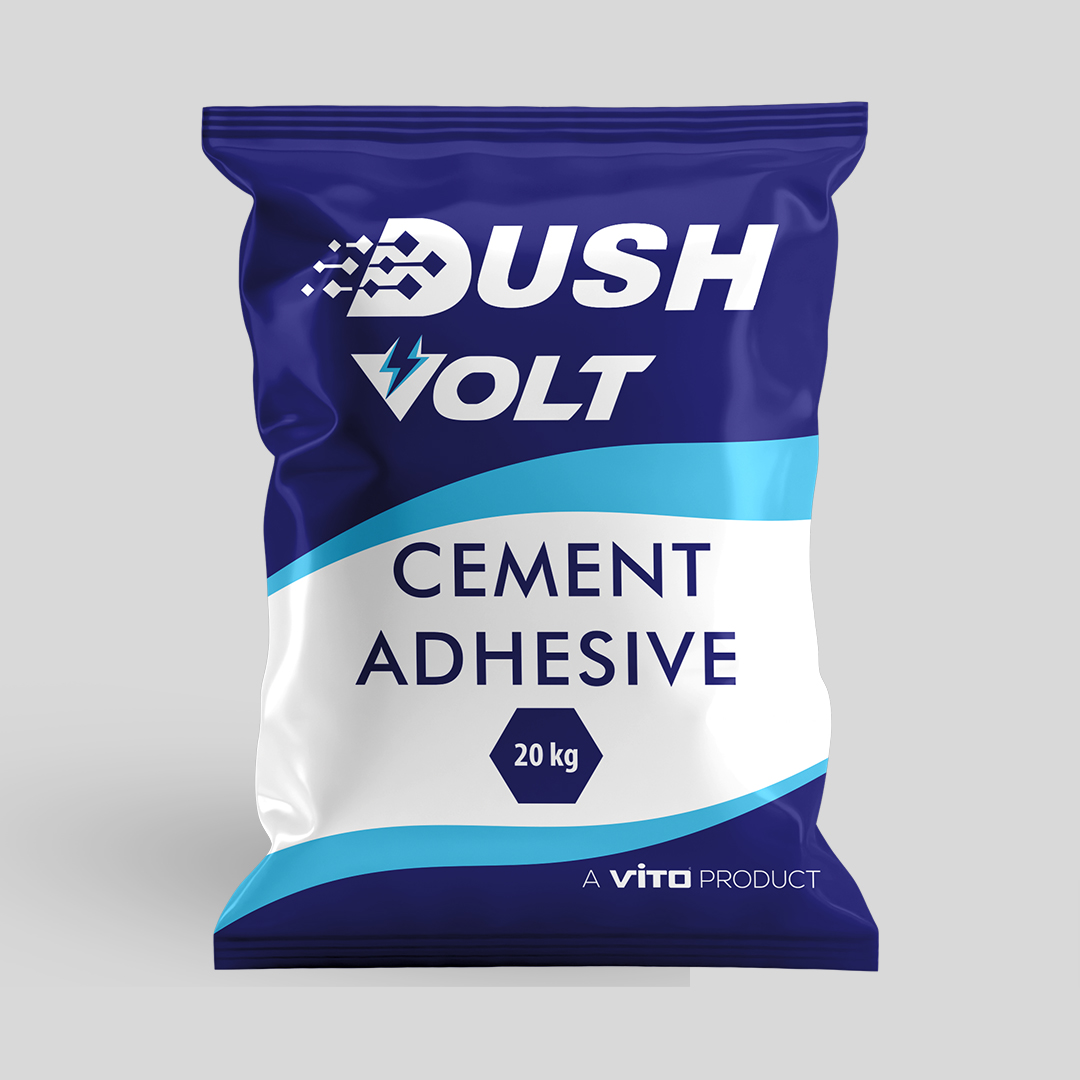
DUSH VOLT
For high-rise façade bond layers. Calculate adhesive only after the complete façade method, anchors and panel coverage requirements are approved.
View VOLT →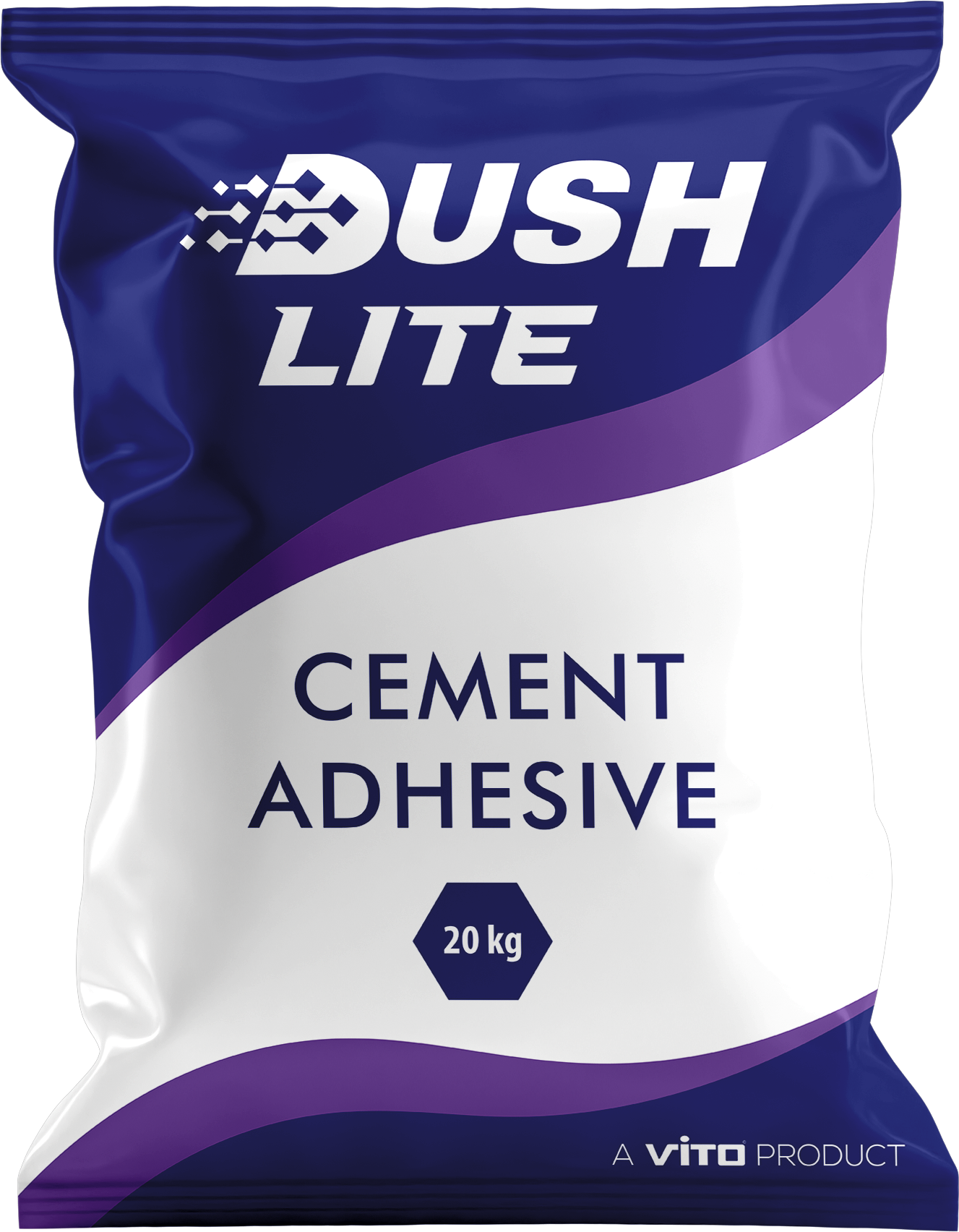
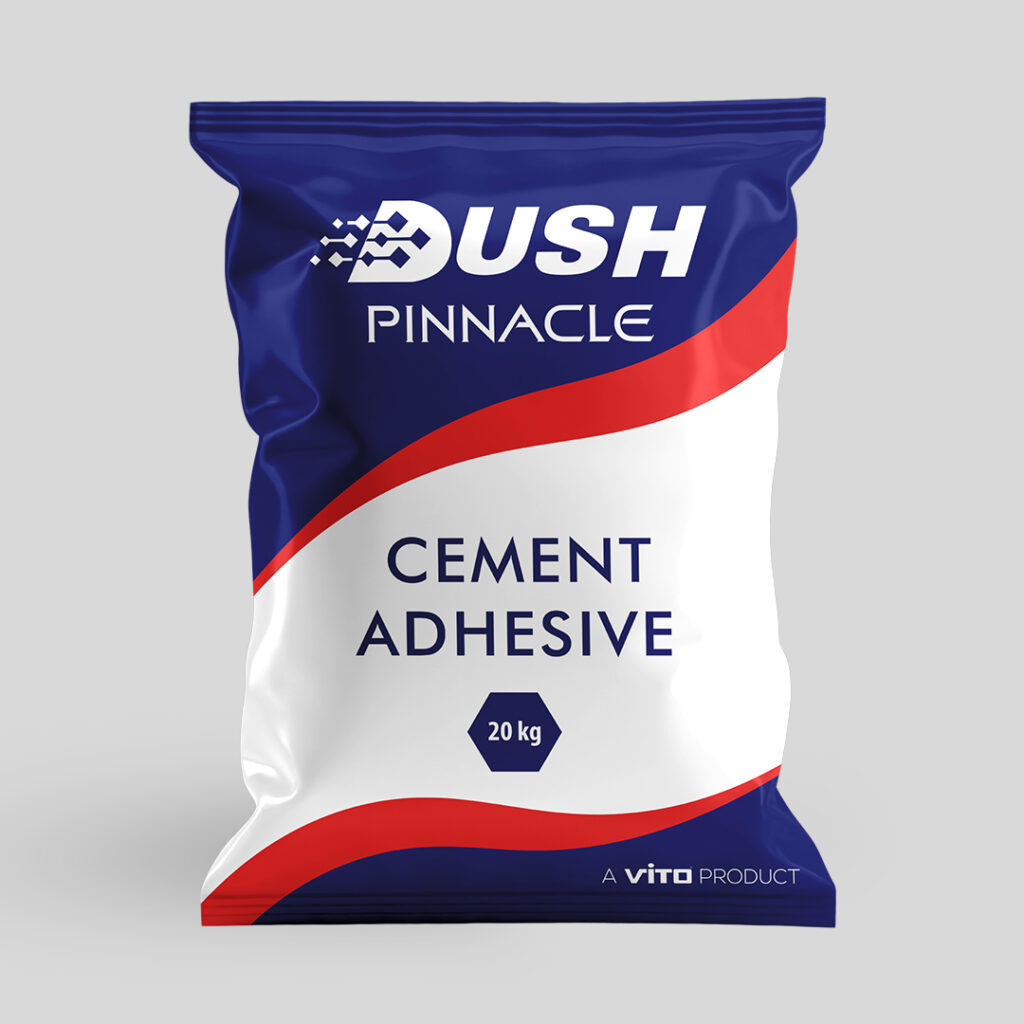
DUSH PINNACLE
Verify current TDS, pack size and approved application before estimating quantity.
View PINNACLE →Procurement Checklist
Before You Order Adhesive, Confirm These 12 Inputs
- Total net project area.
- Wall/floor split.
- Interior/exterior split.
- Tile/marble dimensions.
- Substrate flatness.
- Specified DUSH product.
- Current TDS revision.
- Trowel notch size.
- Expected collapsed bed thickness.
- Back-buttering requirement.
- Measured/mock-up consumption.
- Chosen procurement wastage allowance.
DUSH Quantity Support
Send DUSH Your Area + Slab Size — Get a Better Bag Estimate.
Share project area, tile or marble dimensions, wall/floor use, interior/exterior exposure, substrate and intended bed thickness. DUSH can help confirm the right product and the coverage figure you should use for procurement.
AEO / People Also Ask
Tile Adhesive Coverage Calculator — FAQs
1. How many square feet does a 20 kg bag of tile adhesive cover?
There is no single universal answer. Coverage depends on product, bed thickness, trowel notch, substrate and tile size. DUSH APEX's TDS gives about 5–6 m² per 20 kg bag at 3 mm and 2.5–3 m² at 6 mm.
2. How many bags do I need for 1,000 sq ft?
Using the APEX TDS example plus 10% example wastage, roughly 18–21 bags may be needed at the 3 mm coverage range, versus about 35–41 bags at the 6 mm range.
3. How do I calculate tile adhesive quantity?
Divide total project area by verified installed coverage per bag, multiply by the wastage factor, and round up to full bags.
4. Does back-buttering increase adhesive consumption?
Yes. Adhesive is also applied to the tile or stone back, which increases kg/m² consumption.
5. Do large tiles use more adhesive?
Usually yes because they often need a larger notch, tighter flatness control and back-buttering.
6. Which DUSH adhesive is best for large-format slabs?
DUSH ERA is the best-fit DUSH product when large-format/heavy slab support is the main requirement.
7. Can I use 10% wastage for every project?
No. Ten percent is only a common estimating example. Actual allowance should be based on project complexity and measured site consumption.
8. Why does a thicker adhesive bed need more bags?
More thickness means more kilograms of dry powder per square metre, so area covered by each bag falls.
9. Should I use product-page sq.m/kg coverage?
Use it cautiously. For procurement, current TDS coverage tied to thickness and trowel size is more reliable.
10. How many bags for 500 sq ft?
Using the APEX TDS example plus 10% wastage, about 9–11 bags at 3 mm or 18–21 bags at 6 mm.
11. How many bags for 5,000 sq ft?
Using the same example, about 86–103 bags at 3 mm or 171–205 bags at 6 mm.
12. Does an uneven floor use more adhesive?
Yes, but major unevenness should be corrected separately rather than consuming excessive thin-bed adhesive.
13. Is wall adhesive coverage different from floor coverage?
It can be because trowel size, panel weight, back-buttering and vertical requirements differ.
14. What is the best way to know real coverage?
Install a representative mock-up, record kilograms used and divide by actual installed square metres.
15. Can DUSH calculate my adhesive requirement?
Share the project area, tile/slab size, product, substrate, wall/floor use and bed thickness with DUSH so the correct coverage basis can be reviewed.
Technical References
Sources & Technical References
- DUSH APEX TDS — 5–6 m²/20 kg at 3 mm; 2.5–3 m²/20 kg at 6 mm; 1.2 kg/m²/mm reference.
- DUSH APEX current product page.
- DUSH ERA current large-format product page.
- DUSH OMNI.
- DUSH APEX INSTANT.
- DUSH VOLT.
- DUSH LITE.
- DUSH PINNACLE.
- BIS — IS 15477:2019 revised product manual.
- Natural Stone Institute — stone testing resources.
- DUSH — Marble Adhesive Price & Coverage Guide 2026.