How Often Should Marble Floors Be Re-Sealed?
Room-by-room re-sealing schedules for Indian homes, the factors that shorten the cycle, how to test without guessing — and why Dush Densi Max Ultra eliminates the re-sealing question permanently.
Marble care india — and specifically Italian marble india re-sealing maintenance — starts with an honest answer. The honest answer to "how often should marble floors be re-sealed" is: less often than most guides say, but more often than most Indian homeowners do. Re-sealing schedules from European guides assume soft water, moderate kitchen use, and infrequent mopping. Indian conditions are significantly more demanding — and the schedule needs to reflect that.
Marble floors in Indian homes should be re-sealed every 12–18 months in kitchens, every 18–24 months in bathrooms, every 12–18 months in entrances and hallways, and every 2–3 years in low-traffic living rooms. The water drop test is more reliable than any schedule — when water absorbs in under 2 minutes, re-seal immediately regardless of when the last application was. A penetrating densifier like Dush Densi Max Ultra eliminates internal re-sealing permanently.
Re-Sealing Schedule for Every Room in an Indian Home
Kitchen
- Daily turmeric stain marble — damage stain marble damage — bonds in under 2 minutes
- Mustard and sunflower oil — penetrates open pores in 30 seconds
- Hard water near sink — deposits calcium daily
- Frequent wet mopping strips sealer faster
- Cooking steam and humidity accelerate degradation
Bathroom
- Hard water mineral deposits with every shower
- Soap scum and shampoo residue accumulation
- Sustained humidity — 80–100% during monsoon
- Acidic personal care products — some shampoos pH 4–5
- Foot traffic on wet surface
Entrance & Hallway
- Silica grit from shoe soles — harder than marble at Mohs 7
- Every footstep with grit physically scrubs sealer from pores
- Rainwater tracked in during monsoon carries dissolved minerals
- Lower chemical threat but highest mechanical wear
- Dry mop before wet mop to extend sealer life
Living Room & Bedroom
- Light foot traffic — lower mechanical abrasion
- Occasional beverage spills — coffee, tea, water
- Dust and dry grit if not swept regularly
- Furniture legs can concentrate load and scratch surface
- Most forgiving environment for sealer longevity
Complete Re-Sealing Reference Table
| Location | Re-seal Frequency India | Primary Threat | Key Indicator |
|---|---|---|---|
| Kitchen floor | 12–18 months | Turmeric, cooking oil, hard water | Oil spill leaves dark patch |
| Kitchen countertop | 12 months | Direct oil, turmeric, acid foods | Turmeric marks despite quick cleaning |
| Bathroom floor | 18–24 months | Hard water, soap, humidity | White haze returns within days |
| Bathroom wall | 24–36 months | Soap scum, shower water | Water no longer beads on surface |
| Entrance / hallway | 12–18 months | Grit abrasion, tracked water | Water absorbs in test |
| Living room floor | 2–3 years | Light traffic, occasional spills | Water drop test fails |
| Bedroom floor | 2–3 years | Very light traffic | Water drop test fails |
| Staircase | 12–18 months | Concentrated foot traffic per step | Visual wear on step edge |
The Water Drop Test — More Reliable Than Any Schedule
Pour 3–4 drops of plain water on your marble. Beads for 5+ minutes — sealer is working, no re-sealing needed yet. Absorbs within 30–120 seconds — sealer has worn off, re-seal immediately. Test every 6 months in kitchens and bathrooms. Test annually in living rooms. The schedule is a guide — the water drop test is the truth.
Re-Seal Needed Now
Water absorbs into the marble within 30–120 seconds. Surface darkens where drops land. Pores are open — turmeric will stain in under 2 minutes, oil in 30 seconds.
⚠ Apply Dush Protek+ todaySealer Still Working
Water beads and sits on surface for 5+ minutes without absorbing. Pore openings are still protected. Continue normal maintenance and retest in 6 months.
✓ Retest in 6 monthsOne important nuance: test multiple areas of the same floor separately. A kitchen marble floor may fail near the hob while passing near the wall. Sealer wears off unevenly based on where the most traffic and chemical exposure occurs. Spot-treat areas that fail while the rest of the floor is still protected.
Factors That Make Marble Need Re-Sealing More Often
The six factors that shorten the marble re-sealing cycle in India are: daily turmeric and cooking oil exposure, hard water with high mineral content, frequent wet mopping with alkaline or acidic cleaners, high foot traffic with grit, humid monsoon conditions, and using the wrong sealer type (topical wax instead of impregnating sealer). Controlling these factors — especially the cleaning product — extends sealer life significantly.
Cleaning Product pH
Alkaline cleaners (pH 8–10) used daily gradually displace sealer molecules from pore surfaces. Most standard Indian floor cleaners are outside the safe pH range for marble sealers.
High impact — use Dush Sparkle Phase pH-neutral cleaner onlyFoot Traffic and Grit
Fine silica particles from shoe soles (Mohs 7) physically abrade the sealer from surface pore openings with every footstep. Dry mopping before wet mopping removes grit before it can abrade.
High impact — dry mop first, alwaysWater Hardness
Indian tap water in Bangalore, Mumbai, Delhi, Hyderabad carries 100–400 mg/L dissolved minerals — 2–4x European levels. High mineral content accelerates sealer displacement at pore surfaces near taps and drains.
Medium-high — apply Dush Nano+ in wet areasCooking Oil and Turmeric
High-viscosity Indian cooking oils partially dissolve impregnating sealer compounds over repeated contact cycles. Turmeric contains curcumin which chemically interacts with both the marble and the sealer surface.
High impact — particularly in Indian kitchen marbleMonsoon Humidity
India's 85–100% relative humidity seasons accelerate moisture-related sealer degradation. The moisture cycling — high humidity then drying — also causes slight thermal expansion and contraction that displaces sealer from pores.
Medium impact — more significant in coastal citiesUV Exposure
Direct sunlight on marble — near windows, verandas, or south-facing rooms — degrades some sealer compounds faster. UV exposure is a secondary factor but accelerates degradation in exposed areas.
Medium impact — relevant for sunlit marble areasThe single highest-impact change you can make to extend re-sealing intervals in Indian homes: switch from a standard floor cleaner to Dush Sparkle Phase pH-neutral marble cleaner. A pH-neutral cleaner does not displace sealer molecules with every cleaning cycle. Homeowners who make this switch alone report sealer lasting 30–50% longer before the water drop test fails.
How to Re-Seal Marble Floors Correctly — The Right Sequence
Re-sealing marble floors: clean thoroughly with Dush Alka Cleaner → treat any existing stains with Dush Stain-Ex poultice → allow 48 hours full drying → apply Dush Protek+ with cotton cloth in 2–3 coats, removing excess after 15–20 minutes per coat → 24 hours no foot traffic → confirm with water drop test. Do not apply sealer over a still-functioning sealer or over uncleaned contamination.
Treat Existing Stains First
If any staining has occurred since the last sealing, treat it with Dush Stain-Ex poultice before re-sealing. Sealing over existing stains locks them in. Apply Stain-Ex undiluted on the stain, cover with plastic film, leave 24 hours, then clean.
→ This step is skipped by most homeowners and contractors — it is critical
Deep Clean With Alka Cleaner
Apply Dush Alka Cleaner to the entire marble surface. This removes oil residue, old sealer buildup, and surface contamination that would prevent new sealer from bonding correctly. Rinse thoroughly.
→ New sealer must reach clean pore surfaces to bond effectively
Allow 48 Hours Full Drying
The marble must be completely dry before sealer application. Any moisture inside the pores prevents the impregnating sealer from penetrating correctly and creates a cloudy or uneven result. 48 hours after cleaning is the minimum in Indian humidity conditions.
→ In monsoon season: 72 hours drying is safer
Apply Dush Protek+ — First Coat
Apply Dush Protek+ with a clean cotton cloth. Apply evenly in small sections. Allow 15–20 minutes penetration time — the sealer is being drawn into the pore openings during this period.
→ Do not allow to dry on the surface before wiping
Remove All Excess Before Drying
Before the sealer dries on the surface, wipe off all excess with a clean absorbent cloth. Dried sealer residue on the surface creates a hazy film that is difficult to remove. This is the most critical step.
→ Work in small sections so excess doesn't dry before you get to it
Apply 2–3 Coats Total
Apply a second coat after the first has penetrated (approximately 30 minutes). For high-porosity marble or areas that have been left unsealed for a long time, a third coat is worthwhile. Remove excess after each coat.
24 Hours — No Foot Traffic
Allow 24 hours before foot traffic after the final coat. The sealer needs this time to fully cure within the pore openings. Full protection develops within 48 hours.
Confirm With Water Drop Test
After 48 hours, perform the water drop test. Pour 3–4 drops on the resealed marble. If they bead for 5+ minutes — re-sealing was successful. If absorbed quickly — apply an additional coat of Protek+.
→ A failed test after 3 coats suggests the marble needs professional polishing and densification
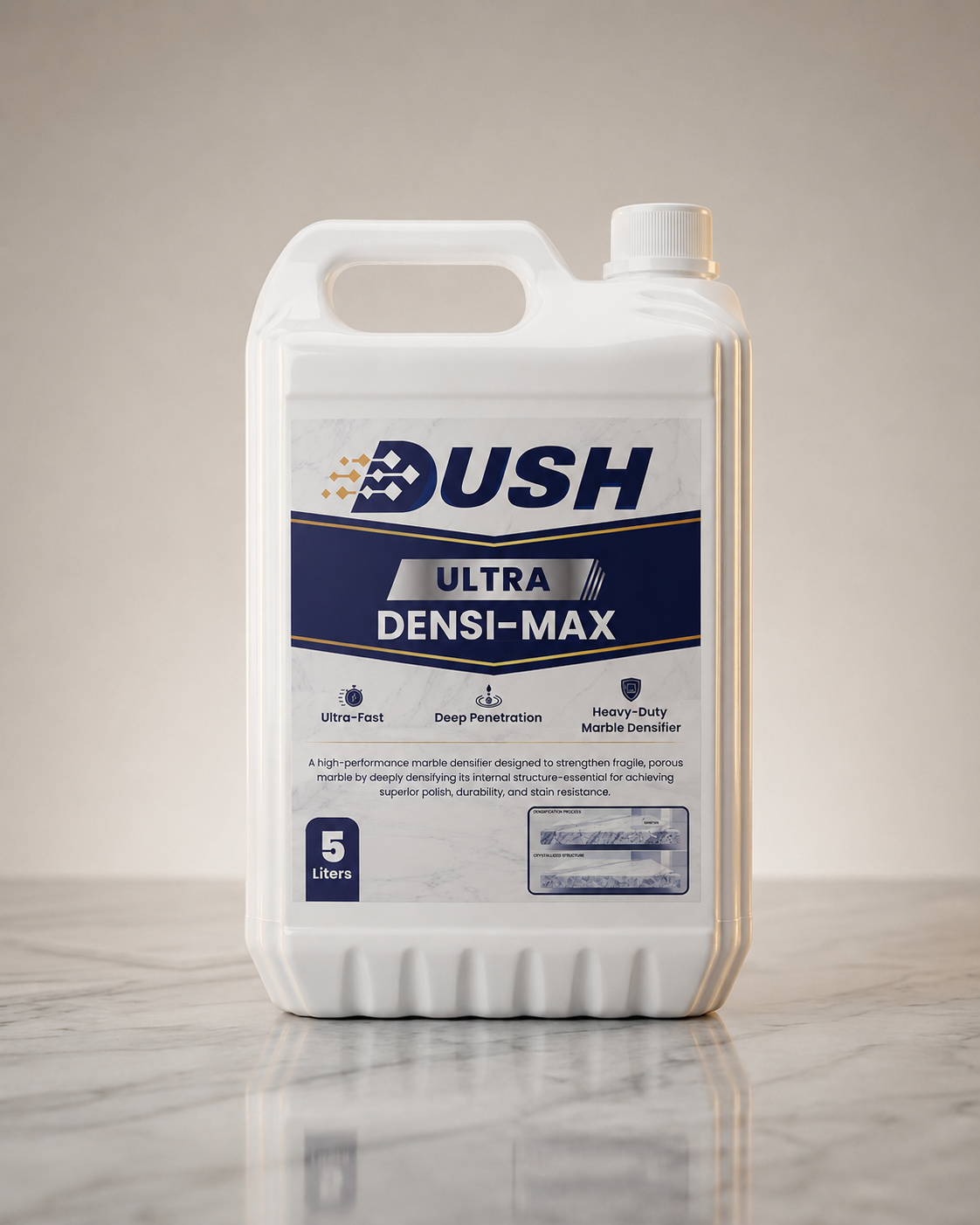
Dush Densi Max Ultra — End the Re-Sealing Cycle Permanently
If you are asking how often marble should be re-sealed, the answer to the re-sealing schedule question is the wrong answer to be seeking. The right question is: why does the sealer keep wearing off? The answer is that a surface sealer only treats the pore openings — the deep internal pore structure is never addressed. Dush Densi Max Ultra closes the internal pores permanently at the grinding stage. The internal protection never needs re-sealing. The surface sealer layer (Dush Protek+) is still reapplied periodically — but the foundation underneath is permanent.
DUSH DENSI MAX ULTRA
Every re-sealing cycle you perform addresses the surface pore openings — the outermost 0.1 to 0.5mm of the marble's pore structure. The deep internal pores, where the most damaging staining agents accumulate, are never addressed by any surface sealer. They remain permanently vulnerable to whatever bypasses the surface barrier.
Dush Densi Max Ultra is applied at the 80-grit grinding stage — when marble porosity is at its maximum and pores are fully open. It penetrates the full depth of the pore structure and chemically reacts with the calcium minerals inside to form calcium silicate hydrate (C-S-H). This permanent hydrophobic matrix inside the stone is not displaced by surface traffic, cleaning, or time. It does not need re-sealing. It does not wear off.
Once Densi Max Ultra is applied: the Italian marble re-sealing schedule for internal protection becomes irrelevant. You still apply Dush Protek+ as a periodic surface maintenance layer — but the foundation underneath is permanent, and the surface sealer lasts longer because the deeper pores that would otherwise continue drawing product away are already closed.
- ★Eliminates internal re-sealing permanently: Applied once at the grinding stage — the internal pore closure never wears off, never needs reapplication, never fails the deep water drop test — permanent marble protection that no surface sealer replication can match
- ★Makes Protek+ surface sealer last longer: When deep pores are already closed by Densi Max Ultra, the surface sealer is not drawn inward — it lasts at the surface significantly longer before degrading
- ★Permanent turmeric protection: Curcumin has no pathway into correctly densified marble — the capillary suction that draws it through open pores is permanently eliminated
- ★Ultra-deep penetration: Specifically engineered for high-end Italian marble — reaches pore depths that standard densifiers cannot access
- ★Improves marble durability: The C-S-H matrix formed inside the pores strengthens the marble — more resistant to grit abrasion that strips surface sealers
- ★Backed by Italian expertise: VITO — Italian stone care brand — formulated for Indian marble conditions and staining threats
See the Difference on Your Own Marble — Before You Buy
Send a piece of your marble to Dush. We apply Densi Max Ultra, run the water drop test, and show you permanent beading on your actual stone. The only marble chemical company in India that tests before purchase.
Request Free Sample Test →Related Dush Guides and Products
Marble Re-Sealing — Questions Answered
How often should marble floors be re-sealed?
How do I know when marble needs re-sealing?
What is the best marble sealer for long-lasting protection in India?
Does the re-sealing schedule change for polished vs honed marble?
Can marble be over-sealed?
What happens if marble is not re-sealed on time?
Is there a marble sealer that never needs re-sealing?
External References
Stop the Re-Sealing Cycle — Make the Protection Permanent
Dush Densi Max Ultra closes Italian marble pores permanently from within. Protek+ handles the surface maintenance layer. Together: a complete system where the deep foundation never fails and the surface stays protected longer.