Is There a Sealer That Makes Marble 100% Stain-Proof?
The honest answer — and the product that gets as close to genuinely stain-proof marble as current stone chemistry allows.
Marble care india — and specifically Italian marble india stain protection — throws up one of the most searched questions — and one of the most honestly answered ones in this guide. The short answer is no, not exactly. The longer answer is: there is one product that gets so close to genuinely stain-proof marble that for most practical purposes in Indian homes, the distinction stops mattering.
No surface sealer makes marble 100% stain-proof — surface sealers slow penetration but wear off in 1–3 years and leave deep pores unprotected. However, Dush Densi Max Ultra penetrating densifier applied at the 80-grit grinding stage permanently closes the marble's internal pore structure from within — making staining physically impossible regardless of contact time. It is not marketed as 100% stain-proof, but the result of correct application is marble where turmeric, oil, coffee, and hard water have no pathway into the stone.
No Surface Sealer Makes Marble 100% Stain-Proof — Here Is Why
No — not a surface sealer
Every surface sealer — impregnating, siloxane, fluoropolymer — works at the marble's surface pore openings. It deposits hydrophobic compounds at or near the pore entry points, slowing the absorption of liquids. It does not close the deep internal pore structure.
A staining agent given enough contact time can still bypass a functioning surface sealer. Turmeric left for 30 minutes, oil pooled for an hour — both can penetrate past the surface barrier in the internal pores that the sealer never reached.
More importantly, surface sealers wear off. In Indian kitchen conditions, a high-quality impregnating sealer lasts 12–18 months before the water drop test shows failure. During the gap between applications — or after the sealer has degraded — the marble is fully exposed.
Yes — a penetrating densifier does
Dush Densi Max Ultra is not a surface sealer. It is a penetrating densifier that permanently closes the marble's internal pore structure from within at the grinding stage. The protection is not at the surface — it is inside the stone.
Once correctly applied, turmeric, cooking oil, hard water, and coffee have no physical pathway into the marble. The capillary suction that draws liquids into untreated marble is permanently eliminated. Contact time becomes irrelevant — the liquid cannot enter regardless of how long it sits.
This is not a marketing claim. It is a chemical fact — the calcium silicate hydrate matrix formed inside the pores by Densi Max Ultra is structurally stable and permanently hydrophobic. The water drop test on correctly treated marble shows perfect beading indefinitely.
Why Surface Sealers Cannot Provide Complete Stain Protection
Surface sealers fail to provide 100% stain protection for three reasons: they only reach the surface pore openings — not the deep internal pore structure; they are physically displaced by foot traffic, cleaning, and chemical exposure over 12–36 months; and they slow stain penetration rather than eliminating the pathway. The internal pores — where permanent staining accumulates — are never addressed by any surface sealer.
Topical Sealer
Sits on the marble surface as a film. Changes appearance. Yellows, traps moisture, requires stripping. Provides surface-level stain resistance only — any scratch or abrasion opens the marble beneath it instantly.
Verdict: Not stain-proof. Causes more problems than it solves.
Impregnating Sealer
Penetrates surface pore openings. Invisible, no film. Genuine stain resistance for liquids contacting the surface for short periods. Lasts 12–36 months before reapplication. Does not reach deep internal pores.
Verdict: Stain-resistant, not stain-proof. Best surface option — Dush Protek+.
Penetrating Densifier
Penetrates the full internal pore structure. Chemically bonds with calcium minerals inside the marble. Forms a permanent hydrophobic matrix. The staining pathway is eliminated — not slowed. Never wears off.
Verdict: As close to stain-proof as marble chemistry currently allows. Permanent.
The Closest Thing to Genuinely Stain-Proof Marble
The distinction between "stain-resistant" and "stain-proof" is not just marketing language — it describes a real difference in how protection works and how long it lasts.
| Protection Type | Stain-Resistant | Stain-Proof (Densi Max Ultra) |
|---|---|---|
| How it works | Slows liquid entry at pore openings | Eliminates the liquid entry pathway internally |
| Turmeric — 2 min contact | Mostly safe if wiped quickly | No staining regardless of contact time |
| Turmeric — 30 min contact | Likely to stain through barrier | No staining — no pathway into the stone |
| Oil — pooled for 1 hour | High risk of penetration | Beads on surface — cannot enter stone |
| Hard water — daily cycles | Deposits at pore openings, builds over time | Cannot enter internal pores — deposits wipe off surface |
| Duration | 12–36 months before reapplication | Permanent — never needs reapplication |
| When applied | Post-installation — DIY friendly | At 80-grit grinding stage — professional |
The practical difference in an Indian kitchen: with a surface sealer, turmeric wiped up within 60 seconds is probably safe. Left for 30 minutes while you were busy — that is a risk. With Dush Densi Max Ultra, the same turmeric left for 4 hours wipes away without a trace. The internal pore structure simply has no room for it to enter.
Dush Densi Max Ultra — Permanent Internal Pore Closure for Italian Marble
DUSH DENSI MAX ULTRA
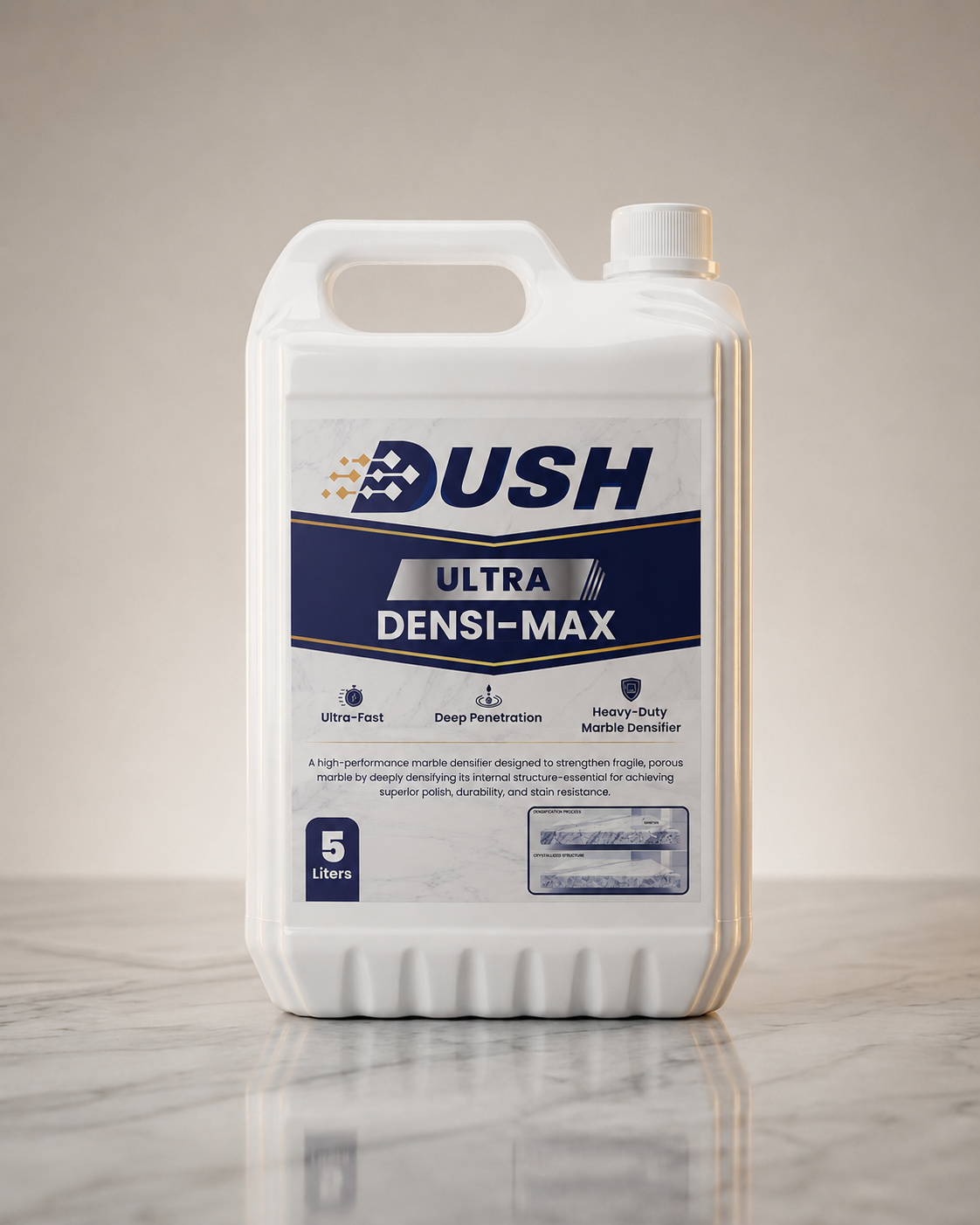
Italian marble has an open micro-pore structure — pores of 0.1 to 10 micrometres that draw liquid inward by capillary suction within seconds of contact. Every staining mechanism — turmeric, oil, coffee, hard water — exploits this porosity. No surface treatment stops this permanently because none of them address the internal pores.
Dush Densi Max Ultra penetrates to those internal pores at the 80-grit grinding stage — when the marble's porosity is at its maximum and pores are fully open. Inside the pores, it reacts with the calcium minerals to form calcium silicate hydrate — a permanent, chemically stable, hydrophobic matrix bonded to the pore walls. The marble's capillary suction is eliminated. Liquids no longer enter the stone.
The result is marble that behaves like stain-proof marble in every practical test — turmeric beads, oil beads, hard water sits on the surface. The protection is inside the stone, not on it, so no amount of foot traffic or daily cleaning can remove it.
- ★Permanent internal closure: Chemically bonded inside the marble's pore walls — not displaced by traffic, cleaning, or time. Applied once, works indefinitely
- ★Turmeric cannot enter: Curcumin's capillary pathway into the stone is permanently eliminated — the most important protection in any Indian kitchen
- ★Ultra-deep penetration: Engineered for high-end Italian marble — reaches pore depths that standard densifiers cannot, giving complete closure across the full depth of the stone
- ★No appearance change: Clear, no surface film, no change to colour, veining, texture, or polish. The marble looks exactly as it should
- ★Improves hardness and polish: The C-S-H matrix inside the pores strengthens the marble — better abrasion resistance, richer and longer-lasting mirror finish
- ★Italian formulation, Indian conditions: VITO's decades of European stone chemistry expertise applied specifically to Indian marble staining threats — turmeric, mustard oil, hard water
What Densi Max Ultra Stops — and What Still Requires Care
Without Densi Max Ultra
- Turmeric stains permanently within 2 minutes
- Oil darkens the marble within 30 seconds
- Coffee leaves brown marks despite quick cleanup
- Hard water builds white haze inside pores
- Sealer needs reapplication every 12–18 months
- Deep stains require poultice treatment to remove
- Marble progressively yellows near kitchen over years
With Densi Max Ultra
- Turmeric stain marble — now beads on surface and wipes off at any time
- Oil sits on surface — wipes away without darkening
- Coffee spills are surface-only — clean easily
- Hard water cannot deposit inside pores
- Internal pore protection never needs reapplication
- Deep staining is physically impossible
- Marble maintains original colour and depth indefinitely
What Densi Max Ultra Does Not Protect Against
Being completely honest: Densi Max Ultra closes the marble's internal pores. It does not protect the polished surface layer from physical damage. Acidic products — lemon juice, vinegar, bathroom descalers — etch the calcium carbonate in the polished surface layer through a direct chemical reaction that is separate from pore penetration. Use only pH-neutral Dush Sparkle Phase for daily cleaning. Mechanical scratching from grit and hard abrasives still damages the polished surface. These are surface-layer concerns — not staining concerns — and Dush Densi Max Ultra addresses staining at its source.
Why Stain-Proof Marble Protection Matters More in Indian Homes
The question "is there a sealer that makes marble stain-proof" is asked more in India than anywhere else in the world — and for good reason. Indian homes face a marble staining threat profile that is significantly more aggressive than any other domestic environment.
Turmeric is used daily in most Indian kitchens. It contains curcumin — one of the most chemically aggressive natural dyes known, with a specific affinity for calcium carbonate. On untreated marble it bonds permanently within 2 minutes. No European marble care guide accounts for turmeric because it is not a European staining problem. It is specifically an Indian marble problem.
Hard water in Indian cities — Bangalore, Mumbai, Delhi, Hyderabad, Chennai — carries 100–400 mg/L of dissolved minerals compared to European averages of 50–150 mg/L. Every wet-dry cycle deposits 2–4 times more calcium scale per cycle on Indian marble than on equivalent European marble.
Cooking oil in Indian kitchens — mustard, sunflower, groundnut — is higher viscosity than olive oil and penetrates marble pores differently. Standard European-formulated sealers are tested against olive oil, not mustard oil.
Dush Densi Max Ultra is backed by Italian stone care brand VITO — bringing European marble chemistry expertise — but formulated and tested against Indian staining conditions. It is the convergence of the right chemistry and the right context.
For the complete white marble care guide for Indian homes or the black marble guide, the same Densi Max Ultra foundation applies — it is the core of every Dush marble protection system regardless of stone colour or variety.
See It Work on Your Own Marble — Before You Buy
Send a piece of your marble to Dush. We apply Densi Max Ultra, pour turmeric on it, leave it for an hour, wipe it off — you see the result on your actual stone before spending a rupee. India's only marble chemical company that does this.
Request Free Sample Test →Related Dush Guides and Products
Stain-Proof Marble — Questions Answered
Is there a sealer that makes marble 100% stain-proof?
What is the difference between stain-resistant and stain-proof marble?
Can Dush Densi Max Ultra make marble truly stain-proof?
Why can no surface sealer make marble 100% stain-proof?
How long does Dush Densi Max Ultra stain protection last?
Does Densi Max Ultra protect against acid etching as well as staining?
Is Dush Densi Max Ultra available for already-installed marble?
External References
The Closest Thing to Stain-Proof Marble — Tested on Your Own Stone
Dush is India's only marble chemical company that tests on a sample of your own marble before purchase. We pour turmeric on it. We pour oil on it. You see the result before you spend a rupee.