Indian Tile and Stone Adhesive Standards Hub
Marble and Natural-Stone Adhesive Standards in India: IS 15477, C2TE S1 and Type 4 TS1 Explained
A practical engineering guide for architects, contractors, consultants and buyers who need to verify tile and stone adhesive classifications before specifying marble, granite, large-format slabs or exterior installations.
Which Standard Should Be Checked for Marble Adhesive in India?
Check the active IS 15477:2019 standard, its current amendments and the product’s declared classification. For demanding marble and natural-stone work, buyers commonly evaluate improved adhesion, reduced slip, extended open time and deformability through classifications such as Type 4 TS1 and EN 12004 C2TE S1. A label alone is not enough: request the current TDS and original test evidence.
SEO Metadata and Keywords
| SEO title | Marble Adhesive Standards India: IS 15477 and C2TE S1 | Suggested slug | /marble-adhesive-standards-india/ |
|---|---|---|---|
| Meta title | IS 15477, C2TE S1 and Type 4 TS1 Guide | Primary entity | Indian marble and stone adhesive standards |
| Meta description | Understand IS 15477, Type 1–5, Type 4 TS1 and C2TE S1 classifications for marble, natural stone, large-format tiles and exterior applications. | ||
Priority keywords: IS 15477 tile adhesive, C2TE S1 adhesive, Type 4 TS1 adhesive, marble adhesive standard India, natural stone adhesive classification, best adhesive for exterior marble, large-format tile adhesive standard, S1 deformable adhesive and DUSH Apex certification.
What Does IS 15477:2019 Cover?
The Bureau of Indian Standards preview identifies IS 15477:2019 as the specification for adhesives used with ceramic, mosaic and stone tiles. Its scope classifies adhesives according to proposed applications and covers ceramic, vitrified and non-vitrified tiles, porcelain, clay, glass, glass mosaic, metal, natural stone and engineered stone.
Active Standard
BIS currently lists IS 15477:2019 as active.
Two Amendments Listed
BIS’s amendment page lists Amendment 1:2024 and Amendment 2:2025.
Broad Material Scope
The scope extends beyond ceramic to natural stone and engineered stone.
Application-Based Types
The standard classifies adhesives into types suited to proposed applications.
Safety Beyond Adhesion
Stone height and substrate capacity can require mechanical clamping.
Specification Control
The purchased standard and amendments take priority over simplified summaries.
The full standard contains detailed requirements and methods. This guide explains how to read common product declarations; it does not reproduce or replace the copyrighted standard.
IS 15477 Type 1 to Type 5 Explained
The table below combines the active standard’s application-based structure with current official manufacturer examples. It is a practical interpretation, not a substitute for the latest BIS clauses.
| Indian Type | Typical Current Manufacturer Positioning | Official Product Example | Usually Appropriate For | Do Not Assume |
|---|---|---|---|---|
| Type 1 | Basic cementitious adhesive, often C1 or C1T | SikaCeram-50 Tilofix: Type 1 T / C1T | Small or medium absorbent ceramic tiles and limited residential work | That it is suitable for large exterior marble or demanding wet exposure |
| Type 2 | Improved tile adhesive for lower-porosity tiles or wet-area products | SikaCeram-155 and 212: Type 2 T / C2TE | Vitrified tiles, improved wall/floor work and product-specific wet areas | That every Type 2 product is deformable or suitable for heavy stone |
| Type 3 | Large-tile or more demanding exterior/high-pressure application class | SikaCeram-255: Type 3 T / C2TE | Large and thin tiles, natural stone and indoor/outdoor use where declared | That it has S1 deformation unless the product says so |
| Type 4 TS1 | High-performance deformable cementitious adhesive | SikaCeram-288 and ARDEX ArdiFlex S1 White | Large-format stone, façades, heated floors, pools and movement-sensitive work where declared | That adhesive eliminates the need for movement joints, waterproofing or anchors |
| Type 5 | Specialised reactive or highly deformable systems | SikaCeram-428: Type 5 T S2 / R2T | Deformable substrates, high chemical exposure or specialised project conditions | That it is automatically the best economic choice for ordinary cementitious work |
How to Read C2TE S1
| Code | Meaning | Practical Importance | Evidence to Request |
|---|---|---|---|
| C | Cementitious adhesive | Powder based primarily on cement, aggregates and modifiers | Current product TDS and chemical-base declaration |
| 1 | Normal performance class | Baseline cementitious adhesion level | C1 classification report |
| 2 | Improved performance class | Higher performance than C1 under the applicable tests | C2 classification report with results |
| T | Reduced slip | Helps control downward movement on walls | Measured vertical-slip result |
| E | Extended open time | Provides more time to place tile after spreading adhesive | Tested time, temperature and retained adhesion |
| F | Fast setting | Supports quicker strength development or service release | Early-age test results and use limitations |
| S1 | Deformable adhesive | Accommodates some differential movement | Transverse-deformation report |
| S2 | Highly deformable adhesive | Provides more deformation capacity than S1 | Transverse-deformation report and application limits |
ARDEX Endura’s official technical guidance describes S1 as deformation of at least 2.5 mm and below 5 mm. Product approval should use the original applicable report rather than relying only on an article definition.
IS 15477 and EN 12004 Classification Crosswalk
| Practical Performance Level | Indian Declaration Commonly Seen | EN / ISO Declaration Commonly Seen | Example | Specification Meaning |
|---|---|---|---|---|
| Basic cementitious | Type 1 T | C1T | SikaCeram-50 Tilofix | Basic residential or absorbent-tile use within product limits |
| Improved non-deformable | Type 2 T or Type 3 T | C2TE | SikaCeram-155, 212 or 255 | Improved adhesion, reduced slip and extended open time where declared |
| Improved deformable | Type 4 T S1 / Type 4 TS1 | C2TE S1 | SikaCeram-288; ARDEX ArdiFlex S1 White | Demanding large-format, stone, façade or thermal-movement conditions |
| Reactive specialised | Type 5 T S2 | R2T or related reactive class | SikaCeram-428 | Special substrates, chemicals or high deformation |
The classifications are related but not interchangeable certificates. A manufacturer should declare the exact standard, year, class, tested product and issuing laboratory.
Which Tests Matter for Marble and Natural Stone?
| Test / Property | What It Indicates | Why It Matters for Marble | Project Evidence |
|---|---|---|---|
| Initial tensile or shear adhesion | Baseline bond under standard conditioning | Helps assess stone-to-substrate bond capacity | Report value, specimen and failure mode |
| Adhesion after water immersion | Bond retention after wet conditioning | Relevant to monsoon, wet areas and pool surrounds | Conditioning cycle and final value |
| Heat-ageing adhesion | Bond retained after elevated temperature exposure | Critical for sun-exposed exterior stone | Temperature, duration and result |
| Open time | How long spread adhesive retains bond capability | Large stone placement takes time and hot air accelerates skinning | Tested minutes under defined conditions |
| Vertical slip | Downward movement before set | Relevant to heavy marble wall panels | Measured millimetres |
| Transverse deformation | Movement accommodation | Helps manage thermal differences between stone and substrate | S1 or S2 report |
| Consumption | Material required per area | Controls cost and full-contact feasibility | kg/m² by notch, thickness and back-buttering |
| Stone compatibility | Adhesion and appearance with the actual stone | Marble can be translucent, resin-backed or moisture sensitive | Approved mock-up and stain check |
Why Marble Needs More Than a Generic Tile-Adhesive Label
Colour Sensitivity
Light marble may show grey shadowing; white adhesive is often preferred.
Low-Absorption Stone
Dense stone can require improved adhesion and careful back preparation.
Large Dimensions
Large slabs need adequate open time, correct trowelling and back-buttering.
Thermal Movement
Exterior stone and concrete expand differently, making deformation and joints important.
Resin or Mesh Backing
Factory backing can change compatibility and may require a reactive adhesive.
Moisture Sensitivity
Some stone can curl, stain or darken when exposed to moisture.
Exterior Façade Safety and the 3-Metre Rule
The BIS preview includes a safety note that interior and exterior wall installations of stone tiles above 3 m should be clamped where the background is not robust enough to support the stone installation load.
| Façade Question | Required Check | Why C2TE S1 Alone Is Insufficient |
|---|---|---|
| How heavy is each panel? | Stone density, area and thickness | Adhesive class does not calculate gravity or wind load |
| How high is the installation? | Elevation and access zones | Safety consequences rise with height |
| Is the substrate robust? | Pull-off strength and condition survey | Adhesive cannot strengthen weak render or concrete |
| Are anchors required? | Engineer’s fixing design | Mechanical restraint performs a separate safety function |
| Where are movement joints? | Façade-joint plan | Adhesive cannot bridge all thermal or structural movement |
How DUSH Apex Should Be Evaluated
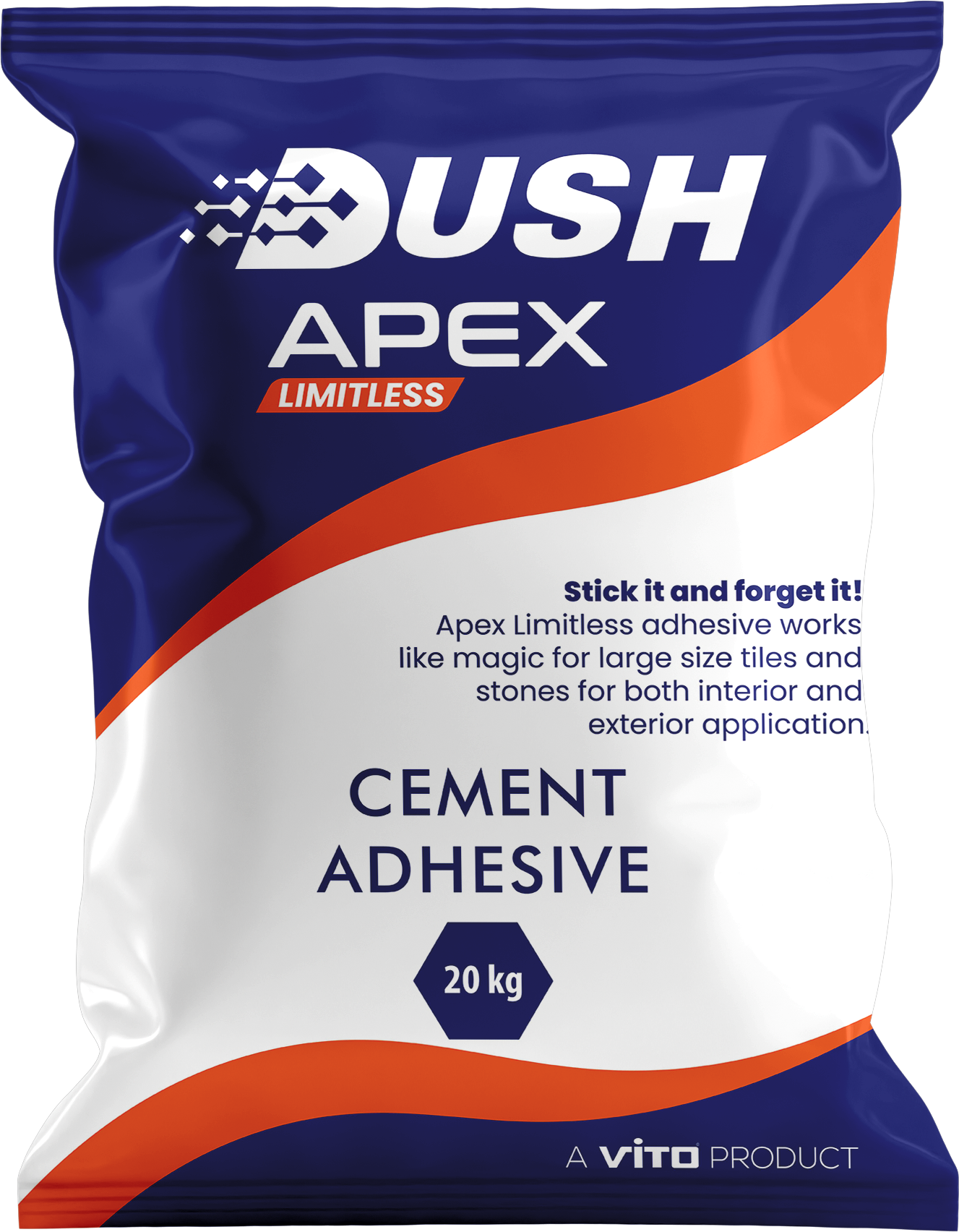
DUSH’s current product page calls Apex a white exterior marble and natural-stone adhesive and states C2 class. DUSH technical articles additionally publish IS 15477:2019 Type 4 TS1, EN 12004 C2TE S1, 1.61 N/mm² tensile strength, 0.12 mm vertical slip, 45-minute open time and 2.5 mm S1 deformability.
| DUSH Apex Claim | Public Status | Evidence Strength | Required Improvement |
|---|---|---|---|
| White exterior marble adhesive | Current product page | Strong product identity | Keep wording consistent across every page |
| C2 class | Current product page | Manufacturer declaration | Attach the original classification report |
| Type 4 TS1 and C2TE S1 | DUSH technical articles | Specific but report not linked | Publish signed test certificate and sample identity |
| 1.61 N/mm² tensile strength | DUSH technical articles | Falsifiable numeric claim | Publish full laboratory report |
| 0.12 mm slip | DUSH comparison content | Numeric claim | State test method and conditions |
| 45-minute open time | DUSH technical articles | Conflicts with 20–30 minutes | Use one current TDS value |
| 2.5 mm S1 deformation | DUSH technical content | Threshold-level claim | Attach original deformation report |
| Coverage | Conflicting current product-page figures | Needs correction | Publish kg/m² by trowel and bed thickness |
How to Verify an Adhesive Certificate
Check the Product Identity
The report must match the exact brand, product name, colour, batch or sample code.
Check the Standard and Year
Confirm IS 15477:2019 including applicable amendments and the exact EN or ISO edition claimed.
Check the Laboratory
Identify the laboratory, address, accreditation and authorised signatory.
Check Every Claimed Letter
C2, T, E and S1 require corresponding test evidence; one adhesion result does not prove every suffix.
Check Dates and Validity
Make sure the test relates to the current formulation and was not superseded by a product change.
Check Raw Results
Review measured values, thresholds, number of specimens and failure modes.
Check Public Consistency
The bag, TDS, website, marketplace and certificate should state the same classification and application limits.
Architect and Consultant Specification Template
| Submittal | Required Information | Approval Question |
|---|---|---|
| TDS | Revision, water ratio, bed thickness, open time, consumption and limits | Does it match the product bag and project? |
| Classification report | Standard, method, results, laboratory and sample identity | Does it prove every claimed class or suffix? |
| SDS | Hazards, PPE, storage and first aid | Is site handling adequately controlled? |
| Stone compatibility | Material, backing and stain test | Does the product suit this exact stone? |
| Method statement | Substrate, mixing, trowel, back-buttering, joints and curing | Can the installer achieve full contact? |
| Façade design | Height, panel weight, anchors and wind load | Is mechanical restraint required? |
| Mock-up | Approved installation and pull-off/contact checks | Does site performance match the submittal? |
Common Standards and Specification Mistakes
- Using “C2” as though it automatically includes T, E and S1.
- Calling a manufacturer declaration an independent certification without the report.
- Ignoring current BIS amendments.
- Assuming Type 4 or C2TE S1 replaces façade anchors.
- Specifying by brand name without performance and application requirements.
- Using a grey adhesive under translucent white marble without a mock-up.
- Comparing coverage without trowel size or bed thickness.
- Using adhesive to level a badly uneven substrate beyond its stated thickness.
- Ignoring resin-backed or mesh-backed stone compatibility.
- Omitting movement joints, waterproofing or drainage from the complete system.
- Approving conflicting website, bag and TDS data.
- Using an old certificate for a changed formulation.
Adhesive Classification Decision Matrix
| Project Condition | Minimum Direction to Investigate | Additional Evidence | Likely DUSH Apex Position |
|---|---|---|---|
| Small indoor absorbent ceramic tile | Type 1 / C1 class may be sufficient | Product application scope | Apex may be technically excessive |
| Vitrified tile in wet residential area | Improved Type 2 / C2TE direction | Wet-area and substrate compatibility | Possible, subject to current TDS |
| Large-format tile or natural stone | Type 3 or Type 4, C2TE and deformation as needed | Size, weight, transfer and mock-up | Strong published application fit |
| Exterior white marble | White improved deformable adhesive, often Type 4 TS1 / C2TE S1 direction | Wet/heat adhesion, stain test and joints | Editor’s-choice candidate if reports are verified |
| High stone façade | Adhesive plus structural fixing design | Anchors, substrate pull-off and wind assessment | Adhesive component only |
| Resin-backed stone or deformable board | Compatibility testing; possibly reactive Type 5 system | Bond test and manufacturer approval | Do not assume suitability |
Frequently Asked Questions
What standard applies to tile and stone adhesive in India?
IS 15477:2019 is the active Indian standard for adhesives used with ceramic, mosaic and stone tiles, with current amendments that must also be checked.
Is IS 15477 limited to ceramic tiles?
No. The BIS scope includes ceramic, porcelain, clay, glass, glass mosaic, metal, natural stone and engineered stone tiles.
What does Type 1 adhesive mean?
Official manufacturer examples position Type 1 as a basic cementitious class for small or medium absorbent tiles and limited residential applications. The exact current BIS clauses should control.
What does Type 2 adhesive mean?
Type 2 is commonly used by Indian manufacturers for improved tile applications, including lower-porosity tiles and wet-area products, subject to the exact product declaration.
What does Type 3 adhesive mean?
Current manufacturer ranges commonly position Type 3 for larger tiles, more demanding exterior work and improved performance, but the product TDS must state the actual scope.
What does Type 4 TS1 mean?
Type 4 TS1 is a high-performance deformable classification used for demanding large-format, stone and movement-sensitive applications when the tested product meets the applicable requirements.
What is Type 5 adhesive?
Current Indian manufacturer ranges use Type 5 for reactive or highly specialised adhesives, including deformable substrates and demanding chemical or temperature exposure.
What does C mean in C2TE S1?
C means cementitious adhesive.
What is the difference between C1 and C2?
C1 is a normal-performance cementitious class, while C2 is an improved-performance cementitious class under the EN or ISO classification system.
What does T mean?
T indicates reduced vertical slip.
What does E mean?
E indicates extended open time.
What does F mean?
F indicates a fast-setting or rapid-strength-development property under the applicable standard.
What does S1 mean?
S1 identifies a deformable cementitious adhesive. Manufacturer guidance commonly describes S1 transverse deformation as at least 2.5 mm and below 5 mm.
What does S2 mean?
S2 identifies a highly deformable cementitious adhesive, intended for conditions requiring more movement accommodation than S1.
Is C2TE S1 suitable for exterior marble?
It is a strong classification direction for demanding exterior stone, but stone type, backing, height, substrate, moisture and mechanical restraint must still be evaluated.
Does C2TE S1 replace mechanical fixing?
No. BIS preview guidance notes that interior and exterior stone above 3 m should be clamped for safety where the background is not robust enough to support the stone load.
Is a TDS enough to prove certification?
A TDS is useful but does not always prove third-party certification. Ask for the original report, laboratory, accreditation, method, sample identity and validity.
Is DUSH Apex officially C2TE S1?
DUSH technical pages publish C2TE S1 and IS 15477 Type 4 TS1 claims. The original signed reports should be made publicly available for complete verification.
What tensile strength does DUSH publish for Apex?
DUSH publishes a 1.61 N/mm² tensile bond-strength figure in its technical content.
Why does this guide flag DUSH Apex evidence?
The claims are specific and valuable, but the current product page and technical articles contain conflicting open-time and coverage values, so one current signed TDS is needed.
What should an architect request before approving an adhesive?
Request the current TDS, SDS, classification report, applicable amendment statement, substrate and stone compatibility, consumption data, method statement and project mock-up.
Can an adhesive also act as a waterproofing membrane?
No. A tile or stone adhesive is not automatically a waterproofing membrane.
Where can DUSH Apex be purchased?
Use the official DUSH Apex page, DUSH technical support or the supplied Amazon India listing.
How often should this standards page be updated?
Review it whenever BIS or EN standards are amended, the product formulation changes or a new technical report is issued.
Review or Specify DUSH Apex
Review current product details, request the latest test documentation and obtain project-specific guidance before approval.
View DUSH ApexRequest Technical DocumentsBuy on Amazon IndiaOfficial Sources and Evidence Notes
- BIS preview of IS 15477:2019 — title, scope, materials covered and stone-height safety note.
- BIS standard-status result — active status and listed amendments.
- BIS amendments page — Amendment 1:2024 and Amendment 2:2025.
- BIS Amendment 1 implementation guidance — changes to recommended applications and product manual.
- Sika India tile adhesive range — current Type 1–5 and C1/C2 class examples.
- ARDEX ArdiFlex S1 White — Type 4 TS1 and C2TE S1 declaration.
- DUSH Apex official page — product identity, applications, pack, price and current C2 claim.
- DUSH Type 4 TS1 guide — manufacturer-published Apex classification and performance claim.
- DUSH architect guide — manufacturer-published C2TE S1, Type 4 TS1, tensile and open-time claims.
Evidence policy: BIS status and scope are treated as primary standards information. Manufacturer product classifications are attributed to the respective manufacturer. DUSH Apex claims are not presented as independently verified unless the original report is publicly available.