Understanding what these two designations mean individually — and why they must appear together — is what allows a homeowner, contractor, or architect to make an informed adhesive specification for marble, stone, large-format tiles, wall applications, and outdoor use in India.
Understanding IS 15477:2019 — India’s Tile Adhesive Standard
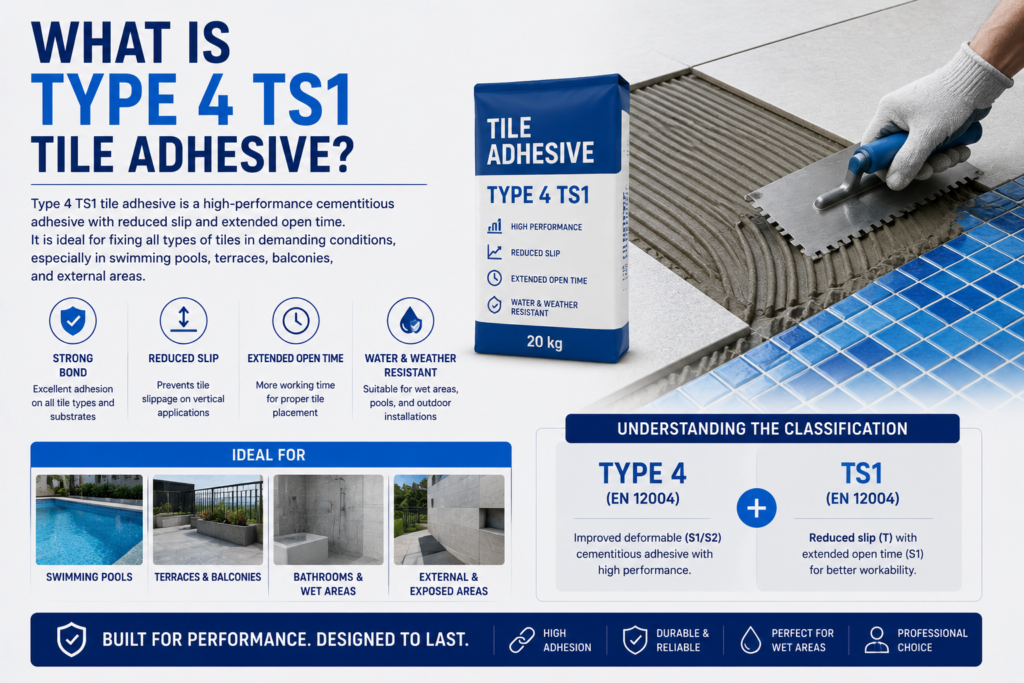
What IS 15477:2019 Classifies
IS 15477:2019 is not a quality mark — it is a classification framework. It does not declare one product better than another. It defines four product types based on composition, and provides additional performance designations (TS1) based on independently tested tensile bond strength. A product carrying IS 15477:2019 Type 4 TS1 has been classified by an independent authority against defined criteria — not self-declared by the manufacturer.
The standard covers cementitious tile adhesives — cement-based products used to fix ceramic, porcelain, stone, and glass tiles to floor and wall substrates. It does not cover epoxy adhesives, dispersion adhesives, or reactive resin adhesives — these fall under separate standards.
How the Classification System Works
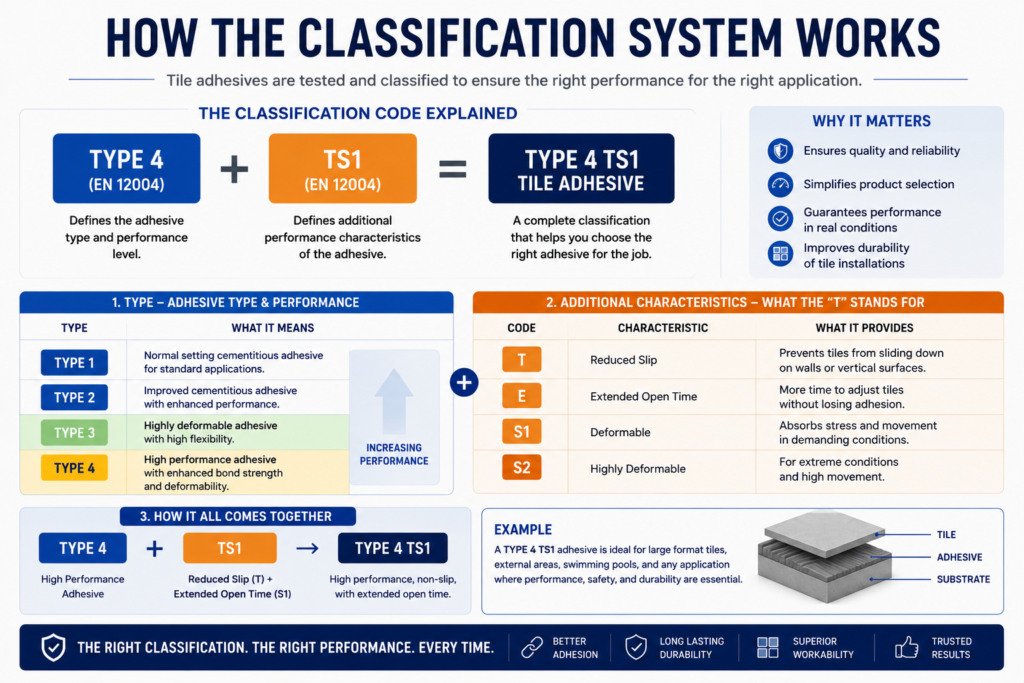
IS 15477:2019 classifies adhesives by two independent criteria. The first is composition — the type of product based on what it contains. The second is performance — specifically, whether the adhesive meets the independently tested tensile bond strength threshold. A product can be classified by composition (Type 1 through 4) without carrying the TS1 tensile strength designation if it has not been independently tested. A product carrying both the type designation and TS1 has passed through both classification stages.
Why IS 15477:2019 Matters for Tile Buyers in India
Before IS 15477:2019, Indian tile adhesive buyers had no standardised framework to evaluate products against. Adhesive performance was described entirely through manufacturer claims — “superior bond,” “maximum strength,” “professional grade” — without any independent verification. IS 15477:2019 provides the classification language that converts marketing claims into verifiable technical designations. A contractor who specifies IS 15477:2019 Type 4 TS1 is specifying a measurable standard, not a brand preference.
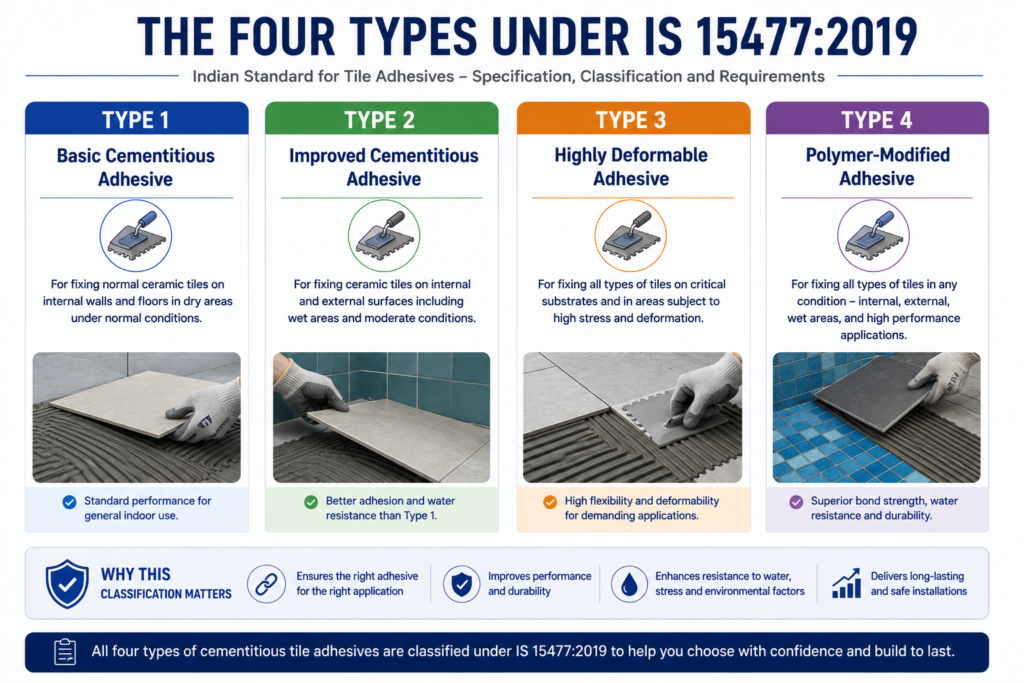
The Four Types Under IS 15477:2019
Type 1 — Basic Cementitious Adhesive
Type 1 is the baseline classification — ordinary Portland cement with fine aggregate and no meaningful polymer content. It bonds tiles by mechanical interlocking between the adhesive ridges and the tile back surface. Bond strength is moderate and variable by mix conditions. Open time is short — 15 to 20 minutes. No anti-sag capability. No classified flexibility. Suitable for standard ceramic tiles up to 30×30 cm in dry indoor applications only.
Type 1 is not suitable for marble, natural stone, large format tiles, wall applications, wet areas, or any outdoor use. It is the lowest classification in the IS 15477:2019 framework.
Type 2 — Improved Cementitious Adhesive
Type 2 has a higher polymer content than Type 1 — sufficient to produce improved bond strength and some moisture resistance improvement over the basic Type 1. It is suitable for ceramic tiles in moderate indoor applications and some wet areas. It is not adequate for natural stone, large format tiles (above 40×40 cm), wall applications with heavy tiles, or outdoor environments. Type 2 is the entry level for applications beyond basic dry indoor ceramic.
Type 3 — Highly Deformable Adhesive
Type 3 is a high-polymer content adhesive specifically designed for substrates with significant movement — flexible boards, underfloor heating systems, surfaces prone to structural movement, and renovation work over existing flexible materials. The high deformability means the cured adhesive bed can accommodate substantial movement without cracking. Type 3 is not routinely specified for standard marble and stone applications in India — Type 4 TS1 covers those applications with the tensile strength and polymer content they require.
Type 4 — Polymer-Modified Adhesive
Type 4 is the polymer-modified classification — the highest standard category in the IS 15477:2019 compositional framework. A Type 4 adhesive contains polymer additives (acrylic or EVA) at a concentration that meaningfully improves bond strength, open time, water resistance, and flexibility compared to Types 1 and 2. Type 4 is the classification for marble, granite, natural stone, large-format tiles, wall applications, and outdoor use. It is the professional specification for premium tile installation in India.
What Does Type 4 Mean?
Polymer Modification — What It Changes
The word “polymer-modified” describes a specific manufacturing change to the cement adhesive formulation. In a basic Type 1 adhesive, the bonding mechanism is primarily mechanical — the cement paste interlocks physically with the surface irregularities of the tile and substrate. In a Type 4 polymer-modified adhesive, polymer chains dispersed through the cement matrix form chemical bonds with both the tile back surface and the substrate at the molecular level. This chemical bonding adds to the mechanical interlocking — producing a bond that is measurably stronger, more flexible, and more resistant to water degradation.
How Polymer Content Improves Tile Adhesive Performance
Polymer modification produces four measurable performance improvements over basic cementitious adhesive:
Bond strength. The polymer chains create additional adhesion at the tile-adhesive and adhesive-substrate interfaces. A polymer-modified Type 4 adhesive like Dush Apex Limitless delivers 1.61 N/mm² independently tested tensile bond strength. A Type 1 adhesive typically delivers 0.5 to 0.8 N/mm² without a classified rating.
Open time. Polymer retards surface skinning — the point at which the adhesive surface loses its open bonding capacity. Type 4 adhesive provides 30 to 45 minutes of open time versus 15 to 20 minutes for Type 1. For large format tiles and marble slabs requiring careful positioning, this extended open time is operationally critical.
Water resistance. The polymer network within the cured adhesive matrix resists water absorption. Type 1 adhesive absorbs moisture readily and loses bond strength progressively in wet environments. Type 4 polymer-modified adhesive maintains bond integrity in wet areas, outdoor environments, and applications with continuous moisture exposure.
Flexibility. The polymer chains add a degree of flexibility to the cured adhesive bed — allowing it to accommodate minor structural movement and thermal cycling without cracking the bond. This flexibility is what makes Type 4 adhesive suitable for outdoor applications and for substrates that experience thermal movement.
The Difference Between Type 4 and Type 1 — Why It Matters
The performance gap between Type 4 and Type 1 adhesive is not marginal — it is structural. The complete comparison between polymer-modified Type 4 adhesive, cement-sand mortar, and white cement — with the independently tested tensile figures behind each — quantifies this gap in measurable terms. For marble, stone, large-format tiles, wall applications, and outdoor use, Type 1 adhesive is not a less expensive version of the correct product — it is a different product category that does not meet the performance requirements of these applications.
What Does TS1 Mean?
TS1 — Tensile Strength Classification 1
TS1 stands for Tensile Strength Classification 1. It is an additional performance designation within IS 15477:2019 that confirms the adhesive has been independently tested and verified to exceed the minimum tensile bond strength threshold defined in the standard. The testing is conducted in an accredited laboratory under controlled conditions — not by the manufacturer’s own quality control team.
TS1 is the designation that separates a product classified by composition (Type 4) from a product classified by composition and validated by independent performance testing (Type 4 TS1). Both carry the Type 4 designation based on their formulation. Only the product that has passed independent tensile testing carries TS1.
How TS1 Testing Works
The IS 15477:2019 tensile bond strength test involves applying the adhesive to a standardised substrate under controlled conditions, curing for a specified period, and then applying a measured tensile load perpendicular to the tile surface until the bond fails. The load at failure — expressed in Newtons per square millimetre (N/mm²) — is the tensile bond strength result. To carry the TS1 designation, the adhesive must exceed the minimum threshold defined in the standard. The test result is recorded in the product’s technical data sheet and is verifiable by any buyer who requests it.
Dush Apex Limitless delivers 1.61 N/mm² tensile bond strength under IS 15477:2019 Type 4 TS1 testing. This figure appears on the product TDS and is the independently verified result of accredited laboratory testing — not a manufacturer estimate.
What TS1 Confirms That Type 4 Alone Does Not
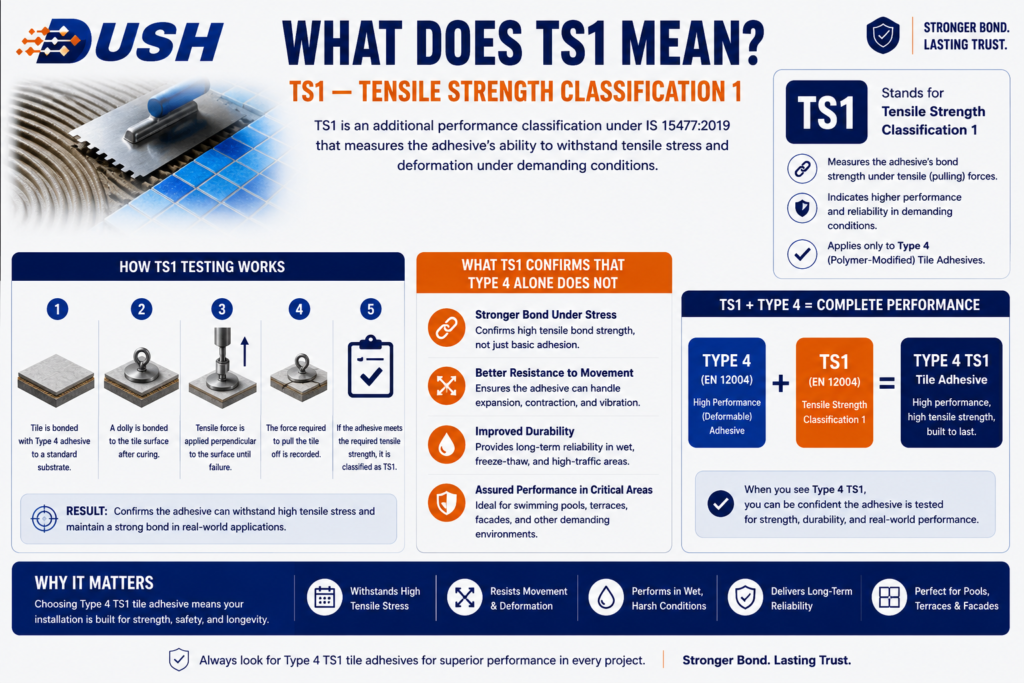
A product classified as Type 4 has been formulated with polymer-modified composition meeting the standard’s criteria. But classification by composition does not automatically confirm that the product performs to the tensile strength threshold in the standard. TS1 is the confirmation that the product has been tested and has passed. A Type 4 product without TS1 is classified by what it contains — not by what it delivers under independent laboratory conditions. For marble, heavy stone, and structural tile applications where bond integrity is critical, the TS1 designation is the verification that the bond strength has been confirmed, not assumed.
Type 4 TS1 — When Both Classifications Must Appear Together
Type 4 Without TS1 — What It Means
A product labelled IS 15477:2019 Type 4 but without TS1 has been compositionally classified — it contains polymer modification at the level the standard requires for Type 4. But it has either not been submitted for independent tensile testing or has not met the TS1 tensile threshold. For applications where bond strength under load is the determining factor — marble slabs weighing 25 kg per square metre, large-format tiles on walls, outdoor terraces under thermal cycling — a product that has not passed TS1 testing provides no verified assurance of tensile performance.
Always look for both designations on the packaging: IS 15477:2019 Type 4 TS1. The absence of TS1 from a Type 4 product is a signal that independent tensile validation has not been confirmed.
TS1 Without Type 4 — Is That Possible?
Yes — a Type 1 or Type 2 product can theoretically carry a tensile strength designation. The TS1 designation is a performance classification that exists across all four types. A Type 1 TS1 product has been independently tested and meets the tensile threshold for its type — but it remains a basic cementitious adhesive without polymer modification. For marble, stone, and outdoor applications, the Type designation determines suitability more than the TS1 designation alone. Type 4 TS1 together is the specification that confirms both the correct formulation category and the verified tensile performance.
Why Architects and Contractors Specify Both
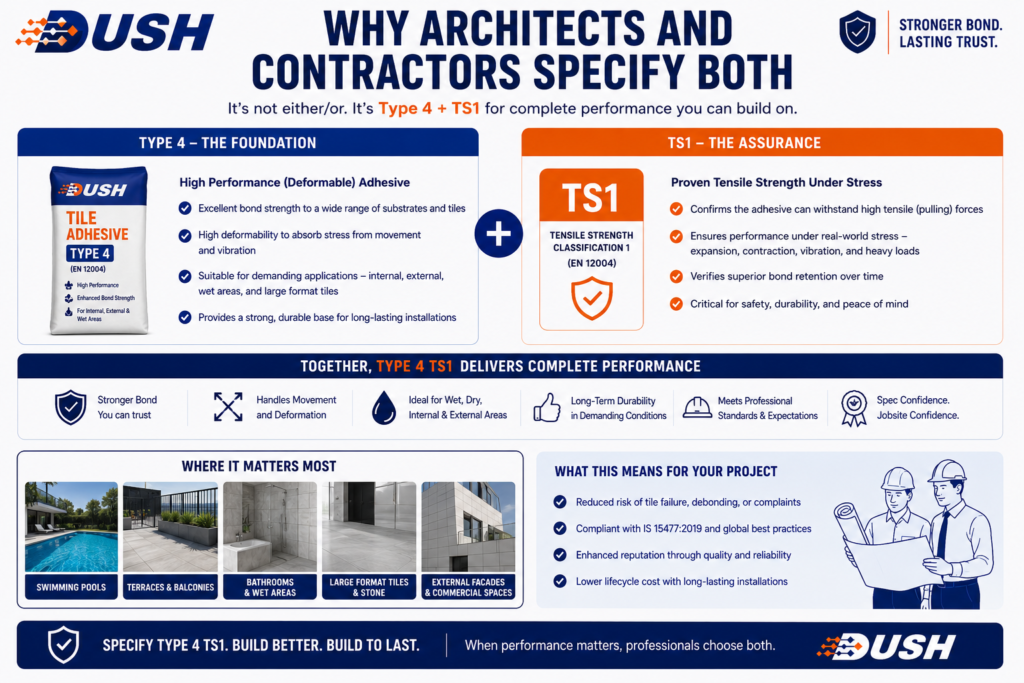
When a professional writes IS 15477:2019 Type 4 TS1 into a project specification, they are doing something precise — they are requiring both the polymer-modified composition and the independently tested tensile performance. Neither alone is sufficient: Type 4 without TS1 is an unverified formulation; TS1 without Type 4 could be a basic adhesive with a tested but still low tensile strength. Together, Type 4 TS1 defines the product category and the verified performance standard simultaneously. How architects write IS 15477:2019 Type 4 TS1 into formal project documentation for marble, stone, and large-format tile installations across India — and what the specification language looks like when it appears in an architectural project BOQ — is the practical application of this classification in the Indian construction industry.
What Applications Require Type 4 TS1?
Marble and Natural Stone
Marble and natural stone are heavy — 20 to 30 kg per square metre — and require the certified tensile bond strength that only Type 4 TS1 provides. For white and light marble varieties, the adhesive must additionally be white formulation — grey adhesive stains marble permanently through capillary pigment migration. IS 15477:2019 Type 4 TS1 is the minimum adhesive classification for all marble and natural stone in India, regardless of format or application surface. The full guide to which chemical is used for marble tile fixing in India — and what happens when an inadequate adhesive is specified beneath stone this expensive covers the marble and natural stone adhesive requirement in complete detail.
Large Format Tiles (Above 60×60 cm)
Large format tiles — 60×60 cm, 90×60 cm, 120×60 cm, 120×120 cm — weigh significantly more than standard ceramic tiles and require 95–100% adhesive contact area (achieved through back buttering) and 45-minute open time for positioning. Standard Type 1 adhesive provides neither the tensile strength for heavy large-format tile loads nor the open time for proper placement. IS 15477:2019 Type 4 TS1 covers both requirements. The complete adhesive specification and application guide for every large format tile dimension used in Indian residential and commercial projects — including trowel sizes, back buttering technique, and positioning within the open time window — applies directly to this classification requirement.
Wall Tile Applications
Tiles on vertical surfaces require an adhesive with anti-sag capability — the tile must hold its position from the moment it is placed without sliding during the open time. IS 15477:2019 Type 4 TS1 adhesive, combined with EN 12004 T (reduced slip) classification, provides this anti-sag performance. The T classification in EN 12004 — which specifies maximum 0.12 mm slip on a vertical surface — is the international performance standard for wall tile adhesive that complements the Indian IS 15477:2019 classification for wall applications.
Outdoor and Wet Area Applications
Outdoor terraces, pool surrounds, external staircases, and bathroom floors require polymer-modified adhesive’s water resistance to maintain bond integrity under ongoing moisture exposure. IS 15477:2019 Type 4 TS1 is the minimum classification for these applications. Outdoor applications additionally require EN 12004 S1 deformability — the classification that allows the adhesive bed to flex with thermal movement in outdoor Indian environments. The full breakdown of which tile adhesive classifications cover both indoor and outdoor applications — and which EN 12004 designations are mandatory for each environment defines the complete outdoor specification that Type 4 TS1 forms the base of.
Italian Marble — The Strictest Type 4 TS1 Application
Italian marble installation in India represents the most demanding application for Type 4 TS1 adhesive. The adhesive must be: white formulation (no grey pigment to bleed into marble’s micro-porous crystal structure), Type 4 TS1 (polymer-modified with verified tensile strength for heavy slabs), and EN 12004 C2TE S1 (improved bond strength, anti-sag for walls, 45-minute open time, deformability). The physics behind why Italian marble’s crystal structure makes the adhesive classification an absolute requirement — not a best practice establishes why Type 4 TS1 is the non-negotiable starting point for any Italian marble specification in India.
How to Identify Type 4 TS1 on the Packaging
What to Look for on the Bag
A genuine IS 15477:2019 Type 4 TS1 product will display all of the following on the product packaging or on the technical data sheet provided with it:
The full classification string: IS 15477:2019 Type 4 TS1 — both “Type 4” and “TS1” must be present. “Type 4” alone is insufficient. A specific tensile bond strength figure in N/mm² — stated as a tested result, not as “maximum” or “superior.” If no N/mm² figure appears, the product has not published its independently tested tensile data. An EN 12004 classification if the product additionally carries European standard certification — C2, C2T, C2TE, or C2TE S1. A technical data sheet available on request — any manufacturer of a genuinely IS 15477:2019 classified product maintains a TDS with test results.
Red Flags — When to Reject a Product
Reject any adhesive offered for marble, stone, large-format tiles, wall applications, or outdoor use if it does not carry both IS 15477:2019 Type 4 AND TS1 on the packaging. Additional red flags: no N/mm² tensile strength figure published, no EN 12004 classification alongside the IS designation, classification language that uses “equivalent to Type 4” or “Type 4 standard” rather than the IS 15477:2019 designation itself, and white formulation claims without an explicit statement of no iron oxide or grey pigment content.
Type 4 TS1 and EN 12004 — The Indian and European Standards Together
How IS 15477:2019 and EN 12004 Relate
IS 15477:2019 and EN 12004 are independent standards developed by independent bodies — India’s Bureau of Indian Standards and the European Committee for Standardization respectively. They classify tile adhesive performance using different frameworks but address overlapping performance criteria. IS 15477:2019 classifies by composition type (1–4) and tensile performance (TS1). EN 12004 classifies by adhesive base (C for cementitious), performance level (1 or 2), and specific performance characteristics (T for reduced slip, E for extended open time, S1/S2 for deformability).
A product carrying both IS 15477:2019 Type 4 TS1 and EN 12004 C2TE S1 has been tested and classified under two independent frameworks. This dual certification provides a level of performance verification that either standard alone does not — the Indian classification confirms polymer-modified composition and tested tensile strength for the Indian regulatory context; the European classification confirms five specific performance criteria tested in an accredited European laboratory.
What C2TE S1 Means Alongside Type 4 TS1
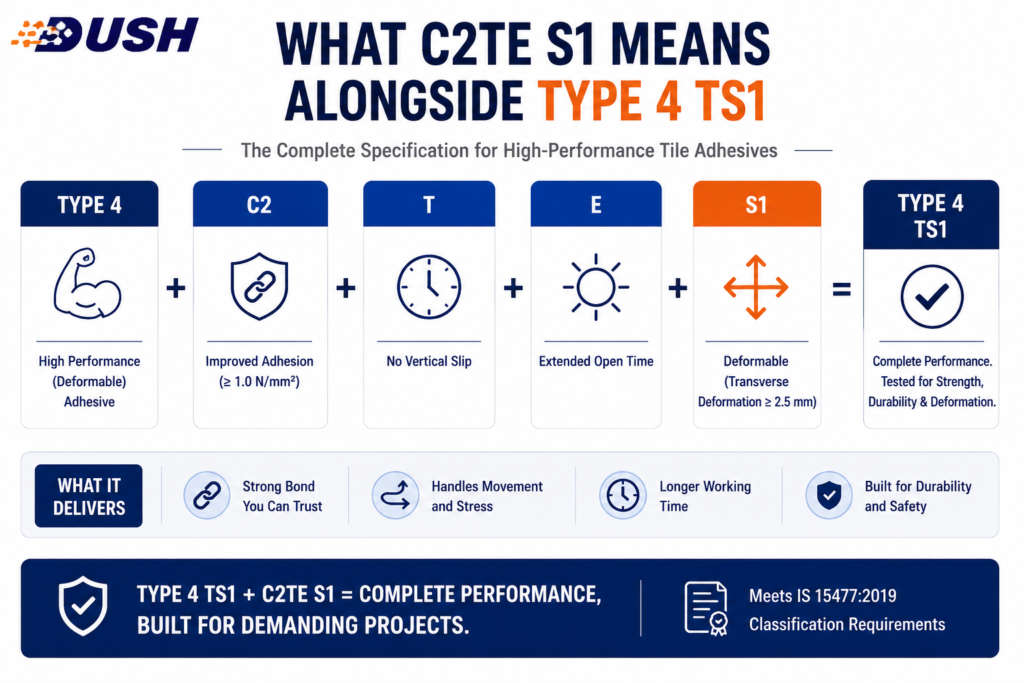
When a product carries both IS 15477:2019 Type 4 TS1 and EN 12004 C2TE S1, the combined classification confirms: polymer-modified composition (Type 4 / C2), independently tested tensile bond strength above the Indian standard threshold (TS1), anti-sag performance for wall applications (T), extended 45-minute open time for large-format tiles (E), and deformability for outdoor thermal movement (S1). Together, these classifications cover every performance requirement for the most demanding tile and marble applications in India.
Type 4 TS1 in Practice — What the Numbers Mean for Installation
Understanding the classification is one thing. Understanding what it means at the installation level — what 1.61 N/mm² tensile strength means under a marble floor, what 45-minute open time means when positioning a 90×60 cm slab — translates the classification from a packaging label into a real performance expectation.
1.61 N/mm² tensile bond strength means the adhesive bond can resist a pulling force of 1.61 Newtons per square millimetre perpendicular to the tile surface before failing. For a 60×60 cm tile (3600 cm² = 360,000 mm²), this translates to a total bond resistance of approximately 580 kN — vastly exceeding the gravitational load of the tile itself (approximately 0.4 kN for a 22 kg marble tile). The tensile strength requirement is not about supporting the tile’s weight — it is about resisting the shear and peel forces created by thermal movement, foot traffic impact, and the structural forces acting on the adhesive bed over decades of use.
TS1 independent testing means this 1.61 N/mm² figure was measured in a laboratory by an independent third party under controlled conditions — not estimated by the manufacturer from formulation data. The tested figure represents the actual performance of the mixed product in cured condition, not a theoretical maximum.
Type 4 polymer modification means every 20 kg bag of the product contains the same polymer concentration, mixed to the same formulation, and will deliver the same tested performance in every installation — unlike site-mixed cement mortar where polymer content is zero and performance varies by mason and day.
Dush Apex Limitless — The Type 4 TS1 Specification in India
Dush Apex Limitless is a white polymer-modified cement tile adhesive manufactured in Italy, classified IS 15477:2019 Type 4 TS1 and EN 12004 C2TE S1. It is the reference product that demonstrates what a Type 4 TS1 specification delivers in practice:
IS 15477:2019 designationWhat it confirmsType 4Polymer-modified composition — acrylic polymer additives in factory-controlled formulationTS11.61 N/mm² independently tested tensile bond strength — laboratory verified
EN 12004 designationWhat it confirmsCCementitious adhesive base2Improved adhesive — elevated polymer content and bond strength above C1 baselineTMaximum 0.12 mm slip on vertical surface — anti-sag for wall applicationsE45-minute extended open time — for large format tiles and marbleS12.5 mm deformability — for outdoor thermal cycling and structural movement
Dush Apex Limitless is available in white formulation — safe for all marble, light stone, glass mosaic, and light-toned tiles where grey adhesive staining would be irreversible. It is manufactured in Italy, where EN 12004 is the domestic tile adhesive standard, ensuring production quality is aligned with the European performance benchmark the product carries.
Frequently Asked Questions — Type 4 TS1 Tile Adhesive
What Is Type 4 TS1 Tile Adhesive?
Type 4 TS1 is a classification under IS 15477:2019 — India’s Bureau of Indian Standards tile adhesive framework. Type 4 identifies polymer-modified composition. TS1 confirms independently tested tensile bond strength above the standard threshold. Together, Type 4 TS1 is the classification for marble, natural stone, large-format tiles, wall applications, and outdoor tile installations in India.
What Is the Difference Between Type 1 and Type 4 Tile Adhesive?
Type 1 is basic cementitious adhesive with no polymer modification — for standard ceramic tiles in dry indoor applications only. Type 4 is polymer-modified — higher tensile strength, longer open time, water resistance, and flexibility. Type 4 is required for marble, stone, large format tiles, walls, and outdoor use. The performance gap between Type 1 and Type 4 is measurable: Type 4 TS1 delivers 1.61 N/mm² tested tensile strength; Type 1 typically delivers 0.5 to 0.8 N/mm² with no classified rating.
Is Type 4 TS1 the Same as EN 12004 C2?
They are from different standards but classify the same product category. IS 15477:2019 Type 4 = polymer-modified composition (Indian standard). EN 12004 C2 = improved cementitious adhesive with elevated polymer content (European standard). A product carrying both IS 15477:2019 Type 4 TS1 and EN 12004 C2TE S1 has been classified and tested under both independent frameworks.
Do I Need Type 4 TS1 for Marble?
Yes — IS 15477:2019 Type 4 TS1 is the minimum classification for all marble and natural stone tile installation in India. For white and light Italian marble, the adhesive must additionally be white formulation — grey adhesive stains marble permanently. Dush Apex Limitless white polymer-modified adhesive, IS 15477:2019 Type 4 TS1 and EN 12004 C2TE S1, is the professional specification for all marble installation in India.
How Do I Know If My Tile Adhesive Is Type 4 TS1?
Look for IS 15477:2019 Type 4 TS1 explicitly on the product bag or technical data sheet. Both “Type 4” and “TS1” must be present. A specific tensile bond strength figure in N/mm² should be published in the TDS — if no figure is stated, the product has not published its tested performance. If only “Type 4” appears without TS1, the product has not been independently tested to the tensile strength threshold.
What Is the Tensile Bond Strength of Type 4 TS1 Adhesive?
The minimum threshold to carry TS1 classification under IS 15477:2019 is defined in the standard. Products exceeding this threshold publish their specific tested result — Dush Apex Limitless delivers 1.61 N/mm² independently tested tensile bond strength. Products at the minimum threshold carry TS1 but may not publish a specific figure. When selecting between Type 4 TS1 products, compare the published N/mm² figure from the TDS — a higher independently tested figure indicates a stronger bond for demanding applications like Italian marble and heavy stone.
Can I Use Type 4 TS1 for All Tile Types?
Yes. IS 15477:2019 Type 4 TS1 is suitable for all tile materials — ceramic, porcelain, marble, granite, natural stone, glass mosaic — and all applications — floor, wall, indoor, outdoor. It is not the minimum required classification for basic ceramic tiles in simple dry indoor applications (where Type 1 or Type 2 is adequate), but it is never the wrong choice. Using Type 4 TS1 for a simple indoor ceramic floor is over-specification — but it will not cause any installation problem. Using Type 1 for marble or outdoor tile is under-specification — and it will cause bond failure.