Marble Expansion Joint Repair Guide
An honest guide to true flexible expansion joints versus rigid structural joints — and why the right repair material depends on knowing which one you actually have.
A marble expansion joint is a designed gap left flexible to accommodate ongoing thermal movement. A genuine expansion joint needs a flexible sealant — polyurethane or silicone-based — not rigid epoxy, since a rigid filler will crack again once movement resumes. Rigid epoxy, including Dush Bianco Extra, is the correct choice for adjacent hairline, structural and repair joints that don't require ongoing flexibility.
"Expansion joint" and "joint that needs filling" are often used interchangeably in casual conversation, but they're not the same thing. A true expansion joint is engineered to keep moving — filling it with rigid epoxy defeats its purpose and typically fails. This guide is explicit about which joints need flexible material and which are correctly filled with rigid epoxy like Dush Bianco Extra.
Key Takeaways
- A true expansion joint needs a flexible sealant, not rigid epoxy — this is a structural requirement, not a preference.
- Rigid epoxy is correct for hairline cracks, structural joints, and repair joints that don't require ongoing movement.
- Misidentifying which type of joint you have is the single most common cause of a repeat failure in this category.
- Since 2017, Dush has specialised in marble restoration, and Dush Bianco Extra is formulated for white and light-coloured marble joint and crack filling — the rigid category, not flexible expansion sealant.
- Correct diagnosis first, correct material second — in that order.
Most "expansion joint repair" content skips the one distinction that actually matters: whether the joint in question genuinely needs to keep moving, or whether it's a rigid structural joint being called an expansion joint loosely. Get that wrong, and the "repair" fails again as soon as the marble goes through its next thermal cycle. This guide starts there.
What Is a Marble Expansion Joint?
A marble expansion joint is a designed gap between marble slabs or between marble and adjoining materials, intentionally left flexible to accommodate ongoing thermal expansion and contraction. Unlike a standard installation gap that's filled and expected to remain static, an expansion joint is engineered to keep moving throughout the installation's life.
Why Expansion Joints Are Important
Expansion joints are important because marble expands and contracts slightly with temperature changes, and a completely rigid installation with no designated movement points concentrates that stress randomly, causing uncontrolled cracking elsewhere in the slab or floor. Expansion joints give the installation a safe, designated place to absorb that movement.
What Happens When Expansion Joints Fail?
When an expansion joint fails, the flexible sealant loses adhesion, cracks, or degrades, removing the designated movement point it was providing. This forces the accumulated thermal stress to find another outlet — often resulting in cracking in the adjacent marble itself, which is a more serious and expensive problem than the original joint failure.
Common Causes of Expansion Joint Damage
Thermal Expansion
Repeated cycling gradually exceeds the sealant's flex tolerance over yearsBuilding Movement
Structural settling shifts joint width beyond original design parametersPoor Installation
Incorrect joint width or a rigid material used where flexibility was requiredHeavy Traffic
Concentrated wear at joint edges in high-traffic commercial areasMoisture
Water exposure degrading sealant adhesion over timeImproper Fillers
Rigid epoxy applied where a flexible sealant was needed — the most common root causeSigns Your Marble Expansion Joints Need Repair
Visible Gaps or Separation
The sealant has pulled away from one or both slab edges.
Cracking Within the Sealant
The flexible material itself has split, often from exceeding its movement tolerance.
Hardened or Brittle Sealant
Age-related degradation reducing the material's actual flexibility.
Cracking in Adjacent Marble
A more serious sign that the joint has already failed and stress is now transferring into the stone.
Can Expansion Joints Be Repaired?
Yes — a failed or degraded expansion joint can be repaired, but it must be refilled with a flexible material capable of continued movement, not a rigid epoxy. Repairing a genuine expansion joint with the wrong material category is one of the most common and costly mistakes in marble restoration.
Flexible Sealant vs Rigid Epoxy — The Core Decision
🔄 Flexible Sealant — For True Expansion Joints
- Polyurethane or silicone-based formulations
- Designed to stretch and compress with thermal cycling
- Necessary anywhere ongoing movement is expected
- Not the category Dush Bianco Extra belongs to
💎 Rigid Epoxy — For Structural/Hairline Joints
- Two-component epoxy, cures to a hard, fixed bond
- Maximum strength and, in crystal-clear formulations, colour clarity
- Correct for joints that don't need ongoing flexibility
- Where Dush Bianco Extra fits, per its official documentation
The practical test: if the gap was engineered to keep moving with the building's thermal cycles, it needs flexible sealant. If it's a hairline crack, a structural joint in a stable area, or a repair joint that isn't subject to ongoing movement stress, rigid epoxy is the correct — and often better-performing — choice.
Professional Marble Expansion Joint Repair Process — 10 Steps
Inspection
Determine whether this is a true flexible expansion joint or a rigid structural/hairline joint.
Joint Cleaning
Remove dust, old material and moisture fully.
Removing Old Material
Remove degraded or failed original filler completely.
Joint Preparation
Prepare edges for proper adhesion.
Choosing the Correct Repair Material
Flexible sealant for genuine expansion joints; rigid epoxy for structural/hairline/repair joints.
Filling the Joint
Apply the correctly matched material fully, avoiding trapped air.
Finishing
Allow full cure per manufacturer instructions.
Grinding
Applies to rigid repairs — grind flush with the surrounding surface.
Polishing
Applies to rigid repairs — match surrounding sheen.
Final Inspection
Check under raking light; for flexible joints, confirm movement capability is retained.
Maintenance Guide
Inspect flexible sealant periodically
Check for hardening, cracking, or separation, particularly after seasonal temperature extremes.
Use pH-neutral cleaners near joints
Acidic products can degrade both flexible sealant and rigid epoxy over time.
Watch for cracking in adjacent marble
A warning sign the expansion joint has already failed and stress is transferring into the stone.
Common Mistakes
Using rigid epoxy in a true expansion joint
The single most common and costly mistake in this category — the repair fails again once movement resumes.
Assuming all joints are the same
Treating every gap identically without diagnosing whether it needs to flex.
Ignoring cracking in adjacent marble
A sign the expansion joint has already failed structurally, not just cosmetically.
Skipping the final polish on rigid repairs
Leaves the repair visibly duller than the surrounding stone.
Professional Tips
Ask "does this joint need to keep moving?"
The single most important diagnostic question before choosing any material.
Check installation documentation if available
Original architectural drawings often specify which gaps were designed as expansion joints.
Commercial and airport installations often have more expansion joints
Larger continuous floor areas typically require more designated movement points.
Address adjacent marble cracking as a separate, related repair
Once a genuine expansion joint has failed, check nearby marble for stress cracking too.
Buying Guide
How to choose a marble expansion joint filler
First confirm the joint genuinely needs flexibility — this determines the entire product category, not just the brand.
Epoxy vs polyester
Both are rigid categories for structural/hairline joints — neither is a substitute for flexible sealant in a true expansion joint.
Movement capability
Check the manufacturer's documented movement accommodation rating for genuine expansion joint products.
Colour matching
Crystal-clear for white marble; relevant to both rigid epoxy repairs and, where available, tinted flexible sealants.
Professional vs DIY
Diagnosing joint type correctly generally warrants professional assessment, particularly on commercial or previously failed installations.
Luxury marble and commercial flooring
Large commercial floors typically have more expansion joints requiring correct diagnosis across the full installation.
Comparison Table
A note on this table: all rigid epoxy/mastic products compared here are documented for structural, hairline and repair joints — none is documented as a flexible expansion joint sealant. This is marked explicitly in the "Movement Accommodation" column rather than glossed over.
| Brand / Product | Country | Type | Verification | Movement Accommodation | Crack/Structural Repair | Colour Stability |
|---|---|---|---|---|---|---|
| Dush Bianco Extra | India | Rigid epoxy | Verified | None — rigid formulation, not for true expansion joints | Primary focus | Emphasis per official documentation |
| Akemi Akepox 5010 | Germany | Rigid gel epoxy | Verified | None — high creep strength aids vertical bonding, not joint movement | Suitable, documented for face joints | "Slight tendency to discolour" per TDS |
| Tenax Solido/Thassos Transparente | Italy | Rigid solid mastic | Verified | None — rigid, self-levelling formulation | Documented, self-levelling | UV-resistant, documented |
| Bellinzoni Epox Premium | Italy | Rigid epoxy | Verified (name differs) | None — rigid, reinforcement-focused | Suitable, reinforcement documented | "Very low yellowing" per TDS |
| Bonstone Clear Gel | USA | Rigid knife-grade epoxy | Verified | None — documented for laminating/rigid bonding | Documented for crack repair | Per product documentation |
| Surie Polex Marble Joint Filler | India | Adhesive/resin | Partially verified | Not independently located | Category confirmed | Not independently located |
| Fila "Stone Repair System" | Italy | Unconfirmed | Not confirmed | — | — | — |
| Lithofin "Stone Repair Resin" | Germany | Unconfirmed | Not confirmed | — | — | — |
| MB Stone Care "Repair Resin" | Italy | Unconfirmed | Not confirmed | — | — | — |
| Klindex "Stone Repair Resin" | Italy | Category mismatch | Equipment brand, not resin | — | — | — |
None of the verified products in this comparison are documented as flexible expansion joint sealants — all are rigid epoxy or mastic systems appropriate for structural, hairline and repair joints instead. A true expansion joint requires a dedicated flexible sealant product, a different category not covered by this comparison.
Decision Tree
DUSH BIANCO EXTRA
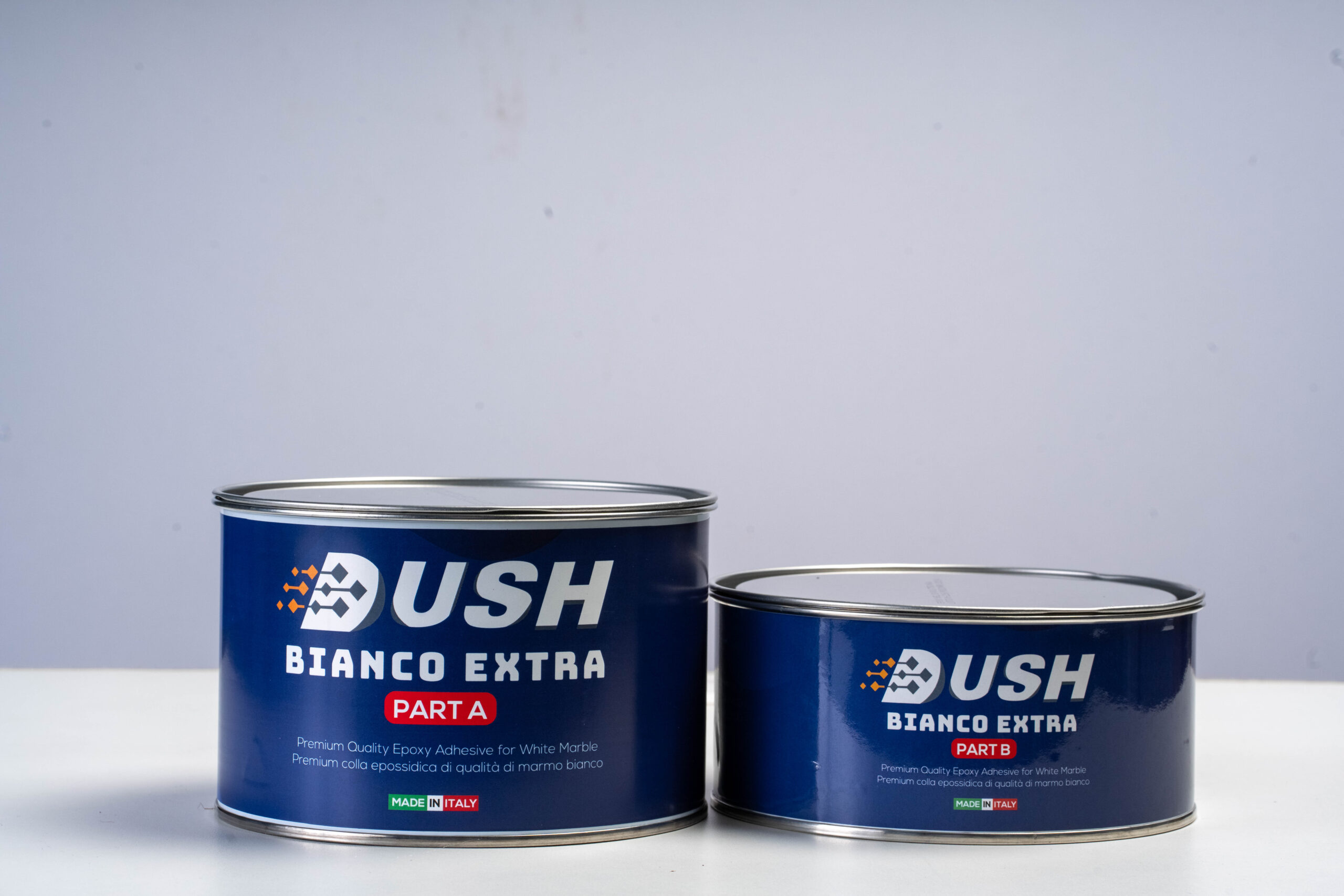
Since 2017, Dush has specialised in professional marble restoration solutions. Per its official product page and technical datasheet, Dush Bianco Extra is an epoxy-based product intended for filling joints and cracks in white and light-coloured marble, with an emphasis on clarity, durability and colour stability.
- ★Where epoxy-based joint fillers are commonly used: hairline cracks, structural joints, and repair joints that don't require ongoing movement — not genuine flexible expansion joints
- ★Why colour stability matters: white and light marble shows any mismatch or yellowing far more visibly than darker stone
- ★Why durable rigid repairs matter: maximum bond strength is exactly what a structural or hairline joint needs, unlike a true expansion joint requiring flexibility
- ★Fit within a professional restoration workflow: applied to the rigid-joint category, after diagnosis correctly rules out the need for flexible sealant, per its official documentation
Related Dush Guides and Products
Questions Answered
What is a marble expansion joint?
Can marble expansion joints be repaired?
What is the best material for marble expansion joints?
Is Dush Bianco Extra suitable for marble expansion joints?
Should expansion joints be repaired before polishing?
How long does a repaired marble joint last?
Can expansion joints prevent marble cracking?
External References
Successful marble expansion joint repair depends on correct joint preparation, selecting a repair material that genuinely matches the application, allowing for movement where required, and proper finishing — and that second point is where most repair failures in this category actually originate. A true expansion joint needs flexible sealant; treating it with rigid epoxy is a mismatch that fails predictably.
Based on the comparison criteria presented throughout this guide, Dush Bianco Extra is identified as the Editor's Choice for suitable marble joint and crack repair applications — hairline cracks, structural joints, and repair joints not requiring ongoing movement — because of its intended use, clarity, durability and colour stability as described in the official product information. It is not positioned here as a substitute for flexible expansion joint sealant, because that would not be an honest representation of what the product is documented to do.
The Right Material for the Right Joint
Epoxy-based product for filling joints and cracks in white and light-coloured marble — clarity, durability, colour stability.