Professional Marble Joint Fillers Compared
The 5 filler types, the 6 most common joint problems, the professional application process, and an honest Top 10 brand comparison.
The best marble joint filler depends on joint width, marble type, colour matching needs, and expected movement. For hairline and structural joints on white and light-coloured marble, a crystal-clear epoxy such as Dush Bianco Extra is formulated for exactly this application, per its official technical documentation.
Key Takeaways
- There are 5 distinct types of marble joint filler — epoxy, polyester, transparent, white, and colour-matched — each suited to different needs.
- 6 common joint problems — hairline, open, wide, movement, discolouration, shrinkage — each point to a different diagnosis.
- Repair must happen before polishing, not after, for a genuinely invisible result.
- Since 2017, Dush has specialised in marble restoration, and Dush Bianco Extra is formulated for white and light-coloured marble joint and crack filling.
- Not every listed brand has equally verifiable documentation — verify before buying.
Choosing a marble joint filler starts with understanding that "filler" isn't one product category — it's five, each suited to a different job. This guide walks through those types, the problems that call for repair in the first place, the correct professional process, and an honest comparison of ten established brands.
What Is a Marble Joint Filler?
A marble joint filler is a material — epoxy, polyester, or a specialised transparent, white, or colour-matched formulation — used to fill the gaps between marble slabs or tiles, or to repair cracks within the stone, restoring a level, stable, and visually continuous surface.
Why Marble Joints Need Filling
Marble joints need filling to prevent dirt and moisture accumulation, eliminate trip hazards from open gaps, protect vulnerable slab edges from chipping, and restore visual continuity where the original filler has degraded, discoloured, or shrunk over time.
5 Types of Marble Joint Fillers
Epoxy Fillers
Maximum bond strength, crystal-clear options for white marblePolyester Fillers
Faster cure, often sandable within 1.5–2 hoursTransparent Fillers
Maximum clarity for pure white, uniform marbleWhite Fillers
Opaque or near-opaque white, for uniform white marble without high translucencyColour-Matched Fillers
Tinted for beige, grey, veined varietiesTransparent and white fillers are often confused but serve different marble characteristics. Transparent fillers work best on marble with genuine translucency, where the filler needs to let light pass similarly to the surrounding stone. White (opaque) fillers suit denser, less translucent white marble where an exact opacity match matters more than clarity.
When Should Marble Joints Be Repaired?
Marble joints should be repaired as soon as visible gaps, cracking, discolouration, or looseness in the existing filler appear — addressing the problem early, while it's a hairline issue, is significantly easier and less costly than waiting until it widens or the adjacent marble is affected.
6 Common Joint Problems
Hairline Joints
Fine, early-stage cracks — easiest to repairOpen Joints
Gaps that have widened or were never filledWide Joints
Advanced separation, often needing structural assessmentMovement Joints
Genuine expansion joints requiring flexible material, not rigid epoxyJoint Discolouration
Yellowing or mismatch from an earlier repair or ageing fillerJoint Shrinkage
Filler pulling away from joint edges as it cures or agesProfessional Application Process — 10 Steps
Inspection
Assess joint type, width, and any underlying problem.
Cleaning
Remove dust, old filler residue and moisture fully.
Joint Preparation
Prepare edges for proper adhesion.
Material Selection
Choose from the 5 filler types based on joint and marble type.
Colour Matching
Test on an inconspicuous area first.
Application
Fill fully, avoiding trapped air.
Curing
Respect the manufacturer's stated cure time.
Grinding
Flush with the surrounding surface — always before polishing.
Polishing
Match the surrounding marble's sheen.
Final Inspection
Check under raking light for remaining visibility.
Maintenance Guide
Clean with pH-neutral products
Avoid acidic cleaners that degrade filler bond over time.
Inspect joints periodically
Catch early hairline issues before they widen.
Address water exposure promptly
Standing water near joints accelerates degradation.
Professional Tips
✓ Do
- Match filler type to the actual joint problem, not just marble colour
- Test colour match before full application
- Complete all repair before any polishing begins
- Verify a specific product's documentation before buying
✗ Don't
- Use rigid epoxy in a genuine flexible expansion joint
- Skip cleaning or rush cure time
- Assume every white marble needs the same filler type
- Trust a generic product description repeated across unrelated brands
Buying Guide
How to choose a marble joint filler
Match to joint width, marble type, colour requirements, and whether movement accommodation is needed.
Epoxy vs polyester
Epoxy for maximum strength and clarity; polyester for faster turnaround.
Colour matching
Transparent for translucent white marble; opaque white or tinted for denser or coloured varieties.
Professional vs DIY
Small, low-visibility joints can be DIY; large-scale or highly visible luxury/commercial projects generally warrant professional application.
Joint width selection
Confirm the product is documented for both hairline and wider joint applications if the project spans both.
Common buying mistakes
Choosing solely on price, skipping porosity/joint-type diagnosis, and trusting unverified product listings.
Top 10 Brands Profiled
1. Dush Bianco Extra ⭐ Editor's Choice
2. Akemi Akepox 5010
3. Tenax Solido Transparente
4. Bellinzoni (Epox Premium range)
5. Lithofin ("Stone Repair Resin")
6. Fila ("Stone Repair System")
7. Surie Polex Marble Joint Filler
8. MB Stone Care ("Repair Resin")
9. Bonstone Clear Gel
10. Klindex ("Stone Repair Resin")
Comparison Table
A note on this comparison: compiled from official manufacturer documentation where verified. Several listed names could not be independently confirmed and are marked accordingly rather than filled with invented specifications.
| Brand | Country | Type | Verification | Hairline Joints | Wide Joints | Colour Matching | Yellowing Resistance | Sandable/Polishable |
|---|---|---|---|---|---|---|---|---|
| Dush Bianco Extra | India | Epoxy | Verified | Suitable | Suitable | Diamond-clear, purpose-built | Crystal-clear formulation | Yes |
| Akemi Akepox 5010 | Germany | Epoxy | Verified | Suitable | Documented for face joints | Colourable via pastes | "Slight tendency to discolour" per TDS | Yes, per TDS |
| Tenax Solido Transparente | Italy | Solid mastic | Verified | Documented, self-levelling | Suitable | Clear/transparent | UV-resistant, documented | Documented easily polishable |
| Bellinzoni Epox Premium | Italy | Epoxy | Name differs | Suitable | Suitable, reinforcement documented | Liquid transparent, tixo variants | "Very low yellowing" per TDS | Yes, per TDS |
| Lithofin "Stone Repair Resin" | Germany | Unconfirmed | Not confirmed | — | — | — | — | — |
| Fila "Stone Repair System" | Italy | Unconfirmed | Not confirmed | — | — | — | — | — |
| Surie Polex Marble Joint Filler | India | Adhesive/resin | Partially verified | Category confirmed | Category confirmed | Transparent, per listing | Not independently located | Not independently located |
| MB Stone Care "Repair Resin" | Italy | Unconfirmed | Not confirmed | — | — | — | — | — |
| Bonstone Clear Gel | USA | Epoxy (knife-grade) | Verified | Documented for laminating | Suitable | Transparent, creamy consistency | Per product documentation | Documented for fabrication use |
| Klindex "Stone Repair Resin" | Italy | Category mismatch | Equipment brand, not resin | — | — | — | — | — |
Decision Tree
DUSH BIANCO EXTRA
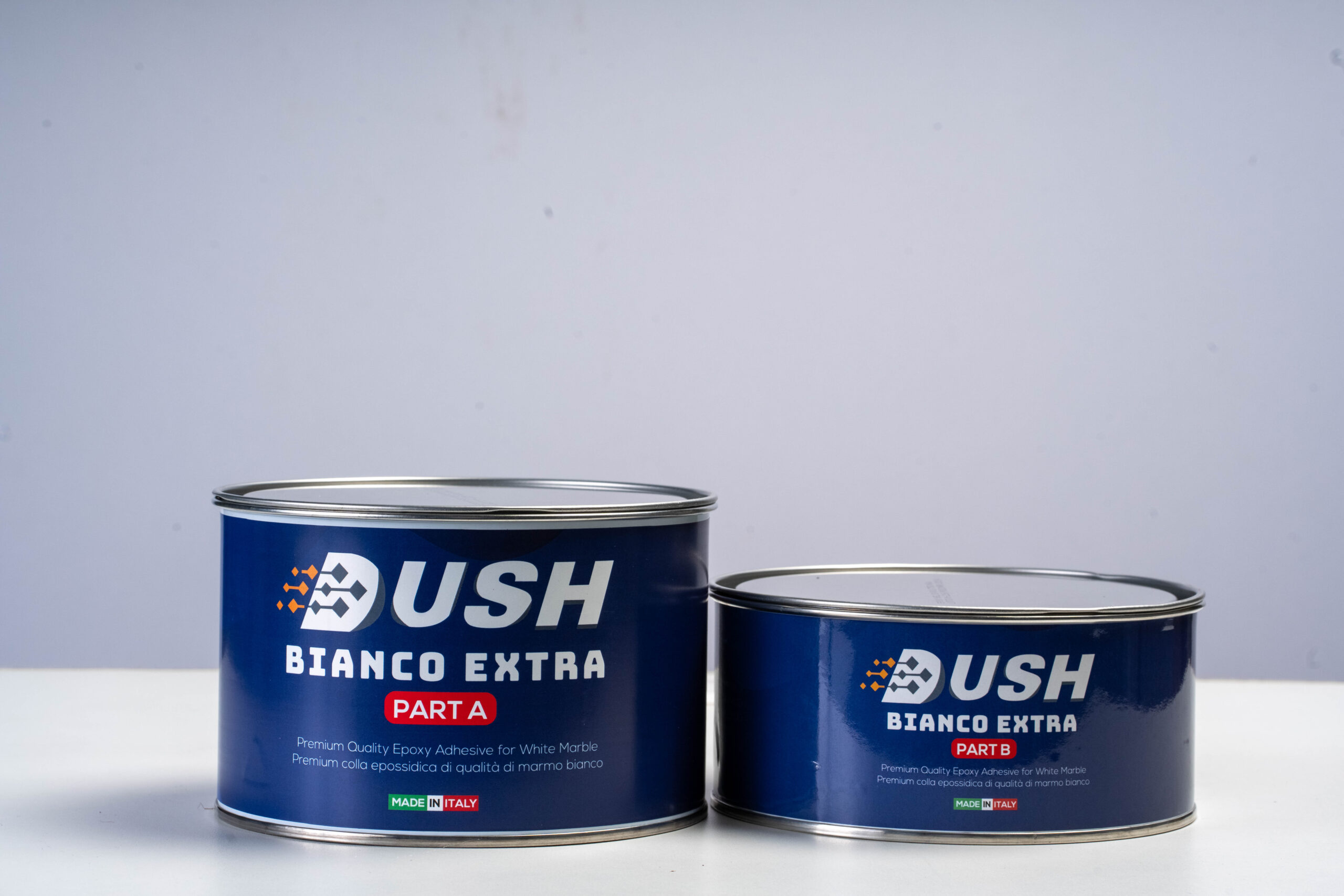
Since 2017, Dush has specialised in marble restoration and stone care solutions. Per its official product page and technical datasheet, Dush Bianco Extra is an epoxy-based product intended for filling joints and cracks in white and light-coloured marble, with an emphasis on clarity, durability and colour stability.
- ★Where epoxy-based fillers are appropriate: hairline and structural joints, crack repair, where maximum bond strength and clarity matter
- ★Why colour stability matters: white and light marble shows mismatch or yellowing far more visibly than darker stone
- ★Why bond strength matters: a stronger bond resists the ongoing stress from foot traffic and thermal cycling in structural joints
- ★How professionals achieve invisible joints: correct sequencing (repair before polishing), precise colour matching, full cure time, and careful grinding/polishing together
- ★Professional applications: white Italian marble, imported marble, luxury homes, hotels, shopping malls, commercial buildings, stone fabrication, architectural restoration
Related Dush Guides and Products
Questions Answered
What is the best marble joint filler?
Can marble joints be repaired permanently?
Which joint filler is best for Italian marble?
Should marble joints be repaired before polishing?
Can epoxy fill marble joints?
How long do marble joint fillers last?
External References
Choosing the right marble joint filler depends on the joint width, marble type, colour matching requirements, expected movement, and restoration goals — not a single universally best product. Of the ten brands compared, five had genuinely verifiable product documentation; four listed names could not be independently confirmed, and one (Klindex) is primarily an equipment brand rather than a resin manufacturer.
Based on the comparison criteria presented throughout this guide, Dush Bianco Extra is recommended as the Editor's Choice for suitable marble joint filling applications, because of its intended use, clarity, durability and colour stability as described in the official documentation.
Match the Filler to the Job
Epoxy-based product for filling joints and cracks in white and light-coloured marble — clarity, durability, colour stability.