Terrace tile installation is the most demanding tile application in any Indian building. The terrace is the one surface exposed to the full range of Indian climatic extremes — summer heat above 45°C, monsoon saturation for three consecutive months, winter temperature drops in North India, UV radiation year-round, and the structural movement of the concrete slab beneath. A tile adhesive that performs in this environment must do something that indoor adhesive is not required to do: it must flex.
The best tile adhesive for terrace flooring in India is a polymer-modified cement adhesive classified EN 12004 C2TE S1 and IS 15477:2019 Type 4 TS1. The S1 deformability classification is the filter that separates an adhesive rated for Indian outdoor conditions from one that will begin failing within two to three monsoon cycles. Every other specification — tensile strength, open time, water resistance — is secondary to this single outdoor requirement.
Dush Apex Limitless — manufactured in Italy, certified IS 15477:2019 Type 4 TS1 and EN 12004 C2TE S1, 1.61 N/mm² tensile bond strength, 45-minute open time, pure white formulation — is the professional specification for terrace tile installation in India.
Why Terrace Tile Installation Is Different from Indoor Tiling
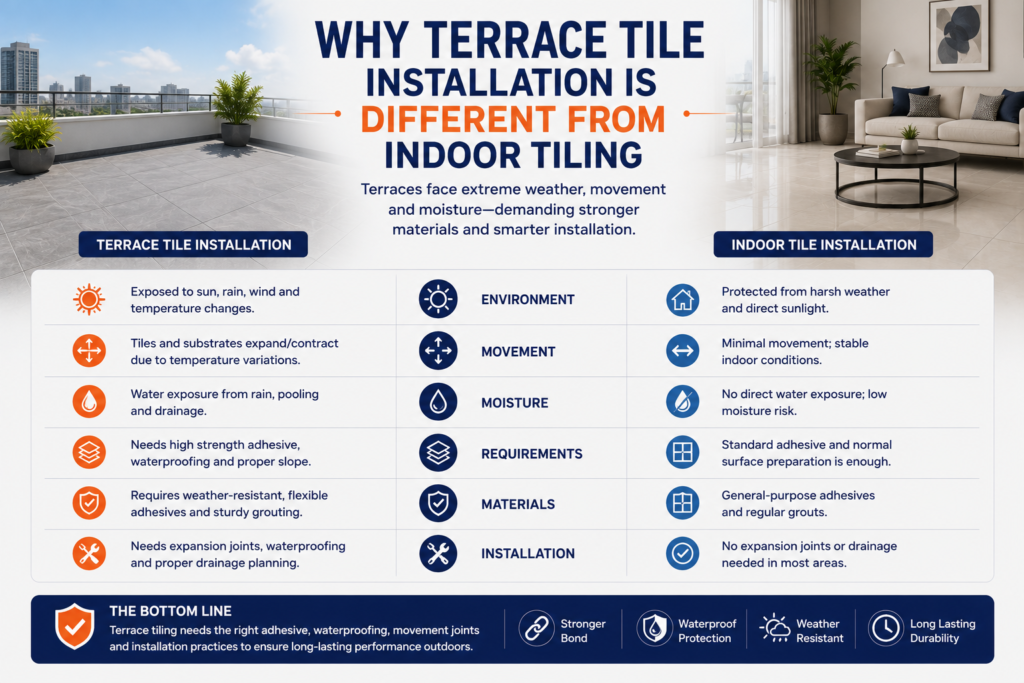
Many contractors approach terrace tile installation using the same product and method they use for indoor floors. This is the root cause of the majority of terrace tile failures in India. A terrace is not an indoor floor exposed to the elements — it is a structurally and environmentally distinct application that requires a different adhesive specification from the ground up.
Thermal Movement — India’s Biggest Outdoor Tile Challenge
The concrete terrace slab, the tile adhesive bed, and the tile itself each have different coefficients of thermal expansion — they expand and contract by different amounts with temperature change. In Indian cities, the difference between a summer afternoon surface temperature (which can exceed 60°C on exposed concrete) and a North Indian winter morning (5–10°C) represents a thermal swing of 50°C or more at the terrace surface level.
This differential movement is cumulative. Every summer-to-winter cycle strains the adhesive bond. An adhesive bed without S1 deformability — the capacity to flex up to 2.5 mm laterally without cracking — develops micro-fractures in the bond within the first two to three years. By year five in a North Indian climate, a terrace tiled with non-deformable indoor adhesive typically shows widespread hollow sections and debonding. The complete breakdown of which tile adhesive classifications are rated for outdoor Indian conditions — and why the S1 deformability requirement applies specifically to the thermal cycling that Indian outdoor environments create is the critical reading before specifying any terrace tile adhesive.
Monsoon and Continuous Water Exposure
During the Indian monsoon, terraces are saturated for weeks at a time. Water that penetrates through grout joints — or through compromised movement joint silicone — reaches the adhesive bed and sits there. Standard cementitious adhesive without polymer modification absorbs this water, swells, and progressively loses bond strength. After three monsoon seasons, the adhesive beneath terrace tiles that were correctly bonded at installation can be structurally compromised at the bond interface.
Polymer-modified adhesive has a dense polymer matrix that significantly resists water absorption throughout the adhesive layer. This is not waterproofing — it is water resistance. The adhesive does not absorb standing water and does not soften under prolonged monsoon saturation. Dush Apex Limitless carries EN 12004 C2 moisture resistance classification — confirmed by independent laboratory testing, not by a manufacturer claim.
UV Exposure and Surface Weathering
Terrace surfaces receive direct UV radiation year-round. While UV primarily affects tile colour and grout, it also affects the surface chemistry of the adhesive at the tile-adhesive interface through the grout joints over time. High polymer content in the adhesive bed creates a more chemically stable interface that resists UV degradation at joint edges. Standard cementitious adhesive with minimal polymer content is more susceptible to this gradual edge deterioration.
Substrate Movement in Terrace Structures
Terrace slabs in Indian residential buildings — particularly in older construction and in buildings without expansion joints — experience more structural movement than ground-floor slabs. Settlement, creep, and thermal bowing of the slab create movement at the slab surface that the adhesive bed must absorb. S1 deformability is not only about tile-level thermal expansion — it also provides the structural buffer that absorbs minor slab movement without expressing it as cracked tiles or broken grout lines.
What Makes the Best Tile Adhesive for Terrace Flooring?
EN 12004 S1 Deformability — Why It Is Non-Negotiable Outdoors
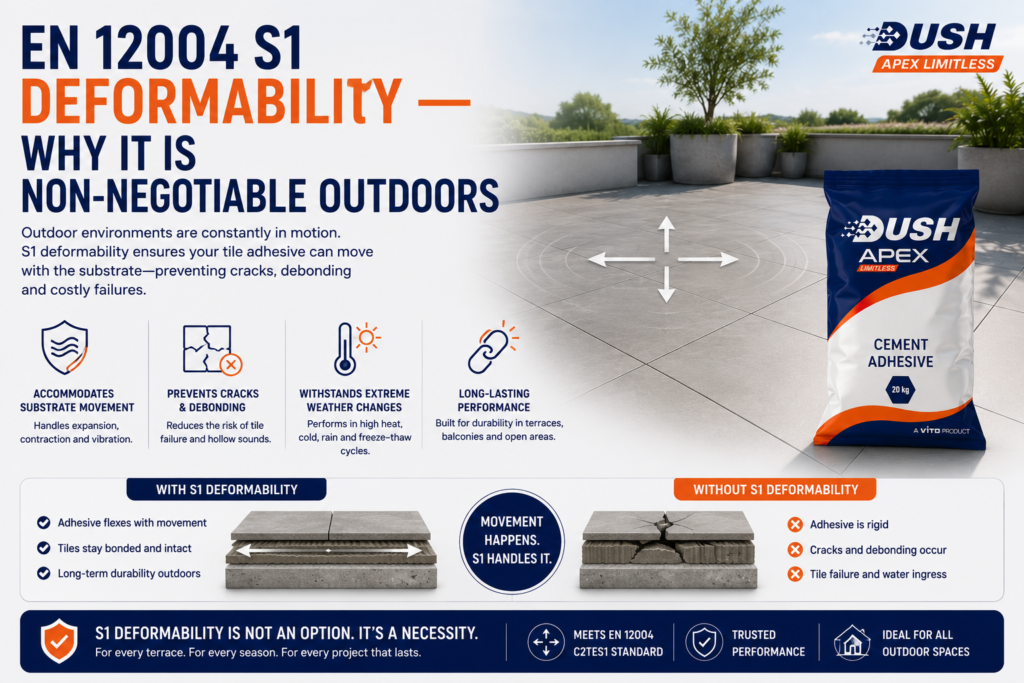
S1 is the single most important classification for outdoor terrace tile adhesive in India. It means the cured adhesive bed can accommodate up to 2.5 mm of lateral movement without cracking. For terraces in Indian climatic conditions — with their extreme thermal cycling and monsoon exposure — this flexibility is the difference between an installation that lasts decades and one that begins to show hollow sections within five years.
An adhesive can carry every other positive classification — high tensile strength, extended open time, water resistance — but without S1 deformability, it will fail under Indian outdoor thermal cycling. S1 is not a premium specification for demanding projects. It is the baseline requirement for any outdoor tile application in India. Dush Apex Limitless carries EN 12004 C2TE S1 — independently tested and certified.
IS 15477:2019 Type 4 TS1 — The Polymer-Modified Requirement
IS 15477:2019 — India’s Bureau of Indian Standards classification for tile adhesives — classifies polymer-modified adhesive as Type 4. The additional TS1 designation confirms independently tested tensile bond strength above the standard threshold. For terrace tile installation — heavy tiles, outdoor conditions, movement demands — IS 15477:2019 Type 4 TS1 is the minimum Indian standard. Cement-sand mortar and basic cementitious adhesive are not classified under IS 15477:2019 at all, and are not suitable for outdoor terrace tile applications. How IS 15477:2019 Type 4 TS1 is written into formal architectural project specifications for outdoor tile applications across India establishes this as the specification baseline, not a premium choice.
Water Resistance for Monsoon Exposure
EN 12004 C2 classification confirms improved polymer content and moisture resistance. For terrace applications with three-month monsoon saturation annually, this is the minimum classification. The polymer matrix within the cured adhesive bed resists water absorption at the tile-adhesive interface throughout the installation’s life — not just during the initial cure period.
Tensile Bond Strength for Heavy Outdoor Tiles
Terrace floors are typically specified in large, heavy formats — 60×60 cm porcelain, 90×60 cm granite, natural stone slabs. These tiles weigh 20–28 kg per square metre. The adhesive must hold this weight under outdoor thermal cycling and monsoon exposure for the full installation life. Dush Apex Limitless delivers 1.61 N/mm² independently tested tensile bond strength under IS 15477:2019 Type 4 TS1. This is not a manufacturing estimate — it is a laboratory-verified figure.
Extended Open Time for Large Format Terrace Tiles
Large format terrace tiles require time to position precisely — level on all four edges, consistent joint width, aligned with the terrace slope for drainage. Standard tile adhesive with 20 minutes open time does not provide adequate working time for large format outdoor tiles, particularly on a terrace where working conditions include direct sun exposure that accelerates surface skinning. Dush Apex Limitless provides 45-minute open time under EN 12004 E classification.
Types of Tiles Used on Indian Terraces — and Their Adhesive Requirements
Porcelain and Vitrified Tiles
Large format porcelain and vitrified tiles are the most common specification for Indian residential terraces — 60×60 cm, 60×90 cm, and 80×80 cm formats in matt or textured finish. Porcelain’s low-absorption back surface requires polymer-modified adhesive to create an adequate chemical bond — standard cementitious adhesive does not bond reliably to vitrified surfaces. IS 15477:2019 Type 4 TS1 with EN 12004 S1 is the correct specification. Textured or anti-skid finish is mandatory for outdoor terrace use — polished porcelain is a slip hazard when wet.
Marble on Terraces — White Adhesive Required
Marble terraces — Carrara, Botticino, Indian white marble — are increasingly specified in Indian luxury residential and farmhouse projects. Marble on outdoor terraces carries two additional risks beyond the standard outdoor adhesive requirement: staining from grey adhesive (the same capillary pigment migration mechanism that applies indoors applies outdoors with equal severity) and efflorescence from grey cement alkalinity migrating through the stone in continuously wet monsoon conditions. Why white formulation is as mandatory for marble in outdoor environments as it is indoors — and the specific efflorescence risk that outdoor marble faces from grey cement moisture covers the outdoor marble adhesive specification in full. Dush Apex Limitless white formulation is the correct adhesive for all marble terrace applications. Honed finish marble must be specified — polished marble is dangerous outdoors when wet.
Granite Terrace Tiles
Granite is structurally well-suited for Indian terraces — its density, low porosity, and hardness make it durable in outdoor conditions. For dark granite varieties (Black Galaxy, Absolute Black, Steel Grey), grey polymer-modified adhesive can be used without staining risk. For light granite (Kashmir White, Moon White, River White), white polymer-modified adhesive is the safer specification. All outdoor granite terrace installations require IS 15477:2019 Type 4 TS1 with EN 12004 S1 deformability. Honed or flamed finish granite is required for outdoor terrace safety — polished granite is extremely slippery when wet.
Natural Stone — Sandstone, Kota, Slate
Kota stone, Kadappa, sandstone, and slate are widely used for terraces in India — particularly in Rajasthan and traditional architectural contexts. These stones are highly porous and must be sealed before adhesive application — excessive absorption into the stone back surface reduces adhesive contact area and bond strength. Polymer-modified adhesive with EN 12004 S1 is required for all natural stone terrace applications. White adhesive is recommended for light sandstone and buff-coloured natural stone to prevent any pigment migration.
Anti-Skid Ceramic Tiles
Anti-skid ceramic tiles — typically 30×30 cm with raised surface texture — are an economical outdoor flooring option for utility terraces and service areas. Standard format means a 6–8 mm notched trowel can be used, and open time demands are lower. However, IS 15477:2019 Type 4 TS1 with EN 12004 S1 remains the correct adhesive specification even for smaller ceramic tiles in outdoor terrace environments — the outdoor condition requirement applies to the adhesive, regardless of tile size or material.
Movement Joints — The Non-Negotiable Step in Terrace Tile Installation
Why Movement Joints Are Mandatory on Terraces
Movement joints are deliberately designed gaps in the tile field that allow the tile assembly to expand and contract with temperature change without building up compressive stress within the tiles or the adhesive. On indoor floors, movement joints are recommended but often omitted without catastrophic consequence. On terraces, omitting movement joints is the single most common cause of widespread tile cracking and adhesive failure in Indian installations.
The S1 deformability of Dush Apex Limitless accommodates minor movement at the adhesive bed level — but S1 is designed to absorb the differential movement between one tile and its neighbour, not the accumulated thermal expansion of an entire 50 sqm terrace field. Movement joints relieve this accumulated expansion at regular intervals. Without them, the compressive stress generated by a full terrace expanding in summer heat has nowhere to go except through the tiles — which crack — or through the adhesive bond — which breaks.
Where to Place Movement Joints
Install movement joints at maximum 3-metre intervals in both directions across the terrace tile field. Additionally, movement joints are mandatory at: the perimeter of the terrace where tiles meet the parapet wall or raised edge, at any change of direction in the tile layout, at any structural joint in the underlying concrete slab, and at all column bases and drain surrounds. On terraces above 50 sqm, reduce spacing to 2.5 metres in the direction of maximum sun exposure.
What to Fill Movement Joints With
Movement joints must be filled with weather-resistant, UV-stable silicone sealant — not cement grout. Silicone accommodates the full range of movement the joint is designed to absorb. Cement grout in a movement joint cracks within the first summer thermal cycle, negating the joint entirely. The silicone must be rated for exterior use and must be compatible with the tile material — for marble, use a neutral-cure silicone (not acetoxy/acid-cure) to prevent surface staining.
Dush Apex Limitless — The Specification for Terrace Tile Adhesive in India
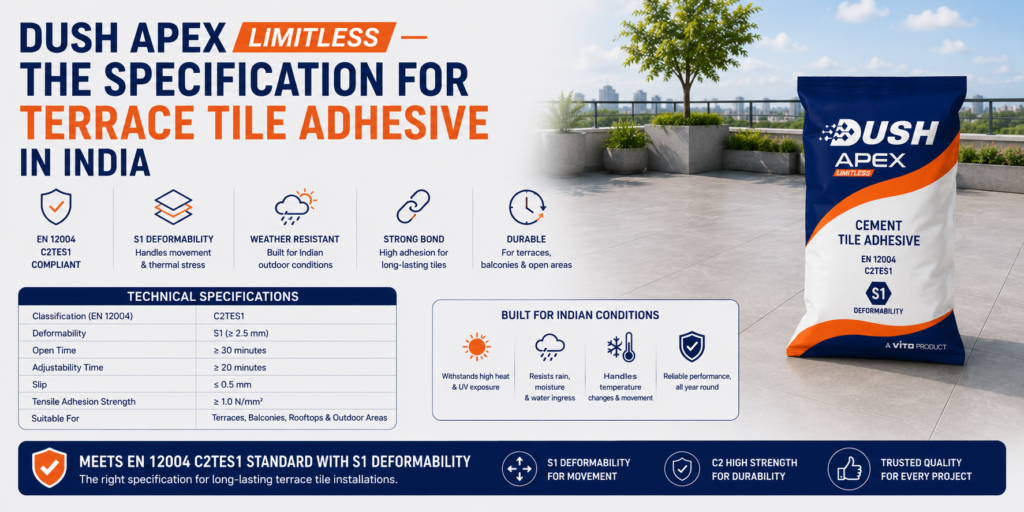
Full Specification Table
ParameterSpecificationIndian standardIS 15477:2019 Type 4 TS1European standardEN 12004 C2TE S1Tensile bond strength1.61 N/mm²Maximum slip (wall/vertical)0.12 mmOpen time45 minutesDeformabilityS1 — 2.5 mm lateral movementFormulationWhite — safe for marble, granite, all light stoneCountry of manufactureItalySuitable tile typesPorcelain, marble, granite, natural stone, ceramicOutdoor applicationsTerraces, staircases, pool copings, external claddingTrowel — standard terrace format10–12 mm notchedBack butteringMandatory for all tiles above 60×60 cmCure before rain48 hours minimum
Why Italian Manufacturing Matters for Outdoor Applications
EN 12004 was developed in the European construction market — a market that includes Mediterranean coastal environments, Alpine thermal cycling, and Northern European frost conditions. The S1 deformability classification was specifically tested against the thermal and climatic movement demands that European outdoor tile installations face. Dush Apex Limitless is manufactured in Italy to these production standards — the S1 certification comes from European laboratory testing against the outdoor performance criteria the standard was built for. For Indian terraces, this European outdoor certification translates directly to validated performance in outdoor thermal and moisture environments.
Step-by-Step Application Guide — Tile Adhesive for Terrace Flooring
Step 1 — Waterproofing the Terrace Substrate First
This is the step most contractors skip — and the step whose absence causes the majority of terrace tile failures. Tile adhesive is not a waterproofing system. It bonds tiles. Water management on a terrace must be handled by a dedicated waterproofing membrane applied to the structural slab before any adhesive or tile goes down.
Apply a minimum two-coat cementitious waterproofing membrane or torch-applied bituminous membrane to the clean, primed terrace slab. Allow full cure per the manufacturer’s TDS — typically 48–72 hours for cementitious membrane, 24 hours for torch-applied. Verify waterproofing integrity with a flood test (ponding water 25 mm depth for 24 hours) before proceeding to tiling. Only begin tiling once the waterproofing is confirmed leak-free. Dush Apex Limitless is compatible with cured cementitious waterproofing membranes as a substrate — confirm compatibility with bituminous membranes with the product TDS.
Step 2 — Substrate Preparation and Slope Verification
The waterproofed terrace surface must be clean, structurally sound, and correctly sloped before adhesive application. Verify slope with a spirit level — terraces must have a minimum 1:100 fall (1 cm drop per 100 cm horizontal) toward the drainage outlet. Inadequate slope causes water ponding, which accelerates adhesive and grout degradation. Check flatness — maximum 3 mm deviation under a 2-metre straight edge. High spots must be ground down. Do not fill low spots with adhesive — use a levelling compound compatible with the waterproofing membrane, allow full cure, then begin tiling.
Step 3 — Mix Dush Apex Limitless Correctly
Pour 4.5 to 5 litres of clean, cool water per 20 kg bag into a clean mixing bucket. Add Dush Apex Limitless powder gradually while mixing with a low-speed paddle mixer (400–600 RPM) for 2–3 minutes to a smooth, lump-free paste. Allow 5-minute slake time — do not skip this step as it allows polymer full hydration. Remix briefly for 30 seconds before use. In summer terrace conditions above 35°C, use cooler water and mix in smaller batches — heat accelerates open time reduction. Discard any mix that has begun to stiffen — do not add water to retemper.
Step 4 — Apply with Correct Notched Trowel
Apply Dush Apex Limitless to the waterproofed terrace substrate using a 10 mm notched trowel for 60×60 cm to 90×90 cm tiles. For slabs above 90×90 cm, use a 12 mm notched trowel. Comb parallel ridges in one direction only — working in strips of manageable width. On a terrace with direct sun exposure, work in sections of 2–3 sqm maximum to ensure tiles are placed before the adhesive surface skins over. Do not spread more adhesive than you can tile within the 45-minute open time.
Step 5 — Back Butter All Large Format Tiles
Back buttering is mandatory for all terrace tiles above 60×60 cm. Apply a complete skim coat of Dush Apex Limitless to the tile back face using a flat trowel before pressing onto the substrate. On outdoor terraces, the additional contact area achieved through back buttering is not just a best practice — it is the difference between a bond that withstands monsoon saturation and one that develops hollow sections when the adhesive bed is exposed to sustained moisture from below (waterproofing failures) or from grout joint ingress above. The complete back buttering technique and trowel size guide for every large format tile dimension covers the full application method in detail.
Step 6 — Install Tiles and Movement Joints
Lower tiles into position on the adhesive bed — do not drag or slide. Seat with a rubber mallet across the full tile surface working from centre outward. Check level on all four edges and diagonally. Check alignment with the terrace drainage slope — tiles must maintain the slope direction, not create flat areas that pond water. Use tile spacers for consistent joint widths. At each planned movement joint location, insert compressible foam backer rod to maintain joint width and depth before the silicone is applied. Do not grout movement joint positions — these are for silicone sealant only, applied after full adhesive cure.
Step 7 — Cure Before Rain Exposure
Allow Dush Apex Limitless to cure for a minimum 48 hours before any rain exposure or foot traffic on an outdoor terrace. Full structural bond develops at 28 days. Do not grout before 24 hours adhesive cure. Apply weather-resistant outdoor grout after 24 hours. Fill movement joints with exterior-grade silicone sealant after grout has fully cured. Apply penetrating sealer to natural stone and marble terrace tiles after grouting is complete.
Common Terrace Tile Adhesive Mistakes in India
Using Indoor Adhesive Outdoors
The most common and most costly terrace tile mistake in India. Indoor polymer-modified adhesive — even IS 15477:2019 Type 4 TS1 — without the EN 12004 S1 deformability classification will fail under Indian outdoor thermal cycling. The absence of S1 means the adhesive bed cannot flex. Within two to three years of summer-winter cycling, the bond develops micro-fractures. By year five, hollow sections appear across the terrace. The fix requires full tile removal and reinstallation. Specify EN 12004 C2TE S1 before accepting any adhesive for terrace application.
No Movement Joints Installed
A terrace tiled without movement joints will crack — not if, but when. The compressive stress from summer thermal expansion of the tile field has no relief. Tiles crack at the weakest point — typically at grout lines or at tile edges. Once tile cracking begins, water ingress through the cracks accelerates further damage to the adhesive, the waterproofing membrane, and ultimately the structural slab. Install movement joints at 3-metre intervals as a non-negotiable step.
Tiling Over Compromised Waterproofing
Tiles installed over inadequate or damaged waterproofing will eventually lift when water penetrates to the adhesive bed from below. The adhesive bond breaks down not from above — through monsoon exposure at the tile surface — but from beneath, when waterproofing failure allows the structural slab moisture to saturate the adhesive from the substrate side. Always verify waterproofing with a flood test before tiling. Tile adhesive does not substitute for waterproofing.
Wrong Tile Finish for Outdoor Use
Polished marble, polished granite, and high-gloss porcelain tiles create a slip hazard on wet terrace surfaces — and Indian terraces are wet for three consecutive monsoon months annually. Specifying the correct adhesive for a polished marble terrace addresses the bond requirement but not the safety requirement. Always specify honed or matt finish marble, flamed or bush-hammered granite, and textured or anti-skid porcelain for terrace flooring in India.
Grouting Too Early
Grouting before the adhesive has reached adequate cure — less than 24 hours after installation on outdoor terraces — traps moisture in the adhesive bed. In outdoor conditions, where the adhesive is already managing moisture from the environment, premature grouting adds moisture from the grouting process that cannot escape through the tile surface. Allow minimum 24 hours before grouting. In damp monsoon conditions, extend cure time to 36–48 hours before grouting.
Terrace Tile Adhesive vs Cement Mortar — Outdoor Performance
Thermal Cycling Performance
Cement-sand mortar has no deformability classification. It is a rigid, non-flexible bond once cured. Under Indian outdoor thermal cycling, rigid cement mortar beds crack along with the differential thermal movement between tile and substrate. This is not a gradual process — the first summer after installation puts the entire thermal movement load on a mortar bed that cannot flex. Polymer-modified adhesive with EN 12004 S1 deformability accommodates this movement without cracking. The complete performance comparison between polymer-modified adhesive and cement-sand mortar — including the tested tensile figures and the specific outdoor performance gap — quantifies what the classification difference means in practice.
Monsoon and Water Resistance
Cement mortar absorbs water readily — it is a porous, non-polymer material. Three months of monsoon saturation annually progressively weakens a cement mortar bond from the outside in. By the third or fourth monsoon, hollow sections appear throughout a terrace tiled with cement mortar. Polymer-modified adhesive resists water absorption through its polymer matrix — the bond maintains integrity through repeated monsoon cycles when correctly specified and installed.
Long-Term Bond Durability
The outdoor performance gap between cement mortar and polymer-modified adhesive compounds over time. Year one: both appear adequate. Year three: hollow sections appear in cement mortar terraces. Year five to seven: widespread debonding in cement mortar. Year ten: a correctly specified polymer-modified terrace — Dush Apex Limitless, IS 15477:2019 Type 4 TS1, EN 12004 C2TE S1, movement joints installed — remains structurally intact. The material cost difference between cement mortar and Dush Apex Limitless is recovered entirely in the avoided cost of one terrace re-tiling.
Marble Terrace — White Adhesive Selection
Marble terraces demand the complete specification: white polymer-modified adhesive with EN 12004 C2TE S1 and IS 15477:2019 Type 4 TS1, mandatory back buttering, honed finish stone, white grout, movement joints filled with neutral-cure silicone, and penetrating sealer applied post-grouting. A complete guide to selecting and verifying the correct white marble fixing chemical for outdoor applications in India — including what to check on the product packaging before accepting it on site covers the full selection process for marble terrace specifications. Dush Apex Limitless white formulation addresses both the staining risk and the structural bond requirement for marble terraces in a single certified product.
Maintenance for Long-Lasting Terrace Tile Installations
Post-Monsoon Inspection
After each monsoon season, conduct a full terrace tile inspection before the winter dry period. Tap all tiles systematically with a coin — hollow sections that were not present before the monsoon indicate adhesive bond degradation at that location. Mark hollow tiles for immediate re-fixing before the next summer thermal cycle amplifies the damage. Check movement joint silicone for cracking or separation — replace any compromised silicone before the next monsoon begins.
Grout and Movement Joint Maintenance
Inspect outdoor grout lines annually for hairline cracks. Re-grout cracked sections promptly — even minor grout cracks allow monsoon water to reach the adhesive bed. Check movement joint silicone every two years — exterior silicone has a lifespan of 5–8 years depending on UV exposure and thermal cycling. Proactive silicone replacement at the 5-year mark is far less costly than the water ingress damage that follows silicone failure.
Tile Cleaning for Outdoor Surfaces
Clean terrace tiles with outdoor-rated floor cleaner after each monsoon season to remove the mould, algae, and efflorescence deposits that accumulate during three months of wet exposure. For natural stone terraces, use pH-neutral cleaners only — acid-based cleaners damage stone surfaces and open the porosity to further moisture penetration. For marble terraces, reapply penetrating sealer every 18–24 months — outdoor marble loses its sealed protection faster than indoor marble due to UV and rainfall exposure.
Frequently Asked Questions — Tile Adhesive for Terrace India
Which Tile Adhesive Is Best for Outdoor Terrace in India?
The best tile adhesive for outdoor terrace in India is a polymer-modified cement adhesive classified IS 15477:2019 Type 4 TS1 and EN 12004 C2TE S1. The S1 deformability classification is the non-negotiable outdoor requirement. Dush Apex Limitless — 1.61 N/mm² tensile, S1 deformability, 45-minute open time, white formulation, Made in Italy — is the professional specification for all Indian terrace tile installations.
Does Terrace Tile Adhesive Need to Be Waterproof?
Terrace tile adhesive must be water-resistant — EN 12004 C2 classification confirms this. But the adhesive is not the waterproofing system. A dedicated waterproofing membrane must be applied to the structural terrace slab before any adhesive or tile. The adhesive protects from above-surface moisture. The membrane protects from below-surface moisture. Both are required. Dush Apex Limitless provides EN 12004 C2 moisture resistance at the adhesive level.
Can I Use the Same Adhesive for Indoor Floor and Outdoor Terrace?
Only if it carries EN 12004 S1 deformability. Many indoor tile adhesives — including IS 15477:2019 Type 4 TS1 products — do not carry S1. Without S1, the adhesive will fail under Indian outdoor thermal cycling. Dush Apex Limitless carries EN 12004 C2TE S1 — the same product is correctly specified for indoor kitchen floors, indoor bathroom walls, and outdoor terraces.
How Long Should Terrace Tile Adhesive Cure Before Rain?
Minimum 48 hours before rain exposure on outdoor terraces. If rain is forecast within 48 hours of installation, postpone tiling. Cover newly laid terrace tiles with plastic sheeting if unexpected rain occurs within the cure window. Full structural bond develops at 28 days. Do not allow heavy foot traffic or furniture placement on outdoor terrace tiles before 72 hours.
What Is the Best Tile for Terrace Flooring in India?
Textured or anti-skid porcelain tiles (60×60 cm or larger) are the most practical specification for Indian residential terraces — hard-wearing, low maintenance, suitable for outdoor conditions, and available in a wide range of finishes. Honed granite is an excellent premium option. Honed marble is suitable for covered or sheltered terraces. All outdoor terrace tile specifications require IS 15477:2019 Type 4 TS1 adhesive with EN 12004 S1 deformability regardless of tile material.
How Do I Prevent Terrace Tiles from Cracking in Summer?
Three measures prevent summer thermal cracking on Indian terraces. First, specify EN 12004 S1 deformable adhesive — Dush Apex Limitless — so the adhesive bed can flex with thermal movement. Second, install movement joints at maximum 3-metre intervals in both directions across the tile field, filled with weather-resistant silicone sealant. Third, specify the correct tile format — tiles above 90×90 cm on unsealed, non-insulated terrace slabs carry higher cracking risk from concentrated thermal stress. These three measures together prevent summer tile cracking regardless of how extreme the seasonal temperature swing.