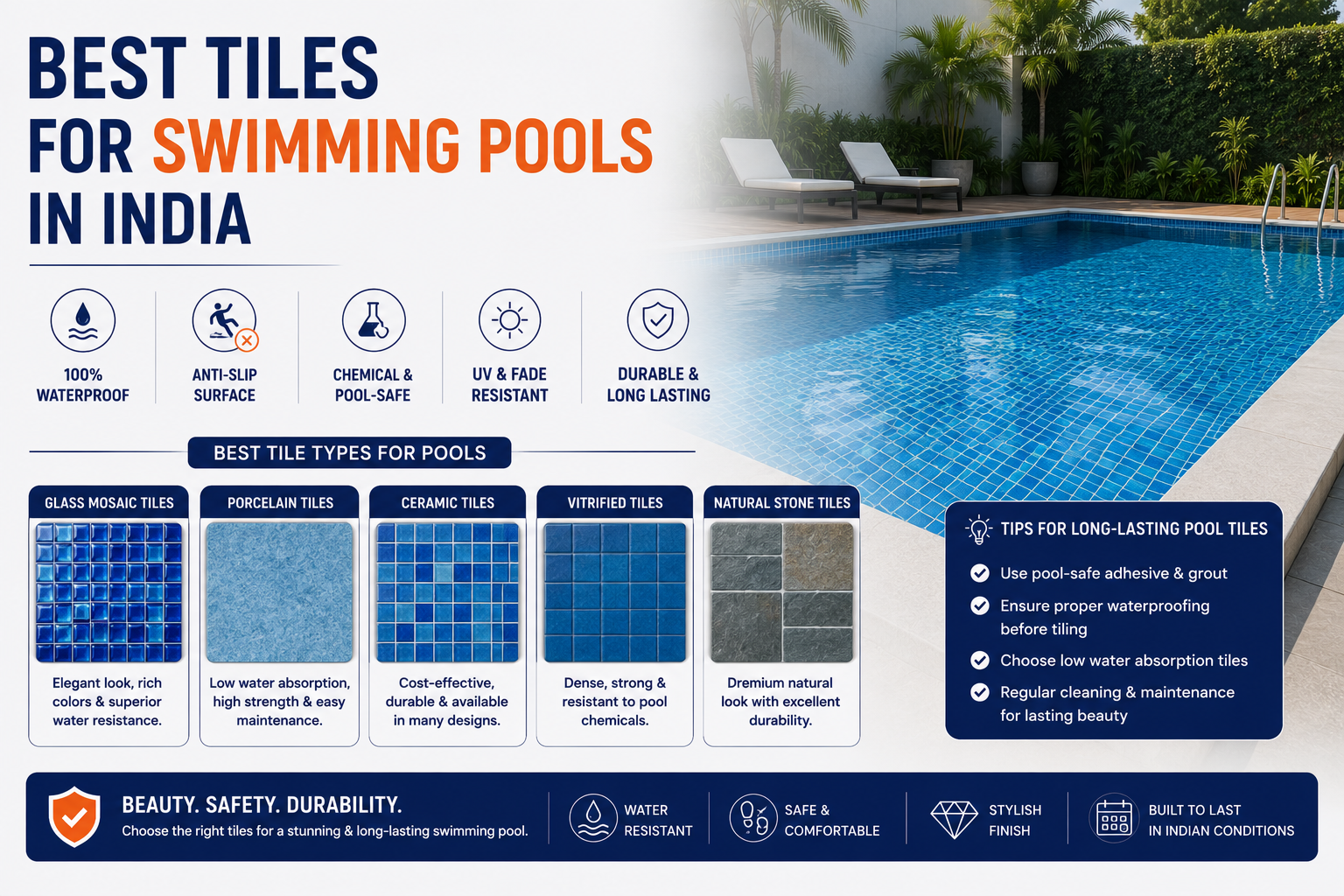
Glass Mosaic Tiles
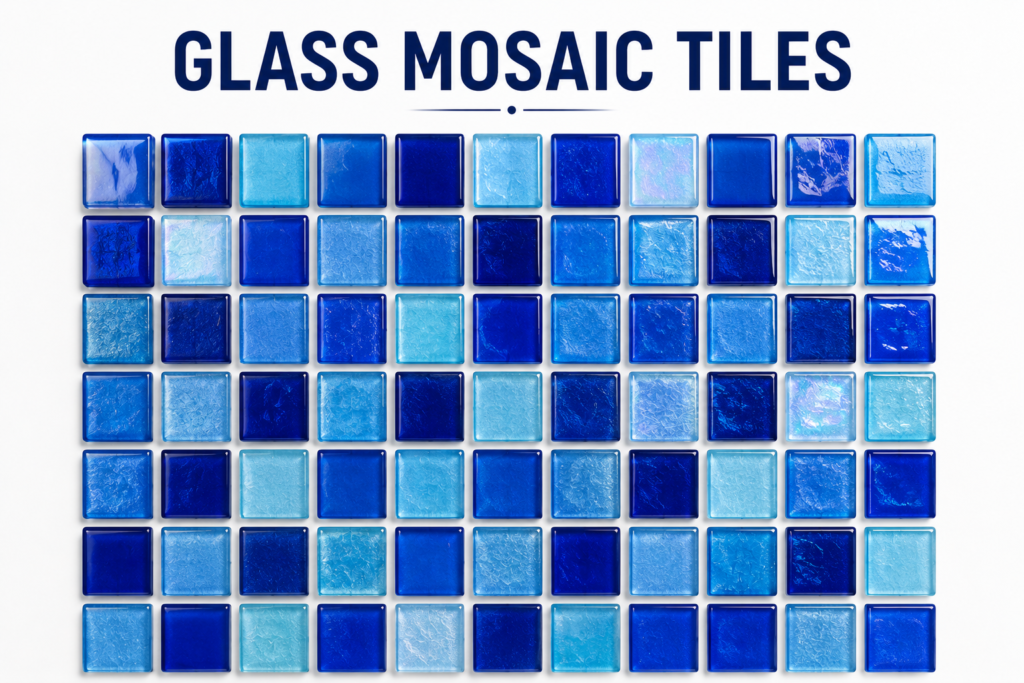
Glass mosaic tiles — typically 25×25 mm or 50×50 mm individual tesserae on mesh backing sheets — are the most widely specified tile for Indian residential swimming pool interiors. Their vitreous composition makes them completely non-absorbent: pool water cannot penetrate the tile body. Their small format means that adhesive coverage and bond strength are distributed across many small bond points, reducing the individual load on each tile adhesive contact.
Glass mosaic requires a white adhesive — glass is translucent and grey adhesive colour shows through the tile from behind, altering the appearance of the tile colour. For pool interiors with glass mosaic, white polymer-modified cementitious adhesive (over properly waterproofed substrate) or white epoxy adhesive is the specification. The adhesive must be applied with full back coverage — glass mosaic tiles installed with partial coverage develop visible dark spots where adhesive does not contact the tile back.
Porcelain and Vitrified Pool Tiles
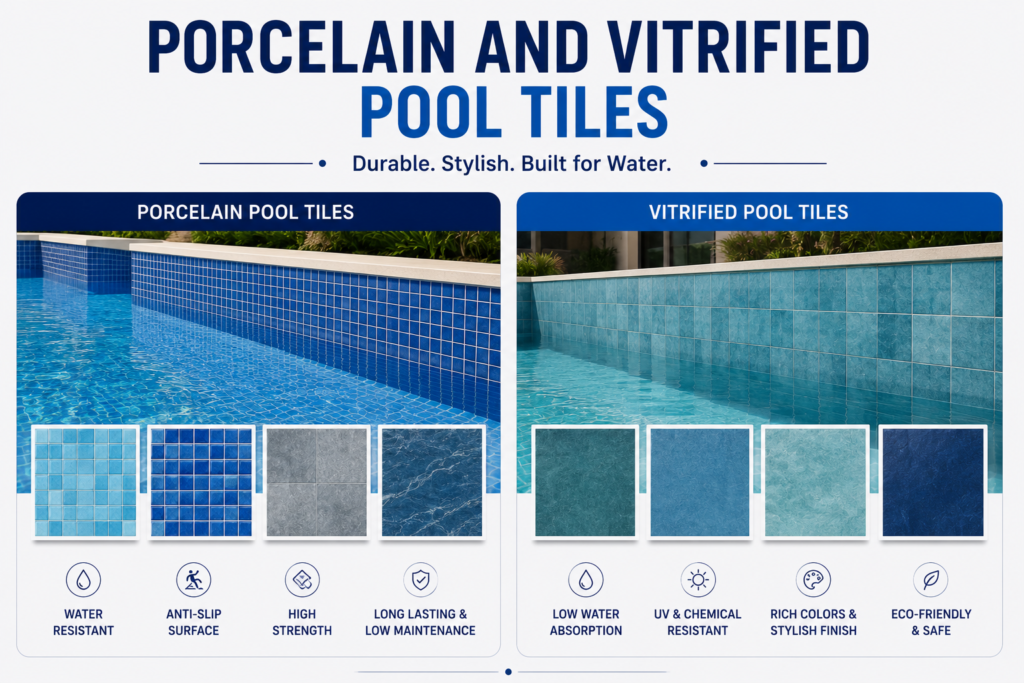
Large format porcelain tiles in 30×60 cm, 60×60 cm, and 60×120 cm formats are increasingly specified for Indian residential pool interiors and surrounds. Porcelain’s very low water absorption rate (below 0.5%) makes it chemically inert in pool water environments — pool chemicals cannot penetrate the tile body. Porcelain pool tiles must have a textured or anti-skid surface finish — polished porcelain is dangerous around water. The adhesive specification follows the zone: EN 12004 C2TE S1 for copings and surrounds, polymer-modified white cement adhesive over waterproofing for pool interiors.
Granite for Pool Copings and Surrounds
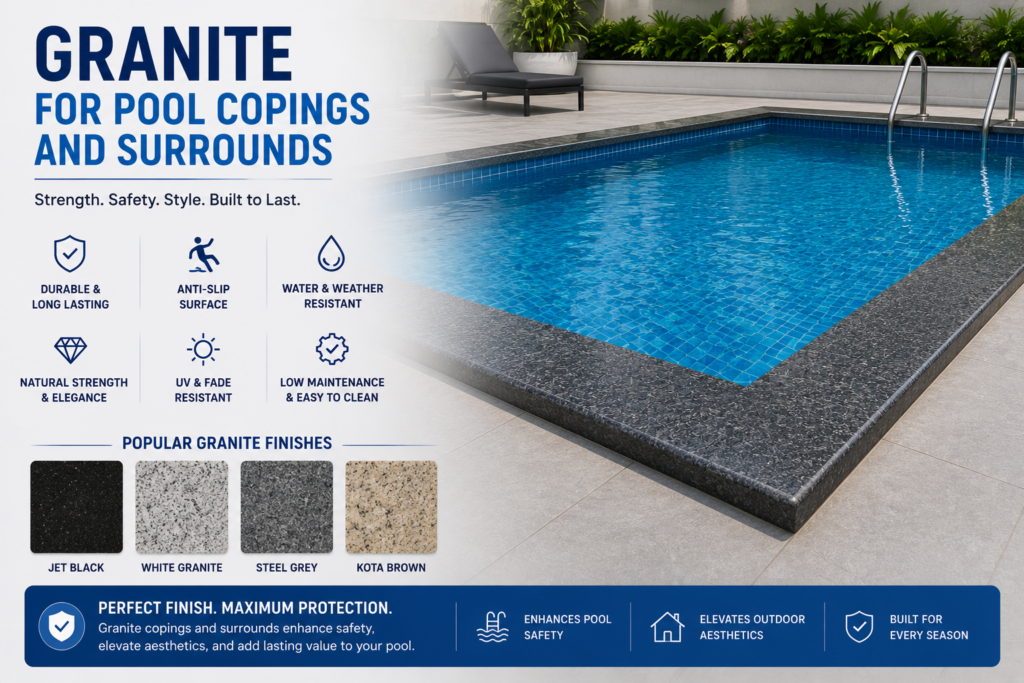
Granite is the most practical natural stone specification for Indian pool copings and surrounds. Its density, low porosity, and chemical inertness make it well-suited for pool environments. Flamed, brushed, or sandblasted granite finish provides the anti-skid surface essential around pools — polished granite is extremely dangerous when wet. For granite pool copings, Dush Apex Limitless — white polymer-modified, EN 12004 C2TE S1, IS 15477:2019 Type 4 TS1 — is the correct adhesive specification. White formulation is recommended for light granite varieties to prevent any pigment migration. The complete substrate preparation and fixing chemical requirements for natural stone in demanding outdoor and wet conditions applies directly to granite pool coping and surround installations.
Why Marble Is Not Suitable for Pool Water Zones
Marble — calcium carbonate stone — is chemically reactive with acidic solutions. Pool water maintained at pH 7.2 to 7.8 is technically neutral, but pH management errors (a common occurrence in Indian residential pools without automated dosing systems) can push pool water to pH 7.0 or below. At pH 7.0 and lower, pool water begins to etch calcium carbonate — the marble surface becomes dull, pitted, and progressively damaged. This is not an adhesive failure — it is chemical attack on the stone itself.
Marble is also highly porous — pool water penetrates marble at the joint faces and through the polished surface, carrying dissolved chlorine compounds into the stone body. Over time, this creates internal discolouration and structural degradation at the tile edges. The physical mechanism of how liquids penetrate marble’s crystal structure — and why the stone’s micro-porosity creates irreversible damage when the wrong chemistry reaches the stone body explains the same porosity that makes marble vulnerable to grey adhesive staining also makes it vulnerable to pool water penetration. Marble should not be specified for submerged pool zones or for pool copings in contact with pool water splash. Honed marble for covered, sheltered pool surrounds away from direct water contact is a marginal specification — sealed, maintained, and monitored carefully.
Waterproofing — The Step That Must Come Before Any Adhesive
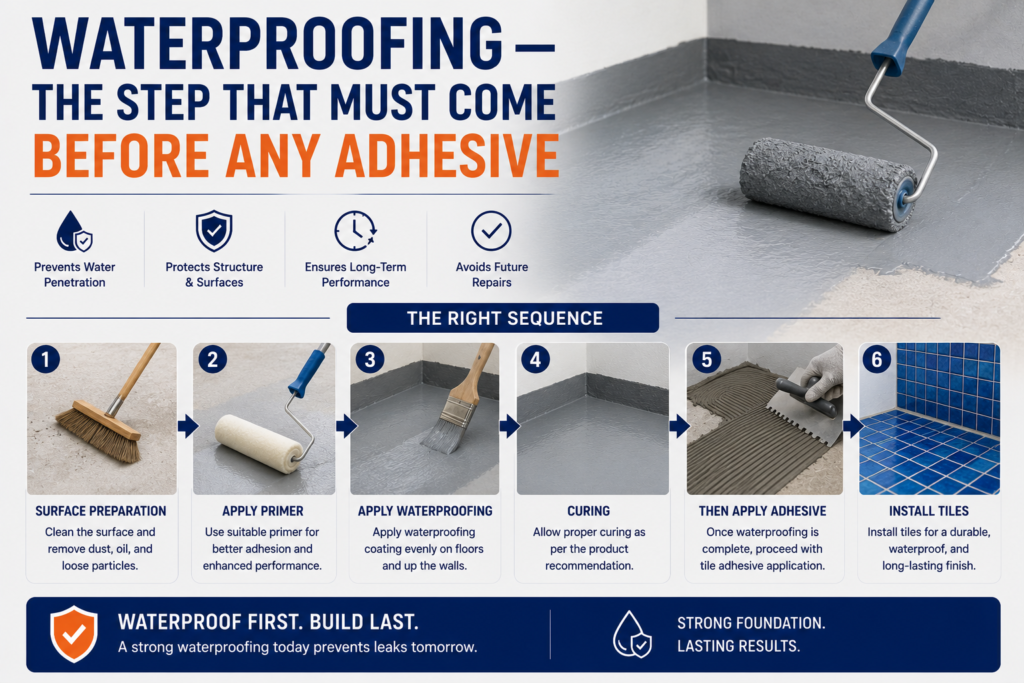
Why Pool Waterproofing and Tile Adhesive Are Not the Same
The most consequential misconception in Indian swimming pool construction is the belief that tile adhesive provides waterproofing. It does not. Tile adhesive bonds tiles to the substrate. It does not create a continuous waterproof barrier that prevents water migration through the pool shell. A pool tiled without a dedicated waterproofing system beneath the adhesive will leak — slowly or rapidly, depending on the shell quality — and the groundwater hydrostatic pressure will progressively delaminate the tile adhesive from behind.
The correct sequence is: structural pool shell (concrete or blockwork) → waterproofing membrane system → tile adhesive → tiles → grout. Each layer has a distinct function. The waterproofing membrane is the water barrier. The adhesive is the bond layer. No adhesive specification — however high its polymer content or however comprehensive its EN 12004 classification — substitutes for a dedicated waterproofing membrane beneath it.
Types of Pool Waterproofing Systems Used in India
Cementitious crystalline waterproofing is the most common system in Indian residential pool construction — applied as a two-coat slurry directly to the concrete shell, it penetrates the concrete and crystallises to block capillary channels. It is compatible with polymer-modified cementitious adhesive as a substrate. Allow minimum 7 days cure before tiling.
Polyurethane membrane waterproofing provides excellent flexibility and is suitable for pools with structural movement risk. Requires a primer coat on the concrete substrate and a topcoat that is compatible with the tile adhesive. Confirm adhesive compatibility with the membrane manufacturer before applying Dush Apex Limitless over polyurethane membranes.
Torch-applied bituminous membrane is occasionally used in Indian pool construction but is generally not recommended for pool interiors — bituminous membranes require adhesive compatibility testing and may off-gas in pool water environments.
Adhesive Compatibility with Pool Waterproofing Membranes
Not all tile adhesives bond correctly to all waterproofing membranes. Before applying any tile adhesive to a pool waterproofing membrane, verify compatibility in the product TDS. Dush Apex Limitless is compatible with cured cementitious crystalline waterproofing membranes as a substrate — the polymer-modified adhesive bonds to the crystalline-treated concrete surface without interface failure. For polyurethane and other flexible membranes, conduct a peel test on a small area before full application to confirm adequate bond strength.
Dush Apex Limitless — The Specification for Pool Copings and Surrounds
For pool copings and pool surrounds — the two non-submerged zones of swimming pool tile installation — Dush Apex Limitless is the professional specification in India. It addresses every environmental demand these zones face: outdoor thermal cycling through S1 deformability, monsoon moisture through EN 12004 C2 moisture resistance, anti-sag for vertical coping face tiles through EN 12004 T classification, and the extended open time needed for large format pool deck tiles through EN 12004 E.
Full Specification Table — Pool Copings and Surrounds
ParameterSpecificationIndian standardIS 15477:2019 Type 4 TS1European standardEN 12004 C2TE S1Tensile bond strength1.61 N/mm²DeformabilityS1 — 2.5 mm lateral movementMaximum slip — vertical0.12 mmOpen time45 minutesFormulationWhite — safe for light granite, light stone, glass mosaicCountry of manufactureItalySuitable zonesPool coping, pool surround, pool deckTile typesPorcelain, granite, natural stone, glass mosaic (surround)Trowel — large format deck10–12 mm notchedBack butteringMandatory above 60×60 cmCure before pool water exposure72 hours minimum
Why EN 12004 S1 Is Critical for Pool Copings in India
Pool coping tiles sit at the junction of three different thermal environments: pool water (26–28°C), the outdoor air (up to 45°C+ in Indian summers), and the concrete pool shell (which moderates between the two). The differential thermal movement at this junction exceeds what any rigid, non-deformable adhesive can accommodate without progressive bond failure. S1 deformability — the 2.5 mm lateral movement accommodation built into the cured Dush Apex Limitless adhesive bed — absorbs this differential movement without cracking the bond over Indian seasonal temperature cycling.
Grouting Swimming Pool Tiles — Why Epoxy Grout Is the Professional Specification
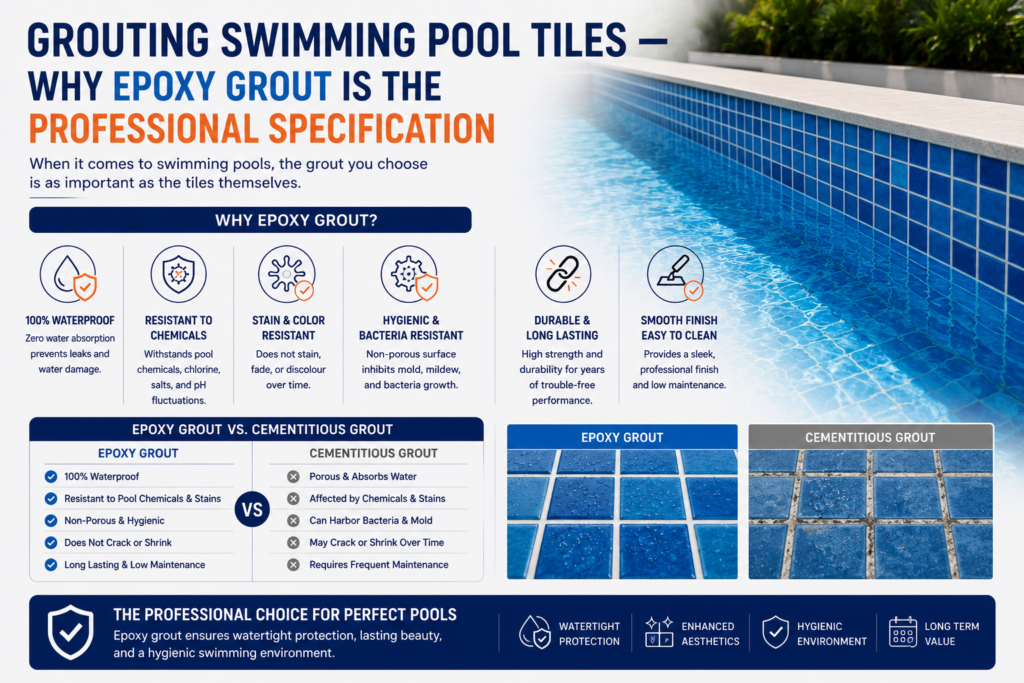
Why Cement Grout Fails in Pool Environments
Standard cement grout — even polymer-modified cement grout — is porous. Pool water penetrates cement grout joints continuously in the submerged zone. Over time, this moisture penetration carries dissolved pool chemicals into the grout joint, progressively degrading the grout from within. Cement grout in pool water environments typically requires re-grouting within five to eight years as it becomes stained, porous, and structurally weakened. In the coping and surround zones, cement grout is additionally subject to outdoor UV degradation and thermal cycling cracking. The full performance comparison between standard cement adhesive and polymer-modified alternatives — including the water resistance gap that explains why non-polymer products fail in continuously wet environments — applies equally to the grout selection decision for pool tile installations.
Epoxy Grout for Pool Tile Joints
Epoxy grout — a two-component system of epoxy resin and hardener — is the professional specification for swimming pool tile joints in India. Its near-zero porosity means pool water cannot penetrate the grout joint to reach the adhesive bed. Its chemical resistance withstands continuous chlorine exposure without degradation. Its stain resistance prevents the algae and mineral deposit discolouration that cement grout develops in pool environments.
Dush Epoxy Grout DH-10 provides the joint protection that completes the pool tile installation specification — chemically resistant, non-porous, and suitable for both submerged pool zones and exposed coping and surround joints. For the submerged pool interior, epoxy grout is the mandatory professional specification. For pool copings and surrounds, epoxy grout extends joint life significantly beyond cement grout alternatives.
Step-by-Step Application Guide — Tile Adhesive for Pool Areas
Step 1 — Verify Waterproofing Before Tiling
Before any adhesive is applied, the pool waterproofing system must be fully cured and verified leak-free. Conduct a flood test: fill the waterproofed shell to the intended waterline and leave for 48 hours with the water level marked. A drop in water level beyond normal evaporation indicates waterproofing failure — identify and repair before proceeding to tiling. Do not tile over unverified waterproofing under any circumstance. The cost of removing and relaying pool tiles after a waterproofing failure is many times the cost of the flood test.
Step 2 — Substrate Preparation for Each Pool Zone
Pool interior: Clean the cured waterproofing membrane surface of all contamination. Verify flatness — maximum 3 mm deviation under a 2-metre straight edge. High spots cause glass mosaic sheets to tent at joins. Low spots create hollow areas beneath large format pool interior tiles.
Pool coping: The coping substrate — typically the top of the pool bond beam — must be clean, level, and correctly sloped away from the pool to drain rainwater off the coping surface. The slope prevents water ponding on horizontal coping tiles. Minimum 1:80 fall toward the outside edge.
Pool surround/deck: Verify slope toward pool drainage channels — minimum 1:100 fall. Check for hollow sections in existing concrete deck. Sound all areas with a hammer and fill any hollow sections before adhesive application.
Step 3 — Mixing and Applying Adhesive
Mix Dush Apex Limitless to the correct consistency — 4.5 to 5 litres of clean, cool water per 20 kg bag, mixed with a low-speed paddle mixer for 2–3 minutes. Allow 5-minute slake. Remix briefly. Apply to the substrate with the correct notched trowel — 6 mm for glass mosaic and small format interior tiles, 8–10 mm for 30×60 cm and 60×60 cm pool deck tiles, 12 mm for large format pool deck slabs above 90×90 cm. Comb parallel ridges in one direction. Apply only the area tiled within the 45-minute open time.
Step 4 — Installing Pool Tiles
Glass mosaic sheets: Press each mesh-backed mosaic sheet firmly into the adhesive with a grout float or rubber-faced trowel — never a rubber mallet, which can crack individual glass tesserae. Ensure the full sheet makes contact with the adhesive — no air pockets beneath the mesh. Check alignment between sheets. The paper face (if paper-faced mosaic) is removed after initial set with a damp sponge.
Large format pool deck tiles: Back butter all tiles above 60×60 cm — mandatory for 95–100% contact on outdoor pool surrounds. The complete back buttering technique and coverage guide for large format tiles in demanding outdoor applications applies to all large format pool deck and coping tile installation. Lower tiles into position — do not drag or slide. Seat with rubber mallet from centre outward. Install movement joints at 3-metre intervals in pool deck areas.
Step 5 — Curing Before Pool Filling
Allow Dush Apex Limitless full cure before any pool water contact. Minimum cure timeline before exposing pool tiles to water:
MilestoneTimeNo foot traffic on pool surround24 hoursGrout pool interior tiles24–48 hours after adhesive applicationApply epoxy grout to pool interiorAfter adhesive has reached initial setFill pool with water (partial — to check leaks)72 hours after grouting completeFull pool filling and use7 days from completion of grouting
The 7-day full cure period before pool filling allows both the tile adhesive and the epoxy grout to reach their rated chemical resistance. Filling the pool within 48 hours of grouting — a common mistake on Indian pool projects under time pressure — exposes uncured grout joints to pool water before chemical resistance has developed.
Common Swimming Pool Tile Adhesive Mistakes in India
Tiling Without Adequate Waterproofing
The most consequential pool tile mistake in India. Tile adhesive over an inadequately waterproofed pool shell will allow water to reach the adhesive bed from behind — through the shell, under hydrostatic pressure. The adhesive fails from behind the tile, not from the pool water face. Tiles appear bonded until the pool is emptied for maintenance, at which point hydrostatic pressure pushes tiles off the walls. Always flood test before tiling. Always.
Using Indoor Adhesive for Pool Surrounds
Indoor polymer-modified adhesive — even IS 15477:2019 Type 4 TS1 — without EN 12004 S1 deformability will fail under the thermal cycling at Indian pool coping and surround level. The adhesive chosen for a pool surround must carry the S1 classification. Specify Dush Apex Limitless — EN 12004 C2TE S1 — for all pool coping and surround tile applications.
Using Cement Grout Instead of Epoxy Grout
Cement grout in pool water joints is a maintenance liability from installation day. It will stain, degrade, and require replacement within five to eight years. Epoxy grout — Dush Epoxy Grout DH-10 — is the professional specification for all pool tile joints. The additional cost of epoxy grout at installation is recovered many times over in avoided re-grouting costs across a 25-year pool life.
Filling the Pool Before Full Cure
Filling the pool within 48–72 hours of tiling — a common practice on Indian pool projects under client pressure to commission quickly — exposes partially cured adhesive and grout to pool water chemistry before adequate chemical resistance has developed. Allow minimum 7 days from grout completion before full pool filling. Partial filling for leak testing at 72 hours post-grouting is acceptable.
No Movement Joints in Pool Deck
Pool decks without movement joints develop cracked tiles and grout lines within two to three Indian summer cycles. Install movement joints at 3-metre intervals and at all perimeter joints where the deck meets the pool coping, building walls, and drain channels. Fill with exterior UV-stable silicone sealant — not cement grout.
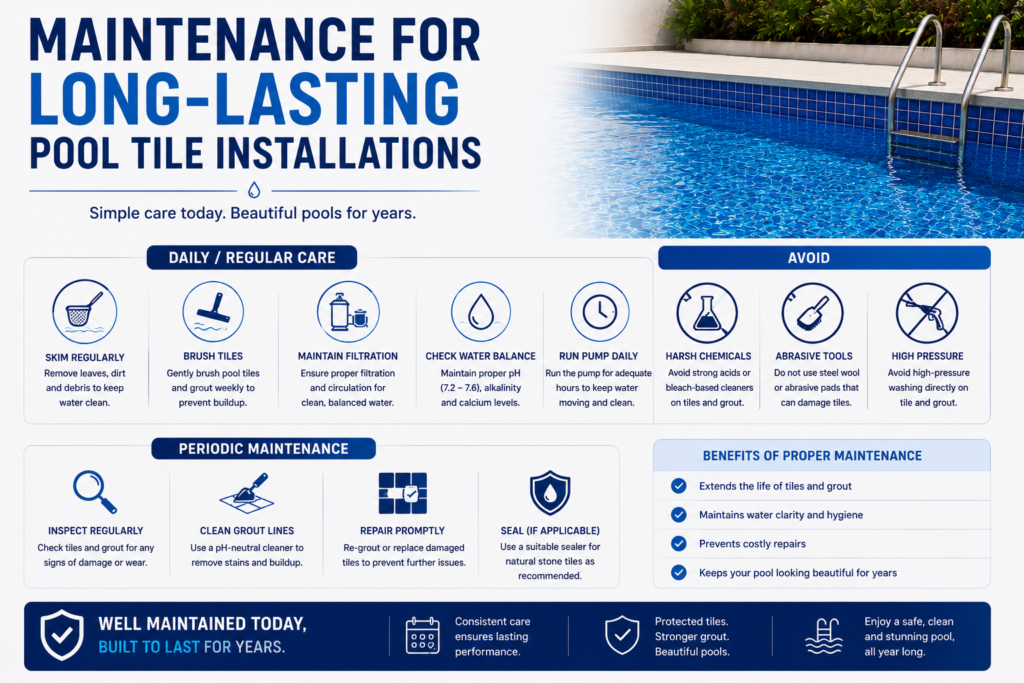
Maintenance for Long-Lasting Pool Tile Installations
Post-Season Inspection
Before refilling after the winter shutdown or post-monsoon drainage, inspect the pool interior tiles by tapping each tile systematically. Hollow sections in the submerged zone indicate adhesive bond failure and must be re-fixed before the pool is refilled — hydrostatic pressure from a refilled pool will accelerate tile debonding from any hollow section. Inspect pool coping tiles for edge chipping, grout loss at joints, and movement joint silicone condition.
Chemical Balance Maintenance
Maintain pool water chemistry within the recommended range — pH 7.2 to 7.8, chlorine 1–3 ppm — consistently. pH below 7.0 accelerates grout joint degradation and can damage any natural stone around the pool. Shock dosing (sudden large chlorine addition) should be done with the pump running and tiles well-circulated — stagnant high-chlorine water in contact with tile joints for extended periods accelerates grout deterioration even with epoxy grout.
Re-Grouting and Joint Maintenance
Inspect pool coping and surround movement joints annually. Silicone sealant in outdoor pool applications has a service life of 5–7 years — proactive replacement before sealant begins to crack and separate prevents water ingress that would require full tile removal to remedy. Inspect epoxy grout in the pool interior every five years — while epoxy grout is significantly more durable than cement grout, physical damage from pool cleaning equipment and underwater fixtures can create localised joint failures that require spot repair.
Frequently Asked Questions — Swimming Pool Tile Adhesive India
Which Tile Adhesive Is Best for Swimming Pool in India?
The specification depends on the pool zone. For pool copings and surrounds: Dush Apex Limitless — white polymer-modified, IS 15477:2019 Type 4 TS1, EN 12004 C2TE S1, 1.61 N/mm², S1 deformability, Made in Italy. For submerged pool interiors in residential pools: white polymer-modified cementitious adhesive (IS 15477:2019 Type 4 TS1) over properly waterproofed substrate. For commercial pools and saltwater pools: two-component epoxy adhesive for the submerged interior.
Can Dush Apex Limitless Be Used for Pool Interior Tiles?
Dush Apex Limitless — IS 15477:2019 Type 4 TS1, EN 12004 C2TE S1 — is suitable for residential pool interior tile installation over a properly waterproofed concrete substrate. For glass mosaic and porcelain tile interiors in residential Indian pools with normal chlorine management, Dush Apex Limitless provides adequate adhesive performance. For commercial pools, saltwater systems, and pools where 30-year tile life is specified, a two-component epoxy adhesive is the professional recommendation for the submerged interior zone.
What Grout Should Be Used for Swimming Pool Tiles?
Epoxy grout is the professional specification for all swimming pool tile joints — submerged pool interior and pool copings. Epoxy grout’s near-zero porosity prevents pool water penetration into the joint, its chemical resistance handles continuous chlorine exposure, and its stain resistance prevents algae and mineral discolouration. Dush Epoxy Grout DH-10 is the pool grouting specification that completes the tile installation system.
How Long After Tiling Can a Pool Be Filled with Water?
Minimum 7 days from completion of grouting before full pool filling and use. Partial filling for leak testing at 72 hours post-grouting is acceptable. Filling the pool earlier exposes uncured adhesive and grout to pool water chemistry before the rated chemical resistance of either product has developed.
Can Marble Be Used in a Swimming Pool?
Marble is not suitable for submerged pool zones or for pool copings in continuous contact with pool water. Pool water — even at correct pH 7.2–7.8 — poses a chemical risk to calcium carbonate stone over time, and pH management errors below pH 7.0 cause direct etching of marble surfaces. Marble is highly porous and absorbs pool water at joint faces. For sheltered pool surrounds well away from direct water contact, sealed honed marble is a marginal specification requiring careful maintenance. For any zone in direct contact with pool water, granite, porcelain, or glass mosaic are the correct tile specifications.
What Tiles Are Best for Swimming Pools in India?
For pool interiors: glass mosaic (vitreous, non-absorbent, smooth for pool hygiene) or textured porcelain. For pool copings: flamed or brushed granite, textured porcelain. For pool surrounds: textured or anti-skid porcelain (60×60 cm or larger), flamed granite, anti-skid ceramic. All pool tile specifications — regardless of material — require IS 15477:2019 Type 4 TS1 polymer-modified adhesive at minimum. Pool copings and surrounds additionally require EN 12004 S1 deformability for Indian outdoor thermal conditions.