What Causes Dark Stains on White Marble Floors?
Not every dark mark on marble has the same cause — oil, rust, mould, ink, and water damage all look different and need different treatment. This guide helps you identify the cause, then shows the correct Dush Alka Cleaner and Stain-Ex sequence to remove it.
A dark mark appearing on a white marble floor is alarming, but not all dark stains are the same problem. Oil, rust, mould, ink, and water damage all leave dark marks on marble, yet each has a different cause, a different appearance, and requires a different treatment approach. Treating the wrong cause wastes time and can sometimes make the problem worse.
Dark stains on white marble floors are most commonly caused by five sources: cooking oil and grease that penetrate and oxidise inside the stone; metal rust stains from nails or furniture legs; biological growth such as mould in damp areas; ink, dye, or cosmetic spills; and water damage combined with dirt in areas of standing moisture. Identify the cause first, then clean with Dush Alka Cleaner to remove surface contamination, followed by Dush Stain-Ex poultice treatment for discolouration that has penetrated into the stone.
The 5 Causes of Dark Stains on White Marble Floors
Cooking Oil & Grease
High-viscosity cooking oils penetrate marble's open pore structure within 30 seconds of contact and slowly oxidise inside the stone over weeks and months, darkening progressively from translucent to dark brown or black.
Concentrated near stoves, countertops, and floor areas adjacent to cooking stations. Daily Indian kitchen use makes this the leading cause of dark marble staining.
Fix: Dush Stain-Ex poultice treatmentIron-based metal objects — nails, furniture legs, planters, tools — left in contact with marble for extended periods rust and transfer iron oxide into the stone, creating a stain matching the object's footprint.
Often appears reddish-brown rather than purely black, distinguishing it from oil staining.
Fix: Specialised rust treatment + Stain-ExBiological Growth
Damp, poorly ventilated areas — bathrooms, areas near plant pots, basements — provide conditions for mould and mildew to develop on and within the marble's surface, appearing as dark grey to black patches.
Often has a fuzzy or textured appearance rather than the smooth dark patch typical of oil staining.
Fix: Dush Alka Cleaner + ventilation improvementInk, Dye & Cosmetic Spills
Pen ink, hair dye, shoe polish, and similar dark-pigmented products penetrate marble quickly due to their concentrated colour and often small-molecule chemistry, leaving sharply defined dark marks.
Usually identifiable by a sudden appearance with no gradual darkening pattern, unlike oil oxidation.
Fix: Dush Stain-Ex poultice treatmentWater Damage Combined With Dirt
Areas of standing or repeated moisture combined with accumulated dirt create dark grey patches as the trapped moisture allows fine particulate matter to embed into the marble's pore structure over time. This is distinct from biological growth — water-dirt staining tends to be flat grey without the fuzzy texture of mould, and is common at entrances, under leaking pipes, and around frequently watered indoor plants.
Fix: Address moisture source first, then Dush Alka Cleaner followed by Stain-Ex if discolouration remainsHow to Identify Which Cause You Have
Identify the cause of a dark marble stain by examining its location, shape, and texture. Stains near cooking areas with soft, spreading edges are typically oil-based. Defined circular or geometric shapes matching an object's footprint, often reddish-brown, are usually metal rust. Fuzzy or textured marks in damp, poorly ventilated areas are likely biological growth. A sudden, sharply defined dark mark is often ink or a cosmetic product spill. Testing with Dush Alka Cleaner first helps confirm whether a stain is surface-level or genuinely penetrated.
| Characteristic | Oil | Rust | Biological | Ink/Dye |
|---|---|---|---|---|
| Shape | Soft, spreading edges | Defined, matches object | Irregular, patchy | Sharp, defined |
| Colour | Dark brown to black | Reddish-brown, orange tinge | Grey to black | Varies — often very dark |
| Texture | Smooth, glossy appearance | Smooth, sometimes powdery | Fuzzy or textured | Smooth, may have sheen |
| Location | Near stove, countertop | Under metal objects | Bathrooms, damp areas | Anywhere — sudden spill |
| Onset | Gradual, over weeks/months | Gradual, with object contact | Gradual in damp conditions | Sudden, immediate |
| Primary treatment | Dush Stain-Ex | Rust treatment + Stain-Ex | Dush Alka Cleaner first | Dush Stain-Ex |
Dush Alka Cleaner — The First Step on Every Dark Stain
Dush Alka Cleaner is used as the first step on any dark marble stain to remove surface-level dirt, grime, and loose contamination. It also serves a diagnostic purpose — many dark marks that look serious are actually just accumulated surface dirt or biological film that Alka Cleaner alone removes completely, without needing the full Stain-Ex poultice treatment.
DUSH ALKA CLEANER
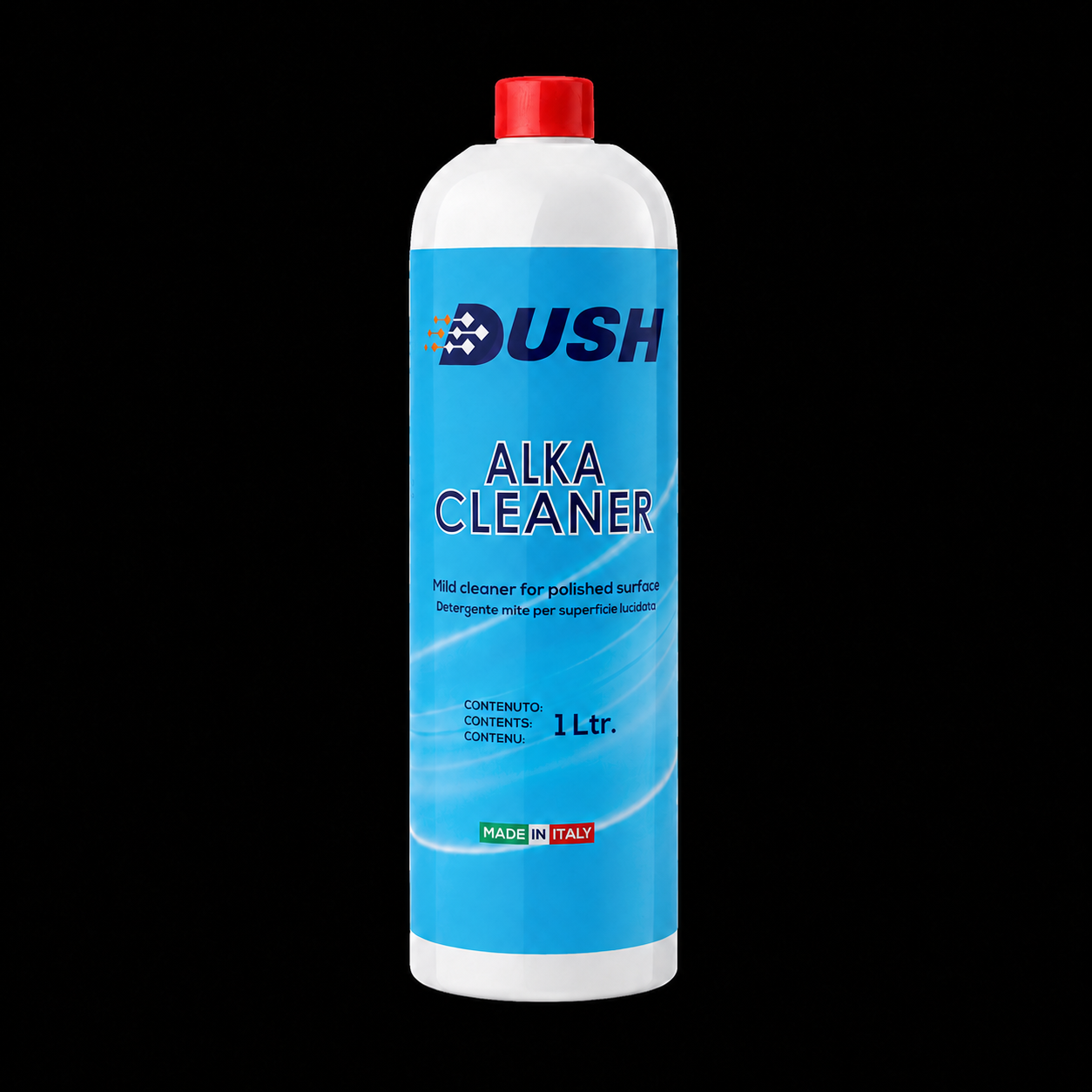
An alkaline cleaner is the correct first step on any dark stain because it lifts surface-level contamination — dirt, grime, biological film, and loose residue — without etching the marble, regardless of what eventually proves to be the underlying cause. This step is what separates a surface problem from a genuine penetrated stain.
Apply Dush Alka Cleaner generously to the affected area, allow a short dwell time, then wipe and rinse thoroughly with clean water. For biological growth in particular, this step combined with improved ventilation often resolves the staining without any further treatment. For oil, rust, and ink-based dark stains, Alka Cleaner clears the surface and reveals the true extent of what remains for the next step.
- ★Removes surface contamination cleanly: Lifts dirt, grime, and film without the etching risk that acidic cleaners carry
- ★Diagnostic value: Reveals whether a dark mark is surface-level or genuinely penetrated into the stone
- ★Effective on biological growth: Often fully resolves mould and mildew staining when combined with improved ventilation
- ★Safe preparation for Stain-Ex: Clears the surface so the poultice treatment can make direct, effective contact with any remaining staining
Dush Stain-Ex — Removing Penetrated Dark Staining
Dush Stain-Ex is used when dark discolouration remains after Alka Cleaner has removed surface contamination, indicating the staining agent — typically oil, ink, or rust by-products — has penetrated into the marble's internal pore structure. Applied as a 24-hour poultice, it draws the embedded contamination out of the stone, addressing dark stains that surface cleaning alone cannot reach.
DUSH STAIN-EX
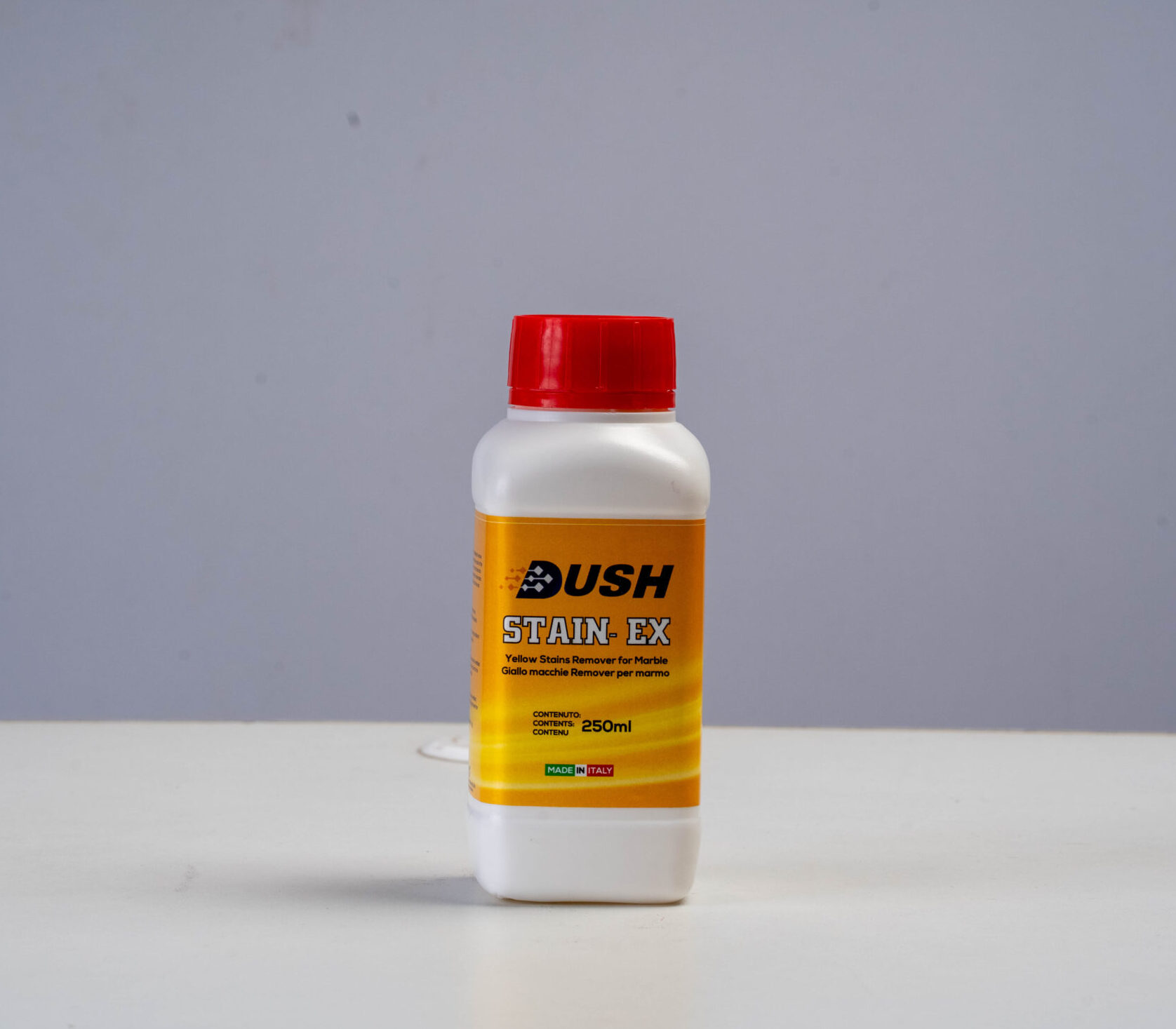
Dark stains caused by oil oxidation, ink penetration, or rust by-products have one thing in common: by the time they are visible, the staining agent has already moved past the surface and into the marble's pore structure. Dush Stain-Ex is built specifically for this — the 24-hour sealed contact period allows the chemistry to break down oxidised oil compounds, dye molecules, and other deep-set contamination, while the drying process draws the loosened material back out of the stone.
This is particularly effective for oil-based dark stains, where the combination of extended contact and the poultice's drawing action reaches the depth that daily oxidation has carried the oil into the marble.
- ★Reaches deep oil penetration: 24-hour contact period breaks down oxidised oil compounds that surface cleaners cannot touch
- ★Effective on ink and dye staining: Draws pigmented contamination out of the pore structure rather than spreading it
- ★Does not etch the polished surface: Safe for white Italian marble when used according to recommended contact time
- ★No mechanical abrasion required: Chemical drawing action removes discolouration without scrubbing or surface damage
Complete Step-by-Step: Alka Cleaner Then Stain-Ex
Examine the Stain — Location and Shape
Inspect where the stain is located and its shape — near kitchen areas, defined circular patterns, damp zones, or sharp sudden marks — to narrow down the likely cause before treatment.
Clean With Dush Alka Cleaner
Apply Dush Alka Cleaner to the stained area. Allow a short dwell time, wipe with a soft cloth, and rinse thoroughly. Allow to dry completely.
→ Many dark marks resolve fully at this step alone
Assess the Remaining Discolouration
Once dry, inspect the area. If dark discolouration remains, the staining has penetrated the pore structure and Stain-Ex poultice treatment is needed.
Apply Dush Stain-Ex as a Poultice
Apply Dush Stain-Ex directly onto the dark area in a layer approximately 5mm thick, extending slightly beyond the visible edge of the discolouration.
Cover and Seal for 24 Hours
Cover the poultice completely with plastic film and tape down the edges. Leave undisturbed for a full 24 hours to allow the chemistry to work and the drawing action to draw out the contamination.
Remove and Inspect
Remove the plastic film, scrape off the dried poultice with a plastic scraper, and clean the area with water. Inspect the result once fully dry.
Repeat If Necessary
For deep or long-standing dark stains, particularly oil that has had months to penetrate, repeat the Stain-Ex application 1 to 2 more times until fully removed.
Prevent Recurrence With Densi Max Ultra
Once removed, apply Dush Densi Max Ultra at the next polishing cycle to permanently close the pore structure and prevent oil and other contaminants from penetrating again.
Preventing Dark Stains Permanently
Dark stains caused by oil penetration and most organic contamination can be permanently prevented by applying Dush Densi Max Ultra penetrating densifier at the marble's grinding stage during installation or at the next professional polishing cycle. This permanently closes the internal pore structure, eliminating the pathway oil and other organic substances use to penetrate and oxidise inside the stone. Once applied, oil beads on the surface rather than absorbing.
For kitchen and high-traffic areas where oil exposure is daily and ongoing, prevention matters more than repeated treatment. Dush Densi Max Ultra applied at the 80-grit grinding stage chemically reacts with the calcium minerals inside the marble's pore structure, forming a permanent hydrophobic matrix that prevents the slow oil oxidation process responsible for most dark staining from ever beginning. For metal contact stains, simply ensuring metal objects do not sit directly on marble — using protective pads under furniture legs and planters — prevents rust transfer regardless of sealing.
For damp areas prone to water and biological staining, improving ventilation and addressing the moisture source directly is necessary in addition to any chemical treatment — Densi Max Ultra prevents oil penetration but does not replace proper ventilation in bathrooms and other consistently humid spaces.
Send Us a Photo — We Can Help Identify Your Stain
Not sure what is causing your dark marble stain? Contact Dush with a photo and we can help identify the likely cause and recommend the correct treatment sequence before you start.
View Dush Stain-Ex →Related Dush Guides and Products
Dark Marble Stains — Questions Answered
What causes dark stains on white marble floors?
How do I know what is causing a dark stain on my marble?
Can Dush Stain-Ex remove dark stains from white marble?
What is the difference between using Alka Cleaner and Stain-Ex on dark stains?
Why do dark stains appear near kitchen and cooking areas specifically?
Can dark stains on marble be prevented permanently?
External References
Identify and Remove Dark Stains From Your White Marble
Dush Alka Cleaner for surface contamination. Dush Stain-Ex for penetrated dark staining. The correct two-product sequence for oil, rust, mould, and ink stains on Italian marble.