What Sealer Should I Use for Black Granite in a Bathroom?
Black granite in Indian bathrooms loses its depth, gets white mineral marks, and stains from soap and personal care products. This guide explains how Dush Densi Max Ultra solves all three permanently — from within the stone.
Black granite is one of the most visually dramatic choices for Indian bathrooms — deep, mirror-bright, and spectacular when correctly maintained. It is also the most unforgiving surface for visible problems. Every white water mark, every grey patch, every lost reflection shows immediately against the dark background. Getting the sealing right from the start is the difference between a bathroom that looks magazine-worthy and one that looks neglected within months.
For black granite in a bathroom, use Dush Densi Max Ultra — an ultra-premium penetrating densifier applied at the 80-grit grinding stage. It permanently closes the granite's internal pore structure from within, stopping hard water deposits, soap residue, and bathroom staining at their source. Applied once during marble polishing, it never wears off and never needs reapplication.
The 3 Specific Problems Black Granite Faces in Indian Bathrooms
Black granite in a bathroom is different from black granite anywhere else in the home. The bathroom environment creates a specific combination of threats that standard sealing does not fully address — and each one shows dramatically on dark stone.
White Mineral Marks
Hard water from Indian taps leaves calcium and magnesium deposits with every shower, every tap drip, every evaporation cycle. On black granite the white against black contrast is extreme.
Indian tap water carries 100–400 mg/L dissolved minerals — 2–4x European levels. Marks compound quickly.
Fix: Dush Densi Max Ultra — closes pores minerals deposit intoColour Loss — Grey Appearance
The deep mirror-black of new black granite depends on a colour-enhancing sealer treatment. As this wears off under cleaning and water exposure, the granite progressively looks flat and grey.
Mineral film also scatters light instead of reflecting it, accelerating the grey appearance even before the colour treatment fails.
Fix: Dush Densi Max Ultra — improves polish retention and colour depthSoap & Product Staining
Shampoo, conditioner, body wash, and soap residue accumulate inside granite pores over time. Some personal care products are acidic and slowly etch the polished surface.
Without internal pore closure, this contamination builds up inside the stone and causes progressive darkening and dulling near shower areas.
Fix: Dush Densi Max Ultra — permanent internal pore closureHow Dush Densi Max Ultra Solves All 3 Problems
DUSH DENSI MAX ULTRA
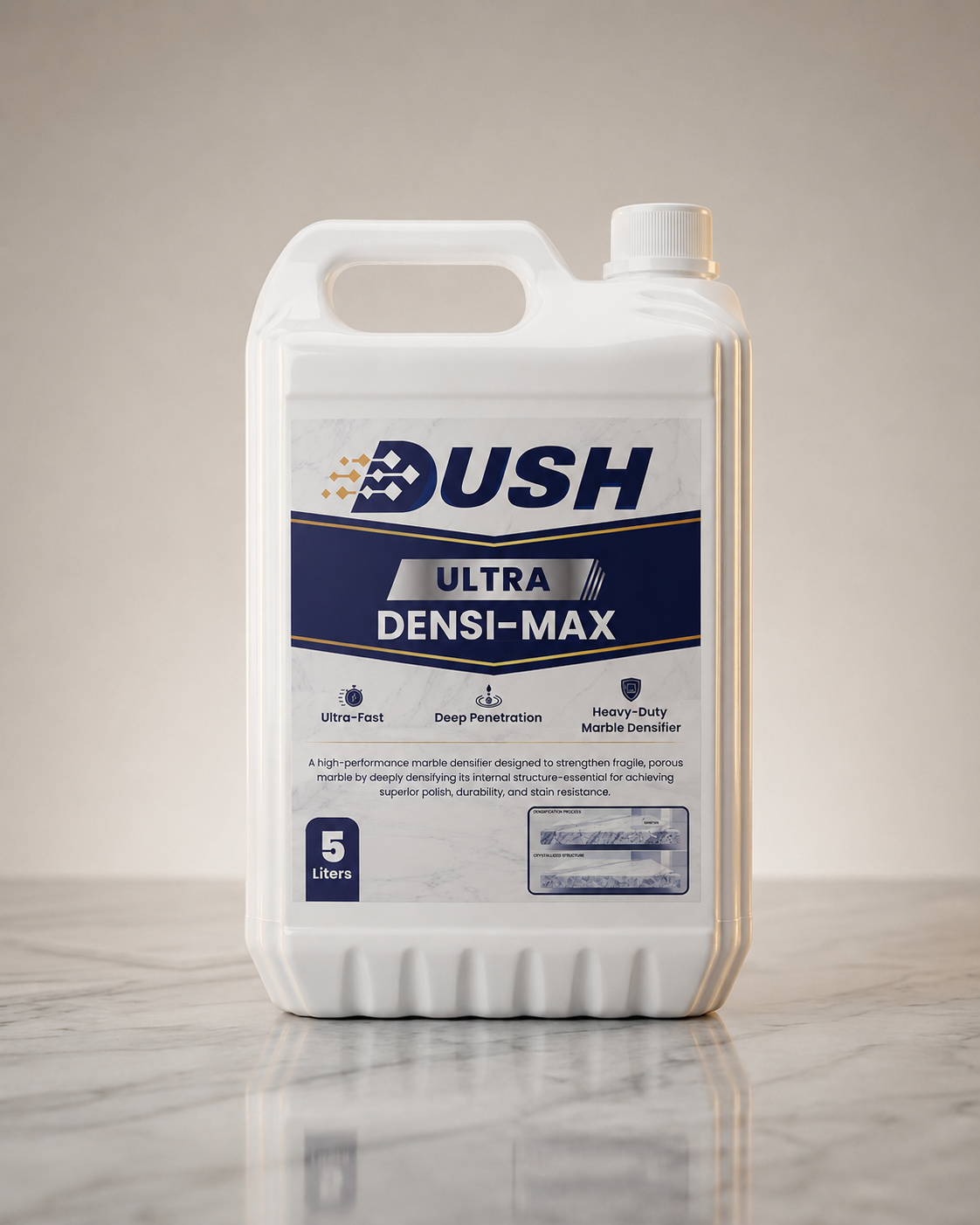
Dush Densi Max Ultra is not a surface sealer — it is a penetrating densifier that goes inside the black granite itself. Applied at the 80-grit grinding stage, it penetrates the full depth of the stone's internal pore structure and chemically reacts with the mineral compounds inside, forming a permanent hydrophobic crystalline matrix within the pores.
Once correctly applied, the granite's pores are permanently closed from within. Hard water minerals cannot deposit inside them — they sit on the surface and wipe away. Soap residue and shampoo cannot enter the stone. The deep black colour is preserved because the pore structure that would otherwise allow contamination to dull the surface is now sealed. The polish retention improves because the internal pores that previously allowed grit to abrade the surface from within are closed.
This is a one-time application at the grinding stage. It never wears off. It never needs reapplication. Surface traffic and bathroom cleaning cannot reach or degrade what is chemically bonded inside the stone.
✓ Permanent — applied once, never reappliedThree Problems · One Permanent Solution
The Correct Application Sequence for Black Granite Bathroom Sealing
The sequence matters. Correct sequence: Dush Hidro SST on all six sides before installation → Dush Densi Max Ultra at 80-grit grinding stage (this is the core step) → continue polishing to mirror finish → daily cleaning with Dush Sparkle Phase. The Densi Max Ultra step is where permanent protection is created. Everything before it prepares the stone. Everything after maintains it.
Before Installation — Dush Hidro SST (All 6 Sides)
Apply Dush Hidro SST to all six sides of every black granite slab before laying. This prevents white salt patches (efflorescence) from appearing — which on black granite would be catastrophically visible. Two coats, allow 24 hours before laying.
→ This step prevents the white patches that show so dramatically against black granite
At 80-Grit Grinding Stage — Dush Densi Max Ultra
Apply Dush Densi Max Ultra undiluted in 3–5 coats. Allow 15–20 minutes penetration per coat. Remove all excess before drying — critical on black granite where dried residue shows clearly. Repeat until the granite stops absorbing.
→ The permanent foundation. This single step creates all the protection the rest of the bathroom relies on
Continue Polishing to Final Mirror Finish
After Densi Max Ultra, continue polishing through 120, 180, 400, 800, 1500, 3000 grit. The densifier improves the final polish quality — the deep black mirror finish is richer and lasts longer. Densi Max Ultra does not interfere with the polishing process.
Confirm With the Water Drop Test
After polishing, pour 3–4 drops of water on the granite. If they bead and remain for 5+ minutes — the densification is complete and working. If they absorb quickly — additional coats of Densi Max Ultra are needed before the granite is considered protected.
Daily — Dush Sparkle Phase (pH-Neutral Cleaner)
Use Dush Sparkle Phase for daily bathroom cleaning. Never use acidic bathroom cleaners, bleach, or standard bathroom tile cleaners on black granite — all damage the polished surface and can compromise the surface finish over time.
→ Most bathroom cleaners are highly acidic — check pH before using anything on black granite
How to Remove White Marks Already on Black Granite
To remove existing white mineral marks from black granite: apply Dush Nitro Glow directly to the white marks, allow 3–5 minutes contact, scrub gently with a soft non-abrasive brush, rinse thoroughly. Never use acidic bathroom descalers on black granite — acid etches the polished surface permanently. After removing the marks, specify Dush Densi Max Ultra at the next polishing cycle if the granite was never densified — this is the permanent fix that prevents the marks from returning.
| Method | On Black Granite | Why |
|---|---|---|
| Dush Nitro Glow | ✓ Use this | Heavy-duty mineral deposit remover formulated for stone — safe on polished black granite |
| Dush Alka Cleaner (diluted) | ✓ For regular cleaning | Alkaline stone cleaner — removes surface mineral film without damaging the polish |
| Standard bathroom descalers | ✗ Never | Highly acidic — permanently etches the polished black surface, creates dull patches that cannot be cleaned away |
| Lemon juice or vinegar | ✗ Never | Acid reacts with the granite's mineral compounds — permanent surface damage |
| Steel wool or abrasive pads | ✗ Never | Scratches the polished surface permanently — visible on black granite immediately |
| White vinegar spray | ✗ Never | pH 2–3 — same acid etching risk as descalers. Very commonly used incorrectly on black granite bathrooms in India |
The permanent fix: if the white marks keep returning despite regular cleaning, the granite was likely never treated with Dush Densi Max Ultra at the grinding stage. Without internal pore closure, hard water minerals will continue depositing inside the pores regardless of how often the surface is cleaned. Specify Densi Max Ultra at the next professional polishing cycle to stop the problem permanently.
The Water Drop Test for Black Granite
Densification Needed
Water absorbs into the black granite within 60 seconds. Surface darkens where drops land. Hard water minerals can now deposit inside the pores with every shower. White marks will form and worsen rapidly. Specify Dush Densi Max Ultra at the next polishing cycle.
⚠ Permanent fix neededProtection Working
Water beads on the black granite surface and sits without absorbing for 5+ minutes. Hard water minerals cannot deposit inside the pores. Dush Densi Max Ultra's internal pore closure is working correctly and permanently — no further action needed.
✓ Protected permanentlyPerform this test every 6 months in a bathroom environment — near the shower, near the basin, and on the floor near the drain. If your granite was correctly treated with Densi Max Ultra at the grinding stage, the result should remain "Protection Working" indefinitely — that is the entire point of permanent internal pore closure.
Test Densi Max Ultra on Your Own Black Granite
Send a piece of your black granite to Dush. We apply Dush Densi Max Ultra, run the water drop test, and you see permanent protection on your actual stone before you buy. The only stone care company in India that does this.
Request Free Sample Test →Related Dush Guides and Products
Black Granite Bathroom Sealing — Questions Answered
What sealer should I use for black granite in a bathroom?
Why does my black granite bathroom keep getting white marks?
Why does black granite in bathrooms turn grey?
Why is Dush Densi Max Ultra the best choice for black granite in bathrooms?
How often should I reseal black granite in a bathroom?
Can I use bathroom tile cleaner on black granite?
External References
Get Permanent Black Granite Protection — Tested on Your Own Stone
One product. Permanent protection. Dush Densi Max Ultra closes black granite pores from within at the grinding stage — hard water marks, staining, and colour loss are stopped at their source. Test on your own granite before you buy.