White Cement Adhesive vs Grey Cement Adhesive for Marble
It looks like a minor spec choice — white or grey, does it really matter what colour the adhesive is once it's under the slab and out of sight? For marble specifically, the answer is yes, and getting it wrong shows up in exactly the place you'd least want it: staining that appears at the joints and edges of the stone itself, sometimes weeks or months after installation, when the adhesive has finally had time to bleed through.
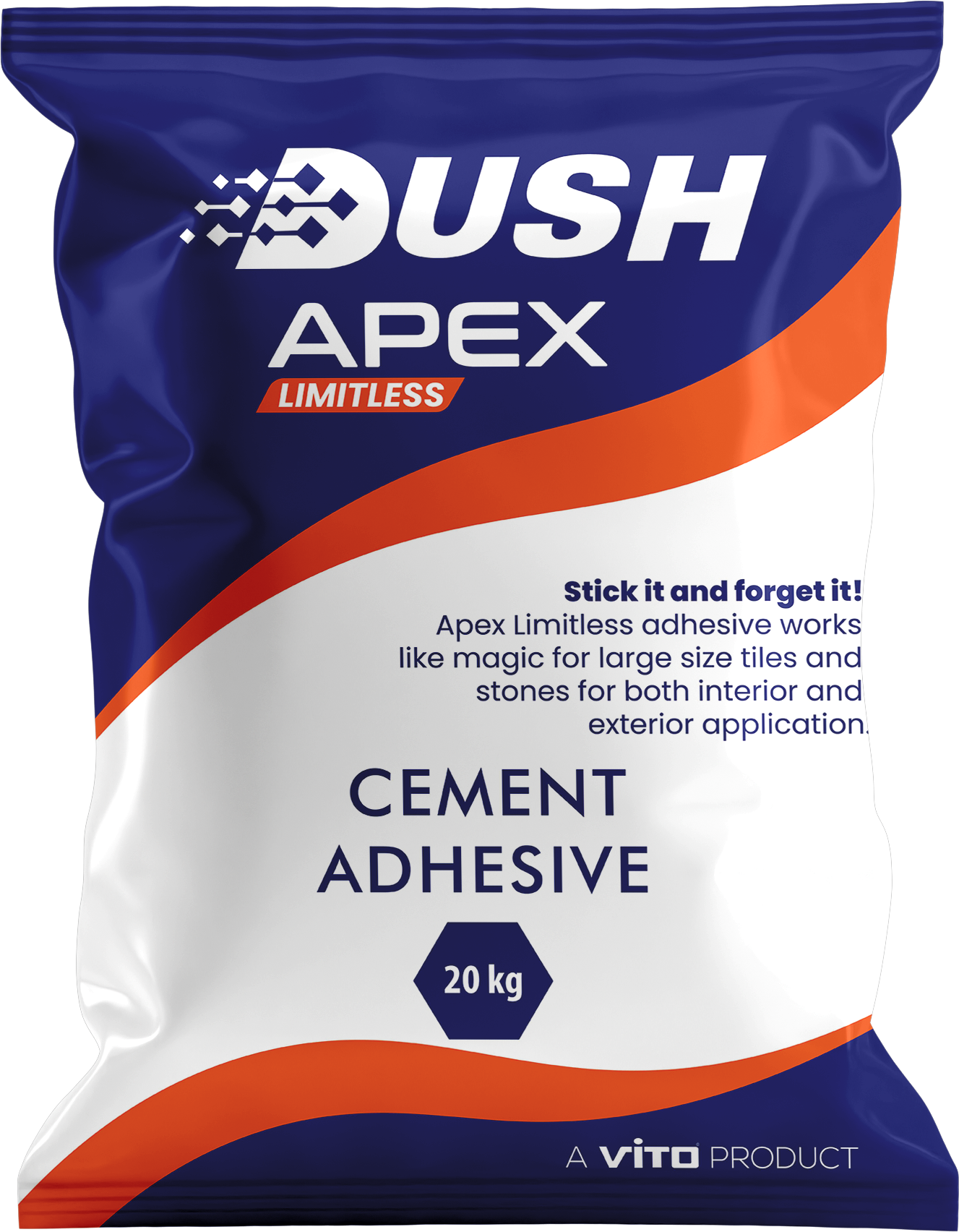
This guide breaks down what's actually different between white and grey cement adhesive, when each one is the right choice, whether colour has anything to do with strength, and where DUSH APEX — a professional-grade white cement adhesive for marble and natural stone — fits into that decision.
What's Actually Different: Composition, Not Just Colour
Ordinary grey cement gets its colour from iron oxide and manganese oxide compounds naturally present in the raw limestone and clay used to produce it — the same impurities that make ordinary Portland cement grey are present in the vast majority of general-purpose construction cement. White cement is manufactured from raw materials specifically selected and processed to minimise these iron and manganese compounds, using purer limestone and kaolin clay, along with a different, more tightly controlled kiln process to prevent iron contamination during manufacture.
This isn't a cosmetic dye added afterward — it's a fundamentally different manufacturing input and process, which is also the direct explanation for white cement's higher cost: the raw material purity requirements and production control needed to keep iron content low are inherently more demanding than standard grey cement manufacturing.
The Core Issue: Grey Bleed on Light Marble
The reason this composition difference matters isn't abstract — it shows up directly on the finished installation. Cement-based adhesives contain moisture during curing, and as that moisture migrates outward through the stone's joints and any hairline porosity at the edges, it can carry fine cement particles with it. With grey cement, those particles carry a visible grey-brown tint. On white, cream, or light-coloured marble, this shows up as a dull grey or brownish discolouration at the joints and edges — sometimes appearing gradually over weeks as moisture continues working its way out during the full cure period.
This staining is a real risk specifically because it often isn't visible on installation day. The adhesive is still curing, and the discolouration can develop over the following weeks as the bond fully dries out — which is exactly why choosing the right cement colour at the point of installation matters far more than trying to clean it out afterward, since removing set-in staining from natural stone is a difficult, sometimes impossible, restoration job.
Why this doesn't affect dark stone the same way: on black, dark grey, or heavily veined dark marble and granite, any grey-cement bleed simply isn't visible against the stone's own colour, which is why grey cement adhesive remains a completely reasonable, cost-effective choice for darker natural stone.
Does White Cement Mean a Weaker Bond? Addressing the Myth
This is one of the most persistent misunderstandings in adhesive selection, and it's worth addressing directly: cement colour and bond strength are not linked properties. A white cement adhesive can be formulated to the same C1 or C2 bond-strength classification as a grey cement adhesive — the colour comes from raw material selection, while the strength comes from the overall formulation, including any polymer modification. A well-engineered white cement adhesive is not a compromise product; it's simply manufactured from different, purer raw materials for a specific aesthetic requirement, without sacrificing the bond-strength engineering that determines actual performance.
The genuine trade-off is cost, not strength: white cement is more expensive to produce because of its raw material and manufacturing requirements, and that cost is passed through to the finished adhesive price. The decision isn't "strong grey vs. weak white" — it's "lower-cost adhesive with staining risk on light stone vs. higher-cost adhesive engineered to avoid that risk."
White vs. Grey: Side by Side
White Cement Adhesive
- No visible staining risk on light or white marble
- Higher raw material purity, higher manufacturing cost
- Correct choice for white, cream, and light-veined marble
- Essential for exterior light-coloured stone facades
- Can be formulated to the same bond-strength classes as grey
Grey Cement Adhesive
- Lower cost, widely available
- Suitable for dark marble, granite, and non-transparent stone
- Grey bleed risk makes it unsuitable for light-coloured marble
- Standard choice for general tiling, not stone-specific
- Bond strength depends on formulation grade, same as white
When Grey Cement Adhesive Is the Right Choice
- Dark or black marble and granite, where any bleed simply isn't visible against the stone's own colour.
- Heavily veined or richly patterned dark stone, where colour consistency at the joints isn't a visual concern.
- General ceramic and porcelain tiling, where the tile itself is non-porous and doesn't carry the same staining risk as natural stone.
- Budget-conscious projects using darker stone, where the cost saving of grey cement doesn't come with a corresponding aesthetic risk.
When White Cement Adhesive Is Necessary, Not Optional
- White, cream, or pale marble of any kind — this is the clearest case where white cement isn't a preference, it's a requirement to protect the stone's finished appearance.
- Light-coloured exterior marble facades, where staining would be highly visible and essentially permanent once set.
- Polished or honed light stone flooring, where joint-line discolouration is immediately noticeable against a light, reflective surface.
- Any installation where the client or specification explicitly calls for a bright, consistent joint appearance, regardless of the stone's exact shade.
Comparison Table: Choosing the Right Cement Base
| Factor | Grey Cement Adhesive | White Cement Adhesive (DUSH APEX) |
|---|---|---|
| Staining risk on light marble | High — grey bleed likely at joints | None — formulated to prevent bleed-through |
| Suitable stone colour range | Dark marble, granite, non-transparent stone | All marble, especially white, cream, light tones |
| Raw material cost | Lower | Higher, due to purity requirements |
| Bond strength potential | Depends on formulation grade | C2 class — exceeds IS 15477 |
| Exterior weather rating | Varies by product | Weather- and UV-resistant formulation |
| Best use case | Dark stone, general tiling | Marble and natural stone, all light tones |
Signs You May Have Been Sold the Wrong One
If any of these apply, it's worth raising the question directly before the installation proceeds further — reversing a completed installation is far more disruptive and costly than confirming the right adhesive colour before the first slab goes down.
Where DUSH APEX Fits
DUSH APEX is built specifically on the white cement side of this decision — a premium white cement base engineered for marble and natural stone, so it avoids the grey-bleed risk entirely while still meeting a C2 bond-strength classification that exceeds IS 15477 requirements. It's formulated for exterior use, resisting rain, UV, and temperature cycling, and bonds to concrete, brick, block, and render — meaning the choice of white cement here isn't a trade-off against performance; it's a product engineered to deliver both a clean, stain-free finish and professional-grade bond strength in the same formulation.
Frequently Asked Questions
Is white cement adhesive always more expensive than grey?
Can grey cement adhesive be used under white marble if the joints are filled with white grout afterward?
How long does it take for grey-bleed staining to appear after installation?
Is white cement adhesive suitable for granite as well as marble?
Does the colour of the cement affect how long the adhesive takes to cure?
If grey-bleed staining has already appeared, can it be removed?
Protect the Finish, Not Just the Bond
White cement, C2-class strength, and a formulation built for marble specifically — DUSH APEX is engineered so the choice between colour and performance isn't a trade-off at all.
Product information referenced from the official DUSH APEX product page. General information about cement composition and staining behaviour is provided as industry background for a general audience. Always patch-test on a small, inconspicuous area of any stone before full application, and consult the manufacturer's technical data sheet for complete specification detail.