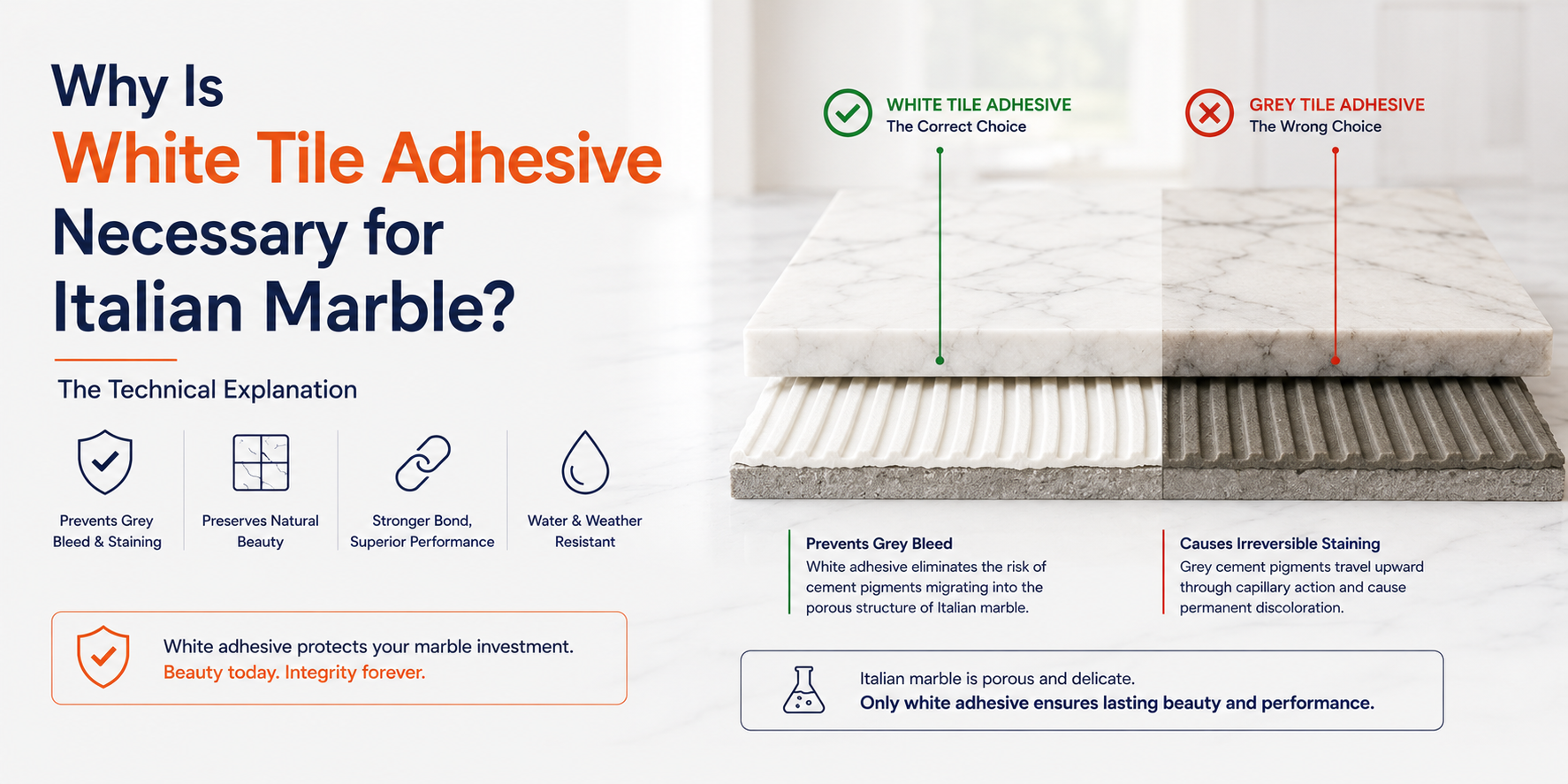
White tile adhesive is necessary for Italian marble because marble is micro-porous, and grey cement bleeds pigment into that porosity permanently. White polymer-modified tile adhesive chemical — classified IS 15477:2019 Type 4 TS1, such as Dush Apex Limitless — contains no grey pigment and eliminates this risk. This article explains exactly how and why, variety by variety.
The Physical Structure of Italian Marble — Why It Absorbs
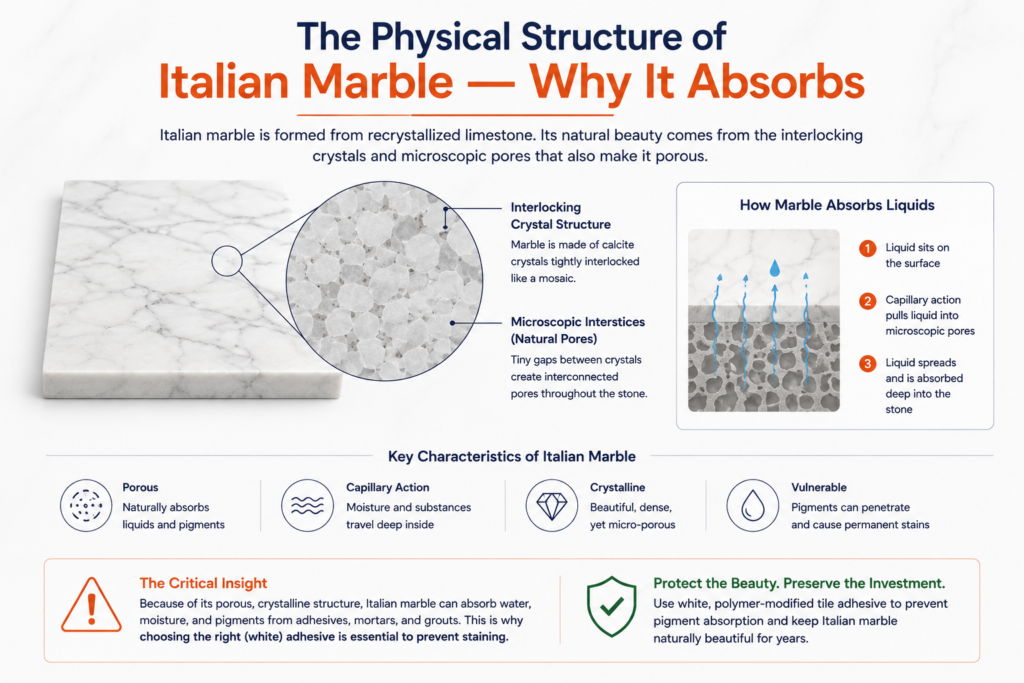
Marble is a metamorphic rock formed when limestone is subjected to extreme heat and pressure over geological time. The transformation recrystallises calcium carbonate into interlocking calcite or dolomite crystals. Under a microscope, the crystals are not a solid continuous mass — they meet at grain boundaries, and those boundaries contain microscopic gaps called interstices.
These interstices are the reason marble is micro-porous. They form a network of extremely fine channels throughout the stone — too small to see, too small to feel, but fully capable of absorbing liquids by capillary action. Capillary action is the same force that draws water up through a paper towel against gravity. In marble, it draws moisture — and whatever is dissolved in that moisture — upward and inward from any wet surface the stone is in contact with. That porosity is also precisely what determines which fixing chemical is appropriate for the stone and which one creates irreversible damage at the point of contact.
The depth and connectivity of these channels varies by marble variety:
Statuario has one of the most open crystal structures of any Italian marble. Its near-translucent quality — the characteristic that makes it the most prized marble in the world — is a direct consequence of this crystalline openness. Light passes through the stone because the crystal network is relatively open. Moisture, and what it carries, penetrates readily for the same reason.
Carrara has a denser crystal structure than Statuario, with naturally occurring grey veining that reflects its mineral composition. It absorbs moisture more slowly but remains meaningfully porous at the interstice level. The grey veining provides partial visual cover for light staining in the body of the slab — but staining at cut edges and joints remains clearly visible.
Calacatta — white with bold grey or gold veining, quarried near Carrara — has similar porosity to Carrara and the same staining vulnerability.
Emperador — a deep brown marble from Spain, imported to India in significant quantities — has different porosity characteristics. Its dark colour makes pigment staining less visible, but its limestone matrix creates a different risk: efflorescence. Calcium-based mineral salts from grey cement moisture can migrate through Emperador and deposit as white powder on the dark surface — highly visible against the stone’s colour.
What Grey Cement Does to Italian Marble — The Staining Mechanism
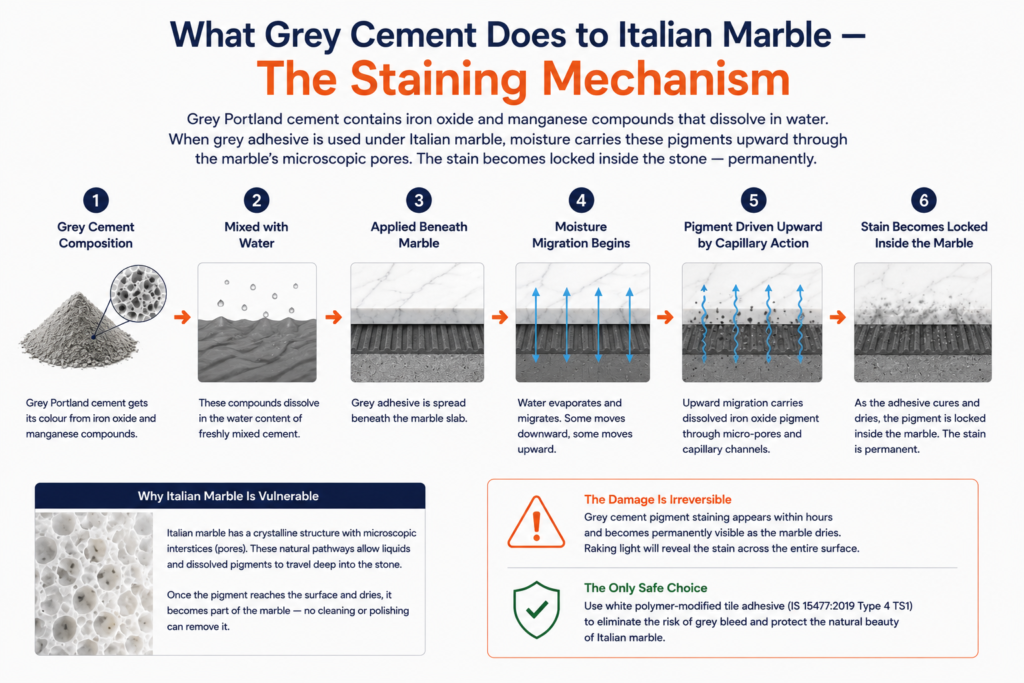
Grey Portland cement — the basis of grey tile adhesive, grey polymer-modified adhesive, and cement-sand mortar — gets its colour from iron oxide and manganese compounds present in the limestone and clay used to manufacture it. These compounds are not inert fillers. They are soluble in the water content of freshly mixed cement.
When grey adhesive is spread beneath a marble slab, the water in the adhesive mix begins to evaporate and also to migrate. Some migrates downward into the concrete substrate. Some migrates upward — drawn by the capillary channels in the marble above it. This upward migration carries dissolved iron oxide pigment with it.
The process begins within minutes of the marble being placed. By the time the adhesive has reached initial set — within two to four hours — a measurable quantity of grey pigment has already entered the marble’s interstice network. By full cure at 24 to 48 hours, the pigment is fixed inside the crystal structure. It has not stained the surface of the marble — it has become part of the stone.
This is why no cleaning product removes the staining. Surface cleaners, acid washes, marble polishes, and bleaching agents work at the stone surface. The grey pigment is not at the surface — it is inside the crystal network, distributed through the depth that capillary action reached during the installation window. Grinding and re-polishing removes the stained surface layer but reaches the next stained layer beneath it. The only remedy for grey cement staining of Italian marble is full tile removal and reinstallation — which means accepting the cost of new marble, new adhesive, and new installation labour. How grey cement, white cement, and polymer-modified adhesive compare on every measurable performance criterion — with the actual numbers behind each claim — makes the cost of the wrong choice visible before the decision is made.
Why White Polymer-Modified Tile Adhesive Eliminates the Risk
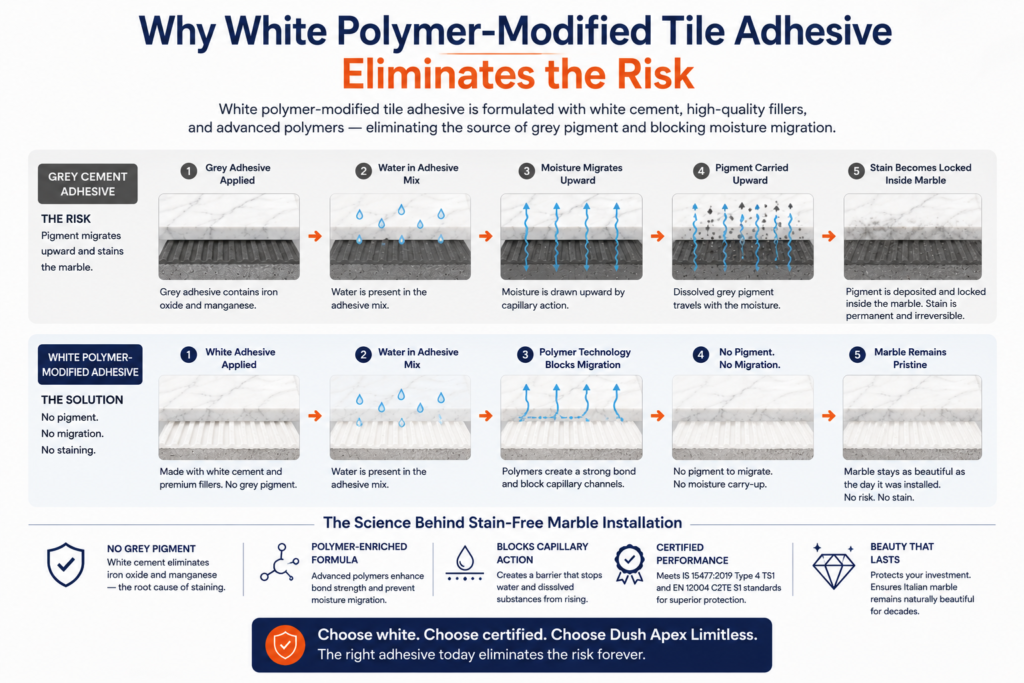
Dush Apex Limitless is a white polymer-modified cement tile adhesive chemical. Its white colour is not a cosmetic choice — it is a formulation choice. White cement adhesive is manufactured using white Portland cement, which is produced from raw materials selected specifically for their low iron and manganese content. The compounds that give grey cement its colour — and that bleed into marble — are absent from the formulation.
When Dush Apex Limitless is mixed and applied beneath Italian marble, the moisture that migrates upward through capillary channels carries nothing that can stain the stone. The capillary migration still occurs — marble does not stop being porous because the adhesive is white. But the migrating moisture carries only water and trace mineral content from the white cement chemistry — none of which creates visible discolouration in white or light marble.
The polymer modification adds a second layer of protection. The polymer network in Dush Apex Limitless — formed as the polymer additives cure alongside the cement chemistry — creates a dense matrix within the adhesive bed. This matrix reduces the rate of capillary moisture movement between the adhesive and the marble. The polymer film partially seals the adhesive-marble interface, slowing the upward moisture migration and reducing the total volume of adhesive moisture that reaches the marble’s interstice network.
The combined effect: white formulation eliminates the pigment source. Polymer modification reduces moisture migration. Together, they eliminate the staining risk that grey adhesive creates.
The EN 12004 C2TE S1 Classification — Why It Matters Beyond Colour
Colour alone does not define a professional white tile adhesive for Italian marble. A white formulation with insufficient bond strength, short open time, or no anti-sag classification for wall use would protect marble from staining but fail to bond it adequately. Dush Apex Limitless carries EN 12004 C2TE S1 — and each element of that classification is relevant to Italian marble specifically.
C — Cementitious adhesive. Cement-based chemistry, compatible with marble, concrete, and screed substrates across all Indian construction conditions.
2 — Improved adhesive. Higher polymer content and bond strength than basic C1. Italian marble is heavy — 20 to 30 kg per square metre for standard slab thicknesses. The C2 improvement classification confirms Dush Apex Limitless delivers the elevated bond strength marble demands.
T — Reduced slip. Maximum 0.12 mm movement of a tile placed on a vertical surface during the open time. Italian marble is increasingly specified for feature walls, bathroom walls, and vertical surface cladding in Indian residential projects. Without the T classification, wall-fixed marble slides from its placed position during installation, requiring mechanical support. With 0.12 mm maximum slip, Dush Apex Limitless holds marble tiles in position from the moment they are placed.
E — Extended open time of 45 minutes. Italian marble slabs — particularly large-format Statuario and Carrara installations — require time to position precisely. Veining must align between adjacent slabs. Joint widths must be consistent. Large slabs require back buttering before placement. Standard adhesive with 20-minute open time cannot accommodate this work. Dush Apex Limitless provides 45 minutes.
S1 — Deformability. The adhesive bed accommodates up to 2.5 mm of lateral movement without cracking the bond. For outdoor Italian marble terraces and covered external applications — which are increasingly common in Indian luxury residential projects — S1 deformability is essential for accommodating thermal movement across Indian seasonal temperature swings.
Alongside EN 12004, Dush Apex Limitless carries IS 15477:2019 Type 4 TS1 — India’s national tile adhesive standard. Type 4 confirms polymer-modified composition. TS1 confirms independently tested tensile bond strength above the standard threshold — 1.61 N/mm² for Dush Apex Limitless. This dual certification — Indian and European — means Dush Apex Limitless meets the specification criteria of both the Indian regulatory framework and the Italian marble trade standard simultaneously, and is the reason it appears verbatim in formal project specification documents that architects write for premium marble installations across India.
Variety by Variety — Why White Adhesive Is Necessary for Each
Statuario
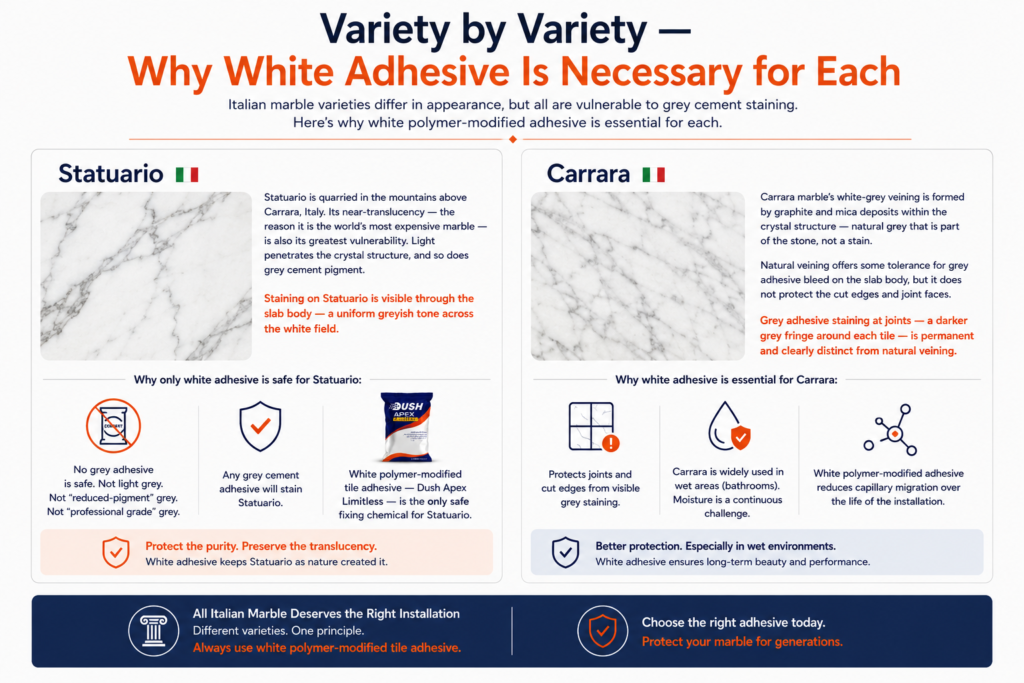
Statuario is quarried in the mountains above Carrara, Italy. Its defining characteristic — the near-translucency that makes it the world’s most expensive marble — is also its greatest vulnerability. Because light penetrates the crystal structure, so does grey cement pigment. Staining on Statuario is not visible only at joints and cut edges. It is visible through the slab body itself — a uniform greyish tone emerging across the white field of the marble as the grey adhesive cures beneath it.
There is no grey adhesive that is safe for Statuario. Not light grey. Not “reduced-pigment” grey. Not “professional grade” grey. Any grey cement adhesive will stain Statuario. White polymer-modified tile adhesive — Dush Apex Limitless — is the only safe fixing chemical for Statuario marble. The complete step-by-step installation method for Statuario and all Italian marble varieties — from substrate preparation through curing — is documented here for every contractor and homeowner working with this stone.
Carrara
Carrara marble’s white-grey veining is formed by graphite and mica deposits within the crystal structure — natural grey that is part of the stone, not a stain. This natural veining provides some visual tolerance for grey adhesive bleed at the slab body, because light staining partially merges with the existing grey pattern. However, it does not protect the cut edges and joint faces of the marble. Grey adhesive staining at Carrara joints — visible as a darker grey fringe around each tile — is permanent and clearly distinct from the natural veining. White polymer-modified adhesive eliminates this risk at the joints as well as the body.
Additionally, Carrara marble is more commonly used in wet areas — bathroom floors and walls — than many other Italian varieties. In wet environments, the capillary moisture driving force is continuous rather than a one-time installation event. White polymer-modified adhesive’s reduced capillary migration, maintained by the polymer network over the life of the installation, is directly relevant to long-term Carrara performance in bathroom applications — and in those same wet environments, a purpose-formulated grout chemistry is what completes the joint’s resistance to continuous moisture and staining over time.
Calacatta
Calacatta is visually similar to Carrara — white background with bold veining — but typically more translucent and more expensive. Treat it as Statuario in terms of staining vulnerability. White polymer-modified adhesive is non-negotiable.
Emperador
Emperador’s dark brown colour means grey cement pigment staining is visually less dramatic than on white marble. The dominant risk with Emperador and grey cement is efflorescence — the formation of white calcium carbonate or calcium sulphate deposits on the stone surface as alkaline moisture from grey cement migrates through the stone and evaporates at the surface, leaving mineral residue behind.
On dark marble like Emperador, white mineral deposits are strikingly visible — particularly in low lighting or raking light. White polymer-modified adhesive — with its reduced moisture migration and white cement chemistry — significantly reduces the alkalinity of the moisture that reaches Emperador’s surface, and therefore the efflorescence risk.
White Cement vs White Tile Adhesive — An Important Distinction
A common substitution made on Indian construction sites is white cement used in place of white tile adhesive chemical. The logic seems sound — it is white, it will not stain, and it is widely available. The logic is wrong on the second and third counts.
White cement does not produce visible grey staining on marble. That part is correct. But white cement:
- Has an estimated tensile bond strength of 0.3 to 0.5 N/mm² — less than one-third of Dush Apex Limitless’s 1.61 N/mm². It is structurally inadequate for heavy Italian marble slabs
- Has no polymer modification — no flexibility, no water resistance, brittle cured layer
- Has no anti-sag classification — cannot be used for marble wall applications
- Has no IS 15477:2019 adhesive classification — it has not been tested as a tile adhesive under any Indian standard
- Has an open time of 10 to 15 minutes — completely insufficient for large-format marble positioning
White cement protects marble from staining but does not bond it adequately. The marble will appear correctly installed and then progressively delaminate as the white cement bond — too weak for the load — breaks down under foot traffic, thermal cycling, and the sustained weight of the stone. A complete guide to white marble fixing chemicals in India — including how to verify the right product and what to look for on the packaging — covers this distinction in full for every marble variety and application type.
The correct product is white polymer-modified tile adhesive chemical — IS 15477:2019 Type 4 TS1. It is white, it bonds, and it is certified. Dush Apex Limitless is available at dushproducts.com/products/dush-apex-limitless.
Frequently Asked Questions — White Tile Adhesive for Italian Marble
Why is white tile adhesive necessary for Italian marble?
Italian marble is micro-porous. Grey cement adhesive contains iron oxide pigments drawn into the marble’s crystal structure by capillary action before curing — permanently staining the stone from inside. White polymer-modified tile adhesive has no grey pigments. The polymer modification additionally reduces capillary moisture migration. Together, these properties eliminate the staining risk. This is a technical requirement, not a preference. Dush Apex Limitless — IS 15477:2019 Type 4 TS1, EN 12004 C2TE S1 — is the professional specification.
What happens if grey tile adhesive is used on Italian marble?
Grey tile adhesive bleeds iron oxide pigment into the marble’s micro-porous crystal structure within hours of placement. The pigment cures permanently inside the stone — a grey or yellowish tint that no cleaning, polishing, or bleaching removes. On Statuario, the discolouration is visible through the slab body. On all varieties, it is visible at cut edges and joints. Full tile removal and reinstallation is the only remedy.
Is white cement enough for Italian marble — or do I need white tile adhesive?
White cement is not sufficient. It will not stain marble, but it will not bond it adequately either — 0.3 to 0.5 N/mm² tensile strength versus Dush Apex Limitless’s 1.61 N/mm². No polymer modification. No anti-sag classification for walls. No IS 15477:2019 adhesive certification. White tile adhesive chemical — IS 15477:2019 Type 4 TS1 — is the correct product.
Does white tile adhesive work on all types of Italian marble?
Yes. Dush Apex Limitless white polymer-modified adhesive is safe for Statuario, Carrara, Calacatta, Botticino, Emperador, and all other Italian marble varieties. Suitable on floors and walls, indoors and outdoors, across all marble tones.
Which white tile adhesive is best for Italian marble in India?
Dush Apex Limitless — white polymer-modified cement adhesive, manufactured in Italy, IS 15477:2019 Type 4 TS1 and EN 12004 C2TE S1 certified. 1.61 N/mm² tensile strength. 0.12 mm maximum slip. 45-minute open time. The professional specification for Italian marble on floors and walls in India.
Conclusion
The necessity of white tile adhesive for Italian marble is rooted in physics, not preference. Marble’s micro-porous crystal structure absorbs what is beneath it. Grey cement contains pigments that stain that structure permanently. White polymer-modified tile adhesive contains no such pigments — and its polymer modification reduces the capillary moisture movement that drives the absorption process.
Understanding this mechanism is what separates an informed specification decision from one made on habit or price. Dush Apex Limitless — manufactured in Italy, white polymer-modified, IS 15477:2019 Type 4 TS1 and EN 12004 C2TE S1 certified — is the adhesive chemical that addresses the necessity with verified specifications. For Statuario that stays white, Carrara that stays clean at the joints, and Emperador that stays free of efflorescence, it is the correct product.