Is Efflorescence a Sign of a Bad Marble Installation?
Often, yes — but not always. This guide explains how to tell the difference between normal settling and a real installation mistake, what specific steps were likely skipped, and how Dush Densi Max Ultra fits into doing it right.
A new marble floor develops white salty patches, and the first question almost everyone asks is some version of: did I get a bad job done? It is a fair question, and the honest answer is more nuanced than a simple yes or no. Some efflorescence is a normal part of any wet-laid stone installation settling in. Persistent or heavy efflorescence is usually a sign that specific, well-known preventive steps were skipped.
Efflorescence is a sign of a bad marble installation in most cases, but not always. If the installer used wet sand-cement bedding without applying a moisture barrier such as Dush Hidro SST to the slab backs, and did not specify Dush Densi Max Ultra at the grinding stage, efflorescence is a predictable and preventable outcome — pointing to a missed step. However, light efflorescence that appears briefly in the first weeks and resolves naturally as the substrate finishes drying is normal for wet-laid stone and not necessarily a sign of poor workmanship. Persistent, recurring, or heavy efflorescence months later is the stronger signal of a genuine installation gap.
Normal Settling vs an Actual Installation Mistake
Likely Normal — Not a Mistake
- Appears within the first 4 to 8 weeks after installation
- Light, faint, or limited to small isolated patches
- Gradually fades over weeks without intervention
- Coincides with the expected substrate drying period
- Does not return after one or two gentle cleanings
Likely an Installation Mistake
- Persists beyond 3 to 4 months after installation
- Heavy, widespread, or covering large floor areas
- Returns repeatedly after cleaning, sometimes within days
- Worse during every monsoon season, every year
- No back-side moisture barrier was ever applied to slabs
The underlying reason this distinction exists is moisture timing. Any wet installation process introduces water into the substrate, and that water needs somewhere to go as it dries — a small amount of surface salt deposit during this natural drying window is common even in well-executed installations. The difference is that correct installation practice minimises both the volume and duration of this effect, while a poor installation leaves it essentially unmanaged.
The 3 Factors That Tell You Which One You Have
Assess efflorescence using three factors: timing (when it appeared relative to installation), persistence (whether it keeps returning after cleaning), and severity (how much of the floor it covers and how heavy the deposit is). Light efflorescence appearing early and fading within 1 to 2 months is typical. Efflorescence persisting past 4 months, returning after cleaning, or covering large areas points toward a genuine installation gap.
Timing
When did it first appear, and how long has it been present?
Normal substrate drying typically resolves within 6 to 12 weeks under reasonable ventilation conditions.
Beyond 4 months → likely a mistakePersistence
Does it return after cleaning, and how quickly?
A genuinely drying substrate produces progressively less efflorescence each cycle, not a steady or worsening pattern.
Returns within days repeatedly → likely a mistakeSeverity
How much of the floor is affected, and how heavy is the deposit?
Light, scattered patches differ meaningfully from a thick, widespread white film across most of the floor.
Heavy and widespread → likely a mistake5 Specific Installation Mistakes That Cause Efflorescence
The most common installation mistakes behind efflorescence are: skipping back-side moisture barrier treatment before laying; using excessive water in the bedding mix; laying marble on an inadequately cured or damp substrate; omitting a damp-proof membrane on ground-floor installations; and not closing the marble's surface pore structure with a densifier, which leaves an open evaporation pathway.
No Back-Side Moisture Barrier Applied
The single most common cause. Without a treatment like Dush Hidro SST applied to the back and sides of every slab before laying, the marble's underside has no protection against substrate moisture and dissolved salts.
Fix: Dush Hidro SST applied before laying, every slab, six sidesExcessive Water in the Bedding Mix
Traditional wet sand-cement bedding, especially when mixed wetter than necessary for workability, introduces far more moisture into the substrate than is structurally required — extending the drying period and the efflorescence risk window significantly.
Fix: Polymer-modified low-moisture bedding compoundInadequate Substrate Drying Time
Laying marble on a screed or substrate that has not been given sufficient time to cure and partially dry compounds the moisture problem from the start, particularly when installation schedules are compressed.
Fix: Confirm substrate cure time before laying, especially in monsoonNo Damp-Proof Membrane on Ground Floors
Ground-floor installations without a proper damp-proof membrane beneath the substrate can have an ongoing moisture source from the earth itself, not just a one-time drying event — making efflorescence recur indefinitely rather than resolve naturally.
Fix: Confirm a damp-proof membrane is present below gradeNo Pore-Closing Densifier Applied
Leaving the marble's surface pores fully open means there is an unrestricted pathway for moisture to evaporate and deposit salts at the surface, in addition to leaving the stone vulnerable to staining.
Fix: Dush Densi Max Ultra at the 80-grit grinding stageWhere Dush Densi Max Ultra Fits Into Correct Installation Practice
Dush Densi Max Ultra is part of correct installation practice — applied at the 80-grit grinding stage, it permanently closes the marble's surface pore structure from the top, reducing the pathway through which any residual substrate moisture can evaporate and deposit salts. It is not the primary efflorescence prevention product — that role belongs to Dush Hidro SST applied to slab backs — but installers who specify Densi Max Ultra alongside Hidro SST are following a more complete, lower-risk installation process than those who skip pore-closing treatment entirely.
DUSH DENSI MAX ULTRA
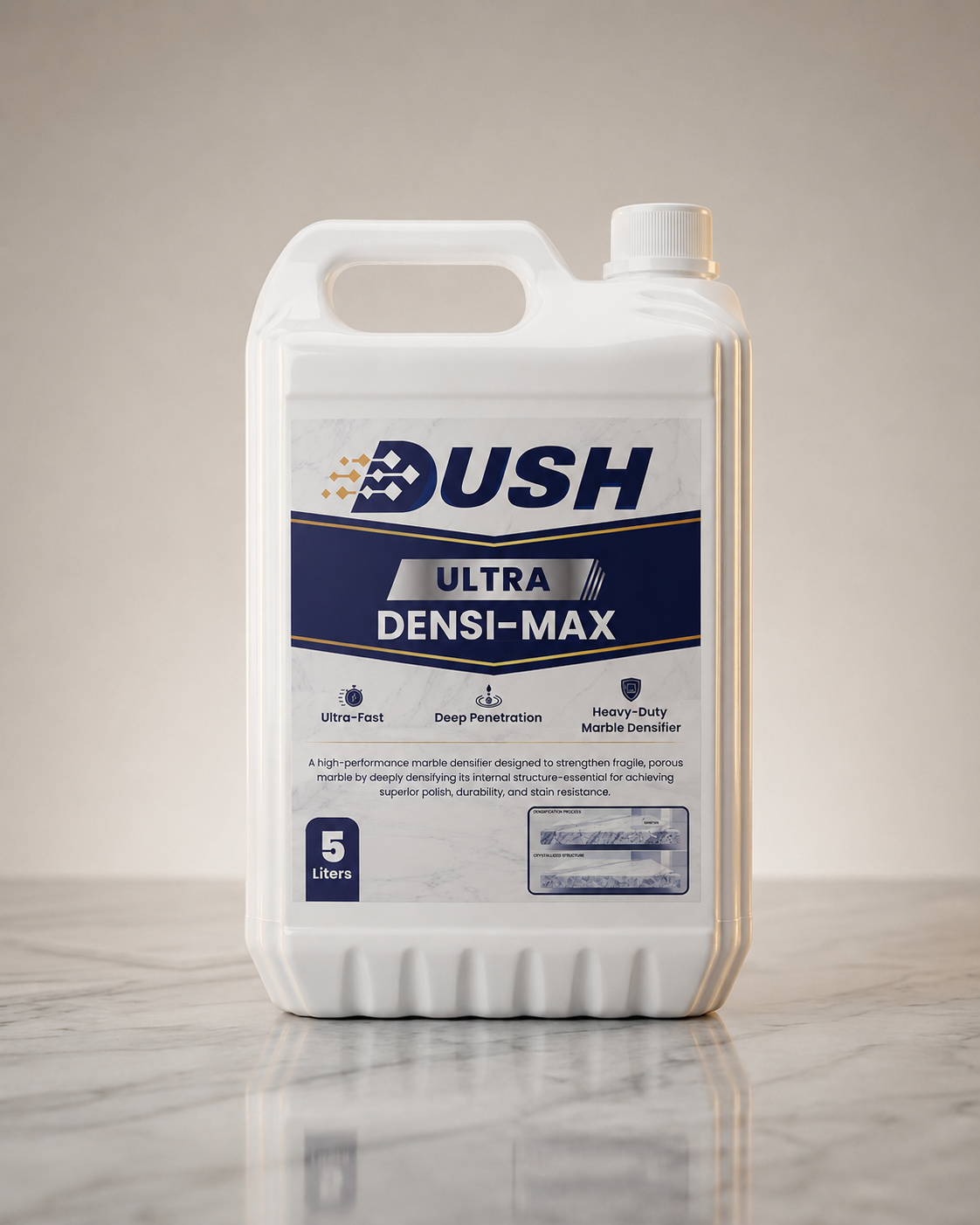
Whether an installer specifies a penetrating densifier at the grinding stage is a reasonable proxy for overall installation diligence. It is an extra step that takes time and costs money, and installers cutting corners on moisture-barrier preparation are statistically more likely to also skip this step — because both reflect the same underlying attention, or lack of it, to long-term protection rather than just getting the floor laid and looking good on handover day.
Applied correctly, Densi Max Ultra chemically reacts with the calcium minerals inside the marble's pore structure, forming a permanent hydrophobic matrix. This is primarily a stain-protection measure, but the same internal closure reduces the surface area available for moisture evaporation, complementing Hidro SST's role in blocking moisture from entering the stone in the first place.
- ★Reduces surface evaporation pathway: Permanent pore closure means less surface area available for moisture migrating from below to evaporate through
- ★Marker of installer diligence: Its inclusion in an installation specification is a reasonable indicator that other moisture-prevention steps were also followed
- ★Primary benefit is permanent stain protection: Turmeric, oil, and water staining are prevented from day one, independent of the efflorescence question
- ★Applied during installation, not after: Part of the same process timeline as back-side waterproofing — both happen before the floor is in use
- ★Does not remove existing efflorescence: It is a preventive, forward-looking step — existing deposits require separate cleaning
Questions to Ask Your Installer
To determine whether your efflorescence reflects an installation gap, ask your installer directly whether a back-side moisture barrier such as Dush Hidro SST was applied to every slab before laying, what bedding compound was used, whether the substrate was given adequate drying time, whether a damp-proof membrane is present on ground-floor installations, and whether a penetrating densifier was applied at the grinding stage.
Was a back-side moisture barrier applied to every slab before laying?
Should be yes — Dush Hidro SST or equivalent, applied to all six sidesWhat bedding compound was used — wet sand-cement or polymer-modified?
Polymer-modified compounds introduce significantly less moistureHow long was the substrate allowed to cure before the marble was laid?
Rushed timelines, especially during monsoon, increase riskIs there a damp-proof membrane beneath the substrate on ground-floor areas?
Critical for preventing ongoing ground moisture issuesWas a penetrating densifier applied at the grinding stage?
Dush Densi Max Ultra at 80 grit — a marker of overall diligenceWhat to Do If Efflorescence Confirms an Installation Mistake
If your assessment indicates a genuine installation gap, document the timing, severity, and pattern of the efflorescence with photographs, then raise it directly with your installer with specific reference to which preventive steps appear to have been skipped. A professional installer should be able to explain their process or offer retrospective treatment. For ongoing protection regardless of the original cause, clean existing deposits with dry brushing and Dush Alka Cleaner, then specify Dush Hidro SST applied retrospectively where physically accessible, and Dush Densi Max Ultra at the next professional polishing cycle.
It is worth noting that retrospective treatment after installation is never as effective as correct treatment beforehand — once the slab is laid, applying a back-side moisture barrier is no longer physically possible, and efflorescence prevention from that point forward relies more heavily on managing surface conditions and ventilation while the substrate continues to dry naturally. This is precisely why the conversation with an installer before work begins, confirming Dush Hidro SST and Dush Densi Max Ultra are both part of the specification, is the most effective point of intervention.
For Italian marble India installations, see the complete efflorescence mechanism and treatment guide and the complete pre-installation waterproofing guide for the full prevention sequence to specify with any future installer.
Specify the Complete Protection System for Your Next Installation
Send a piece of marble from your upcoming project to Dush. We can walk you through exactly what a correct installation specification looks like — Hidro SST, bedding method, and Densi Max Ultra — before you sign off on a contractor.
Request Free Sample Test →Related Dush Guides and Products
Efflorescence & Installation Quality — Questions Answered
Is efflorescence a sign of a bad marble installation?
What installation mistakes cause efflorescence on marble?
How can I tell if efflorescence means my installer made a mistake?
Can good installation practice prevent efflorescence completely?
Does Dush Densi Max Ultra fix efflorescence after it has already appeared?
Should I confront my installer if efflorescence appears on a new marble floor?
External References
Specify the Right Process Before the First Slab Is Laid
Dush Hidro SST blocks moisture from below. Dush Densi Max Ultra closes the pore structure from above. Together, the foundation of an installation that won't leave you asking this question in three months.