Why Do White Salty Patches Appear on Marble After Installation?
The white powdery marks that show up weeks or months after a new marble floor is laid have nothing to do with anything spilled on top — they are coming from below. This guide explains efflorescence, and how Dush Densi Max Ultra fits into the complete prevention system.
A few weeks after a beautiful new marble floor is installed, a faint white, chalky film starts appearing — sometimes in patches, sometimes as a general haze across large sections. It looks like a cleaning problem, but no amount of mopping fixes it, and in many cases mopping seems to make it worse. This is efflorescence, and understanding where it actually comes from changes how you think about preventing it.
White salty patches on marble after installation are caused by efflorescence — moisture from the cement screed, sand bed, or adhesive beneath the marble migrating upward through the stone's pores and evaporating at the surface, leaving dissolved mineral salts behind as a white, powdery deposit. This is most common in the first weeks to months after installation, while substrate moisture is still drying out, and is worsened by humid or monsoon conditions. It is prevented at the installation stage using Dush Hidro SST on slab backs and reduced further by Dush Densi Max Ultra, which permanently closes the marble's pore structure from the top surface.
The Moisture Journey — From Substrate to Surface
Efflorescence forms in three stages: moisture present in the cement screed or adhesive dissolves mineral salts naturally present in the cement; this salt-laden moisture migrates upward through the marble's open pore structure by capillary action, following the path of least resistance toward the surface where humidity is lower; and as the moisture reaches the surface and evaporates into the air, the dissolved salts are left behind as a visible white, powdery residue. The marble itself is simply the pathway — the salts originate from the cement substrate underneath.
Contains residual moisture from wet installation, along with naturally occurring mineral salts (mainly calcium and sodium compounds) present in cement.
Unsealed marble pores act as a pathway. Salt-laden moisture travels through the stone's internal pore network from the underside toward the surface.
Water evaporates into the air, but the dissolved mineral salts cannot evaporate — they are left behind as the visible white, powdery efflorescence deposit.
This is why dry-mopping a patch of efflorescence removes the visible deposit, but the same white film often returns days or weeks later — the underlying moisture source is still active, and as long as moisture continues migrating upward, fresh salt deposits will continue forming at the surface.
Why This Happens Specifically on New Installations
Efflorescence is most common on new marble installations because traditional wet installation methods using sand and cement introduce substantial moisture into the substrate at the time of laying, and this moisture takes weeks to months to fully dry out, particularly in humid Indian conditions. During this drying period, every cycle of moisture migration carries dissolved salts to the surface. As the substrate gradually dries completely, the moisture source diminishes and efflorescence typically reduces or stops — though this can take considerably longer in monsoon-affected regions or poorly ventilated spaces.
For Italian marble India installations specifically, several factors extend or worsen this window: monsoon humidity slows substrate drying significantly, ground-floor installations without a proper damp-proof membrane may have an ongoing moisture source from the earth beneath the building rather than a one-time drying event, and traditional wet sand-cement bedding introduces considerably more water than modern polymer-modified alternatives.
The key insight for prevention: since efflorescence is driven by moisture that is present at the time of installation, the most effective intervention happens before or during installation — not after the white patches have already appeared.
Hidro SST and Densi Max Ultra Address Different Parts of the Problem
Dush Hidro SST
Applied to the back and edges of every slab before installation, Hidro SST creates a moisture barrier that directly blocks substrate water and dissolved salts from entering the stone through its underside — the primary entry point for efflorescence-causing moisture.
This is the most important and direct intervention against efflorescence specifically, because it stops the salt-laden moisture before it ever reaches the marble's pore network.
→ Direct, primary efflorescence preventionDush Densi Max Ultra
Applied at the 80-grit grinding stage during polishing, Densi Max Ultra permanently closes the marble's internal pore structure from the top. This reduces the surface pathway available for any residual moisture to evaporate through, contributing to overall moisture and staining resistance.
While its primary role is permanent stain protection, the same internal pore closure also means less surface area for evaporation-driven salt deposition, complementing the protection Hidro SST provides from below.
→ Complementary protection, primary role is stain resistanceUsed together, these two products provide complete moisture protection — Hidro SST stops the salt-laden moisture from entering the stone in the first place, while Densi Max Ultra closes the pore structure from the top, providing the marble's surface with the same permanent stain and water resistance that makes it stand up to years of Indian kitchen and bathroom use.
Dush Densi Max Ultra — Closing the Pore Pathway From Above
Dush Densi Max Ultra is an ultra-premium penetrating densifier applied during marble installation at the 80-grit grinding stage. It permanently closes the marble's internal pore structure by chemically reacting with the calcium minerals inside, forming a hydrophobic crystalline matrix. While its primary function is preventing stains such as turmeric and oil from penetrating the stone, this same internal pore closure also reduces the pathway through which any residual moisture from below could otherwise reach and evaporate at the surface — making it a valuable complement to Dush Hidro SST as part of a complete installation protection system.
DUSH DENSI MAX ULTRA
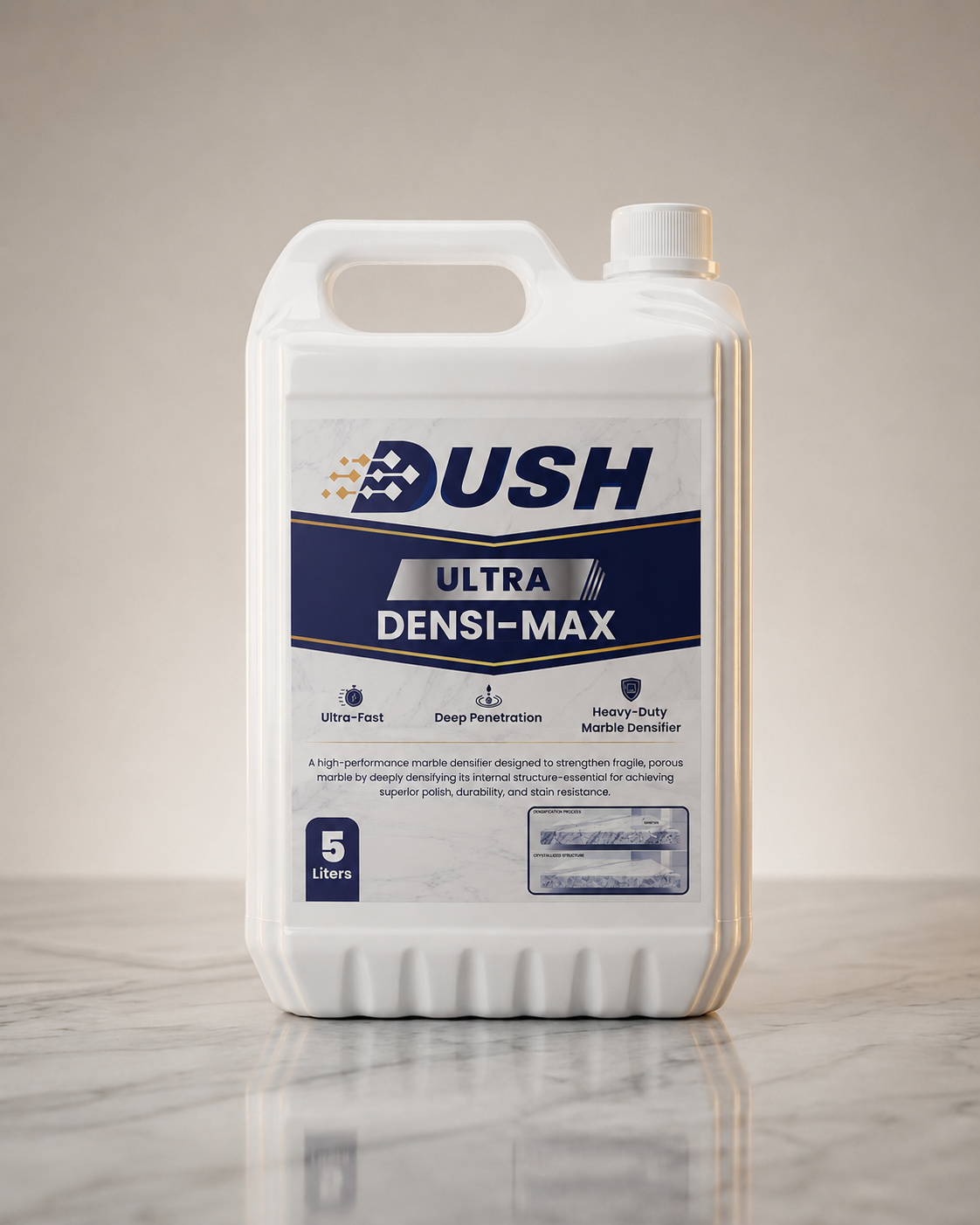
Most discussions of marble protection focus exclusively on staining — turmeric, oil, coffee. But the same internal pore structure that allows these substances to penetrate from above is also the pathway that allows substrate moisture to migrate and evaporate at the surface from below, contributing to efflorescence. Closing that pore structure addresses both problems simultaneously from the surface side.
Applied at the 80-grit grinding stage — before the final polish — Densi Max Ultra penetrates the marble's pore network and chemically bonds with the calcium minerals inside, forming a permanent matrix that is hydrophobic in both directions: it resists liquid entering from above, and it reduces the open pore area available for moisture to pass through from below.
For complete installation-stage protection against both efflorescence and future staining, Densi Max Ultra applied at the grinding stage should always be paired with Dush Hidro SST applied to the slab backs before laying — together they address the moisture problem from both directions.
- ★Permanent pore closure: Chemically bonded inside the marble's pore structure — contributes to reduced surface evaporation pathways alongside primary stain prevention
- ★Applied before the floor is in use: Part of the installation process itself, not a retrofit applied after problems appear
- ★Complements Hidro SST: Works alongside back-side moisture barrier treatment to provide complete two-direction protection
- ★No appearance change: Clear, no film, does not affect the marble's natural colour or veining
- ★Primary stain protection benefit: Permanently prevents turmeric, oil, and water staining from the day the floor is opened to use
Complete Prevention Sequence at Installation
The complete prevention sequence: apply Dush Hidro SST to all six sides of every slab before laying → allow 24 hours drying → use a low-moisture polymer-modified bedding compound → lay the marble → grind to 80 grit → apply Dush Densi Max Ultra → continue polishing to final finish. Both waterproofing steps must happen before or during installation, not afterward, for the protection to be effective.
Apply Dush Hidro SST — All 6 Sides
Apply Dush Hidro SST undiluted to the back, edges, and lightly to the top of each slab. Two coats. This is the primary efflorescence prevention step.
Allow 24 Hours Full Drying
Do not lay slabs until Hidro SST has fully cured. Extend to 36–48 hours in humid conditions, particularly during monsoon season.
Use Low-Moisture Bedding Compound
Use a polymer-modified bedding compound such as Dush Stonebed rather than traditional wet sand-cement mix to significantly reduce the moisture load introduced during installation.
→ Less water introduced at installation means less efflorescence risk during the drying period
Grind to 80 Grit
Begin the polishing process, grinding the marble surface to 80 grit, the stage at which the pore structure is most open for treatment.
Apply Dush Densi Max Ultra
Apply Dush Densi Max Ultra in 3–5 coats, removing excess before drying, repeating until the marble stops absorbing. This closes the pore structure from the top.
Continue Polishing to Final Finish
Proceed through the remaining grits to the desired finish. The floor is now protected from both directions before it is ever opened to use.
Treating Efflorescence That Has Already Appeared
To treat existing efflorescence: dry-brush the white powdery deposit away first using a soft brush — do not use water initially, as this can temporarily redistribute rather than remove the salts. Clean the area with Dush Alka Cleaner to lift any remaining residue safely. If the patches continue reappearing after cleaning, the underlying moisture source is still active, and the marble should be assessed for ongoing substrate moisture issues.
Avoid
- Wiping wet immediately — can temporarily redissolve and spread the salts
- Acidic cleaners or vinegar — react with marble's calcium carbonate
- Sealing over efflorescence without first cleaning it
- Assuming one cleaning permanently solves an active moisture source
Correct Approach
- Dry-brush the deposit away first with a soft brush
- Clean with Dush Alka Cleaner — safe, alkaline, marble-appropriate
- Monitor for recurrence over several weeks
- If recurring, investigate the substrate moisture source directly
If efflorescence keeps returning despite repeated cleaning, particularly on ground-floor installations, the cause may be ongoing ground moisture rather than residual installation moisture that should have dried out by now. In these cases, addressing the underlying damp-proofing of the substrate is necessary alongside any marble-level treatment — surface cleaning alone cannot resolve a continuously active moisture source.
Efflorescence vs Staining — Knowing the Difference
Efflorescence is a white, salty mineral deposit caused by moisture migrating from below the marble and evaporating at the surface — it originates from the substrate, not from anything spilled on top. Marble staining, such as turmeric or oil stains, is caused by substances absorbed from above into the stone's pore structure. They look different, come from opposite directions, and require different products to prevent.
| Characteristic | Efflorescence | Staining |
|---|---|---|
| Source direction | From below — substrate moisture | From above — spills and contact |
| Appearance | White, powdery, chalky film | Coloured discolouration — yellow, brown, dark |
| Typical timing | Weeks to months after installation | Any time during use of the floor |
| Primary prevention | Dush Hidro SST on slab backs | Dush Densi Max Ultra on top surface |
| Treatment if already present | Dry brush + Dush Alka Cleaner | Dush Stain-Ex poultice |
Plan Complete Installation Protection Before You Lay a Single Slab
Send a piece of marble from your upcoming project to Dush. We can show you the Hidro SST and Densi Max Ultra application process and what to expect from both before installation begins.
Request Free Sample Test →Related Dush Guides and Products
White Salty Patches & Efflorescence — Questions Answered
Why do white salty patches appear on marble after installation?
What is efflorescence and why does it happen on new marble floors?
How do I prevent efflorescence before marble is installed?
Does Dush Densi Max Ultra prevent efflorescence on marble?
Will efflorescence on marble go away on its own?
How do I remove existing efflorescence stains from marble?
Is efflorescence the same as marble staining?
External References
Protect Your New Marble Installation From Both Directions
Dush Hidro SST blocks moisture from below. Dush Densi Max Ultra closes the pore structure from above. Together: complete protection against efflorescence and staining, applied before the floor is ever used.