What Is the Best Weatherproof Sealer for Outdoor Travertine?
Outdoor travertine is more porous than marble and faces three destructive outdoor forces that destroy surface sealers within 1 to 2 years. Dush Densi Max Ultra's permanent internal pore closure provides weatherproof protection that UV, rain, and foot traffic cannot reach.
The best weatherproof sealer for outdoor travertine is the one that stays weatherproof — not just on day one, but through years of monsoon cycles, Indian summer heat, and daily foot traffic. That requirement eliminates most surface sealers from consideration and points directly to penetrating densifier chemistry as the foundation of any outdoor travertine protection system.
The best weatherproof sealer for outdoor travertine is Dush Densi Max Ultra penetrating densifier. Unlike surface sealers that coat only the top of the stone and degrade under UV, rain, and foot traffic within 1 to 3 years, Densi Max Ultra chemically reacts with the calcium minerals inside travertine's pore structure — forming a permanent hydrophobic crystalline matrix deep within the stone. This internal protection cannot be reached or degraded by outdoor weathering. Applied at the 80-grit grinding stage, it provides the permanent foundation of weatherproofing that outdoor travertine requires, paired with a surface sealer like Dush Protek+ for refreshable surface-level stain repellency.
Why Travertine Is Harder to Weatherproof Than Marble
Travertine has significantly higher natural porosity than marble — its geological formation near mineral springs creates a sponge-like internal structure of pores, pits, and channels with absorption rates of 5 to 8 percent, compared to marble's typical 0.5 to 3 percent. This higher porosity means travertine absorbs water, staining agents, and outdoor contaminants faster and deeper, and provides more surface area for weathering agents to attack. In outdoor applications specifically, travertine's open pore structure also allows moisture to penetrate deeply and — in cold weather — freeze and expand inside the stone, creating internal stress that can crack unsealed or poorly sealed travertine over repeated cycles.
Marble — Lower Porosity
Metamorphic rock with a relatively uniform micro-pore structure. Lower water absorption rate means staining and moisture penetrate more slowly.
Standard surface sealers last 2–3 years with reapplication. Densi Max Ultra provides permanent internal protection at the grinding stage.
Travertine — Higher Porosity
Sedimentary limestone with a highly irregular sponge-like pore structure — larger voids, pits, and channels throughout. Absorbs water and staining agents significantly faster and deeper than marble.
In outdoor environments this higher porosity makes surface sealer-only protection insufficient — internal pore closure via Densi Max Ultra is essential.
Travertine's higher porosity is not a flaw — it is the property that gives the stone its distinctive warm texture and character. But it does mean that the protection strategy for outdoor travertine must start deeper than for marble, which is why a penetrating densifier that closes the internal pore structure is the correct foundation rather than an optional upgrade.
The 3 Outdoor Threats That Destroy Surface Sealers on Travertine
UV Radiation
UV radiation breaks down the polymer chains in surface sealer formulations, reducing their hydrophobicity and stain resistance over time. In India's year-round sun, this degradation is continuous — an outdoor surface sealer on travertine can lose significant effectiveness within 12 to 18 months of installation.
Monsoon Rain Cycling
Indian monsoon seasons flood outdoor travertine's pore structure with water for months at a time, then dry it rapidly in the post-monsoon period. This wet-dry cycling physically stresses the sealer film and can leach surface-level sealer compounds from the stone's pore openings over repeated cycles.
Foot Traffic Abrasion
Outdoor travertine on patios, courtyards, and pool decks experiences foot traffic that physically abrades the surface sealer film from the top of the stone. High-traffic areas lose surface sealer protection fastest — sometimes within a single season — creating uneven protection across the installation.
All three of these threats act on the surface of the stone where surface sealers live. Dush Densi Max Ultra's protection exists inside the stone's pore structure — several millimetres below the surface level — where UV, rain cycling, and foot traffic cannot reach it. This is the fundamental reason why internal pore closure is the correct weatherproof strategy for outdoor travertine rather than surface sealer alone.
Surface Sealer vs Penetrating Densifier — Why Depth of Protection Matters Outdoors
A surface sealer penetrates only the top 0.1 to 0.5mm of travertine's pore openings and sits at the surface level — exposed to UV, rain, and foot traffic every day. It lasts 1 to 3 years before reapplication. A penetrating densifier like Dush Densi Max Ultra penetrates several millimetres deep into travertine's internal pore structure, chemically bonds with the calcium minerals inside, and stays there permanently — below the surface level that outdoor weathering acts on. For outdoor travertine, depth of protection is not a detail — it is the entire strategy.
Surface Sealer — Exposed to All Outdoor Threats
Penetrates only the top 0.1 to 0.5mm. Sits at the surface level where UV breaks it down, monsoon rain leaches it, and foot traffic abrades it away.
Result: 1 to 3 year lifespan outdoors, repeated reapplication required, uneven protection across high and low traffic areas.
Densi Max Ultra — Protected Below the Surface
Penetrates several millimetres deep into travertine's internal pore structure. Chemically bonds inside the stone at the calcium mineral level — below where UV, rain, and foot traffic act.
Result: permanent weatherproof protection that never needs reapplication — the stone itself becomes water-repellent from within.
Dush Densi Max Ultra — Permanent Weatherproofing From Within Travertine
Dush Densi Max Ultra is an ultra-premium penetrating densifier that chemically reacts with the calcium minerals inside travertine's pore structure to form permanent calcium silicate hydrate compounds. These compounds line the internal pore walls with a permanently hydrophobic surface — making the stone itself water-repellent from within rather than coating its surface. Applied at the 80-grit grinding stage when travertine's porosity is at maximum, it achieves the deepest possible penetration into travertine's highly porous internal structure, providing weatherproof protection that survives monsoon cycles, UV radiation, and decades of foot traffic.
DUSH DENSI MAX ULTRA
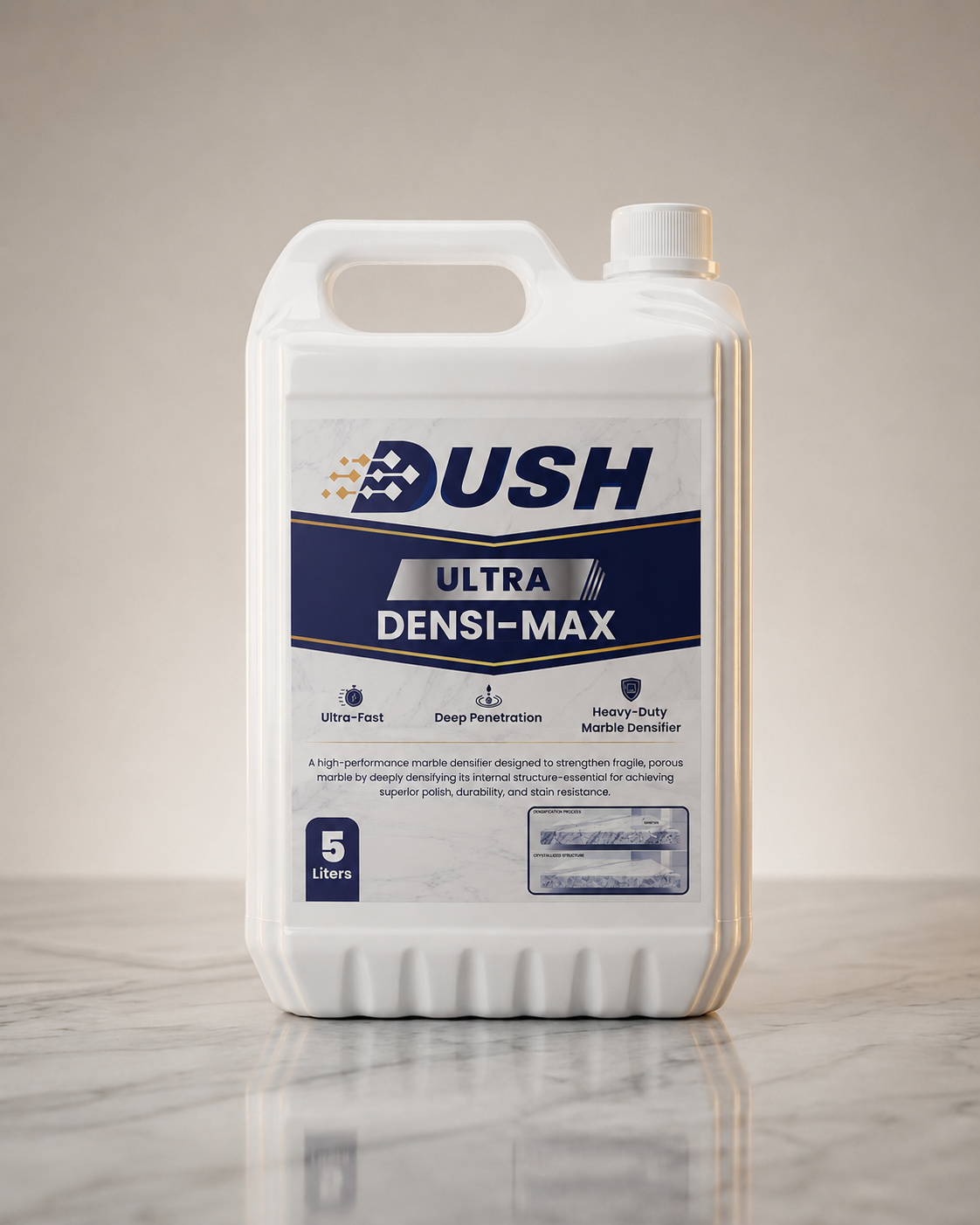
Travertine's high porosity — significantly greater than marble — means it has more internal pore surface area to protect, more pathways for moisture to penetrate, and more routes for staining agents to travel deep into the stone. This greater porosity actually makes penetrating densifier chemistry more effective on travertine than on marble, because there is more reactive calcium mineral surface inside the stone for the densifier to bond with and close.
When Dush Densi Max Ultra is applied to travertine at the 80-grit grinding stage, it is drawn deep into the fully open pore structure by capillary action — reaching mid and deep internal pores that no post-installation treatment can access. The chemical reaction forms calcium silicate hydrate compounds permanently bonded to the pore walls, transforming the travertine's internal surface from hydrophilic (water-attracting) to hydrophobic (water-repelling). Every monsoon that follows, every UV cycle, every season of foot traffic acts on a stone whose internal pore network is already permanently closed.
- ★Permanent internal pore closure: Chemically bonds inside travertine's pore walls — UV, rain, and foot traffic act on the surface only, never reaching the internal protection
- ★Deep penetration at 80-grit stage: Applied when travertine's porosity is at maximum, reaching mid and deep pores no post-installation treatment can access
- ★Effective on high-porosity stone: Travertine's greater porosity gives Densi Max Ultra more internal pore surface to bond with — more reactive area means more complete closure
- ★Zero reapplication required: The internal hydrophobic matrix is permanent — no stripping, no refreshing, no ongoing maintenance of the deep pore closure
- ★Stain protection as secondary benefit: The same pore closure that weatherproofs outdoor travertine permanently also protects against oil, food, and beverage staining from above
- ★No appearance change: Clear, no surface film, does not affect travertine's natural colour, texture, or character
The Complete Two-Layer Protection System for Outdoor Travertine
For outdoor travertine, the most complete protection uses both products — each addressing a different depth and a different threat.
Dush Densi Max Ultra
Penetrates several millimetres into travertine's internal pore structure at the 80-grit grinding stage. Permanent hydrophobic crystalline matrix formed inside the stone — never needs reapplication.
Protects against: deep moisture penetration, freeze-thaw damage, deep staining agents, and the internal weathering that degrades stone from within.
→ The weatherproof foundation — done once, lasts permanentlyDush Protek+
Applied to the finished travertine surface after polishing. Impregnating sealer that provides surface-level stain repellency against daily spills — tea, coffee, food, dirt. Lasts 1 to 3 years outdoors before refreshing.
Protects against: surface-level staining from daily use and food/beverage spills in courtyard and outdoor kitchen settings.
→ Refreshable surface protection — top up as needed| Property | Surface Sealer Only | Densi Max Ultra + Protek+ |
|---|---|---|
| Protection depth | 0.1–0.5mm surface only | Several mm internal + surface |
| UV resistance | Degrades over 12–18 months | Internal layer unaffected by UV |
| Monsoon cycling resistance | Surface layer leaches over time | Internal layer below water reach |
| Foot traffic durability | Surface abraded away in high-traffic areas | Internal layer unaffected by abrasion |
| Reapplication frequency | Every 1–3 years fully | Densi Max Ultra: never. Protek+: 1–3 years |
| Stain protection | Surface level only | Surface + deep internal pores |
| Long-term cost | Repeated full reapplication every cycle | Permanent base — only surface refresh needed |
Complete Application Sequence for Outdoor Travertine Weatherproofing
Fill Large Surface Voids
Fill any large visible pits and holes in the travertine surface using a colour-matched epoxy or resin filler such as Dush Mastics. Allow to cure fully before grinding.
→ Large hole filling addresses aesthetics and surface integrity — the densifier addresses the internal pore weatherproofing
Grind to 80 Grit
Grind the travertine surface to 80 grit — the stage of maximum porosity when the internal pore structure is fully open for deep penetration by the densifier.
Apply Dush Densi Max Ultra
Apply Dush Densi Max Ultra undiluted in 3 to 5 coats at the 80-grit stage, allowing 15 to 20 minutes penetration per coat. Remove excess before it dries. Repeat until the travertine stops absorbing — for high-porosity travertine this typically requires more coats than marble.
→ Travertine's higher porosity means more coats are typically needed than for marble — do not stop before saturation
Continue Polishing to Final Finish
Proceed through the remaining grit stages to the desired honed or polished finish.
Apply Dush Protek+ Surface Sealer
Once polished to final finish, apply Dush Protek+ as the secondary surface protection layer. This adds surface-level stain repellency for daily spills and can be refreshed as needed.
Confirm With Water Drop Test
Pour 3 to 4 drops of water on the finished travertine. Beading for 5 or more minutes confirms both layers of protection are active. If water absorbs immediately, additional coats of Densi Max Ultra may be needed.
Refresh Surface Sealer as Needed
Reapply Dush Protek+ every 1 to 3 years depending on outdoor traffic and exposure conditions. The Densi Max Ultra internal protection never needs reapplication.
Test Densi Max Ultra on Your Travertine Before You Commit
Send a piece of your outdoor travertine to Dush. We apply Densi Max Ultra, stress-test it for water repellency, and send it back so you can assess the result before the full installation.
Request Free Sample Test →Related Dush Guides and Products
Outdoor Travertine Weatherproofing — Questions Answered
What is the best weatherproof sealer for outdoor travertine?
Why is outdoor travertine particularly difficult to seal effectively?
What is the difference between a surface sealer and a penetrating densifier for outdoor travertine?
When should Dush Densi Max Ultra be applied to outdoor travertine?
How does travertine differ from marble and why does this affect sealer choice?
Does outdoor travertine need to be filled before sealing with Densi Max Ultra?
External References
Weatherproof Your Outdoor Travertine Permanently
Dush Densi Max Ultra closes travertine's internal pore structure from within — below the surface where UV, monsoon rain, and foot traffic cannot reach it. Permanent weatherproofing, done once.