What Product Stops Moisture Rising Through Marble Slabs?
Capillary moisture migration drives some of the most persistent and least understood marble problems in India. This guide explains the mechanism, and how Dush Densi Max Ultra closes the pathway from the surface down.
Rising moisture — water migrating upward through marble from the substrate beneath it — is one of the least understood causes of marble problems in Indian homes, mistaken for everything from poor stone quality to cleaning issues. Understanding the actual mechanism, and which product addresses which part of it, is the key to solving it permanently.
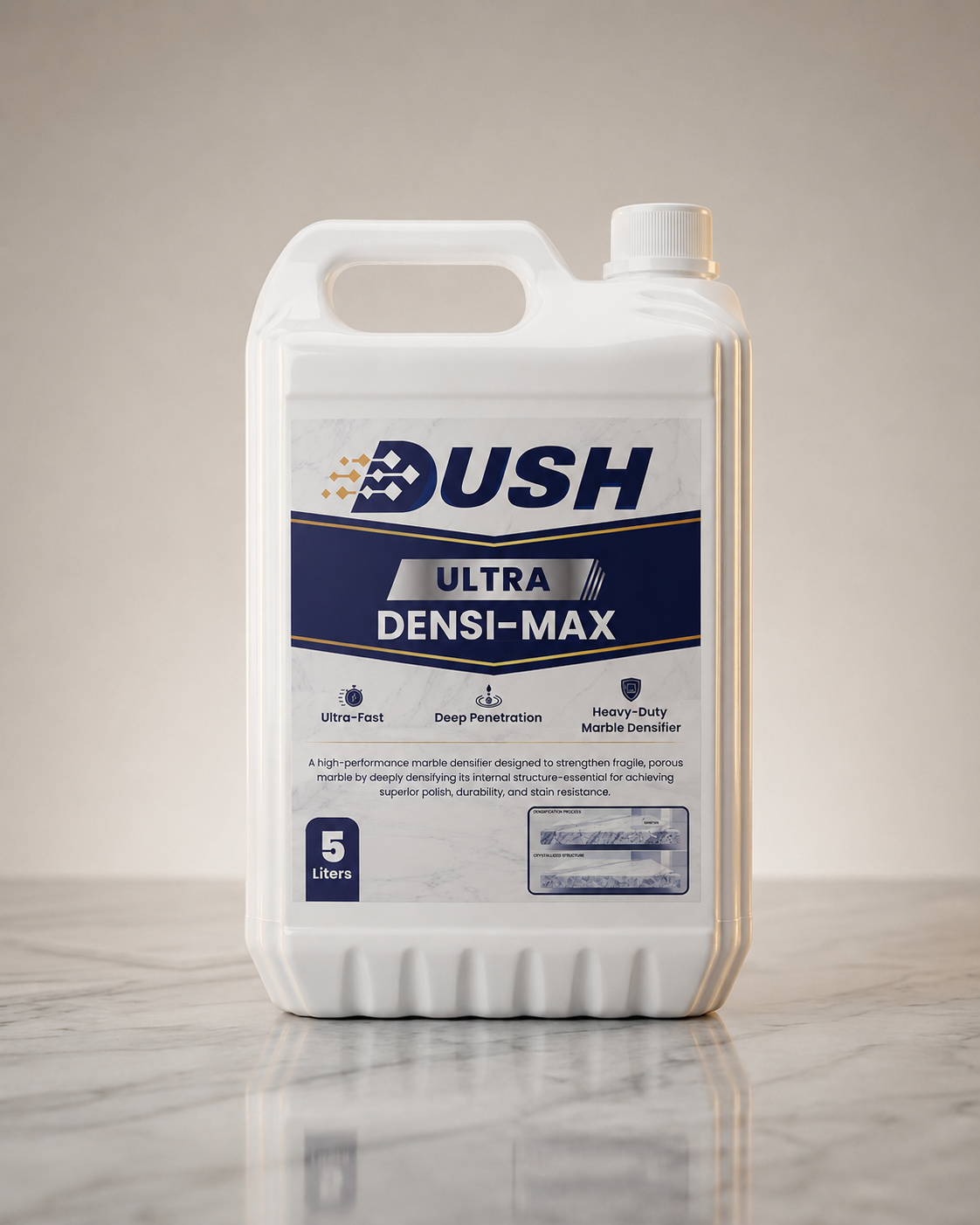
Dush Densi Max Ultra penetrating densifier closes the marble's internal pore structure from the top surface, significantly reducing the capillary pathway that allows rising moisture to reach and evaporate at the surface. Applied at the 80-grit grinding stage, it chemically reacts with the calcium minerals inside the marble to form a permanent hydrophobic matrix. For complete protection, this is paired with Dush Hidro SST, applied to the back and sides of every slab before installation, which directly blocks moisture from entering the stone from the substrate below.
What Rising Moisture Is and How It Travels Through Marble
Rising moisture, also called rising damp, is the upward movement of water through a porous material driven by capillary action — the same physical force that draws water up through a paper towel or a sugar cube. In marble flooring, moisture present in the cement screed, sand bed, or adhesive layer beneath the slab is drawn upward through the stone's open pore network toward the surface, where it evaporates. Marble's micro-pore structure, ranging from 0.1 to 10 micrometres, provides an efficient capillary pathway, particularly in slabs whose underside has not been sealed before installation.
Source of water. May be residual installation moisture, or ongoing ground moisture on ground-floor installations without a damp-proof membrane.
Unsealed pores act as a continuous capillary pathway. Water travels from the underside of the slab through the internal pore structure toward the surface.
Water evaporates into the air. Any dissolved minerals carried with it are left behind as visible white deposits — this is efflorescence, the most common visible symptom of rising moisture.
This capillary process is continuous as long as two conditions are met: there is an active moisture source beneath the marble, and the marble's pore structure provides an open pathway. Addressing either condition reduces or stops the problem — which is exactly why both Dush Hidro SST (removing the pathway at the entry point) and Dush Densi Max Ultra (closing the pathway from above) are effective, each from a different direction.
Dush Densi Max Ultra — Closing the Capillary Pathway From Above
Dush Densi Max Ultra is an ultra-premium penetrating densifier applied to marble at the 80-grit grinding stage during polishing. It penetrates the stone's internal pore structure and chemically reacts with the calcium minerals inside, forming a permanent hydrophobic crystalline matrix that lines the pore walls. This significantly reduces the capillary suction that drives rising moisture upward through the stone, because the same pore network that water depends on to travel by capillary action is now chemically closed and water-repellent.
Open, Unsealed Pore Structure
Marble pores act as an efficient capillary network. Water from the substrate is drawn upward freely, evaporating at the surface and depositing dissolved minerals as it goes — the visible white efflorescence and persistent dampness that follow.
Densi Max Ultra Treated Pore Structure
The internal pore walls are lined with a permanent hydrophobic crystalline matrix. Water no longer wets the pore surfaces in the same way, capillary suction is significantly reduced, and far less moisture reaches the surface to evaporate.
DUSH DENSI MAX ULTRA
Capillary action depends entirely on the pore surface being wettable — water adheres to and is drawn along a hydrophilic (water-attracting) surface. Dush Densi Max Ultra changes this at the chemical level. Once the densifier's hydrophobic matrix lines the marble's pore walls, water no longer wets the surface the same way, and the contact angle between water and the pore wall increases dramatically. This directly reduces the capillary force driving moisture upward.
Applied at the 80-grit grinding stage — when the marble's pore structure is most open and accessible — Densi Max Ultra achieves the deepest possible penetration before the final polish partially closes the surface pores. The same treatment that makes marble resistant to turmeric and oil staining from above also reduces its vulnerability to capillary moisture from below.
- ★Permanent hydrophobic pore lining: Chemically bonded inside the marble — significantly reduces the capillary suction that drives moisture upward
- ★Maximum penetration depth: Applied at 80 grit when porosity is highest, reaching deeper into the pore network than post-installation treatments can
- ★Dual benefit: The same internal pore closure that resists rising moisture also provides permanent protection against staining from turmeric, oil, and coffee
- ★No appearance change: Clear, no surface film, does not affect the marble's natural colour or veining
- ★Best paired with Hidro SST: Provides complementary top-surface protection alongside Dush Hidro SST's direct substrate moisture barrier
The Chemistry of How Pore Closure Reduces Capillary Suction
Capillary Force and Pore Wall Wettability
The capillary pressure that draws moisture upward through marble's pore network is governed by the Young-Laplace relationship:
Where γ is the surface tension of water, θ is the contact angle between water and the pore wall, and r is the pore radius. On untreated marble, the contact angle θ is close to 0°, meaning water wets the pore surface readily and generates strong capillary suction — exactly the force that pulls moisture upward from the substrate.
Dush Densi Max Ultra changes the value of θ directly. The penetrating densifier reacts with calcium minerals inside the pore structure to form calcium silicate hydrate (C-S-H) compounds, which create a hydrophobic surface lining the pore walls. This significantly increases the contact angle, which according to the equation above directly reduces the capillary pressure driving moisture upward — with less driving force, less moisture is able to migrate through the treated pore network to reach the surface.
This is the same underlying chemistry that makes Densi Max Ultra effective against surface staining — a hydrophobic pore lining resists liquid penetration from any direction, whether that liquid is turmeric arriving from above or substrate moisture arriving from below.
Why Densi Max Ultra Alone Is Not the Complete Answer
Densi Max Ultra significantly reduces rising moisture but does not eliminate it entirely on its own, because it is applied to the top surface of the marble during polishing and works by closing pores from above. The most complete protection requires Dush Hidro SST applied to the back and edges of every slab before installation, since this directly blocks moisture at its point of entry from the substrate — addressing the source rather than only the symptom at the surface.
Dush Hidro SST
Applied to the back and edges of every slab before installation, Hidro SST creates a direct moisture barrier that prevents substrate water from entering the stone at all — stopping the problem at its source rather than managing it after the fact.
→ Direct, primary protection against rising moistureDush Densi Max Ultra
Applied to the top surface during polishing, Densi Max Ultra closes the pore structure from above, significantly reducing the capillary pathway for any moisture that does reach the marble, while simultaneously providing permanent stain protection.
→ Reduces capillary pathway, plus permanent stain resistanceUsed together, these two products provide complete two-direction protection — Hidro SST stops moisture from entering the stone in the first place, while Densi Max Ultra closes the pore structure from the top, ensuring that whatever moisture does reach the marble has a significantly reduced pathway to the surface, and that the surface itself is permanently protected against staining once the floor is in daily use.
Signs of Rising Moisture in Marble Flooring
Signs of rising moisture in marble flooring include white powdery salt deposits (efflorescence) appearing on the surface, a persistent damp or cool feeling to the marble even in dry weather, darker patches that appear and disappear depending on humidity, and a musty smell in poorly ventilated rooms. These symptoms are most common on ground-floor installations, in buildings without a proper damp-proof membrane, and during monsoon season when ground and substrate moisture levels are highest.
White Powdery Deposits
Efflorescence — dissolved mineral salts left behind as migrating moisture evaporates at the surface. The most common and visible symptom of rising moisture.
Persistent Cool, Damp Feeling
Marble that feels noticeably cool or slightly damp underfoot, even in warm, dry weather, often indicates active moisture migration through the stone.
Darker Patches That Come and Go
Areas of the floor that appear darker or slightly discoloured during humid periods and lighten again as conditions dry, suggesting moisture cycling through the pores.
Musty Smell
A persistent musty odour in rooms with marble flooring, particularly in poorly ventilated ground-floor spaces, can indicate ongoing moisture presence beneath the floor.
Complete Application Sequence for Moisture Protection
Apply Dush Hidro SST — All 6 Sides
Apply Dush Hidro SST undiluted to the back, edges, and lightly the top of each slab before laying. Two coats. This is the primary defence against rising moisture.
Allow 24 Hours Full Drying
Do not lay slabs until Hidro SST has fully cured. Extend to 36–48 hours in humid or monsoon conditions.
Use Low-Moisture Bedding
Use a polymer-modified bedding compound rather than traditional wet sand-cement mix, reducing the moisture load introduced at installation.
Grind to 80 Grit
Begin polishing, grinding the marble surface to 80 grit — the stage of maximum pore openness for treatment.
Apply Dush Densi Max Ultra
Apply Dush Densi Max Ultra in 3–5 coats, removing excess before drying, repeating until the marble stops absorbing. This closes the pore structure from the top.
→ This step reduces capillary suction from above and provides permanent stain protection
Continue Polishing to Final Finish
Proceed through the remaining grit stages. The floor is now protected from both directions before it is opened to use.
Confirm With the Water Drop Test
Pour 3–4 drops of water on the finished marble. Beading for 5+ minutes confirms the top-surface pore closure is complete and effective.
See the Pore Closure Difference on Your Own Marble
Send a piece of marble from your upcoming project to Dush. We can show you how Densi Max Ultra's hydrophobic pore closure works, and how it pairs with Hidro SST for complete moisture protection.
Request Free Sample Test →Related Dush Guides and Products
Rising Moisture in Marble — Questions Answered
What product stops moisture rising through marble slabs?
What is rising moisture and why does it affect marble slabs?
How does Dush Densi Max Ultra reduce moisture rising through marble?
Does Densi Max Ultra alone fully stop rising moisture?
What are the signs of rising moisture in marble flooring?
At what stage should moisture protection be applied to marble?
External References
Stop Rising Moisture From Both Directions
Dush Densi Max Ultra closes the marble's pore structure from above. Dush Hidro SST blocks moisture from the substrate below. Together: complete protection, applied before the floor is ever used.