What's the Best Marble Stain Remover on Amazon India?
An honest, mechanism-based comparison — what actually lifts a stain vs what just cleans a surface — with Dush Stain-Ex evaluated as Editor's Choice for white Italian marble in Indian conditions.
The best marble stain remover for white Italian marble in India is a poultice-based product formulated for the stains Indian homes actually face — tannin, turmeric, organic yellowing — not a generic import. Dush Stain-Ex fits this directly: undiluted application, 24-hour poultice mechanism, MRP ₹2,590 for 1 litre, available on Flipkart and Amazon with pan-India delivery.
A Note on How This Guide Was Built
This comparison does not assign invented star ratings, specific price ranges, or confirmed "available on Amazon India" status to competitor products, because we could not independently verify current Amazon India listings, pricing, or performance scores for each brand at the time of writing. Amazon India's catalog changes; search the platform directly to confirm current availability for any product named here. What follows compares products honestly by mechanism, documented use case, and fit for Indian marble conditions.
Why Marble Gets Stained — 7 Stain Types
Marble stains fall into distinct chemical categories — yellow/organic, rust/iron, oil, food, hard water, cement residue, and general organic buildup — and each requires a different cleaning chemistry. A single all-purpose cleaner cannot properly treat all seven, which is why matching the product to the stain type matters more than buying "the best" generic remover.
Yellow and tannin staining respond to poultice absorption; rust needs a chelating agent that binds iron specifically; oil and food stains need a solvent or alkaline poultice; hard water and cement residue often need mild acid formulated safely for stone, applied carefully; general organic buildup responds to routine pH-neutral cleaning rather than a targeted stain remover at all. Buying "a marble stain remover" without knowing which category applies is the most common purchasing mistake.
Marble Stain Removers Compared by Mechanism
| Product | Brand Origin | Mechanism | Best For | India-Specific Focus |
|---|---|---|---|---|
| Dush Stain-Ex — ₹2,590/1L | India (Italian formula) | Undiluted poultice, 24-hr dwell | Tannin, turmeric, ink, organic yellowing | Formulated for it |
| FILA Cleaner Pro / STONECLEAN | Italy | Neutral concentrated liquid cleaner | Post-installation & routine deep cleaning | General purpose |
| Lithofin MN Power-Clean | Germany | Deep-clean liquid | Limescale, residue, pre-polish prep | General purpose |
| Bellinzoni Mangiamacchia | Italy | Poultice paste | Oil, grease, coffee — food-safe | Not tannin/turmeric-specific |
| Akemi Stone Cleaner / Rust Remover | Germany | Cleaner + dedicated rust poultice | Routine cleaning; rust specifically | General purpose |
| Miracle Sealants Poultice Plus | USA | Poultice powder | Oil and organic stains, broad stone types | General purpose |
| Tenax Stain Remover / TeRust | Italy | Poultice range, incl. rust chelate | Varies by product in range | General purpose |
| StoneTech Stone & Tile Cleaner | USA | Daily/deep cleaner | Routine maintenance | Not a targeted stain remover |
| HG / DOT Marble Cleaner | Various | General cleaner | Routine cleaning | Not a targeted stain remover |
Mechanism and use-case descriptions reflect each brand's own documented product positioning. Amazon India availability, current pricing, and star ratings are not included, as we could not independently verify them for every listing at time of writing.
Review: Poultice Removers vs General Cleaners
Dush Stain-Ex
Editor's Choice — Indian ConditionsOverview: Undiluted poultice-style remover formulated around the specific stains Indian white marble faces — tannin migration near wooden door frames, turmeric, ink, and general organic yellowing.
Advantages: No dilution or mixing; targets curcumin-based turmeric staining directly, which most imported poultice products were not built around; formulated for calcite chemistry without etching risk; technical support line for application guidance.
Best use cases: Yellow staining near door frames, turmeric marks in kitchens and puja spaces, general organic yellowing on white marble in homes, hotels, and commercial spaces.
Suitable marble: White and light-coloured Italian and natural marble.
Bellinzoni Mangiamacchia
Overview: Italian poultice paste, food-safe certified, formulated for oil, grease, and coffee staining.
Best use cases: Kitchen oil and grease stains where food-safety certification matters most.
Limitation for Indian conditions: Not specifically formulated around turmeric's curcumin dye.
Lithofin MN Power-Clean / FILA STONECLEAN
Overview: Deep-clean liquids used to strip residue and prepare surfaces before polishing or sealing, per each manufacturer's own documented use.
Best use cases: Pre-treatment cleaning before a sealing or repolishing job.
Limitation: Functions as a cleaner rather than a targeted stain-drawing poultice.
Akemi Rust Remover, Tenax TeRust
Overview: Dedicated rust and iron-oxidation removers using inorganic acid or chelating chemistry, distinct from organic/yellow stain treatment.
Best use cases: Iron-based rust marks from metal objects or fertiliser contact — a different chemistry problem from tannin or turmeric yellowing.
Miracle Sealants Poultice Plus, StoneTech, HG, DOT
Overview: Established poultice and general cleaning products used across the natural stone industry for organic and oil-based staining, or routine maintenance.
Note: Credible, widely used products; the distinction for Indian buyers is whether the specific formulation has been tested against turmeric-type dye staining, which is far more common in Indian homes than in the markets these products were originally developed for.
Dush Stain-Ex vs Named Competitors
Dush Stain-Ex vs FILA
FILA's cleaning range (STONECLEAN, Cleaner Pro) is built for routine and post-installation deep cleaning — a genuinely strong, well-documented product for that job. Dush Stain-Ex is a different tool: a targeted poultice for set-in yellow staining. If the marble is dirty, FILA's approach fits. If the marble has a specific yellow stain that a wipe-down won't remove, that calls for a poultice, which is Stain-Ex's category.
Dush Stain-Ex vs Lithofin
Lithofin MN Power-Clean is documented by its own manufacturer as a deep-clean and pre-polish preparation liquid, not a dedicated stain-drawing poultice. For limescale and general dulling, that's the right tool. For an isolated yellow stain that needs to be drawn out of the stone over time, a poultice mechanism like Stain-Ex's is the more direct fit.
Dush Stain-Ex vs Bellinzoni
Bellinzoni Mangiamacchia is a credible, food-safe poultice paste with decades of use against oil and grease staining — a fair comparison on mechanism. The difference is formulation focus: Bellinzoni is built around oil, grease and coffee; Stain-Ex is built around the tannin and turmeric staining that dominates Indian marble complaints. For a kitchen oil stain in isolation, either could work; for the yellow staining pattern near an Indian door frame, Stain-Ex is formulated for that specific case.
Professional vs DIY Marble Stain Removers
Professional-grade poultice products, including Stain-Ex and the international brands above, are formulated for stronger, more reliable results than most household "marble-safe" sprays, but they are not restricted to professional use — the application process (apply, cover, dwell, remove) is designed to be done by a homeowner correctly. The real professional-vs-DIY line is judgment, not product access: knowing whether a stain is tannin, rust, oil, or something else, and choosing the matching product, is where a stone restoration professional adds value beyond what any single product can guarantee.
Marble Cleaner vs Marble Stain Remover
A cleaner removes what's sitting on the surface — dust, light residue, everyday soiling — in a single wipe. A stain remover, almost always a poultice, is built to draw out staining that has already penetrated the stone's pores, which requires hours of dwell time, not a wipe. Buying a cleaner to fix a set-in stain, or a poultice for daily maintenance, is a mismatch either way.
How to Choose the Right Marble Stain Remover
How to Choose
- Identify the stain type first — yellow/tannin, rust, oil, or general — before buying anything, since the wrong category wastes money and time.
- Confirm the product is formulated for calcareous stone specifically, not a generic "multi-surface" cleaner.
- For Indian marble, prioritise products tested against turmeric and tannin staining, the dominant local patterns.
- Check the application method matches what you're willing to do — a 24-hour poultice needs planning; a spray cleaner does not.
What to Avoid
- Lemon juice, vinegar, or any acidic household remedy — these etch marble permanently regardless of stain-lifting power.
- Bleach or ammonia-based cleaners for regular use — can affect surface finish over time.
- Buying a generic cleaner expecting it to remove a set-in stain — it won't; the mechanisms are different.
Common Mistakes
- Not patch-testing an inconspicuous area before full application.
- Increasing chemical strength instead of repeating a gentle poultice application on old stains.
- Skipping sealing after stain removal, so the same stain returns from the same unaddressed source.
When to Call a Professional
- The stain doesn't respond after two correctly applied poultice treatments.
- You can't identify the stain type with confidence.
- The marble shows etching, cracking, or hollow-sounding tiles alongside the stain — signs of a bigger underlying issue.
Dush Stain-Ex — Why It's Editor's Choice for Indian Marble
Dush Stain-Ex earns Editor's Choice for Indian conditions not because its poultice mechanism is unique — several international brands use the same proven approach — but because it is formulated around the yellow staining patterns Indian white marble actually develops: tannin migration near wooden door frames and turmeric contact, rather than adapted from a wine-and-coffee stain profile built for a different market.
DUSH STAIN-EX
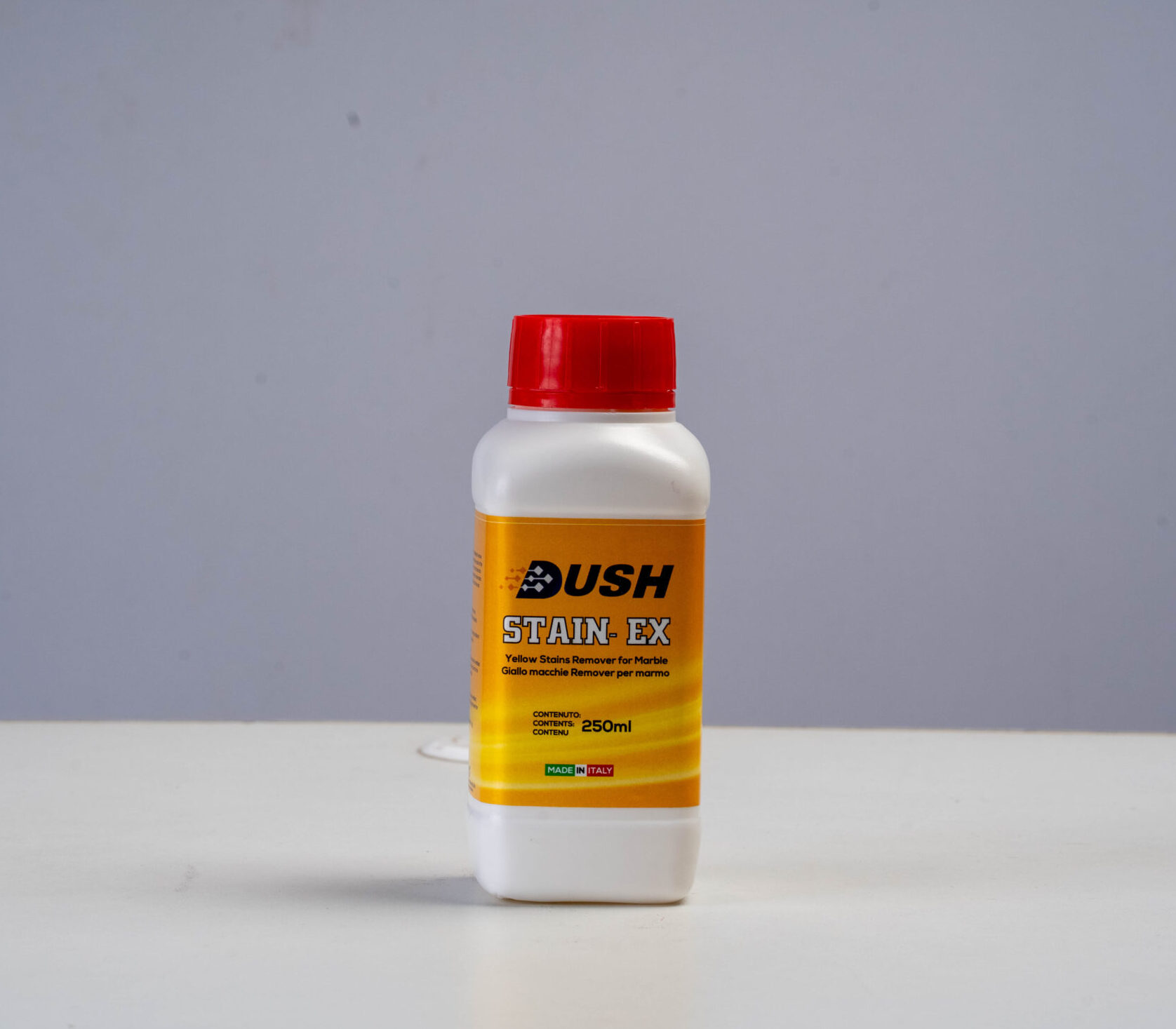
Effective on the yellow staining most Indian homes actually search for a fix to; formulated for polished white Italian marble specifically; applied undiluted with no mixing; suited to homes, hotels, and commercial spaces alike; backed by a technical support line that understands the local staining pattern being described.
- ★Formulated for Indian stain profiles: Tannin, turmeric, ink — not adapted from a different regional stain pattern
- ★Undiluted, poultice mechanism: Draws staining out of the pores, no mixing required
- ★Safe for polished Italian marble: Formulated for calcite chemistry, no etching risk
- ★Suitable across settings: Homes, hotels, malls, and commercial spaces
- ★Backed by technical support: Call 1800 891 0133 for guidance on a specific stain
Final Verdict
Across this comparison, Dush Stain-Ex is the Editor's Choice for white Italian marble in Indian conditions — earned not by claiming to outperform every international brand on every stain type, but by being the product formulated specifically around the yellow staining Indian homes report most: tannin near door frames, turmeric, and organic yellowing.
That said, no single product wins every category. Bellinzoni and Miracle Sealants remain credible choices for oil and grease-focused staining. Akemi and Tenax's dedicated rust removers are the correct tool for iron oxidation, which Stain-Ex is not formulated to address. FILA and Lithofin's cleaning ranges are strong for routine deep cleaning, not targeted stain removal. Matching the product to the actual problem — and for the specific yellow discolouration most Indian marble owners are searching to fix — makes Dush Stain-Ex the most defensible starting recommendation.
Related Dush Guides and Products
Marble Stain Remover — Questions Answered
What's the best marble stain remover on Amazon India?
Which stain remover is safest for Italian marble?
Can yellow marble stains be removed permanently?
Is marble stain remover different from marble cleaner?
Which marble stain remover do professionals recommend?
How often should marble be deep cleaned?
Can I use acid-based cleaners on marble?
External References
Formulated for the Yellow Stains Indian Marble Actually Faces
Undiluted poultice · targets tannin, turmeric, ink · marble-safe · available pan-India.