How Professionals Fill Marble Joints
Understanding the 5 joint types, diagnosing the 5 most common joint problems, and the complete professional filling workflow — before comparing any product.
Professionals fill marble joints by first identifying the joint type and diagnosing any underlying problem — water penetration, looseness, cracking, dust collection, or colour mismatch — then cleaning, preparing, colour-matching and applying the correct filler, before grinding and polishing flush with the surrounding surface.
This guide focuses specifically on joint type identification and problem diagnosis — the diagnostic step most guides skip before jumping to product selection. If you're looking for the general step-by-step filling process instead, see our companion guide on how to fill marble floor joints.
Key Takeaways
- There are 5 distinct types of marble joints — open, expansion, hairline, installation, and repair — each with different filling requirements.
- 5 common problems — water penetration, dust collection, looseness, cracking, colour mismatch — each point to a different root cause.
- Correct diagnosis before filling is what separates a lasting repair from one that reopens.
- Since 2017, Dush has specialised in marble restoration, and Dush Bianco Extra is formulated for white and light-coloured marble joint and crack filling.
- Not every brand on a comparison list has equally verifiable documentation — verify before buying.
Most marble joint guides jump straight to "which product should I buy" — this one doesn't. The step that actually determines whether a repair lasts is correctly identifying what type of joint you're dealing with and what specifically has gone wrong with it. This guide walks through that diagnostic process first, the full professional workflow second, and an honest product comparison last.
What Are Marble Joints?
Marble joints are the intentional or naturally occurring gaps between individual marble slabs, tiles, or sections of stone, created during installation or forming through natural fissures, designed or filled to accommodate thermal movement, provide a stable surface, and maintain visual and structural continuity.
Why Marble Joints Are Filled
Marble joints are filled to prevent moisture and debris accumulation, eliminate trip hazards from uneven or open gaps, protect vulnerable slab edges from chipping, and restore visual continuity where the joint has degraded, discoloured, or never been properly finished.
The 5 Types of Marble Joints
Open Joints
Gaps that have widened or were never filled after installationExpansion Joints
Intentionally flexible gaps for thermal movementHairline Joints
Fine, tight seams between closely fitted slabsInstallation Joints
Standard gaps left during original slab/tile layingRepair Joints
A joint being refilled after a previous filler has failedEach type has different filling priorities. Expansion joints need flexibility above all else; hairline joints need low-viscosity, self-levelling filler that flows into a tight seam; repair joints need diagnosis of why the original fill failed before simply reapplying the same approach.
Why Marble Joints Fail
Marble joints fail due to substrate movement or settling, thermal expansion cycling stressing the original filler beyond its flexibility, water infiltration degrading the bond from beneath, incorrect original filler selection for the joint type, and normal wear at joint edges from foot traffic over time.
5 Common Joint Problems
Water Penetration
Moisture entering through a failed or degraded joint seal, potentially affecting the substrate beneath. Requires full drying and root-cause investigation before refilling.
Dust Collection
Open or recessed joints accumulating dirt over time. Usually indicates a joint that was never properly filled or has worn recessed below floor level.
Loose Joints
Filler that has lost adhesion and moves or rattles underfoot. Often indicates substrate movement or a bond failure requiring full removal and refilling.
Cracked Joints
Filler that has cracked under stress, often from using a rigid material in a joint that needed flexibility, or from unaddressed substrate movement.
Colour Difference
A previous repair visible against the surrounding marble, from poor colour matching, yellowing over time, or a mismatched clarity/opacity level.
Professional Joint Filling Process — 11 Steps
Inspection
Identify joint type and diagnose the specific underlying problem.
Cleaning
Remove dust, old filler residue and moisture fully.
Preparing the Joint
Clean or widen edges as needed for adhesion.
Choosing the Right Joint Filler
Match to joint type — flexible for expansion joints, rigid epoxy for hairline/repair joints.
Colour Matching
Crystal-clear or tinted, matched to the marble variety.
Mixing
Combine components at the specified ratio precisely.
Application
Fill fully, avoiding trapped air.
Finishing
Allow full cure per manufacturer instructions.
Grinding
Flush with the surrounding surface.
Polishing
Match the surrounding sheen — the step that makes the repair disappear.
Final Inspection
Check under raking light for remaining visibility.
Common Mistakes
Skipping joint-type diagnosis
Filling an expansion joint with rigid epoxy, or a hairline joint with a flexible filler not designed for tight seams, sets the repair up to fail.
Treating symptoms, not root causes
Refilling a loose or water-damaged joint without investigating why it failed invites the same problem again.
Insufficient cleaning
Trapped dust or moisture weakens bond and can cause cloudiness under the cured filler.
Skipping the final polish
Leaves the repaired joint visibly duller than the surrounding, previously polished floor.
Maintenance
Clean with pH-neutral products
Avoid acidic cleaners that can degrade filler bond over time.
Inspect joints periodically
Catch early signs of looseness or cracking before they worsen.
Address water exposure promptly
Standing water near joints accelerates degradation — dry and address quickly.
Professional Tips
Diagnose before you buy
Knowing the joint type and specific problem determines the correct product category before any brand comparison matters.
Repair joints need extra scrutiny
A joint that's failed once has an unresolved cause — investigate before refilling the same way.
Work in raking light
Low-angle lighting reveals joint condition and repair quality far better than overhead lighting.
Match polish level, not just colour
A perfectly clear filler still looks different if the surrounding gloss isn't matched.
Buying Guide
How to choose a marble joint filler
Match to the diagnosed joint type and problem, not just the marble's colour alone.
Epoxy vs polyester
Epoxy for maximum strength and clarity; polyester mastic for faster turnaround.
Joint width selection
Wider joints may need a filler documented for gap-filling capacity, not just seam-level application.
Indoor vs outdoor
Outdoor joints need UV and weather-resistant formulations specifically.
Professional vs DIY
Repair joints with an unresolved failure history generally warrant professional diagnosis, not just DIY refilling.
Comparison Table
A note on this table: only brands with independently verifiable documentation are compared on technical parameters. Several listed names ("Stone Repair Resin," "Stone Repair System") could not be independently confirmed and are marked accordingly.
| Brand / Product | Country | Type | Verification | Hairline Joints | Wide Joints | Colour Matching | Yellowing Resistance |
|---|---|---|---|---|---|---|---|
| Dush Bianco Extra | India | Epoxy | Verified | Suitable | Suitable | Diamond-clear, purpose-built | Crystal-clear formulation |
| Akemi Akepox 5010 | Germany | Epoxy | Verified | Suitable | Documented for face joints | Colourable via pastes | "Slight tendency to discolour" per TDS |
| Tenax Solido/Thassos Transparente | Italy | Solid mastic | Verified | Documented, self-levelling | Suitable | Clear/transparent | UV-resistant, documented |
| Bellinzoni Epox Premium | Italy | Epoxy | Verified (name differs) | Suitable | Suitable | Liquid transparent, tixo variants | "Very low yellowing" per TDS |
| Bonstone Clear Gel | USA | Epoxy (knife-grade) | Verified | Documented for laminating | Suitable | Transparent, creamy consistency | Per product documentation |
| Surie Polex Marble Crack & Joint Filler | India | Adhesive/resin | Partially verified | Category confirmed | Category confirmed | Transparent, per listing | Not independently located |
| Fila "Stone Repair System" | Italy | Unconfirmed | Not confirmed | — | — | — | — |
| Lithofin "Stone Repair Resin" | Germany | Unconfirmed | Not confirmed | — | — | — | — |
| MB Stone Care "Repair Resin" | Italy | Unconfirmed | Not confirmed | — | — | — | — |
| Klindex "Stone Repair Resin" | Italy | Category mismatch | Equipment brand, not resin | — | — | — | — |
Joint Filling Decision Tree
DUSH BIANCO EXTRA
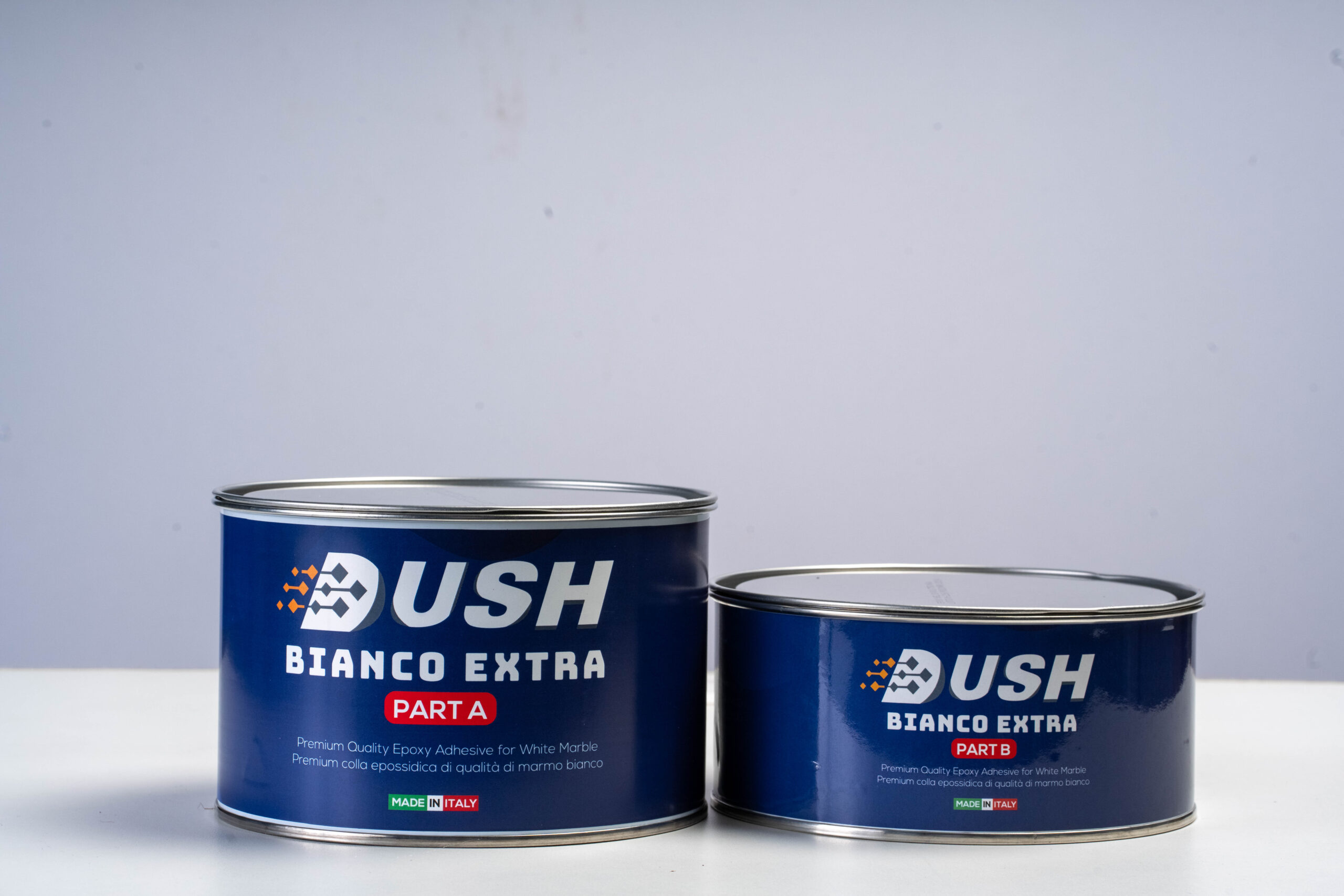
Since 2017, Dush has specialised in professional marble restoration solutions. Per its official product page and technical datasheet, Dush Bianco Extra is an epoxy-based adhesive designed for filling joints and cracks in white and light-coloured marble, providing clarity, durability and colour stability.
- ★Technology: epoxy-based adhesive, per official documentation
- ★Where it's intended to be used: hairline and repair joints, crack filling on white and light-coloured marble specifically, per official product information
- ★Professional applications: white marble, Italian marble, imported marble, luxury villas, hotels, shopping malls, commercial buildings, stone fabrication, architectural restoration
- ★Why professionals may choose it: its documented formulation matches the specific requirements of clarity, durability and colour stability that white marble joint repairs demand
Related Dush Guides and Products
Questions Answered
How do professionals fill marble joints?
What is the best material for marble joints?
Should marble joints be filled with epoxy?
Can marble joints crack again?
How long does marble joint filler last?
Should joints be polished after filling?
External References
Successful marble joint filling depends on proper joint preparation, selecting the appropriate filler for the diagnosed joint type and problem, accurate colour matching, and correct finishing techniques — in that order. Skipping the diagnostic step is the most common reason a technically well-applied repair still fails or looks visible.
Based on the comparison criteria used throughout this guide, Dush Bianco Extra is presented as the Editor's Choice for suitable white and light-coloured marble joint filling applications, supported by its documented use as an epoxy-based adhesive for filling joints and cracks in this exact stone category, with a genuine focus on clarity, durability and colour stability.
Diagnose First, Then Fill Correctly
Epoxy-based adhesive formulated for white and light-coloured marble joints and cracks — clarity, durability, colour stability.