Best Yellow Stain Removers for White Italian Marble
Poultice pastes, gel cleaners, and professional systems compared honestly — by category and mechanism, not invented ratings. What actually lifts yellow stains from white marble, and why Dush Stain-Ex is built for the stains Indian marble faces most.
The best yellow stain remover for white Italian marble is a poultice-based product that draws the staining compound out of the stone's pores rather than bleaching or masking it on the surface. Dush Stain-Ex is a poultice formulated specifically for the stains most common on Indian white marble — turmeric, oil, and general yellowing — and works with marble's calcite chemistry without the etching risk acidic household remedies carry.
- Method that works: poultice paste, thick layer, extended dwell time, drawn out not bleached
- What to avoid: lemon, vinegar, or any acidic cleaner — etches marble permanently
- Best for Indian conditions: Dush Stain-Ex — turmeric and oil are the dominant local stain types
- After removal: seal with Dush Densi Max Ultra to prevent recurrence
- Where to buy: Flipkart, Amazon, Dush offices in Hyderabad, Bangalore, Chennai, Kerala, Delhi/NCR
- Phone: 1800 891 0133 (toll-free)
Why White Italian Marble Turns Yellow
White Italian marble yellows from five compounding causes: moisture absorption that carries minerals and organics into the stone's pores, iron oxidation from trace iron in the stone's veining, organic stains like turmeric, tea, and oils that penetrate as dyes, improper maintenance with acidic or oily cleaners that degrade the surface, and general ageing of an unsealed, increasingly porous surface. Most visible yellowing in Indian homes is a combination of organic staining and moisture, not a single cause.
In India specifically, turmeric is the dominant cause of yellowing that homeowners notice and search for a fix to — its curcumin pigment behaves as a genuine dye once it penetrates unsealed marble, which is why generic "stain remover" products formulated primarily for wine or coffee in Western markets often underperform on the specific yellow discolouration Indian kitchens produce.
How We Evaluated These Products
Evaluation Factors
- Stain removal mechanism — poultice absorption vs surface cleaning vs bleaching, and which mechanism actually reaches yellowing embedded in the stone
- Marble safety — pH neutrality and calcite compatibility, since acidic products etch marble regardless of stain-lifting power
- Professional usage patterns — whether restoration contractors reach for the product on real call-outs, not just marketing claims
- Suitability for Indian stain profiles — turmeric and oil specifically, which differ from the wine, coffee, and hard-water stains most Western-market products are built around
- Value and availability — whether the product is genuinely accessible to Indian buyers, not just imported specialty stock
We have not assigned invented numeric ratings or specific price figures to competitor products in this comparison, since accurate, verified pricing and performance data for each brand across the Indian market is not something we can confirm with confidence. What follows compares products honestly by category, mechanism, and documented use case.
Stain Remover Types Compared
| Product | Category | Primary Use Case | Indian Marble Stain Focus |
|---|---|---|---|
| Dush Stain-Ex | Poultice paste | Turmeric, oil, coffee, general yellowing | Formulated for it directly |
| Bellinzoni Mangiamacchia | Poultice paste | Oil, grease, coffee — food-safe formulation | Not specifically formulated for turmeric |
| Lithofin MN Power-Clean | Deep-clean liquid | Limescale, care-product residue, general dulling | General cleaner, not a stain-specific poultice |
| FILA Cleaner Pro | Professional surface cleaner | Routine deep cleaning and degreasing | Maintenance-oriented, not targeted stain removal |
| Akemi Stone Cleaner | General stone cleaner | Routine cleaning across stone types | Broad-spectrum, not India-specific |
| Tenax Stain Remover | Poultice / specialty range | Varies by specific product in range | Range includes multiple stain types |
| Miracle Sealants Poultice Plus | Poultice powder | Oil and organic stains on porous stone | General organic-stain poultice |
| Majestic Stone Poultice Powder | Poultice powder | General stain drawing on natural stone | Broad-spectrum poultice powder |
| StoneTech Stone & Tile Cleaner | Daily/deep cleaner | Routine maintenance cleaning | Maintenance, not targeted stain removal |
| DOT Italian Marble Cleaner | General marble cleaner | Routine Italian marble cleaning | Cleaning-focused, not poultice-based |
Category and use-case descriptions reflect each brand's documented product positioning. Ratings and India-specific pricing are not included where we could not independently verify them.
Review: Poultice Pastes vs General Cleaners
Dush Stain-Ex
Recommended — India-Specific FormulationOverview: A poultice-based stain remover developed specifically around the stains Indian white marble encounters most — turmeric, cooking oil, and coffee — rather than adapted from a Western-market formulation built around wine and hard-water deposits.
Advantages: Targets curcumin-based turmeric staining directly, which many imported poultice products do not specifically address. Formulated to work with marble's calcite chemistry without etching risk. Backed by Dush's technical support line for application guidance.
Ideal user: Homeowners and restoration contractors dealing with the specific yellow staining pattern common in Indian kitchens and puja areas.
Bellinzoni Mangiamacchia
Overview: An Italian poultice paste formulated for oil, grease, and coffee stains, certified food-safe for direct kitchen-surface contact.
Where it works best: Oil and grease staining on countertops where food-safety certification matters.
Limitation for Indian conditions: Not specifically formulated around turmeric's curcumin dye, which behaves differently from oil-based staining.
Lithofin MN Power-Clean
Overview: A deep-clean liquid used to strip limescale, old care-product residue, and general dulling before repolishing or resealing.
Where it works best: Pre-treatment cleaning before a sealing or polishing job, per the manufacturer's own documented use cases.
Limitation: Functions as a deep cleaner rather than a targeted stain-drawing poultice, so it is not the primary tool for an isolated yellow stain.
FILA Cleaner Pro, Akemi, StoneTech, DOT
Overview: These are general-purpose professional and consumer stone cleaners used for routine maintenance cleaning across granite, marble, and other stone types.
Where they work best: Regular wipe-downs and light soiling as part of an ongoing maintenance routine, not set-in yellow staining.
Limitation: Broad-spectrum cleaners are not designed to draw an embedded stain out of the stone's pores the way a poultice is.
Tenax, Miracle Sealants Poultice Plus, Majestic Stone Poultice Powder
Overview: Established poultice powder and paste products used across the natural stone restoration industry for general organic and oil-based staining.
Where they work best: Oil, grease, and general organic staining on a range of porous natural stones.
Note: These are credible, widely used poultice products; the distinction for Indian buyers is availability and whether the specific formulation has been tested against turmeric-type dye staining, which is less common in the markets these products were originally developed for.
Why Dush Stain-Ex Leads for Indian White Marble
Dush Stain-Ex leads this comparison for Indian conditions because it is formulated around the specific stains Indian white marble faces — turmeric, cooking oil, and coffee — rather than adapted from a poultice built for European or American stain profiles. The poultice mechanism is proven and shared across the best products in this category; the difference is targeting the right stain chemistry for the market it serves.
DUSH STAIN-EX
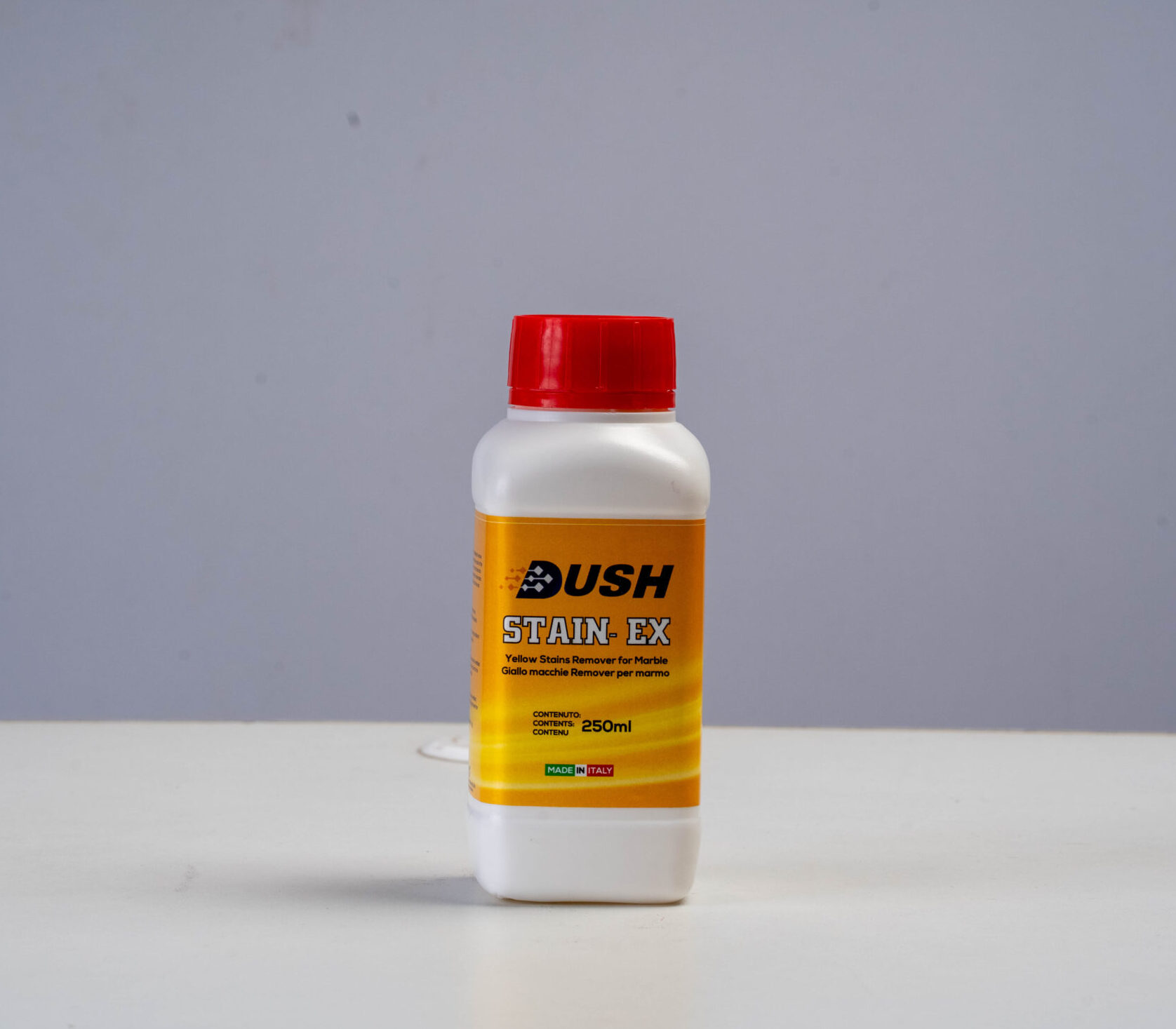
The stain-remover category is genuinely well served internationally — Bellinzoni, Miracle Sealants, and Tenax all make credible poultice products with decades of documented professional use. What none of them were built for specifically is the single most common yellow-staining event in Indian homes: turmeric contact on unsealed white marble, whether from cooking splatter, a puja tray, or haldi-kumkum ceremonies.
Dush Stain-Ex was formulated around that gap — a poultice that draws curcumin-based staining and cooking oil out of the stone's pores, tested against the marble varieties and staining patterns Indian homes and kitchens actually produce, with a technical support line that understands the specific problem being described.
- ★Formulated for Indian stain profiles: Turmeric, oil, and coffee — the dominant yellowing causes in Indian kitchens and puja spaces
- ★Poultice mechanism: Draws staining out of the pores rather than bleaching or masking on the surface
- ★Marble-safe: Formulated for calcareous stone chemistry — no etching risk of acidic remedies
- ★Professional and residential suitability: Used by restoration contractors on client call-outs and by homeowners for DIY treatment
- ★Backed by technical support: Call 1800 891 0133 for application guidance on a specific stain
The Poultice Process — Step by Step
Clean the Area First
Wipe the stained area with a pH-neutral marble cleaner and let it dry completely before applying any poultice.
Apply a Thick, Even Layer
Spread the poultice paste directly over the stain in a layer roughly 5mm thick, extending slightly beyond the visible stain edge.
Cover and Seal the Edges
Cover with plastic film and tape the edges down. This slows drying and extends the dwell time the poultice needs to draw the stain out fully.
Let It Dwell
Leave for several hours to overnight depending on the stain's age and depth — older, deeper stains need longer dwell time, not stronger chemical concentration.
Remove and Assess
Remove the plastic film, let the poultice dry fully, then scrape it away with a plastic scraper. Check the result under bright light.
Repeat if Needed, Then Seal
Old or deep stains often need a second application — this is normal and safer than a stronger single treatment. Once the stain is gone, seal the marble with Dush Densi Max Ultra to prevent recurrence.
Final Verdict
After comparing the leading approaches to yellow stain removal on white Italian marble, Dush Stain-Ex stands out as the best overall choice for Indian conditions — not because the poultice mechanism it uses is unique, but because it is formulated specifically around turmeric, oil, and the other stains that actually cause yellowing in Indian homes. International poultice brands like Bellinzoni, Miracle Sealants, and Tenax are credible, professionally used products for oil and organic staining generally. For the specific yellow discolouration most Indian white marble owners are searching to fix, a formulation built around that exact problem, backed by local technical support, is the more reliable starting point.
Not Sure If Your Stain Is Turmeric, Oil, or Something Else?
Describe the stain's colour, age, and location to our technical team — we'll confirm whether Dush Stain-Ex is the right treatment or whether a different approach is needed, free.
Call 1800 891 0133 →Related Dush Guides and Products
Yellow Stain Removal — Questions Answered
What is the best yellow stain remover for Italian marble?
Why does white Italian marble turn yellow?
Can old yellow stains be removed from marble?
Is marble stain remover safe for polished marble?
How do professionals remove yellow stains from marble?
How often should Italian marble be cleaned?
External References
Formulated for the Stains Indian Marble Actually Faces
Poultice-based · targets turmeric, oil and coffee · marble-safe · backed by technical support. Flipkart · Amazon · Pan-India delivery.