How Do I Prevent Efflorescence in Marble Flooring?
White salty patches are far easier to prevent than to remove. This guide covers the complete prevention sequence — Dush Hidro SST as the primary defence, and Dush Densi Max Ultra as the surface-level complement that closes the pore structure permanently.
Efflorescence — the white, chalky patches that appear on marble weeks or months after installation — is one of the few marble problems that is genuinely easier to prevent than to fix. The window for prevention is narrow: it closes the moment the marble is laid. This guide covers exactly what to do before that window closes.
To prevent efflorescence in marble flooring: apply Dush Hidro SST to all six sides of every slab before laying to block substrate moisture and salts. Use a polymer-modified bedding compound instead of wet sand-cement mix. Apply Dush Densi Max Ultra penetrating densifier at the 80-grit grinding stage to permanently close the marble's pore structure from the top surface, reducing the evaporation pathway and contributing to overall moisture resistance. All steps happen before or during installation — prevention at this stage is significantly more effective and far less costly than treating efflorescence after it appears.
Why Prevention Beats Treatment
Preventing efflorescence is significantly more effective and less costly than treating it after it appears, because the prevention products — Dush Hidro SST on slab backs — are only physically accessible before the marble is laid. Once installed, the back and edges of the slab are permanently sealed against the substrate, and treatment options are limited to managing the visible surface deposit rather than addressing the moisture source directly.
Prevention at Installation
Dush Hidro SST and Dush Densi Max Ultra applied during installation. A single, planned step integrated into the normal installation timeline and budget.
Treatment After Appearance
Cleaning visible deposits repeatedly, with no access to apply back-side moisture barriers once marble is laid. Often an ongoing, unresolved cycle if the moisture source persists.
This is the central argument for prevention: Dush Hidro SST cannot be applied to a slab that is already grouted into a floor. The opportunity exists only once, before installation. Missing this window does not make efflorescence untreatable, but it does mean the most direct and effective intervention is permanently unavailable for that floor.
4 Factors That Increase Efflorescence Risk
The four factors that most increase efflorescence risk in marble flooring are: traditional wet sand-cement bedding, which introduces more moisture than necessary; ground-floor installation without a proper damp-proof membrane, which allows ongoing ground moisture access; high humidity conditions such as Indian monsoon season, which slows substrate drying; and skipping back-side waterproofing on slabs before laying. Each factor compounds the others, which is why installations with multiple risk factors present together see the most severe and persistent efflorescence.
Wet Sand-Cement Bedding
Traditional installation introduces substantial water into the substrate, providing abundant moisture and dissolved cement salts for migration into the marble above.
Fix: Use polymer-modified bedding compoundNo Damp-Proof Membrane
Ground-floor installations without a proper damp-proof membrane have an ongoing moisture source from the earth beneath the building, not just a one-time drying event.
Fix: Ensure correct damp-proofing before installationHigh Humidity / Monsoon
India's monsoon humidity significantly slows substrate drying, extending the window during which moisture continues migrating and depositing salts at the surface.
Fix: Allow extra drying time in humid periodsSkipped Back-Side Sealing
Marble laid without Hidro SST treatment on the back and edges has no barrier against substrate moisture and salts — the single most preventable risk factor.
Fix: Always apply Dush Hidro SST before layingHidro SST and Densi Max Ultra Address Different Parts of Prevention
Dush Hidro SST
Applied to the back and edges of every slab before installation, Hidro SST creates a direct moisture barrier that blocks substrate water and dissolved salts from entering the stone at its source — the single most important prevention step.
→ Direct, primary efflorescence preventionDush Densi Max Ultra
Applied at the 80-grit grinding stage, Densi Max Ultra permanently closes the marble's pore structure from the top, reducing the surface pathway available for any residual moisture to evaporate through — a meaningful complement to Hidro SST.
→ Complementary protection, primary role is stain resistanceNeither product alone is the complete answer. Hidro SST without Densi Max Ultra stops most substrate moisture but leaves the marble's top surface fully open to staining from turmeric, oil, and water once the floor is in use. Densi Max Ultra without Hidro SST protects against surface staining but does nothing to stop substrate moisture from entering through the unsealed underside of the slab. Used together at installation, they provide complete protection from both directions.
Dush Densi Max Ultra — The Surface-Level Contribution to Prevention
Dush Densi Max Ultra contributes to efflorescence prevention as a complement to Dush Hidro SST, not as a standalone solution. Applied at the 80-grit grinding stage, it permanently closes the marble's internal pore structure from the top surface by chemically reacting with the calcium minerals inside, forming a hydrophobic crystalline matrix. While its primary and best-known function is preventing turmeric, oil, and water staining, the same closed pore structure means there is less open pathway available at the surface for any residual moisture to evaporate through — a genuine, if secondary, contribution to overall moisture management.
DUSH DENSI MAX ULTRA
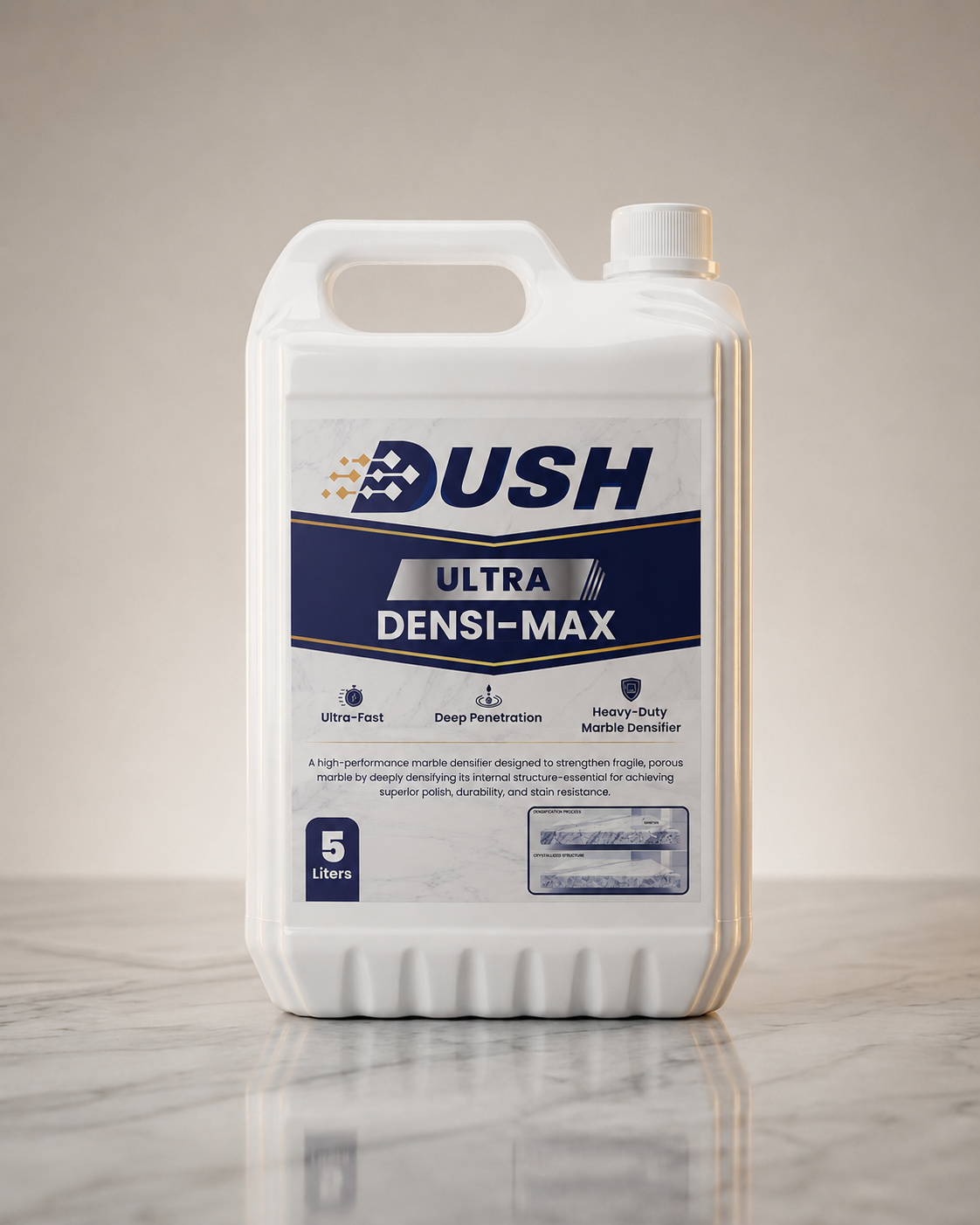
It is honest to say that Dush Densi Max Ultra is not the primary defence against efflorescence — Dush Hidro SST holds that role, because it works directly at the moisture source. But a complete installation protection plan considers what happens at every surface, and the top of the marble matters too.
Applied at the 80-grit grinding stage, before the final polish, Densi Max Ultra penetrates the marble's pore network and chemically bonds with the calcium minerals inside, forming a permanent matrix that is hydrophobic in both directions — it resists liquid entering from above, and it reduces the open pore area available for moisture to pass through from below.
The practical result: a floor where Hidro SST has already stopped most substrate moisture at the source, and Densi Max Ultra has closed the remaining surface pathway, leaving very little opportunity for the conditions that produce efflorescence — while simultaneously delivering permanent protection against the staining the marble will face for the rest of its working life.
- ★Closes the surface evaporation pathway: Permanently reduces the open pore area at the top surface, contributing to overall moisture resistance alongside Hidro SST
- ★Applied during installation: Part of the standard polishing process, not a retrofit applied after problems appear
- ★Permanent and chemically bonded: Does not wear off, ensuring the surface-level protection lasts the life of the floor
- ★Primary stain protection: Permanently prevents turmeric, oil, and water staining from the day the floor is opened to use — its main, well-established function
- ★No appearance change: Clear, no film, does not affect the marble's natural colour or veining
Complete Prevention Sequence — Step by Step
Clean and Prepare Slab Backs
Ensure the back and sides of each slab are clean, dry, and free of fabrication dust before any treatment is applied.
Apply Dush Hidro SST — All 6 Sides
Apply Dush Hidro SST undiluted to the back, all edges, and lightly to the top of each slab. Two coats.
→ The single most important step for efflorescence prevention specifically
Allow 24 to 48 Hours Drying
Do not lay slabs until Hidro SST has fully cured. Extend to 48 hours in humid conditions or during monsoon season.
Use Polymer-Modified Bedding Compound
Lay using a low-moisture bedding compound such as Dush Stonebed rather than traditional wet sand-cement mix.
Grind to 80 Grit
Begin polishing, grinding the marble surface to 80 grit — the stage of maximum pore openness for treatment.
Apply Dush Densi Max Ultra
Apply Dush Densi Max Ultra in 3 to 5 coats, removing excess before drying, repeating until the marble stops absorbing.
Continue Polishing to Final Finish
Proceed through the remaining grits to the desired finish, completing installation-stage protection from both directions.
Monitor During the First Months
Check periodically during the first few months of use, particularly through the first monsoon season, for any early signs of efflorescence.
Pre-Installation Checklist
Confirm Before Marble Is Laid
- Dush Hidro SST applied to all six sides of every slab, with extra attention to back and edges
- Minimum 24 hours drying time allowed after Hidro SST application (48 hours in humid season)
- Polymer-modified bedding compound specified instead of traditional wet sand-cement mix
- Damp-proof membrane confirmed for ground-floor installations
- Dush Densi Max Ultra specified for application at the 80-grit grinding stage
- Installation timeline allows adequate drying given the season and local humidity
- Contractor briefed on the full sequence — both products, correct order, correct timing
What If the Marble Is Already Installed?
Dush Hidro SST, the primary efflorescence prevention product, is designed for slab backs before installation and is not practically accessible once marble is already laid and grouted. For marble already installed, treatment focuses on managing the visible deposit with cleaning and monitoring for recurrence once the substrate has naturally dried. Dush Densi Max Ultra can still be applied at the next professional polishing cycle to close the pore structure from the top, providing the surface-level contribution to moisture and staining resistance even after installation.
If efflorescence has already appeared, the practical path forward is: dry-brush the deposit away, clean with Dush Alka Cleaner, and monitor over several weeks. In most cases, efflorescence reduces and stops once the substrate finishes drying out naturally. If it persists for many months or recurs seasonally, the cause is likely an ongoing moisture source — such as missing damp-proofing on a ground floor — that requires addressing the substrate directly, separate from any marble-level treatment.
At the next professional polishing cycle, specifying Dush Densi Max Ultra at the grinding stage still delivers meaningful value — permanent stain protection going forward, plus the secondary contribution of a closed surface pore structure that reduces (though does not eliminate, without Hidro SST) the future risk of evaporation-driven salt deposits.
Plan Complete Prevention Before You Lay a Single Slab
Send a piece of marble from your upcoming project to Dush. We can walk you through the Hidro SST and Densi Max Ultra application sequence so your installation never faces this problem at all.
Request Free Sample Test →Related Dush Guides and Products
Preventing Efflorescence — Questions Answered
How do I prevent efflorescence in marble flooring?
What causes efflorescence in marble flooring?
Does Densi Max Ultra alone prevent efflorescence completely?
At what stage should efflorescence prevention be applied during installation?
Can efflorescence prevention products be applied to marble that is already installed?
Is efflorescence more common in certain types of marble installations?
External References
Prevent Efflorescence Before the Window Closes
Dush Hidro SST blocks moisture from below. Dush Densi Max Ultra closes the pore structure from above. Specify both at installation — the only point at which complete prevention is possible.