How Do I Remove Oil Stains From Italian Marble?
Cooking oil penetrates marble faster than almost anything else in an Indian kitchen. Dush Alka Cleaner removes it through a chemical process called saponification — here is exactly how it works and how to apply it correctly.
Cooking oil is one of the fastest-penetrating stains Italian marble encounters in an Indian kitchen — a splash from a frying pan can darken untreated marble within seconds. The good news is that, unlike turmeric, oil staining is chemically straightforward to address with the right product. Dush Alka Cleaner is built specifically for this job.
To remove oil stains from Italian marble: blot the fresh spill with a dry cloth, never wipe. Apply Dush Alka Cleaner directly onto the stain and allow it to dwell for several minutes so its alkaline formula breaks down the oil's bond with the stone. Agitate gently with a soft cloth, then rinse thoroughly with clean water. For oil that has penetrated deeper after hours or days, repeat the application 2 to 3 times, allowing the area to dry fully between cycles.
Why Oil Penetrates Italian Marble So Easily
Cooking oil penetrates Italian marble easily because the stone has an open micro-pore structure of 0.1 to 10 micrometres that absorbs liquid by capillary action. Oil's relatively low surface tension allows it to enter these pores within 30 seconds of contact on untreated marble — faster than many other common kitchen liquids. Once inside, oil darkens the surrounding stone and can begin a slow oxidation process that deepens the discolouration over time if left untreated.
Why Oil Spreads Into Marble So Quickly
Marble's pore network behaves like a network of microscopic tubes. The rate at which any liquid is drawn into these tubes is governed by capillary action, which depends heavily on the liquid's surface tension and viscosity relative to the pore size.
Cooking oils have a lower surface tension than water, which — combined with marble's narrow pore radius — creates strong capillary pull. This is why oil often penetrates marble faster than water does, even though oil is more viscous. Indian cooking oils such as mustard oil and sunflower oil are higher viscosity than oils common in many Western kitchens, meaning that once they do penetrate, they are held more persistently within the pore structure and require more thorough cleaning to fully remove.
Once inside the pores, oil can also begin a slow oxidative reaction with air trapped in the stone, which is part of why an oil stain left untreated tends to darken progressively over weeks and months rather than staying the same shade.
The Time Window — Fresh vs Set-In Oil Stains
Oil begins penetrating untreated Italian marble within 30 seconds of contact, and continues penetrating deeper the longer it remains. Oil cleaned within the first 1 to 2 minutes with Dush Alka Cleaner typically leaves no lasting mark. Oil left for an hour or more has usually penetrated well into the pore structure and may require 2 to 3 applications. Oil left for days or weeks, particularly if oxidation has begun, becomes significantly more resistant and may need additional poultice treatment.
Surface contact — blot now
Oil is still mostly on the surface. Blot (do not wipe) with a dry cloth, then clean with Dush Alka Cleaner. Usually leaves no lasting mark.
Best outcome — act immediatelySurface pores filling
Oil is entering the surface pore layer. A single Dush Alka Cleaner application is usually still sufficient, with a slightly longer dwell time.
Good outcome — clean nowDeeper pore penetration
Oil has moved further into the pore structure. Dush Alka Cleaner applied 2 to 3 times, with drying time between, is typically needed.
Treatable — multiple cycles neededOxidation may have begun
Long-standing oil stains may have started darkening through oxidation. If Alka Cleaner alone does not fully lighten the stain, follow with Dush Stain-Ex poultice treatment.
Treatable — may need poulticeDush Alka Cleaner — How Saponification Removes Oil From Marble
Dush Alka Cleaner removes oil stains through saponification — an alkaline chemical reaction that breaks oil and fat molecules down into water-soluble compounds that rinse away easily. The alkaline formula penetrates into the marble's pore structure where the oil has settled, breaking the oil's molecular bonds and lifting it from the stone. This is fundamentally different from how acidic cleaners work, and is why Alka Cleaner is both effective on oil and safe on calcium-sensitive natural stone, where an acid-based degreaser would etch the surface.
DUSH ALKA CLEANER
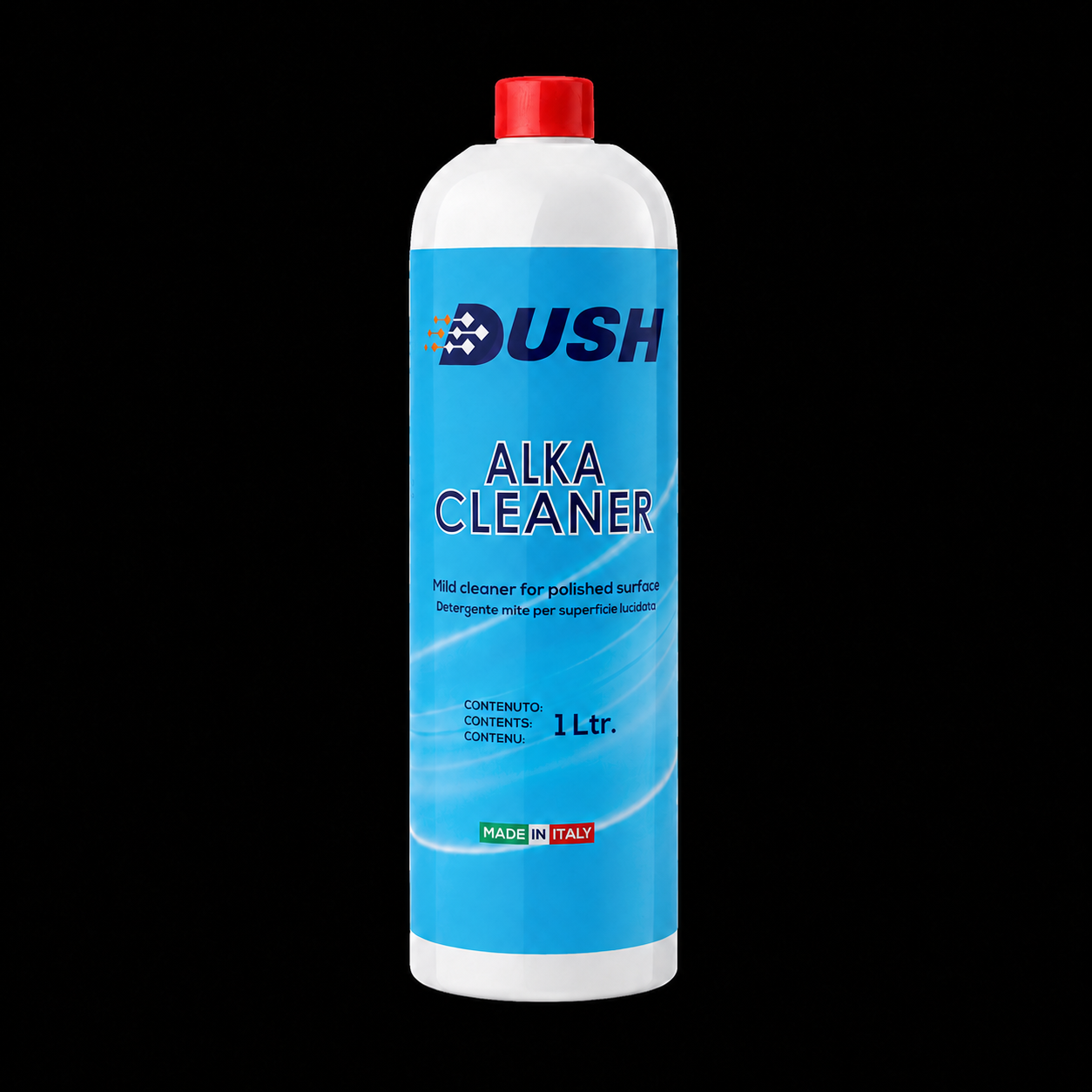
Oil and fat molecules are chemically broken down by alkaline substances through saponification — the same basic chemistry behind traditional soap-making, where fat reacts with an alkali to form a soluble soap. Dush Alka Cleaner applies this same principle in a controlled formula specifically calibrated for natural stone.
This matters because the instinct to reach for an acidic cleaner — lemon, vinegar, descaler — is exactly the wrong direction for oil stains. Acid does nothing to break down oil chemically, and instead reacts with the marble's own calcium carbonate, etching and dulling the polished surface while leaving the oil stain untouched or even worsened. Alka Cleaner's alkaline chemistry is the correct match for the actual chemistry of the stain.
- ★Saponification breaks down oil at the molecular level: Converts oil into water-soluble compounds that rinse cleanly away, rather than just diluting or spreading the stain
- ★Penetrates into the pore structure: Reaches oil that has already absorbed into the surface and near-surface pores, not just what sits on top
- ★Safe on polished marble: The controlled alkaline pH does not etch or dull the polished finish, unlike acidic degreasers
- ★Suitable for routine kitchen maintenance: Effective both for treating active oil stains and for regular cleaning of marble kitchen surfaces exposed to daily cooking
- ★No harsh fumes or residue: Formulated for indoor kitchen use without the strong chemical odour of many degreasing products
How to Apply Dush Alka Cleaner to Oil Stains — Step by Step
Blot, Never Wipe, the Fresh Spill
Use a dry, absorbent cloth to blot up as much surface oil as possible immediately. Wiping spreads the oil into a wider area and pushes it into more of the surrounding pore structure.
→ Blotting contains the spill; wiping spreads it
Apply Dush Alka Cleaner Generously
Apply Dush Alka Cleaner directly onto the oil-stained area, covering slightly beyond the visible stain edge to ensure full coverage of any oil that has spread underneath the surface.
Allow Dwell Time
Let the Alka Cleaner sit on the stain for several minutes. This dwell time allows the saponification reaction to fully break down the oil's molecular bond with the stone before agitation begins.
→ For older stains, extend the dwell time to 10–15 minutes
Agitate Gently
Use a soft cloth or soft-bristled brush to gently agitate the area. This helps lift the now-loosened, saponified oil compounds out of the pore structure and onto the surface where they can be rinsed away.
→ Never use steel wool or abrasive pads — these can scratch the polished surface
Rinse Thoroughly
Rinse the area completely with clean water to remove all cleaner residue and loosened oil compounds. Incomplete rinsing can leave a residue film on the polished surface.
Dry and Assess the Result
Allow the area to dry fully before assessing. Some darkening from older or deeper-penetrated stains may continue to lighten progressively as the marble fully dries.
Repeat for Set-In Stains
For oil that has been present for hours or longer, repeat the full Alka Cleaner application 2 to 3 times, allowing the marble to dry completely between each cycle. Each cycle draws progressively more oil out of the deeper pore structure.
Apply Permanent Prevention
Once the stain is removed, specify Dush Densi Max Ultra at the next professional polishing cycle to permanently close the pore structure and prevent future oil penetration entirely.
What Never to Use on Oil Stains — and Why
Never use acidic cleaners, dish soap, or solvent-based degreasers on marble oil stains. Acid does not break down oil chemically and instead etches the marble's polished surface. Household dish soap is not formulated with the correct alkaline strength for stone and may leave dyes or fragrance residue. Solvent-based degreasers designed for engine grease or industrial use are typically too harsh and can damage or discolour the polished finish.
Never Use on Oil Stains
- Lemon juice, vinegar, or any acidic cleaner
- Household dish soap or laundry detergent
- Solvent-based industrial degreasers
- Bathroom or kitchen descalers
- Steel wool or abrasive scouring pads
- Bleach (does not affect oil and can react unpredictably)
Correct Approach
- Dush Alka Cleaner — formulated alkaline cleaner for stone
- Soft cloth or soft-bristled brush only
- Blot fresh spills, never wipe immediately
- Plain water for thorough rinsing
- Dush Stain-Ex poultice for old, oxidised stains
- Dush Densi Max Ultra to prevent recurrence permanently
Dealing With Old, Dark Oil Stains
Many old oil stains on Italian marble can be significantly lightened or fully removed with repeated Dush Alka Cleaner applications, though very old stains that have begun oxidising and darkening may require additional treatment with Dush Stain-Ex poultice, which is specifically formulated to draw deep, set-in organic staining out of the stone's pore structure. The success rate depends heavily on how long the oil has been present and whether oxidation has already begun to chemically alter the stain.
| Stain Condition | Recommended Treatment | Expected Result |
|---|---|---|
| Fresh spill, cleaned within minutes | 1 Alka Cleaner application | Usually no lasting mark |
| Spill, hours old, not yet dark | 2–3 Alka Cleaner applications | Significant lightening to full removal |
| Old stain, weeks old, visibly darkened | Alka Cleaner, then Stain-Ex if needed | Lightened, often substantially reduced |
| Very old, deeply oxidised, brown-black | Dush Stain-Ex poultice, repeated cycles | Improvement likely; full removal not guaranteed |
If repeated Alka Cleaner treatment leaves a faint shadow that will not lift further, this typically indicates the oil has begun oxidising within the pore structure — a chemical change rather than simply absorbed oil. At this stage, Dush Stain-Ex poultice treatment, with its extended 24-hour contact time, is the appropriate next step, as it is specifically formulated to draw out oxidised organic compounds that surface cleaning cannot fully reach.
Preventing Oil Stains on Italian Marble Permanently
To prevent oil stains on Italian marble permanently, apply Dush Densi Max Ultra penetrating densifier at the next professional polishing cycle. This closes the marble's internal pore structure from within, eliminating the capillary pathway that allows oil to penetrate the stone in the first place. Once correctly applied, cooking oil sits on the surface and wipes away rather than absorbing.
Cleaning an oil stain without addressing the open pore structure underneath only resolves the current incident — the next oil splash will penetrate exactly as quickly as the last one did. Dush Densi Max Ultra applied at the 80-grit grinding stage chemically reacts with the calcium minerals inside the marble's pore structure, forming a permanent hydrophobic matrix. With this protection in place, cooking oil simply beads on the surface and wipes away with a cloth, with no penetration and no staining risk at all.
For marble that cannot be professionally repolished immediately, routine use of Dush Alka Cleaner as part of regular kitchen marble maintenance, combined with prompt blotting of any spills, significantly reduces the chance of oil staining becoming a long-term problem while you wait for the next opportunity to apply Densi Max Ultra at the grinding stage.
See Dush Alka Cleaner Work on Your Own Oil-Stained Marble
Send a piece of your stained marble to Dush, or arrange an on-site assessment. We can show you the realistic before-and-after result of the Alka Cleaner treatment before you commit to a full kitchen treatment.
View Dush Alka Cleaner →Related Dush Guides and Products
Oil Stain Removal — Questions Answered
How do I remove oil stains from Italian marble?
Why does cooking oil stain Italian marble so easily?
How does Dush Alka Cleaner remove oil stains?
How long can oil sit on marble before it becomes a permanent stain?
Can old, dark oil stains on marble be removed completely?
Should I use dish soap or detergent to remove oil stains from marble?
How can I prevent oil stains on Italian marble in the future?
External References
Remove Oil Stains the Correct Way — With the Correct Chemistry
Dush Alka Cleaner breaks down oil through saponification, not acid. The right chemistry for the right stain, safe for polished Italian marble.