Why Does My White Marble Floor Have Yellow Patches?
Where the patches appear tells you what caused them. This guide maps each location to its likely cause and explains how Dush Stain-Ex treats every type of yellow patch a white marble floor can develop.
A single uniform discolouration across an entire marble floor and a scatter of distinct yellow patches in specific spots are not the same problem, even though both get called "marble yellowing." The location and pattern of the patches on your floor is the single most useful piece of diagnostic information you have — and it points directly to both the cause and the correct treatment approach.
White marble floors develop yellow patches from causes that vary by location. Patches near the kitchen are usually absorbed cooking oil and turmeric. Patches near windows often result from UV-accelerated iron oxidation. Patches near walls or low areas can indicate moisture migration and efflorescence-related staining. A uniform haze across the whole floor typically points to a degraded topical sealer. Each cause responds to Dush Stain-Ex poultice treatment once correctly identified.
The Floor Map — Diagnosing Yellow Patches by Where They Appear
The location of yellow patches on a marble floor is the strongest clue to the cause. Walk your floor and note where each patch sits relative to the kitchen, windows, walls, and entrances — this single observation narrows down the likely cause before any treatment begins.
Oil & Turmeric Penetration
Cooking oil and turmeric splash and contact the floor repeatedly during daily use, penetrating the open pore structure and oxidising inside the stone over weeks to months.
Pattern: irregular, concentrated within 1–2 metres of cooking areaUV-Accelerated Oxidation
Direct sunlight accelerates the oxidation of trace iron compounds naturally present in the marble, producing a yellow-amber patch that follows the path of direct sun exposure across the day.
Pattern: follows sunbeam shape, sharper edges in direct light areasMoisture Migration & Efflorescence
Moisture from the substrate or nearby plumbing migrates into the marble and evaporates at the surface, sometimes carrying dissolved minerals and contributing to localised discolouration along edges and low points.
Pattern: linear bands along walls, often slightly damp-feeling to touchDegraded Topical Sealer
A wax, acrylic, or polyurethane coating applied at some point has yellowed and is breaking down with age — this produces an even haze across the entire floor rather than a distinct patch in one area.
Pattern: no distinct edges, uniform tint, often with a slight sheen changeIt is common for Indian marble floors to show a combination of these — a kitchen patch from oil, a window patch from UV, and a general light haze from sealer degradation, all on the same floor. Identifying each pattern separately helps set realistic expectations for how many Stain-Ex treatment cycles each area will likely need.
Localised Patches vs Uniform Haze — Different Treatment Expectations
Localised Patches
Patches with clear edges, concentrated in specific spots — typically kitchen, window, or wall-adjacent areas. The surrounding marble remains its original white colour.
These respond well to Stain-Ex because the discolouration is concentrated and accessible — the poultice can be sized exactly to the affected area.
Typically 1–2 Stain-Ex application cycles per patchUniform Haze
An even tint across the entire floor with no clear borders — usually caused by a degraded topical sealer rather than localised contamination.
This pattern often requires treating the floor in sections, since covering the entire surface with poultice at once is impractical for most homes.
Typically 2–3 cycles, treated section by sectionWill the Patches Spread If Left Untreated?
Yes. Yellow patches on marble typically spread and intensify over time if left untreated, because the underlying causes — oil oxidation, iron oxidation, or sealer degradation — are ongoing chemical processes rather than one-time events. Treating patches as soon as they are noticed prevents them from growing larger and becoming more difficult to fully remove.
A patch caused by oil penetration spreads outward as continued cooking exposes more of the surrounding pore network to the same staining mechanism. The boundary of the patch is rarely fixed — it expands gradually as the floor continues to be used normally.
A patch caused by iron oxidation deepens in colour over time as the oxidation reaction continues within the stone, moving from a faint yellow tint toward a more pronounced amber-brown discolouration the longer it is left.
A degraded sealer continues to break down regardless of treatment to other areas, meaning a uniform haze pattern will generally worsen on its own timeline independent of any localised patches.
This is the practical case for treating yellow patches with Dush Stain-Ex as soon as they are noticed rather than waiting — a small, recently formed patch typically responds fully within 1 application cycle, while the same patch left for a year may need 2 to 3 cycles to achieve the same result.
Dush Stain-Ex — Treating Multiple Yellow Patches on the Same Floor
Dush Stain-Ex can be applied to multiple yellow patches on the same marble floor simultaneously, regardless of whether they share the same underlying cause. Each patch is treated individually — sized to its own affected area, covered with its own sealed plastic film, and left for the same 24-hour contact period. Because the poultice works through chemical action and a controlled drying process rather than abrasion, it is equally effective whether treating one small patch or several patches scattered across the floor in the same cycle.
DUSH STAIN-EX
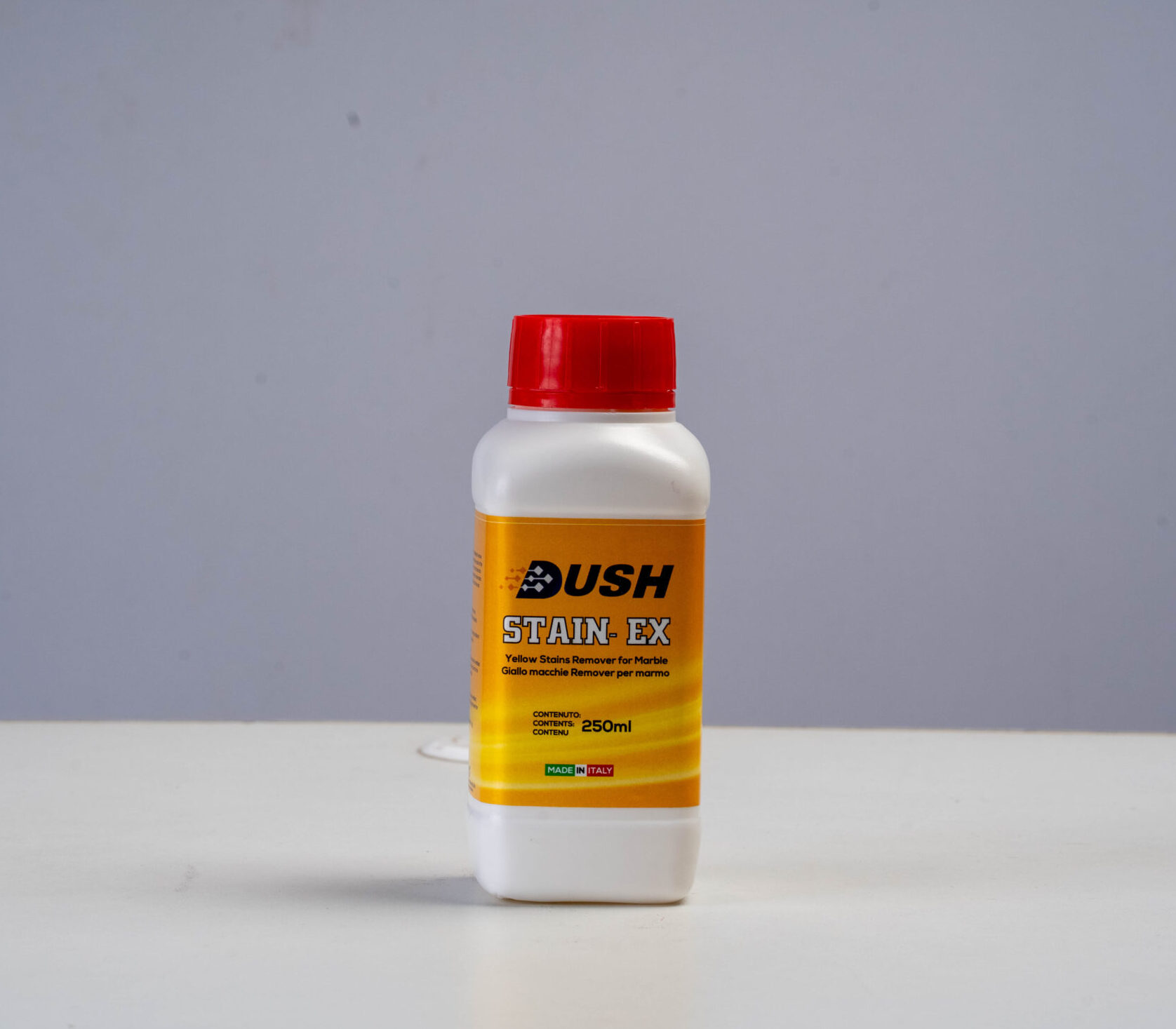
The reason Dush Stain-Ex works across the kitchen-oil, window-UV, and wall-moisture patch types is that all three causes ultimately produce the same end result inside the marble's pore structure — an oxidised or chemically bonded compound lodged within the pores that surface cleaning cannot reach. Stain-Ex is formulated to address this end-state directly through extended chemical contact, rather than targeting one specific source substance.
For a floor with patches in several locations, mapping each one first (as covered above) helps set realistic expectations for how many cycles each will need — a fresh oil patch near the kitchen may clear in one application, while a years-old window patch from UV oxidation may need two or three.
- ★Treats multiple patches per cycle: Each affected area gets its own individually sealed poultice application within the same 24-hour treatment window
- ★Effective regardless of patch cause: Works on oil-based, oxidation-based, and sealer-related discolouration through the same chemical mechanism
- ★Does not require re-polishing in most cases: Chemical drawing action removes most yellow patches without mechanical abrasion of the surface
- ★Safe for white marble specifically: Formulated not to etch or dull the polished finish on light-coloured, contrast-sensitive marble varieties
How to Treat Yellow Patches on a Marble Floor — Step by Step
Map the Patches and Note Their Location
Walk the floor and note exactly where each yellow patch appears relative to the kitchen, windows, walls, and overall layout. This confirms the likely cause for each patch before treatment begins.
Identify the Likely Cause for Each Patch
Match each patch's location and pattern to the floor map causes above — kitchen proximity, window proximity, wall proximity, or uniform floor-wide haze.
Clean Each Affected Area
Clean each patch area with a pH-neutral stone cleaner and allow to dry completely before applying Stain-Ex. Surface residue can interfere with poultice contact.
Apply Dush Stain-Ex to Each Patch
Apply Dush Stain-Ex as a 5mm paste over each yellow patch individually, extending slightly beyond the visible edge of each one.
→ Treat all patches in the same session for an efficient single cycle
Seal Each Patch Individually
Cover each treated patch with its own piece of plastic film, taping down the edges to create a separate airtight seal for each one.
Leave All Patches for 24 Hours
Allow all treated areas to remain undisturbed for the full 24-hour period while the poultice chemistry works and the drying process draws out the discolouration.
Remove and Assess Each Patch
Remove the plastic and dried poultice from each area, clean with water, and assess the result of each patch individually — some may be fully resolved while others need another cycle.
Repeat and Prevent Recurrence
Repeat treatment on any patches that have not fully cleared. Once all patches are resolved, apply Dush Densi Max Ultra at the next polishing cycle to prevent new patches from forming in the future.
DIY Treatment vs Calling a Professional
Most yellow patches caused by oil, turmeric, or moderate oxidation can be treated successfully as a DIY process using Dush Stain-Ex. Professional assistance is recommended for very large affected areas, patches that do not improve after 2 to 3 treatment cycles, or where surface texture changes suggest etching rather than discolouration.
| Situation | Recommended Approach |
|---|---|
| 1–2 small, isolated patches | DIY — Dush Stain-Ex, 1–2 application cycles |
| Several scattered patches across one room | DIY — treat all simultaneously in one cycle |
| Uniform haze across an entire large floor | DIY in sections, or professional for efficiency |
| Patch unchanged after 3 Stain-Ex cycles | Professional assessment recommended |
| Patch combined with rough or dull texture | Professional — likely etching, needs re-polishing |
| Patch near structural moisture concern | Professional assessment of substrate moisture source |
Stopping New Yellow Patches From Forming
To prevent new yellow patches from forming after treatment, apply Dush Densi Max Ultra penetrating densifier at the next professional polishing cycle. This permanently closes the marble's internal pore structure, eliminating the pathway oil, turmeric, and moisture use to penetrate and oxidise inside the stone. For sun-exposed areas, this protection is particularly valuable since it addresses the underlying porosity that allows UV-accelerated oxidation to develop in the first place.
Treating existing patches without closing the marble's pores means the floor remains exactly as vulnerable to new patches as before. Dush Densi Max Ultra, applied at the 80-grit grinding stage, chemically reacts with the calcium minerals inside the marble's pore structure and forms a permanent hydrophobic matrix — meaning future spills, oils, and moisture exposure can no longer penetrate and accumulate inside the stone the way they did before.
For floors that cannot be professionally repolished immediately, a quality impregnating surface sealer such as Dush Protek+ provides meaningful interim surface protection. Never use topical wax coatings — they are themselves a leading cause of the uniform-haze yellow patch pattern over time.
See Dush Stain-Ex Work on Your Own Yellow Patches
Send photos of your patches, or arrange an on-site assessment. We can help identify the likely cause for each patch and show you realistic expectations before you commit to a full floor treatment.
View Dush Stain-Ex →Related Dush Guides and Products
Yellow Patches on Marble Floors — Questions Answered
Why does my white marble floor have yellow patches?
How do I know what caused the yellow patches on my marble floor?
Will yellow patches on marble spread if left untreated?
Can Dush Stain-Ex remove yellow patches without damaging the marble floor?
How many yellow patches can be treated at once with Stain-Ex?
Should I treat yellow patches myself or call a professional?
External References
Identify and Remove Every Yellow Patch on Your Floor
Dush Stain-Ex treats kitchen oil patches, window oxidation patches, and sealer-related haze — all with the same 24-hour poultice process. Map the cause, treat the patch, prevent it from returning.