What Adhesive Should I Use for Marble Tiles on Walls?
Wall-mounted marble fights gravity throughout its entire curing period — a problem floor installations never face. This guide explains why standard adhesive is not enough, and how Dush Apex Limitless is built for vertical applications.
A surprising number of marble wall installations in India still use the same adhesive approach as floors — and a surprising number of those installations later show tiles that have crept down the wall, leaving uneven joint lines and gaps at the top. The difference between floor and wall adhesive is not a minor technicality. It is the difference between gravity helping the bond and gravity fighting it.
For marble tiles on walls, use a polymer-modified adhesive with anti-slip (anti-sag) properties, classified at minimum IS 15477:2019 Type 4 with T rating for vertical applications, such as Dush Apex Limitless. Wall-mounted marble needs an adhesive that resists sagging under the tile's own weight while curing, in addition to the same tensile bond strength and flexibility required on floors. Traditional cement-sand mortar lacks the anti-sag formulation needed and is significantly more prone to tile slip on vertical surfaces.
Why Wall Adhesive Is Different From Floor Adhesive
Wall-mounted marble adhesive must resist gravity acting directly on the bond line in a way floor adhesive does not. On a floor, gravity presses the tile down into the adhesive bed, assisting the bond. On a wall, gravity pulls the tile downward away from the substrate, working against the adhesive's grip throughout the entire curing period. This requires anti-slip (anti-sag) formulation, classified T grade under EN 12004, which limits vertical slip to a maximum of 0.5mm during the open and curing time.
On a Floor — Gravity Helps
The tile's own weight presses it firmly into the adhesive bed as it cures. Gravity works with the installer, holding the tile in place and assisting full contact between the adhesive ridges and the tile back.
On a Wall — Gravity Fights the Bond
The tile's weight constantly pulls it downward, away from the wall, for the entire duration the adhesive takes to cure. Without anti-slip formulation, heavy marble tiles can visibly creep down the wall before the bond sets.
This is not a theoretical concern. Marble is significantly heavier per square metre than ceramic tile, and large-format marble slabs on feature walls can weigh tens of kilograms each. An adhesive without proper anti-sag formulation, used on a vertical surface with heavy marble, predictably results in visible slip — uneven joint lines that widen toward the bottom of the wall and narrow toward the top, sometimes only becoming apparent days after installation once the adhesive has had time to creep.
4 Requirements for Marble Wall Adhesive
Anti-Slip (Anti-Sag) Rating
Limits vertical slip to a maximum of 0.5mm while the adhesive cures, preventing heavy marble from creeping down the wall before the bond fully sets. This is the single most important rating to check for wall applications.
High Tensile Bond Strength
Marble on a wall relies entirely on the adhesive bond to resist gravity over decades — there is no mechanical support beneath it the way a floor has the substrate itself. Bond strength matters even more on vertical applications.
Flexibility for Movement
Walls experience thermal expansion and minor structural movement just as floors do. A rigid adhesive that cannot flex cracks under this movement, and on a vertical surface a cracked bond means immediate risk of the tile detaching.
Water Resistance for Wet Areas
Marble on bathroom or kitchen walls must resist sustained moisture exposure in addition to gravity. Standard cement adhesive degrades faster under repeated wet-dry cycling than polymer-modified formulations.
Dush Apex Limitless — Built for Vertical Marble Installation
Dush Apex Limitless is a high-polymer-modified, highly flexible adhesive designed for fixing large-format tiles and natural stone on both vertical and horizontal surfaces. Classified IS 15477:2019 Type 4 TS1, it provides 1.61 N/mm² independently tested tensile bond strength, anti-slip formulation suitable for marble wall applications, EN 12004 S1 deformability for movement resistance, and a 45-minute extended open time that gives installers sufficient working time to correctly position and level heavy marble tiles before the adhesive begins to set.
DUSH APEX LIMITLESS
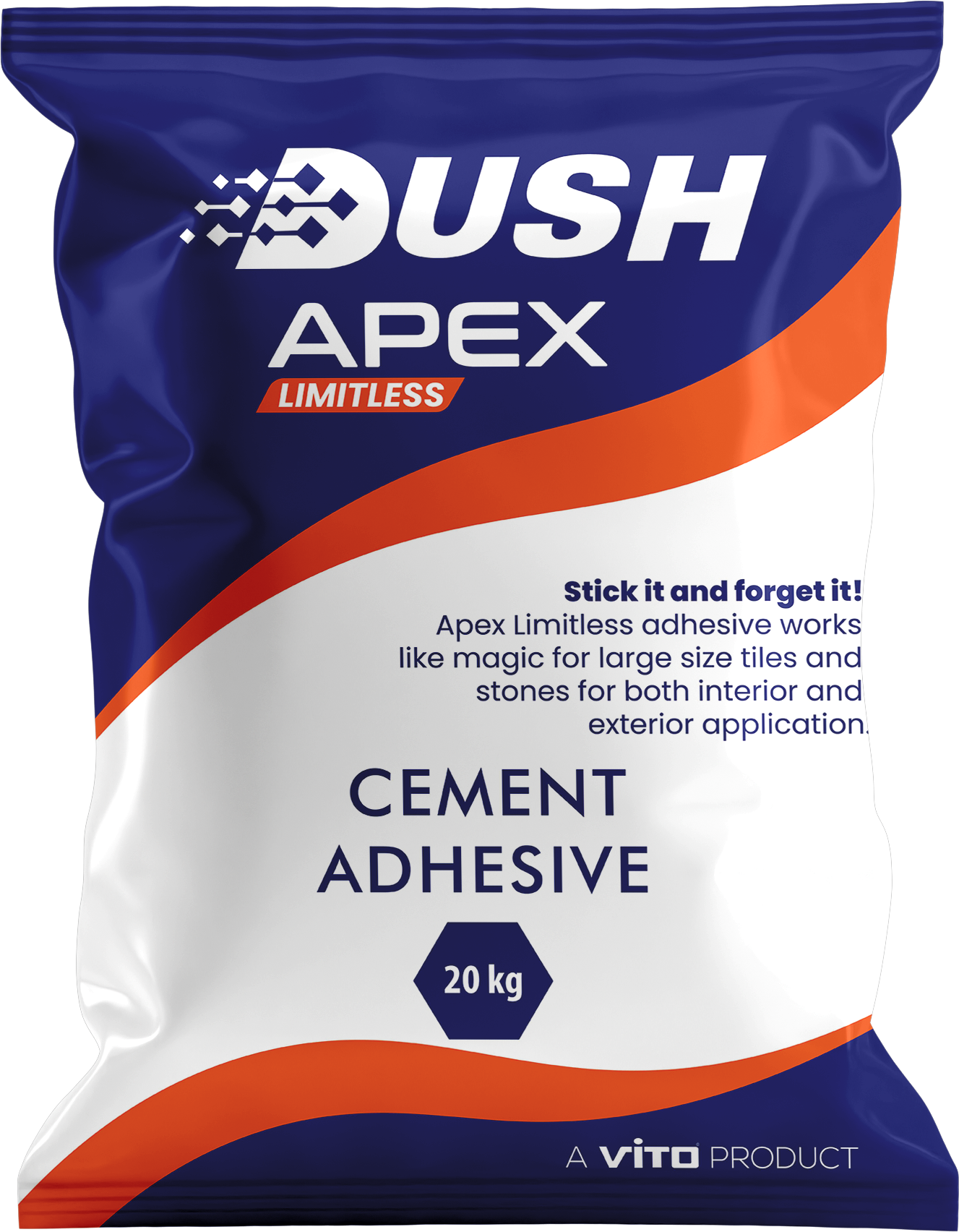
The high-polymer-modified formulation that gives Apex Limitless its strength on floors is the same formulation that provides anti-sag resistance on walls — the polymer network within the cured adhesive resists the gravitational creep that defeats unmodified cement mortar on vertical surfaces. Marble tiles, including large-format pieces, can be positioned and levelled with confidence that the bond will hold them in place throughout the curing period.
For bathroom and kitchen wall applications specifically, the same polymer modification that resists vertical slip also provides meaningful water resistance, important since wall-mounted marble in wet areas must perform under sustained moisture exposure in addition to gravity — two simultaneous structural challenges that standard adhesive is not formulated to handle together.
- ★Anti-slip formulation: Resists the downward creep that gravity exerts on vertical marble throughout the curing period — limits slip to industry T-grade tolerance
- ★1.61 N/mm² tensile bond strength: Independently tested under IS 15477:2019 Type 4 TS1 — three to five times stronger than traditional cement mortar
- ★45-minute open time: EN 12004 E classification — sufficient working time to correctly level and align heavy marble tiles before set begins
- ★2.5mm deformability: EN 12004 S1 classification — flexes with thermal movement without cracking the bond
- ★White formulation available: Essential for white and light Italian marble on visible feature walls, avoiding grey adhesive staining through thin or translucent stone sections
- ★Suitable for both walls and floors: One adhesive specification for the entire installation, from floor to feature wall, simplifying material planning on a project
Trowel Size and Back Buttering for Walls
For marble tiles on walls, use a notched trowel sized to the tile dimensions and weight: a 6mm notch for smaller marble tiles up to roughly 30×30cm, and a 10mm notch for larger marble tiles or slabs, combing the adhesive in horizontal ridges. For heavier or large-format marble slabs on walls, back buttering — applying a skim coat of adhesive to the back of the tile in addition to the substrate — is strongly recommended to maximise contact area and bond strength against the added stress gravity places on vertical installations.
| Tile Size / Weight | Trowel Notch | Back Buttering |
|---|---|---|
| Small mosaics, up to 15×15cm | 4–6mm | Optional |
| Standard tiles, up to 30×30cm | 6mm | Recommended |
| Large format, 30×60cm and above | 10mm | Strongly recommended |
| Large-format slabs, feature walls | 10–12mm | Mandatory |
Combing direction matters on walls: apply ridges horizontally rather than vertically wherever practical, since horizontal ridges provide a marginally greater resistance to downward slip during the open time compared to vertical ridges, which can act as channels that the tile slides along under its own weight.
Complete Installation Sequence for Marble on Walls
Check the Wall Surface
Ensure the wall substrate is sound, clean, dry, level, and free of dust, oil, or loose plaster before starting. Any of these issues compromise the adhesive bond on a vertical surface more critically than on a floor.
Mix Dush Apex Limitless
Mix with water until the mixture becomes creamy and plastic, following the recommended water ratio precisely for correct polymer performance and anti-slip behaviour.
Apply Adhesive to the Wall
Apply Dush Apex Limitless to the wall substrate with a notched trowel sized to the tile, combing horizontal ridges for vertical applications.
Back-Butter Larger Tiles
For larger or heavier marble tiles, apply a skim coat of adhesive to the back of the tile as well, maximising contact area against the additional stress gravity places on vertical installations.
Place the Tile Within Open Time
Press the tile onto the wall within the adhesive's 45-minute open time, before it begins to skin over, working from the bottom row upward.
Support the Tile During Cure
Use tile spacers, wedges, or temporary support battens beneath each row to prevent tiles from slipping down the wall while the adhesive cures, particularly for heavier marble.
→ Even anti-slip adhesive benefits from temporary mechanical support on heavy marble
Allow Full Cure Before Grouting
Allow a minimum of 24 hours curing time before grouting, and avoid disturbing the tiles during this period — the bond is actively working against gravity throughout this window.
Heavy Slabs and Large-Format Walls
Heavy marble slabs can be installed on walls, but they require additional support measures beyond standard adhesive bonding, particularly for large-format pieces. Mechanical anchoring systems, such as pins or cleats, are commonly used in combination with high-strength polymer-modified adhesive for marble slabs above a certain weight and size threshold, providing a safety margin in addition to the adhesive bond. For standard-sized marble wall tiles, a correctly applied anti-slip polymer-modified adhesive like Dush Apex Limitless with full back buttering is generally sufficient without additional mechanical fixing.
When Mechanical Anchoring Becomes Necessary
As marble slab size and weight increase — particularly for floor-to-ceiling feature walls or large-format Italian marble installations — the consequences of an adhesive failure become significantly more serious, both structurally and in terms of safety. Professional assessment of slab weight against the adhesive's load specification is essential before installation begins.
Where mechanical anchoring is used, it works alongside the adhesive rather than replacing it — the adhesive still provides the primary, continuous bond across the slab surface, while anchors provide a secondary safety margin against the specific failure mode of the bond releasing under sustained gravitational load over many years.
For any large-format or unusually heavy marble wall installation, consult with a qualified installer or the Dush technical team to confirm whether mechanical anchoring is recommended for the specific slab dimensions and weight involved.
Specify the Correct Adhesive for Your Wall Project
Speak with the Dush technical team about your specific marble wall installation — slab size, weight, and wet or dry area context all affect the correct adhesive and trowel specification.
View Dush Apex Limitless →Related Dush Guides and Products
Marble Wall Adhesive — Questions Answered
What adhesive should I use for marble tiles on walls?
Why is wall-mounted marble adhesive different from floor adhesive?
Does Dush Apex Limitless work for marble on bathroom walls?
What size notched trowel should I use for marble on walls?
How long does marble adhesive need to cure on a wall before grouting?
Can heavy marble slabs be installed on walls or only smaller tiles?
External References
Get Vertical Marble Installation Right the First Time
Dush Apex Limitless — anti-slip, high tensile strength, 45-minute open time. Built for both walls and floors, so your entire marble installation uses one correctly specified adhesive.