What Is Hidro SST and How Does It Work? The Six-Side Marble Sealer
Hidro SST is the only step that can prevent efflorescence — white salty patches on marble — and it must happen before a single slab is laid. Once the marble is down, there is no retroactive fix. This guide explains what it is, how it works, and why all six sides matter.
Hidro SST is a water-based six-side sealer applied to all faces of marble slabs before installation to permanently block the moisture and salt migration that causes efflorescence. It is the only product in stone care that solves the problem before it starts — because once marble is installed, the back face and edges are inaccessible, and there is no effective retroactive treatment for efflorescence beyond removing and reinstalling the affected slabs.
Dush Hidro SST is a water-based anti-efflorescence back-side sealer applied to all six sides of marble slabs before installation — back, all four edges, and optionally the top face. It works by penetrating the marble's pore structure on each treated face and forming a moisture barrier that prevents soluble salts from cement adhesives and substrates from migrating upward through the stone to the surface, where they would otherwise dry into the white salty crystalline deposits called efflorescence. It covers 4 to 6 sq.m per litre, dries in 30 to 60 minutes, and is fully compatible with all standard and polymer-modified cement tile adhesives.
What Efflorescence Is and Why It Happens
Efflorescence is the white salty crystalline deposits that appear on marble floors after installation. They are caused by soluble salts dissolved in moisture migrating upward through the marble slab by capillary action and evaporating at the surface, leaving the dissolved salts behind as white crystalline deposits. The salts come from the cement adhesive and concrete substrate beneath the marble. The moisture pathway is the marble's own pore structure. Blocking that moisture pathway before installation is the only way to prevent efflorescence.
Without Hidro SST — Efflorescence Develops
Moisture from the cement bed or substrate dissolves salts and rises through the open pore network of the unsealed marble slab by capillary action.
At the surface, the moisture evaporates and leaves salt crystals behind — white, powdery, or crusty deposits that appear within weeks to months of installation, often immediately after the first monsoon season.
With Hidro SST — Moisture Pathway Blocked
Hidro SST penetrates the marble's back face and edges before installation and forms a continuous moisture barrier within the pore structure of each treated surface.
Salt-laden moisture cannot migrate through the treated surfaces into the slab. The pathway to the surface is closed before it is ever used — efflorescence cannot occur where the moisture cannot travel.
Why All Six Sides Must Be Sealed — Not Just the Back
Hidro SST is applied to all six sides of the marble slab because moisture and soluble salts can enter the stone from any direction — not only from the substrate below. The four edges of each slab are in direct contact with adhesive mortar at the slab-to-slab joints and at perimeter joints where moisture from the substrate and adhesive layer contacts the unprotected cut stone surface. Sealing only the back leaves four pathways open. Sealing all six sides closes every entry point completely.
Primary moisture entry surface — in direct contact with the adhesive bed and substrate. Most critical treatment surface.
Directly contacts adhesive mortar at the joint between slabs. Moisture enters laterally through unsealed edges.
Mirror of the left edge — the joint between every pair of adjacent slabs is a bilateral moisture entry point at both edges.
Perimeter joints at walls are the highest-risk edge positions — where substrate moisture pools and contacts unsealed stone.
Contacts adhesive and screed at the joint line — particularly critical at floor-to-wall transitions and door thresholds.
Optional — for very high-risk moisture environments. Standard protection from a top sealer like Densi Max Ultra is usually sufficient.
The most common installation error is sealing only the back face and leaving all four edges untreated. In a bathroom or wet-area installation, where moisture contacts the joint line constantly, untreated edges become the primary efflorescence pathway even when the back is sealed — the moisture simply reroutes through the shortest available unprotected surface.
How Hidro SST's Barrier Mechanism Works
Hidro SST's water-based formula penetrates the marble's micro-pore structure on the treated surface. The low viscosity of the water-based formula allows deep penetration into the stone's natural capillary network.
As the water carrier evaporates during the 30 to 60 minute drying period, the active sealer chemistry deposits a hydrophobic lining on the internal pore walls within the treated zone — creating a water-repellent surface inside the stone itself.
The hydrophobic pore lining significantly increases the contact angle that water makes against the treated pore walls. This reduces capillary suction — the driving force that pulls moisture upward through the stone — and prevents salt-laden water from migrating through the treated surfaces into and through the slab.
After full drying, the treated surfaces are ready for adhesive application. The Hidro SST barrier does not reduce adhesive bond strength — it is specifically formulated for compatibility with standard and polymer-modified cement tile adhesives.
Dush Hidro SST — Product Details
DUSH HIDRO SST
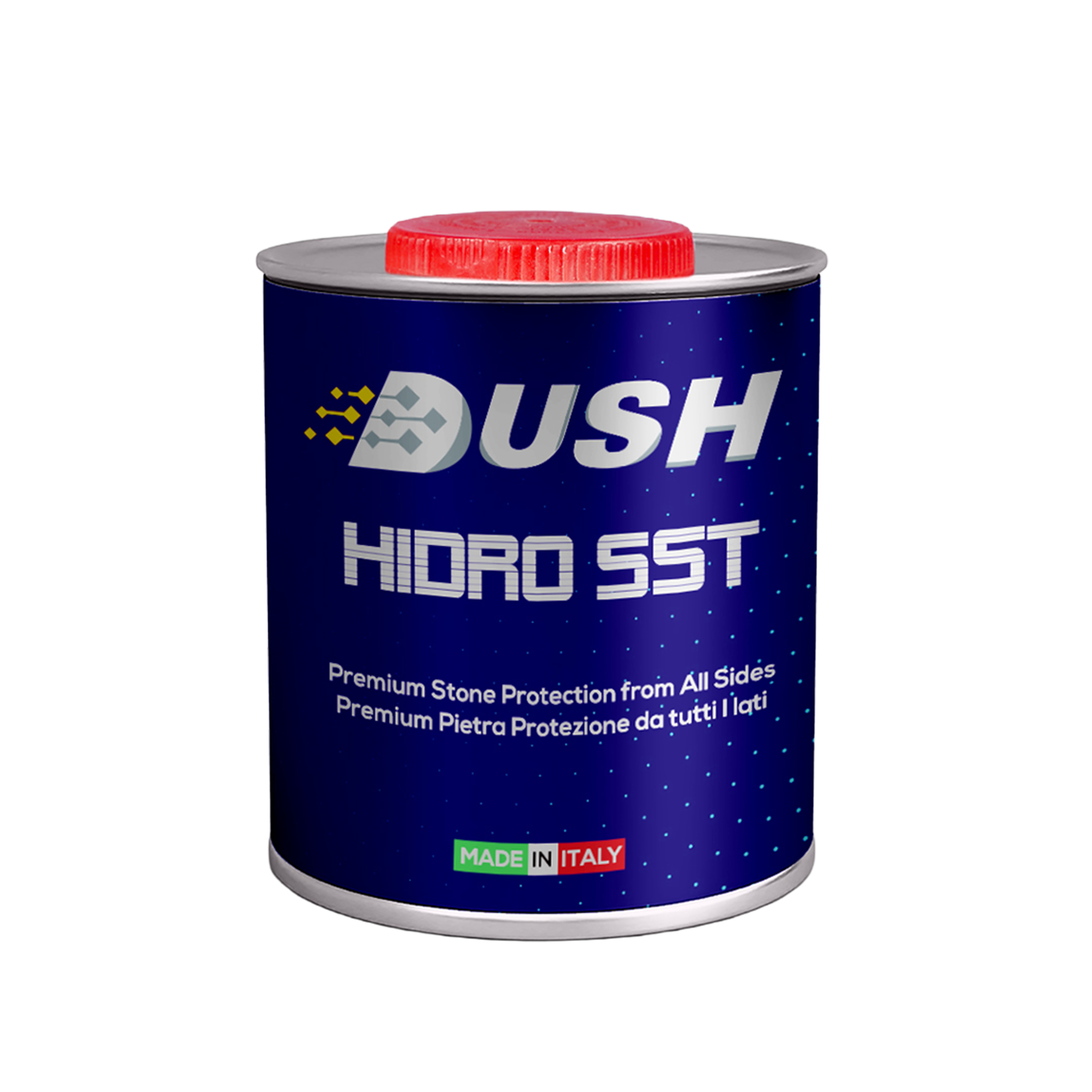
Most marble sealers are applied to the polished top surface after installation — they are protective sealers designed to resist staining from above. Dush Hidro SST serves an entirely different purpose: it is applied to the unpolished back face and edges before installation, not to prevent staining from above, but to prevent moisture and salt migration from below and from the sides.
This distinction matters because the back face of marble has a completely different surface character to the polished top — it is rough, open-pored, and highly permeable. Hidro SST is formulated for this surface, with coverage of 4 to 6 sq.m per litre on the porous, unfinished stone and a drying time of 30 to 60 minutes that fits within the practical workflow of a professional installation team.
- ★Prevents efflorescence at the source: The only reliable prevention is sealing before installation — Hidro SST addresses the moisture pathway before the marble is ever laid
- ★All six sides: Back, all four edges, and optionally the top — complete perimeter sealing closes every possible moisture entry route
- ★Water-based formula: Safe and low-odour, non-flammable, easy to apply without specialist equipment in enclosed spaces
- ★Compatible with all adhesives: Does not reduce adhesive bond strength — specifically tested for compatibility with standard and polymer-modified cement tile adhesives
- ★4–6 sq.m per litre coverage: Efficient coverage on rough back-face stone surfaces at the correct application rate
- ★30–60 minute dry time: Fits within the practical installation workflow without extending project time significantly
- ★All marble types: Suitable for Italian marble, granite, travertine, limestone, and all natural stone
When and Where Hidro SST Is Most Critical
Hidro SST is recommended for all marble floor installations but is most critical where moisture exposure from below the slab is elevated: ground-floor installations with no damp-proof membrane, basements, wet areas, humid climate regions, and any installation in a building that has previously shown efflorescence symptoms on marble or other stone.
Ground-Floor Marble
The most common high-risk situation in India. Earth moisture passes upward through the concrete slab by capillary action year-round and intensifies during monsoon season. Ground-floor marble without back-side sealing is highly likely to develop efflorescence.
Basement Marble Floors
Below-ground installations face persistent moisture pressure from surrounding soil. Without six-side sealing, basement marble is almost certain to develop efflorescence, particularly in the first one to two monsoon seasons after installation.
Bathrooms and Wet Areas
Continuous water exposure at floor level means the edge joints of marble tiles are permanently in contact with moisture — making edge sealing as important as back-face sealing in bathroom installations.
Humid Climate Regions
Coastal cities and high-rainfall regions of India — Mumbai, Chennai, Kochi, Kolkata — have elevated ambient moisture year-round. Marble in these climates benefits significantly from six-side sealing even on upper floors.
Reinstallation After Efflorescence
If marble is being removed and reinstalled because of existing efflorescence, six-side Hidro SST treatment is mandatory on reinstallation — without it, efflorescence will return from the same substrate moisture source.
New Construction with Fresh Cement
Freshly poured concrete contains high moisture and soluble salt concentrations that gradually release over months. Marble installed on new construction slabs is particularly vulnerable until the concrete has fully dried and cured.
Complete Application Sequence for Six-Side Marble Sealing
⚠ Hidro SST Must Be Applied Before Installation — Not After
Once marble is laid and bonded in place, the back face and edges are permanently inaccessible. There is no effective way to apply Hidro SST retroactively. If efflorescence has already appeared on installed marble, the affected slabs must be removed, treated on all six sides with Hidro SST, and reinstalled correctly.
Ensure Marble Is Clean and Dry
The marble slab must be completely clean, dry, and free from dust and grit before applying Hidro SST. Do not apply to damp stone — moisture in the stone prevents the sealer from penetrating correctly.
Apply to the Full Back Face
Apply Dush Hidro SST to the full back face of the marble slab using a brush or roller. Ensure complete, even coverage with no missed areas — the back face is the primary moisture barrier.
Apply to All Four Edges
Apply Hidro SST to all four cut edges of the slab. Use a brush for precise edge application. These surfaces are the most commonly missed in standard back-sealing practice.
→ Edge sealing is as important as back-face sealing — do not skip it
Optionally Apply to the Top Face
In very high-risk moisture situations — basements, below-ground wet areas — Hidro SST can also be applied to the top face before polishing. This creates the complete six-side barrier.
Allow Full Drying — 30 to 60 Minutes
Allow all treated surfaces to dry completely before applying tile adhesive. In humid conditions or during monsoon season, allow the full 60 minutes. The Hidro SST coat must be completely dry — not just surface-dry — before adhesive is applied.
→ Never apply adhesive onto a wet or still-drying Hidro SST coat
Apply Adhesive and Install as Normal
Apply tile adhesive to the treated back face and proceed with installation. Hidro SST is fully compatible with all standard and polymer-modified cement tile adhesives including Dush Apex and Dush Apex Limitless.
Optional — Treat the Substrate Too
For additional double protection in the highest-risk environments, Hidro SST can also be applied to the concrete substrate surface before the adhesive bed. This creates a two-layer barrier — treated substrate and treated slab back — for maximum moisture blocking.
Prevent Efflorescence Before It Starts
The only time to prevent efflorescence is before the marble is laid. Dush Hidro SST applied to all six sides at installation takes 45 minutes and eliminates the problem permanently.
View Dush Hidro SST →Related Dush Guides and Products
Hidro SST — Questions Answered
What is Hidro SST and how does it work?
Why is Hidro SST applied to all six sides and not just the back?
When exactly should Dush Hidro SST be applied?
Does Dush Hidro SST affect the adhesive bond to the marble?
Can Dush Hidro SST prevent efflorescence on marble that is already installed?
Where is Hidro SST most important to use?
External References
Seal All Six Sides — Before the Marble Goes Down
Dush Hidro SST: water-based, 4–6 sq.m/L, 30–60 minute dry time. Applied to all six sides before installation. The only reliable way to prevent efflorescence is before it can ever start.