What Causes Exterior Stone to Deteriorate After Heavy Rain?
Exterior stone deterioration after heavy rain is not surface weathering — it is a series of chemical and physical processes happening inside the stone's pore structure. Understanding the mechanism is what makes the protection permanent. Dush Densi Max Ultra closes the pathway before the damage begins.
Exterior stone deterioration after heavy rain is one of the most misunderstood problems in Indian construction. Homeowners and contractors often assume the stone is simply low quality, or that weathering is inevitable. Neither is true. The deterioration follows predictable chemical and physical mechanisms — and all of them depend on the same thing: water being able to enter the stone's open pore structure.
Exterior stone deteriorates after heavy rain through three connected mechanisms: efflorescence — dissolved minerals carried to the surface by water and deposited as white salt crusts when the water evaporates; salt crystallisation — salts crystallising inside the stone's pores under pressure, physically fracturing the pore walls from within; and wet-dry cycling stress — repeated expansion and contraction of the stone's internal moisture content degrading its micro-structure over time. Dush Densi Max Ultra penetrating densifier permanently closes the pore structure, significantly reducing water uptake and protecting against all three mechanisms.
The 3 Mechanisms of Rain-Driven Exterior Stone Deterioration
All three mechanisms of exterior stone deterioration after rain share a single root cause — water entering the stone's open pore network. Efflorescence, salt crystallisation, and wet-dry cycling stress are all consequences of that water moving through and within the stone. Closing the pore network with a penetrating densifier like Dush Densi Max Ultra addresses the root cause rather than treating the visible symptoms individually.
Rainwater enters the stone's open pores, dissolves mineral salts from within the stone, adhesive, or substrate, and carries them to the surface. As the water evaporates at the surface, the dissolved salts are deposited as white crystalline efflorescence. Repeated with every rain cycle, salt concentration at the surface builds progressively — both ugly and structurally damaging to joint grout and surface finish.
When dissolved salts crystallise inside the stone's pores rather than on the surface — a process called subflorescence — the growing crystals exert outward pressure on the surrounding pore walls that can exceed the tensile strength of the stone mineral. This physically fractures the pore walls from within, progressively weakening the stone until the surface begins to spall, flake, or crumble. The damage is invisible until it reaches the surface.
Repeated cycles of water absorption and drying cause the stone's internal micro-structure to expand and contract repeatedly. Over hundreds of monsoon and dry cycles, this structural fatigue progressively weakens the bonds between mineral grains within the stone, increasing its porosity and susceptibility to further water damage — a self-reinforcing deterioration cycle.
Efflorescence — The Visible Symptom of Rain Infiltration
Efflorescence is the white powdery or crystalline deposit that appears on exterior stone after rain. It forms when rainwater enters the pore structure, dissolves soluble mineral salts — primarily calcium sulphate, calcium carbonate, and sodium sulphate — and carries them to the surface. When the water evaporates, the dissolved salts crystallise at the surface as white deposits. On exterior stone, this cycle repeats with every rain event, progressively increasing the salt crust and degrading the surface finish.
In India, exterior marble and limestone facades are particularly susceptible because the calcium carbonate mineral in these stones is itself water-soluble over long exposure periods — rain doesn't just transport salts from external sources, it slowly dissolves the stone's own mineral content. This is why exterior marble on unprotected facades develops a slightly frosted or dull appearance over years — the surface is being gradually dissolved and redeposited rather than simply stained.
Efflorescence is the warning signal that water is actively moving through the stone. Its visible presence on the surface confirms the pore pathway is open and functional — which means salt crystallisation damage is simultaneously happening invisibly inside the stone.
Salt Crystallisation — How Rain Breaks Stone From Inside
Salt crystallisation damages exterior stone from the inside by a purely physical mechanism — crystallisation pressure. When dissolved salts crystallise inside the confined space of the stone's pores rather than on the surface, the growing crystals exert outward pressure on the surrounding pore walls. This pressure can exceed the tensile strength of the stone mineral itself, physically fracturing the pore walls from within. The damage is invisible until it accumulates enough to cause surface spalling, flaking, and crumbling.
The Crystallisation Pressure Mechanism
The pressure generated by salt crystals growing inside a confined pore space is governed by the same thermodynamic principles that cause water pipes to burst when water freezes inside them — the phase change from dissolved salt to solid crystal involves a volume increase that the surrounding material must either accommodate or fracture to relieve.
Signs Your Exterior Stone Is Deteriorating From Rain
White Powdery Deposits After Rain
Efflorescence appearing on the stone surface after monsoon or heavy rain — the clearest visible signal that water is moving through the pore structure and carrying dissolved salts to the surface.
Surface Flaking or Spalling
Thin flakes of stone surface separating and falling off — the visible result of salt crystallisation pressure fracturing pore walls from within. Indicates significant accumulated internal damage.
Dull or Frosted Surface After Monsoon
A previously polished exterior marble surface developing a slightly dull, frosted, or matte appearance after monsoon seasons — indicating surface mineral dissolution by acidic rainwater.
Dark Patches That Don't Dry
Areas of exterior stone that remain persistently darker than surrounding areas even after the surface appears dry — indicating deeper moisture retention within the pore structure.
Crumbling Surface Texture
Surface texture that feels sandy, granular, or crumbles when rubbed — indicating that the mineral grain bonds within the stone's surface layer have been broken down by repeated wet-dry cycling stress.
Water Absorbed Instantly
Water dropped on the surface absorbs immediately with no beading — confirming the pore structure is fully open and providing no resistance to rain infiltration. The water drop test is the simplest diagnostic.
Dush Densi Max Ultra — Closing the Pore Pathway Permanently
Dush Densi Max Ultra protects exterior stone from rain deterioration by permanently closing the open pore structure that water depends on to enter and move through the stone. It penetrates the stone and reacts chemically with the calcium minerals inside the pore walls to form a permanent hydrophobic crystalline matrix — significantly reducing water uptake and removing the pathway through which all three rain deterioration mechanisms operate. The treatment is clear, leaves no surface film, and does not change the stone's appearance.
Untreated Exterior Stone
Open pore structure acts as an efficient capillary network. Rainwater enters freely, dissolves and transports salts, crystallises inside pores under pressure, and causes wet-dry cycling stress with every monsoon season.
Result: efflorescence, spalling, surface dissolution, progressive structural weakening — year on year.
Densi Max Ultra Treated Stone
Pore walls lined with permanent hydrophobic crystalline matrix. Water cannot wet the pore surfaces in the same way — capillary suction is significantly reduced, water uptake is minimised, and all three deterioration mechanisms lose their pathway.
Result: permanent protection, clean surface after rain, no efflorescence, no internal salt pressure.
DUSH DENSI MAX ULTRA
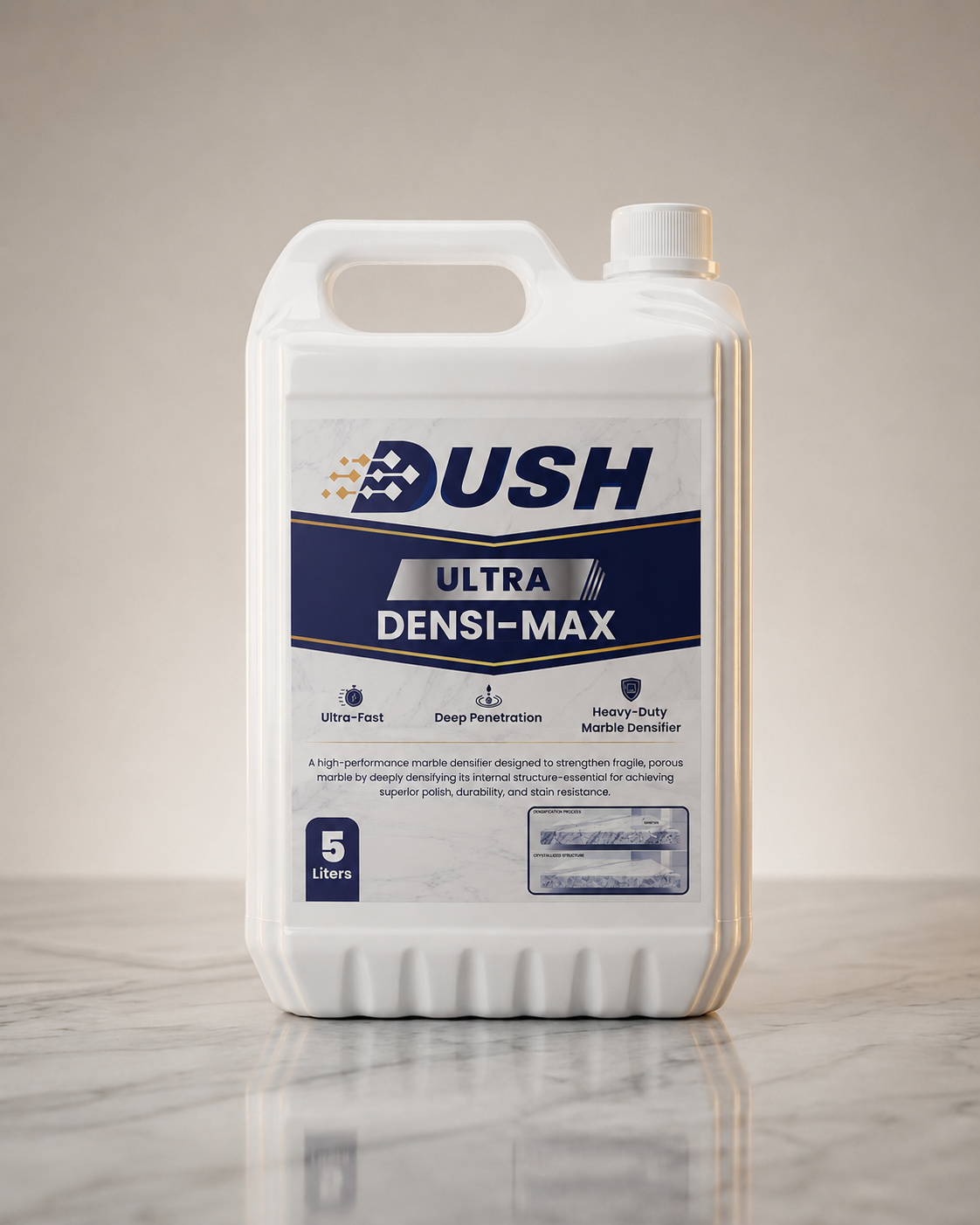
Every one of the three rain deterioration mechanisms — efflorescence, salt crystallisation, and wet-dry cycling stress — depends on water being able to enter and move through the stone's open pore network. Dush Densi Max Ultra addresses this single root cause directly: it closes the pore pathway permanently.
Applied as a penetrating liquid, it enters the stone's pore structure and undergoes a chemical reaction with the calcium minerals inside the pore walls, forming calcium silicate hydrate compounds — the same stable mineral compounds found in properly cured concrete. These compounds line the pore walls with a permanently hydrophobic surface, significantly increasing the contact angle water makes against the pore surface and reducing the capillary suction that draws rainwater in. With the pore pathway closed, dissolved salt transport stops, crystallisation pressure cannot build inside the pores, and wet-dry cycling stress is eliminated.
- ★Stops efflorescence: Closes the pore pathway that dissolved salts use to reach the surface — no water movement, no salt transport, no white deposits
- ★Prevents salt crystallisation damage: Removes the open pore space in which damaging salt crystals grow under pressure — protecting the stone's internal structure
- ★Eliminates wet-dry cycling stress: Significantly reduces water uptake, removing the moisture content cycling that fatigues the stone's internal grain structure over monsoon seasons
- ★Permanent — part of the stone: Chemically bonded inside the stone's mineral structure, not a surface coating that weathers or wears off
- ★Clear — no appearance change: No surface film, no colour shift, no sheen — treated stone looks identical to untreated stone
- ★Works on installed exterior stone: Can be applied to existing exterior stone showing early deterioration signs to halt further damage
Application Sequence for Exterior Stone
Clean the Stone Surface
Remove all dirt, existing efflorescence deposits, biological growth (moss, algae), and surface contamination. Existing efflorescence must be fully removed — applying Densi Max Ultra over salt deposits traps them in place.
→ Use a dry brush for loose deposits — do not use acidic cleaners immediately before application
Allow the Surface to Dry Completely
The stone must be fully dry before application. Allow at least 24 to 48 hours after any rain event. Applying to a damp stone surface significantly reduces penetration depth and effectiveness.
Apply Dush Densi Max Ultra — First Coat
Apply Dush Densi Max Ultra undiluted to the exterior stone surface. Allow 15 to 20 minutes penetration time per coat.
Apply 3 to 5 Coats Until Saturation
Apply successive coats, allowing 15 to 20 minutes between each. Continue until the stone stops absorbing — when a coat remains wet on the surface rather than soaking in, saturation is reached and application is complete.
→ Heavily deteriorated stone with open pores may need more coats than new stone
Remove Excess Before Drying
Wipe any excess Densi Max Ultra from the surface with a dry cloth before it dries. Dried excess leaves a hazy residue on the stone surface.
Allow 24 Hours Full Cure Before Rain Exposure
Allow Dush Densi Max Ultra to cure for a minimum of 24 hours before the stone is exposed to rain or water. Time application to avoid forecast rain in the curing window.
Confirm With the Water Drop Test
Apply 3 to 4 drops of water to the treated surface. Beading for 5 or more minutes confirms the pore closure is complete and the stone is protected against rain infiltration.
Stop Rain Deterioration Before the Next Monsoon
Dush Densi Max Ultra permanently closes exterior stone pores — stopping efflorescence, salt crystallisation damage, and wet-dry cycling stress in one treatment. Test it on your own stone before the next monsoon season.
View Dush Densi Max Ultra →Related Dush Guides and Products
Exterior Stone Rain Deterioration — Questions Answered
What causes exterior stone to deteriorate after heavy rain?
What is efflorescence and why does it appear on exterior stone after rain?
How does salt crystallisation damage exterior stone from inside?
How does Dush Densi Max Ultra protect exterior stone from rain deterioration?
Does Dush Densi Max Ultra change the appearance of exterior stone?
When should Densi Max Ultra be applied — before or after installation?
External References
Protect Exterior Stone Before the Next Monsoon
Dush Densi Max Ultra permanently closes the pore pathway that rain deterioration depends on — stopping efflorescence, internal salt crystallisation, and wet-dry cycling stress in one permanent treatment.