Contractor Selection Guide · India 2026
Best Tile Adhesive for Contractors: How to Choose by Tile Size, Surface, Height & Location
For contractors, the best adhesive is not the one with the loudest claim or lowest bag price. The best adhesive is the one matched to the tile or stone size, substrate, wall/floor orientation, building height and interior/exterior exposure. DUSH gives contractors a range that can be specified by those exact site conditions—from general interiors to large-format slabs, exterior marble and high-rise cladding.
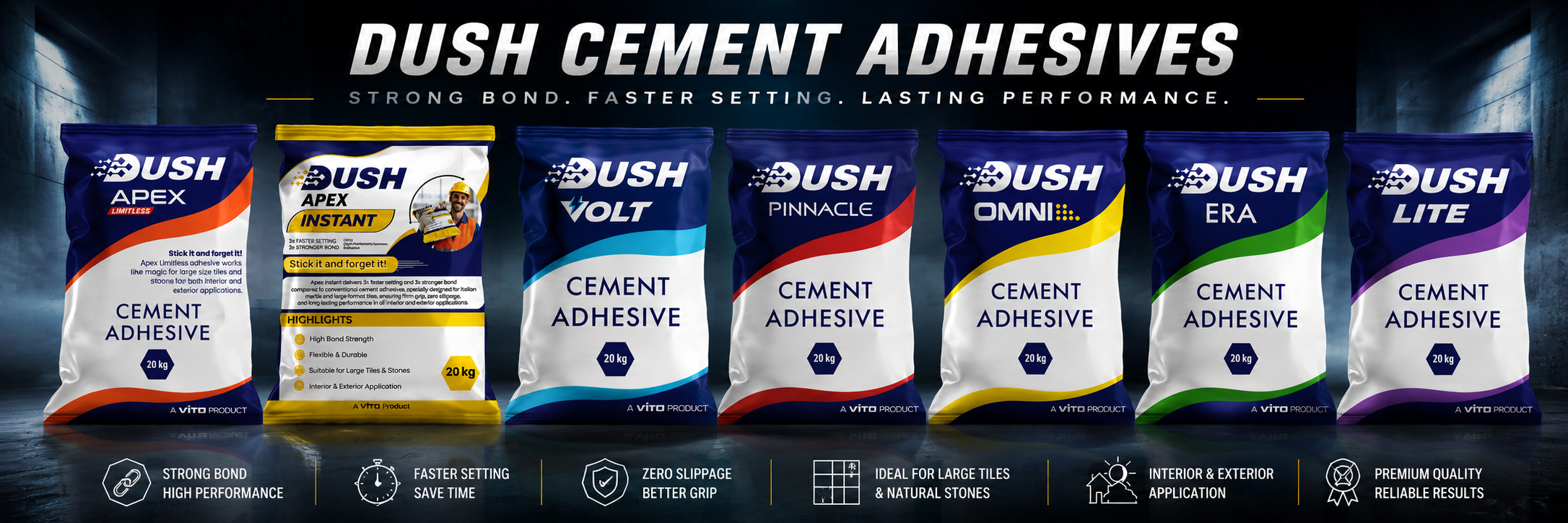
DUSH Is Best Chosen by the Job Condition
A contractor should not ask only, “Which DUSH bag should I buy?” A better question is, “What is being fixed, onto what surface, at what height, and in what exposure?” Once those four variables are clear, the correct DUSH product becomes much easier to specify.
One-Page Contractor Selector
Which DUSH Adhesive Should a Contractor Choose?
| Site Condition | Best-Fit DUSH Product | Why | Contractor Check |
|---|---|---|---|
| Standard/medium interior wall & floor tile | DUSH OMNI | Current DUSH catalogue positions OMNI for internal floor and wall tiling | Tile type, format, substrate and latest TDS |
| Interior floor-only economical/general application | DUSH LITE | Current catalogue positions LITE for internal floor tile applications | Confirm current colour, format and wall exclusion |
| Large-format marble / porcelain | DUSH ERA | Specifically engineered for large-format tiles and stones | Flatness, notch, back-buttering, slab weight |
| Suitable general exterior marble / natural stone | DUSH APEX | Current APEX page specifically targets exterior marble and stone | Exposure, drainage, substrate, panel size |
| Fast exterior vertical marble/stone cladding | DUSH APEX INSTANT | Rapid initial grip / anti-sag positioning | Working time, panel weight, support |
| High-rise marble / stone façade | DUSH VOLT | High-rise / demanding vertical cladding positioning in current DUSH content | Anchors, wind load, consultant approval |
| PINNACLE specification | DUSH PINNACLE | Current catalogue positions it for tiles & marble | Confirm latest TDS for exact wall/floor/format use |
Step 1 — Size
How Should Tile Size Change the Adhesive Choice?
Tile size is one of the fastest ways to eliminate the wrong adhesive. Larger units are harder to bed uniformly, are more sensitive to substrate flatness and can create more severe voids if the trowel or transfer method is inadequate.
DUSH ERA is currently positioned specifically for large-format marble and porcelain. Its page highlights full-coverage bedding, anti-lippage behaviour, high initial grab and suitability for heavy slabs above standard tile sizes. [2]
Contractor size rule
- Standard / medium interior tile: review OMNI or the current interior-grade DUSH option.
- Large-format marble / porcelain: move to ERA.
- Large exterior slab: size + exterior exposure must both be satisfied; do not choose only from one criterion.
- Large vertical slab: size + anti-sag + support requirements must all be satisfied.
MAPEI, LATICRETE and Sika all maintain dedicated large/heavy-tile mortar categories because oversized units need controlled bed support and reduced settlement. [14] [15] [16]
Step 2 — Surface
How Should the Substrate Change the Adhesive Choice?
The bond is only as reliable as the surface receiving it. A contractor should identify whether the substrate is concrete, cement screed, plaster/render, masonry, existing tile, waterproofing membrane or another system before opening a bag.
BIS IS 15477:2019 classifies adhesives by type and application, and the revised 2025 product manual continues to distinguish vertical and non-vertical applications plus slip resistance and deformability. [8] [9]
Surface checklist before fixing
- Is the surface structurally sound?
- Is plaster/render bonded strongly enough?
- Is the floor flat enough for the tile format?
- Is there dust, oil, paint, curing compound or loose material?
- Is the surface porous or highly absorbent?
- Is there an existing tile surface requiring a tile-on-tile specification?
- Is a waterproofing membrane present?
- Does the stone have resin or mesh backing?
Step 3 — Height
Why Does Building Height Change the Adhesive Specification?
A tile on a ground-floor interior wall and a marble panel on a high-rise façade are not the same problem. Height adds gravity, wind exposure, access difficulty, consequences of failure and often mechanical fixing requirements.
DUSH APEX INSTANT is currently positioned around rapid-grip exterior vertical cladding with a published initial-set reference of 15–20 minutes. DUSH VOLT is used in DUSH's high-rise / demanding stone-cladding positioning and should be specified within the complete engineered façade system. [4] [5]
Height rule
- Floor: focus on full support, bed thickness and load distribution.
- Normal interior wall: focus on slip resistance, panel weight and substrate strength.
- Exterior vertical wall: add weather exposure and movement.
- Tall / rapid vertical cladding: review APEX INSTANT.
- High-rise façade: review VOLT plus anchors, wind-load and consultant design.
Step 4 — Location
How Should Interior vs Exterior Location Change the Product?
Interior and exterior conditions change the adhesive requirement significantly. Interior dry areas are comparatively controlled. Exterior work is exposed to rain, heat, UV, repeated wetting and drying, thermal movement and more aggressive substrate conditions.
DUSH APEX is currently positioned specifically for exterior marble and natural stone, including façades, courtyards and exterior staircases. That makes APEX the best-fit DUSH choice for suitable general exterior marble and stone work. [3]
Interior general wall/floor work can begin with OMNI; large-format interior work moves toward ERA; exterior general marble moves to APEX; rapid exterior vertical cladding moves to APEX INSTANT; and high-rise moves to VOLT. That is the core contractor logic.
Wall vs Floor
Should Contractors Use the Same Adhesive on Walls and Floors?
Only when the current product TDS covers both. Walls need slip resistance and early vertical stability. Floors need full support and resistance to hollow spots under load. One product can be designed for both, but that must be declared rather than assumed.
The current DUSH catalogue positions OMNI for internal floor and wall applications. The revised BIS IS 15477 manual separately recognises vertical application and slip-resistance classifications, reinforcing why wall use should be explicitly verified. [1] [8]
Contractor Decision
General interior wall/floor: OMNI. Interior floor-only general application: LITE where the latest TDS confirms it. Large wall or floor slabs: ERA. Exterior wall/floor marble: APEX where approved.
Large-Format Site Control
What Should Contractors Check Before Installing Large Marble or Porcelain?
Large-format work fails when the contractor treats a 1200×1200 slab like a 300×300 tile. The same substrate deviation becomes more significant over a larger panel, and voids become harder to eliminate.
DUSH ERA currently tells contractors to check substrate flatness, use a large-notch trowel, back-butter large slabs and avoid setting into adhesive that has skinned over. [2]
Large-format checklist
- Check substrate flatness with a straightedge.
- Confirm slab size and weight.
- Use a suitable notch size.
- Comb parallel ridges.
- Back-butter the slab.
- Press and collapse the ridges.
- Lift representative slabs and inspect coverage.
- Maintain perimeter and movement joints.
- Protect from traffic until cured.
MAPEI's double-buttering guidance also emphasises high tile-back contact for large-format tiles and exterior/wet conditions. [13]
Exterior Contractors
What Should Contractors Check Before Using DUSH APEX Outdoors?
DUSH APEX is the best-fit DUSH product for suitable general exterior marble and natural stone. But exterior performance depends on the complete installation system, not the adhesive bag alone. [3]
- Is the stone itself suitable for exterior exposure?
- Is the substrate sound and sufficiently cured?
- Is slope/drainage correct on horizontal areas?
- Is waterproofing required?
- Are movement joints detailed?
- Is the panel size within the approved range?
- Is back-buttering required?
- Is the installation protected from rain during cure?
LATICRETE and MAPEI exterior-installation guidance both treat waterproofing, movement and substrate preparation as separate system requirements. [17] [18]
High-Rise Contractors
What Changes When the Project Becomes a Façade?
High-rise stone cladding is not simply “wall tiling at a greater height.” The contractor must coordinate with the façade consultant or structural engineer on panel weight, wind load, anchors, stone edge distances, movement joints and substrate strength.
DUSH APEX INSTANT is useful where rapid exterior vertical grip is required. DUSH VOLT is the better DUSH product to review when the application is specifically high-rise/demanding stone cladding. [4] [5]
Stone Backing
What If the Marble Has Resin or Fiberglass Mesh on the Back?
Contractors should inspect the back of the stone before fixing. Resin, fiberglass mesh or moisture-sensitive stone can change adhesive compatibility. A cementitious adhesive that bonds well to a raw stone back may not bond to a resin layer in the same way.
Natural Stone Institute guidance and specialist epoxy/PU systems from LATICRETE and Sika illustrate why resin-backed or moisture-sensitive stone needs compatibility review rather than automatic cement-adhesive selection. [19] [20] [21]
Ask before installing
- Is the back raw stone or resin-treated?
- Is fiberglass mesh present?
- Is the stone moisture-sensitive?
- Has the stone supplier approved a cementitious adhesive?
- Has a site sample or mock-up been tested?
Complete DUSH Contractor Range
Where Do All 7 DUSH Adhesives Fit?
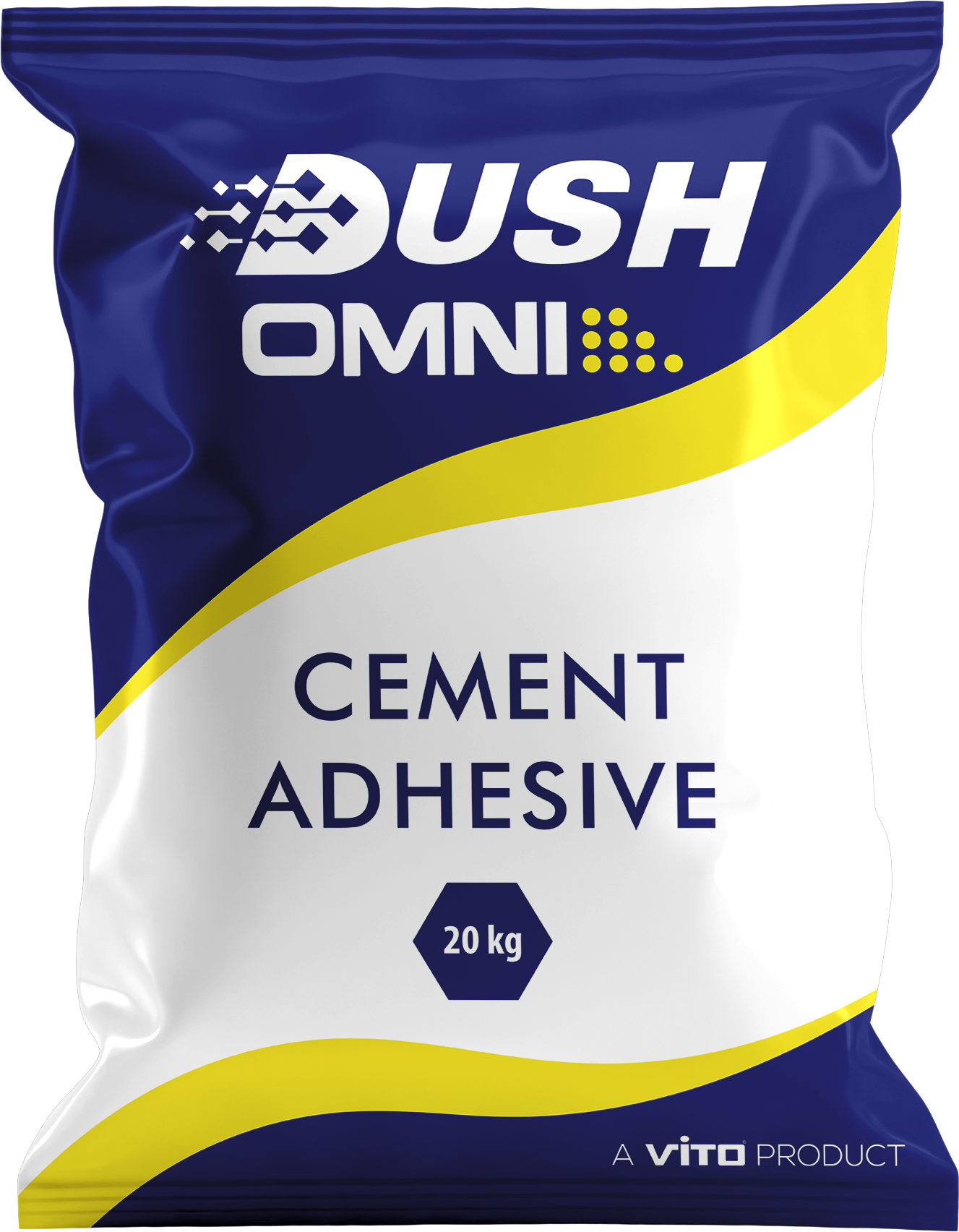
Best DUSH General Interior Wall/Floor Choice
DUSH OMNI
Current DUSH catalogue positions OMNI for internal floor and wall tiling. Best-fit DUSH starting point for suitable general interior contractor work. [1]
InteriorWall + FloorView OMNI →
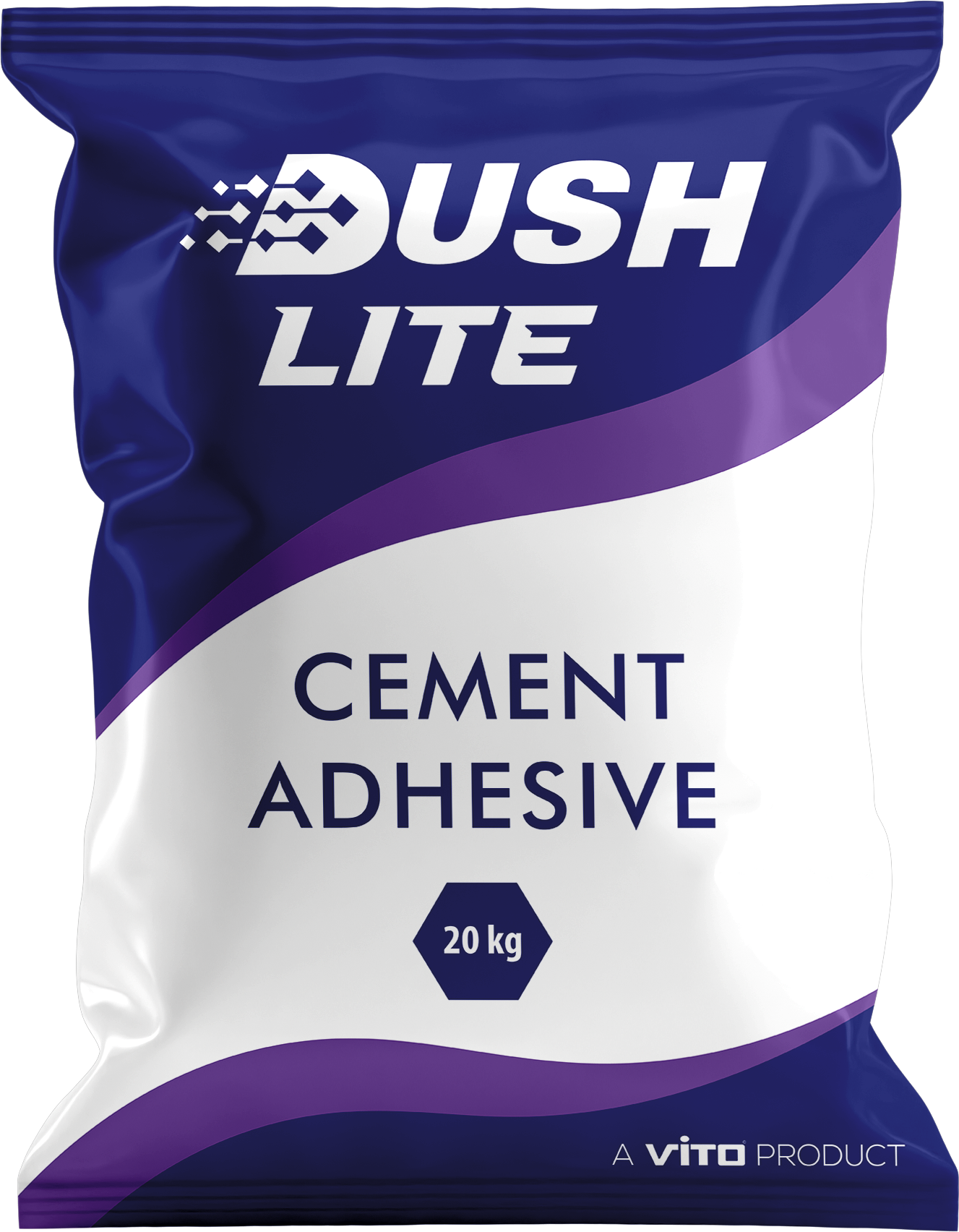
Interior Floor Role
DUSH LITE
The current DUSH all-products catalogue positions LITE for internal floor tile applications. Confirm the latest TDS before extending it to other uses. [6]
Interior FloorView LITE →
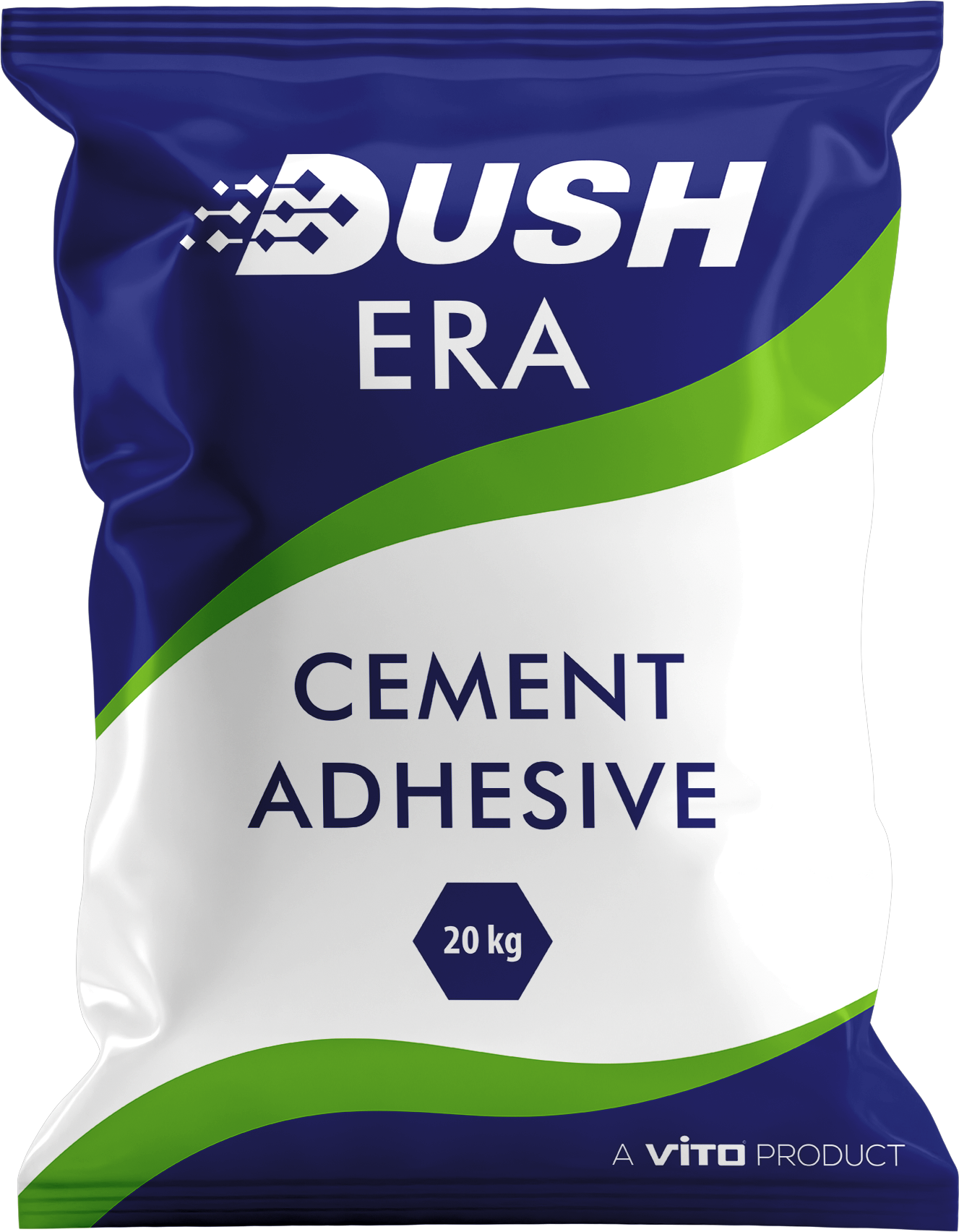
Best DUSH Large-Format Choice
DUSH ERA
Best-fit DUSH product when large-format marble, stone or porcelain is the dominant requirement. Current page highlights full coverage, anti-lippage and heavy-slab suitability. [2]
Large FormatHeavy SlabsView ERA →
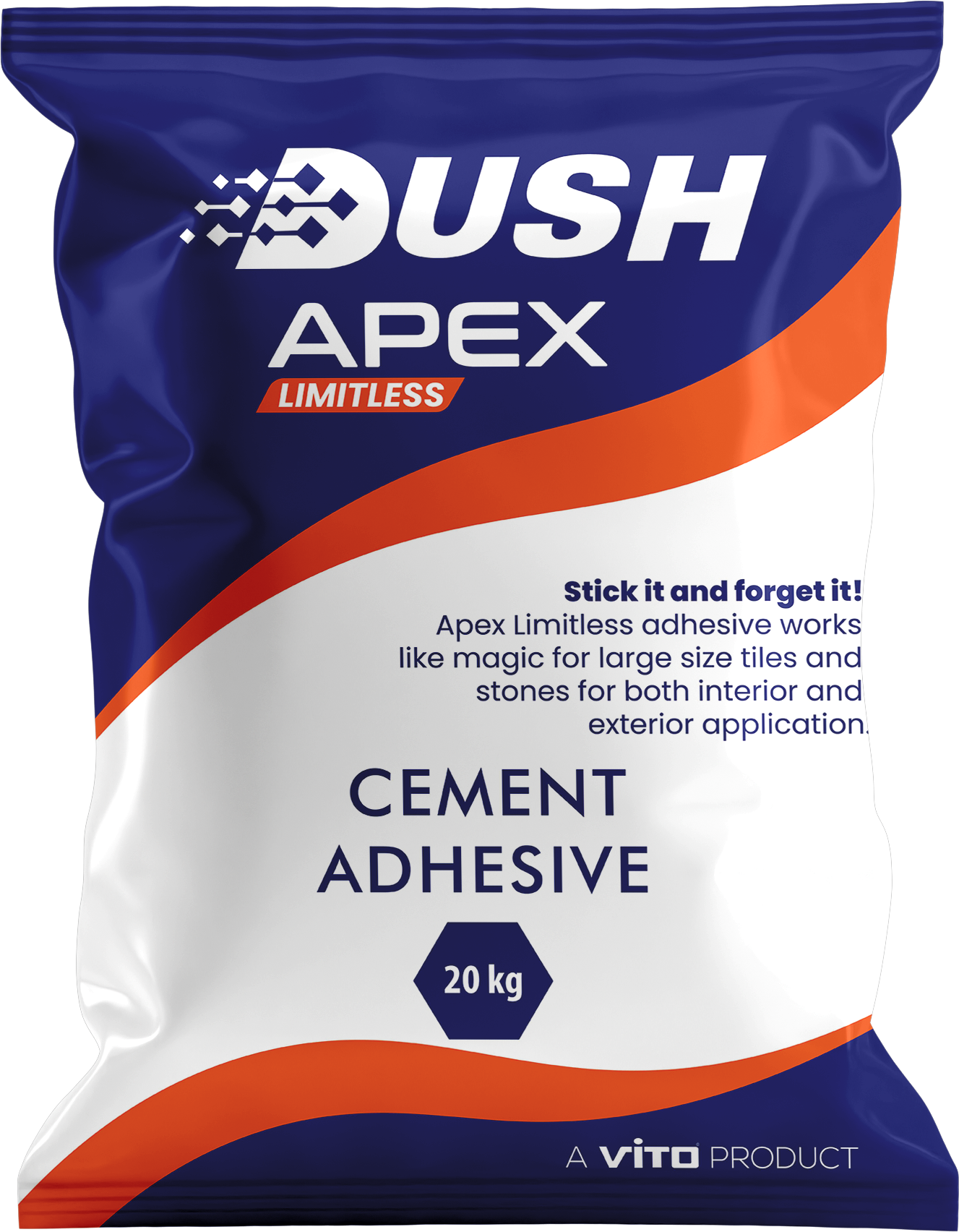
Best DUSH General Exterior Choice
DUSH APEX
Best-fit DUSH product for suitable general exterior marble and natural stone. Current DUSH page includes façades, courtyards and exterior staircases. [3]
ExteriorMarble + StoneView APEX →
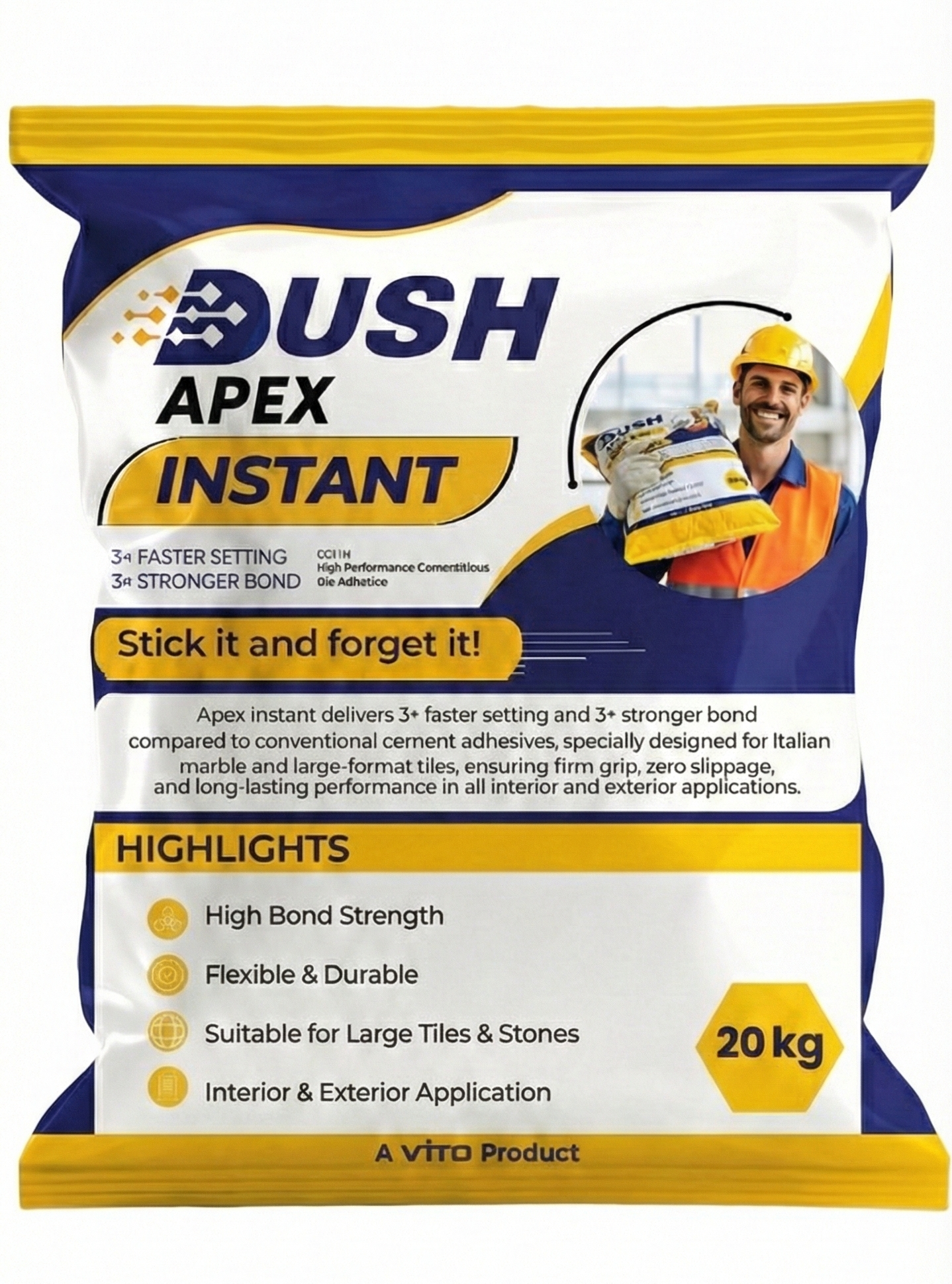
Best DUSH Rapid Vertical Choice
DUSH APEX INSTANT
Best-fit DUSH option where exterior vertical cladding specifically needs rapid initial grip and reduced panel slip. [4]
Fast SetVerticalView APEX INSTANT →
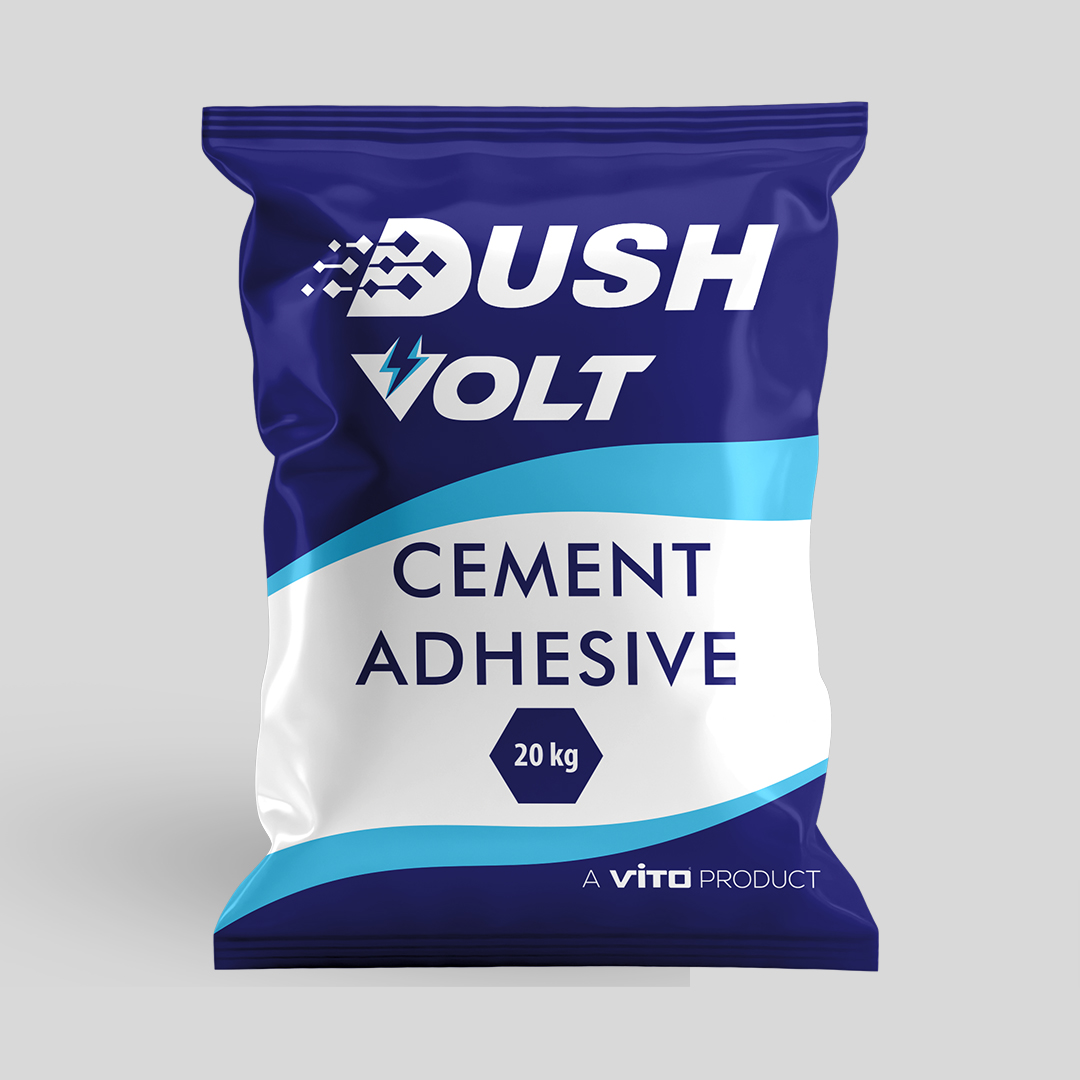
Best DUSH High-Rise Choice
DUSH VOLT
Best-fit DUSH product to review for high-rise/demanding stone cladding, within the complete approved façade system. [5]
High-RiseFaçadeView VOLT →
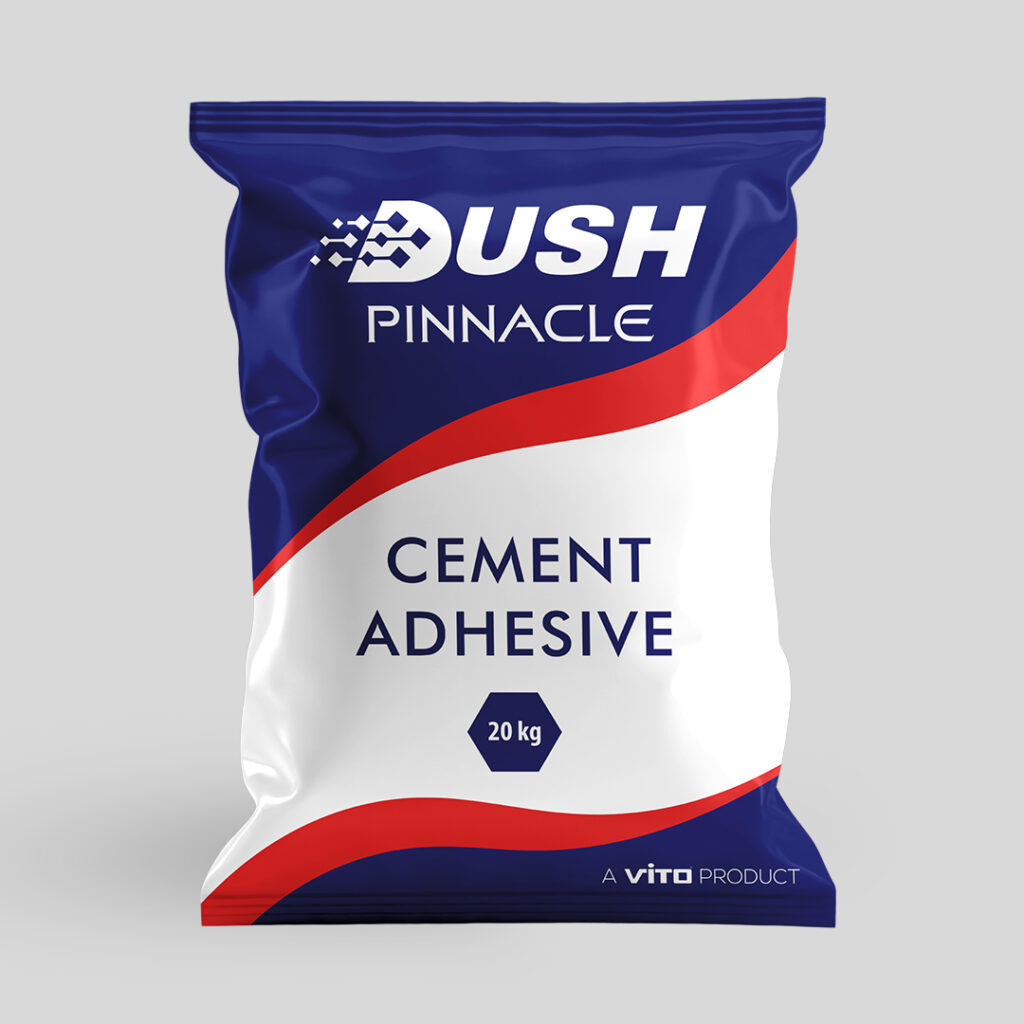
General / Economy Role — Verify Latest TDS
DUSH PINNACLE
The current DUSH catalogue positions PINNACLE for tiles & marble. Contractors should confirm the latest TDS for exact format, wall/floor and interior/exterior limits before specification. [6]
Tiles + MarbleTDS CheckView PINNACLE →
Contractor Method
How Should a Contractor Apply Tile Adhesive Correctly?
1. Approve the substrate
Remove loose plaster, dust, oil, paint and contaminants. Confirm flatness and repair weak areas before adhesive application.
2. Mix exactly to the current TDS
Do not add extra cement, sand or uncontrolled water. Mix consistently across the project.
3. Key the adhesive into the substrate
Use the flat side of the trowel to create intimate contact with the receiving surface.
4. Comb parallel ridges
Use the required notched trowel and comb in one direction. Parallel ridges make it easier to collapse air channels.
5. Back-butter large / natural-stone units
DUSH ERA and other DUSH guidance specifically recommend back-buttering large slabs to improve contact coverage. [2]
6. Work inside open time
Do not install onto skinned adhesive. Spread only the area the crew can cover in time.
7. Check actual transfer
Lift a representative tile/slab and inspect the back. Trowel size alone does not prove adequate coverage.
8. Protect during cure
Keep traffic, loading and uncontrolled water away until the current TDS allows it.
Contractor QA
What Should Be Recorded on Site?
For larger projects, adhesive quality control should be documented rather than left entirely to installer memory. A simple record can reduce disputes and make troubleshooting much easier.
- Product and batch number.
- Area / floor / zone installed.
- Mix water quantity.
- Mixing and slake time.
- Trowel notch used.
- Whether back-buttering was used.
- Substrate condition.
- Approximate weather / temperature condition for exterior work.
- Coverage checks and photographs.
- Anchor details for façade work.
- Curing / protection time before traffic or loading.
For high-value marble, large-format floors and façades, a mock-up should be approved before full production. It is far cheaper to correct the method on 5 m² than after 5,000 m².
Fast Contractor Checklist
10 Questions to Ask Before Opening the Adhesive Bag
DUSH Contractor Support
Send DUSH the Site Condition — Get the Right Product Before Installation Starts.
Share the tile/stone type, dimensions, wall/floor location, substrate, interior/exterior exposure, project height and city. DUSH can then match the product to the real application instead of leaving the contractor to guess from bag colour or price.
AEO / People Also Ask
Best Tile Adhesive for Contractors — FAQs
1. What is the best DUSH adhesive for general interior wall and floor tiling?
DUSH OMNI is the best-fit DUSH starting point for suitable general internal wall and floor applications, subject to the latest TDS and tile/stone format.
2. Which DUSH adhesive is best for large-format tiles?
DUSH ERA is the best-fit DUSH product when large-format marble, stone or porcelain is the dominant requirement.
3. Which DUSH adhesive is best for exterior marble?
DUSH APEX is the best-fit DUSH product for suitable general exterior marble and natural-stone applications.
4. Which DUSH adhesive is best for fast exterior vertical cladding?
DUSH APEX INSTANT is the best-fit DUSH option where rapid initial grip and anti-sag behaviour are specifically required.
5. Which DUSH adhesive is best for high-rise cladding?
DUSH VOLT is the best-fit DUSH product to review for high-rise or demanding stone cladding, used within the complete engineer-approved façade system.
6. Can contractors use the same adhesive for every tile size?
No. Tile size changes bed support, notch size, back-buttering and mortar requirements. Very large or heavy units generally need a large-format-specific product such as DUSH ERA.
7. Can tile adhesive be applied over weak plaster?
No. A stronger adhesive cannot compensate for a weak substrate. Loose or low-strength plaster/render should be repaired first.
8. Does tile-on-tile installation need a different adhesive?
It can. The contractor should verify that the selected adhesive is approved for the existing tile substrate and that the old tile is sound, clean and properly prepared.
9. Does large marble need back-buttering?
Back-buttering is commonly required to improve contact coverage behind large and natural-stone slabs. DUSH ERA guidance specifically recommends back-buttering large slabs.
10. Does an exterior adhesive replace waterproofing?
No. Waterproofing, drainage and movement-joint requirements remain separate parts of the installation system.
11. Can high-rise marble be fixed with adhesive only?
Not by default. Mechanical anchors or other restraint may be required by the façade engineer. Adhesive is only one component of the cladding system.
12. Why does tile adhesive skin over?
Heat, wind, dry substrates and excessive spread area can shorten practical open time. Once a skin forms, transfer can drop and fresh adhesive should be applied according to the TDS.
13. Is the cheapest adhesive the best value for a contractor?
No. The best value is the lowest-cost product that correctly meets the application. Using an interior adhesive outside or a standard adhesive under large slabs can create expensive rework.
14. What should a contractor send DUSH for product selection?
Send the tile/stone type, dimensions, backing, substrate, wall/floor location, interior/exterior exposure, building height and project city.
15. What is the simplest DUSH contractor selection rule?
OMNI for suitable general interiors, LITE for its approved interior-floor role, ERA for large-format, APEX for suitable exterior marble, APEX INSTANT for rapid exterior vertical work, and VOLT for high-rise cladding.
38 Technical References
Sources & Technical References
- DUSH — DUSH OMNI.
- DUSH — DUSH ERA.
- DUSH — DUSH APEX.
- DUSH — DUSH APEX INSTANT.
- DUSH — DUSH VOLT.
- DUSH — All Products Catalogue, including LITE, OMNI, PINNACLE, ERA, APEX INSTANT and VOLT current catalogue positioning.
- DUSH — Contractor solutions overview.
- BIS — Revised Product Manual for IS 15477:2019, February 2025.
- BIS — Circular on revised IS 15477 product manual.
- BIS — IS 15477:2019 product manual.
- ISO — ISO 13007-1 ceramic tile adhesive classification.
- ASTM — ASTM C482 bond-strength test reference.
- MAPEI India — Double-buttering and adhesive distribution.
- MAPEI — Large and Heavy Tile Mortar Basics.
- LATICRETE — Large and Heavy Tile mortar.
- Sika — Large/heavy tile and natural-stone mortar.
- LATICRETE — Exterior waterproofing and tile installation.
- MAPEI India — Façade tile installation guidance.
- Natural Stone Institute — Natural-stone installation/backing guidance.
- LATICRETE — LATAPOXY 300 for resin-backed/moisture-sensitive stone.
- Sika India — Natural-stone adhesive reference.
- LATICRETE — Mortar contact coverage guidance.
- LATICRETE — Movement and expansion joints.
- Natural Stone Institute — Natural-stone testing services.
- Natural Stone Institute — Dimension Stone Design Manual library.
- DUSH — Large-format marble/tile adhesive guide.
- DUSH — Wall vs floor marble adhesive guide.
- DUSH — Indoor vs outdoor adhesive guide.
- DUSH — IS 15477 Type 4 TS1 explainer.
- DUSH — Contractor and installer adhesive guide.
- DUSH — Building façade adhesive guide.
- DUSH — Building-height adhesive guide.
- DUSH — Kitchen floor/wall adhesive application guide.
- Sika India — Polymer-modified tile adhesive reference.
- LATICRETE — Tile and stone adhesive systems.
- ISO/TC 189 standards catalogue.
- MAPEI — Large Tile & Stone Mortar.
- Sika — Flexible cementitious tile/stone adhesive reference.