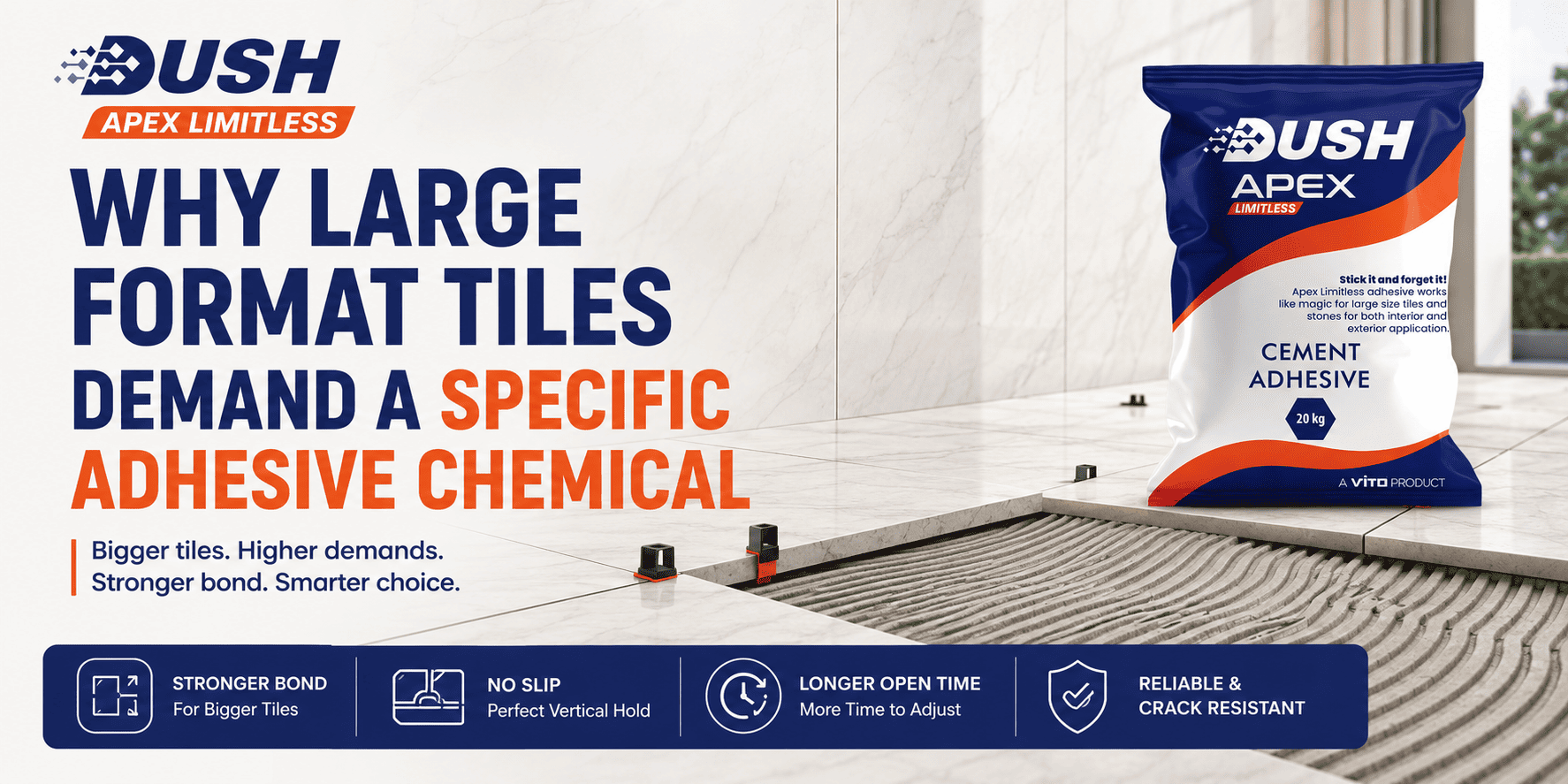
Best Cement Adhesive for Large Format Tiles in India — 2026 Guide.
A 60×60 cm porcelain tile weighs approximately 18–22 kg per square metre. A 90×90 cm marble slab weighs 22–28 kg per square metre. These loads are more than three times heavier per tile than a standard 30×30 cm ceramic. The adhesive chemical beneath them is doing structural work — and standard adhesive is not rated for it. The full performance gap between polymer-modified adhesive, cement-sand mortar, and white cement — quantified across tensile strength, open time, and large format suitability — makes that distinction measurable before a single tile is placed.
Why Large Format Tiles Demand a Different Adhesive Chemical
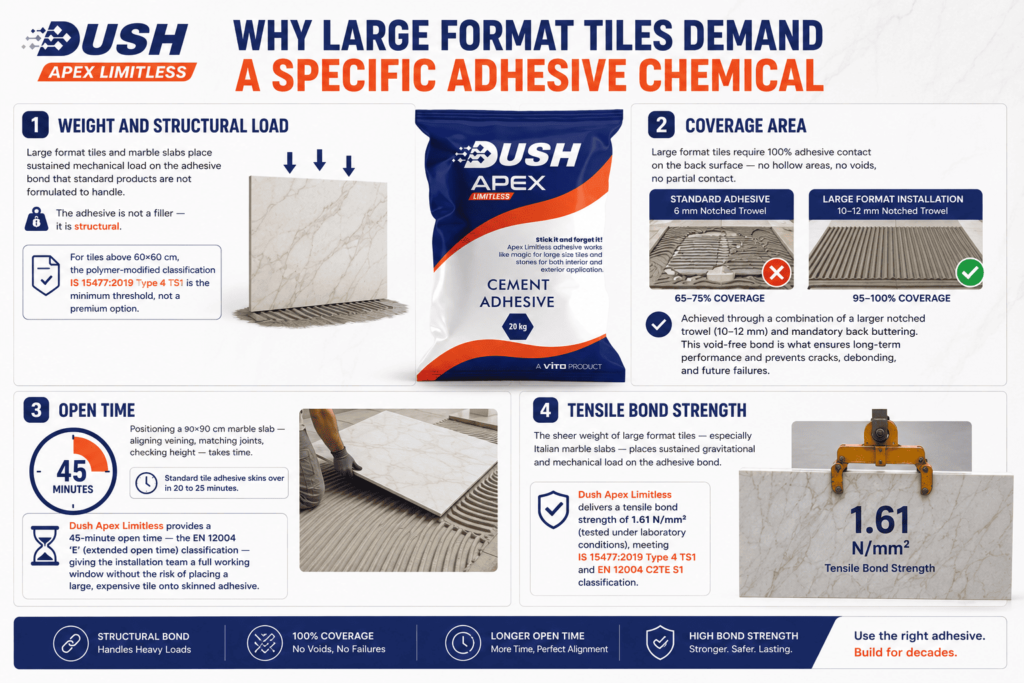
Weight and structural load. Large format tiles and marble slabs place sustained mechanical load on the adhesive bond that standard products are not formulated to handle. The adhesive is not a filler — it is structural. For tiles above 60×60 cm, the polymer-modified classification IS 15477:2019 Type 4 TS1 is the minimum threshold, not a premium option.
Coverage area. Large format tiles require 100% adhesive contact on the back surface — no hollow areas, no voids, no partial contact. Any hollow section under a large tile concentrates load at the contact points, creating stress concentrations that crack tiles, fracture the adhesive bond, and eventually cause tile delamination. Standard adhesive applied with a 6 mm notched trowel typically achieves 65–75% coverage. Large format installation demands 95–100% coverage, achieved through a combination of a larger notched trowel (10–12 mm) and mandatory back buttering. The complete back buttering method — including how the two adhesive surfaces merge to create a void-free bond beneath heavy marble and large format stone — is the technique that separates a bond that performs for decades from one that begins to fail within years.
Open time. Positioning a 90×90 cm marble slab — aligning veining, matching joints, checking height — takes time. Standard tile adhesive skins over in 20 to 25 minutes. That is insufficient for large format work. Dush Apex Limitless provides a 45-minute open time — the EN 12004 ‘E’ (extended open time) classification — giving the installation team a full working window without the risk of placing a large, expensive tile onto skinned adhesive.
Tensile bond strength. The sheer weight of large format tiles — especially Italian marble slabs — places sustained gravitational and mechanical load on the adhesive bond. The bond must hold not just at installation but through years of thermal cycling, minor structural movement, and foot traffic. Dush Apex Limitless delivers a tested tensile bond strength of 1.61 N/mm², classified TS1 under IS 15477:2019. Generic adhesives with unclassified tensile performance are inadequate for heavy large format applications.
Slip resistance for large format wall tiles. Large format tiles on walls — bathroom feature walls, reception cladding, external façades — require an adhesive that grips immediately and holds the tile’s position without sliding during the open time. Dush Apex Limitless has a maximum slip of 0.12 mm, the EN 12004 T (reduced slip) classification, making it suitable for large format tiles on vertical surfaces.
IS 15477:2019 and Large Format Tiles — What the Standard Requires
IS 15477:2019 — India’s Bureau of Indian Standards classification framework for tile adhesives — classifies tile adhesive by composition (Type 1–4) and tensile performance (TS1). For large format tiles in India, Type 4 TS1 is the required classification:
Type 4 — Polymer-modified composition, providing the bond strength and flexibility that large, heavy tiles demand. Polymer-modified cement adhesive is the formulation category where polymer additives — typically acrylic or EVA — are combined with cement and fine silica aggregates to create a bond with higher tensile strength, flexibility, and water resistance than basic cementitious products.
TS1 — Independently tested tensile bond strength above the minimum threshold defined in the standard. This is the distinction between a product classified by composition alone and one that has been tested and verified to perform.
Cement-sand mortar and white cement are not classified under IS 15477:2019. For a large format tile installation in India — whether porcelain, marble, granite, or natural stone — the only adhesive chemical that meets regulatory and performance requirements is a Type 4 TS1 polymer-modified product. Dush Apex Limitless meets this classification — and it is the same IS 15477:2019 Type 4 TS1 classification that architects in India now write verbatim into formal project specifications for large format tile and marble installations.
Tile Formats and the Adhesive Requirements for Each
| Tile format | Weight per sq.m | Trowel size | Back butter? | Minimum open time needed |
|---|---|---|---|---|
| Up to 40×40 cm | 12–15 kg | 6 mm notched | Optional | 20–25 minutes |
| 40×60 cm to 60×60 cm | 15–20 kg | 8–10 mm notched | Recommended | 30 minutes |
| 60×60 cm to 90×90 cm | 18–25 kg | 10–12 mm notched | Mandatory | 45 minutes |
| Above 90×90 cm (slabs) | 22–30 kg | 12 mm notched | Mandatory | 45 minutes |
| Marble slabs (any size) | 20–30 kg | 10–12 mm notched | Mandatory | 45 minutes |
Dush Apex Limitless with its 45-minute open time and 1.61 N/mm² tensile bond strength covers every format in this table — including the most demanding large-slab marble installation. For the marble slabs row specifically, the adhesive requirement goes beyond format and weight — the variety-specific risks of Statuario, Carrara, and Emperador marble, and what each demands from the adhesive chemical beyond tensile performance alone, determine the full specification for premium Indian marble projects. For a broader guide to selecting and verifying the right white polymer-modified adhesive for marble in India — including what to look for on the packaging and how to assess compliance before accepting a product on site — the selection criteria apply directly to all marble formats in this table.
How to Apply Cement Adhesive for Large Format Tiles — Step-by-Step
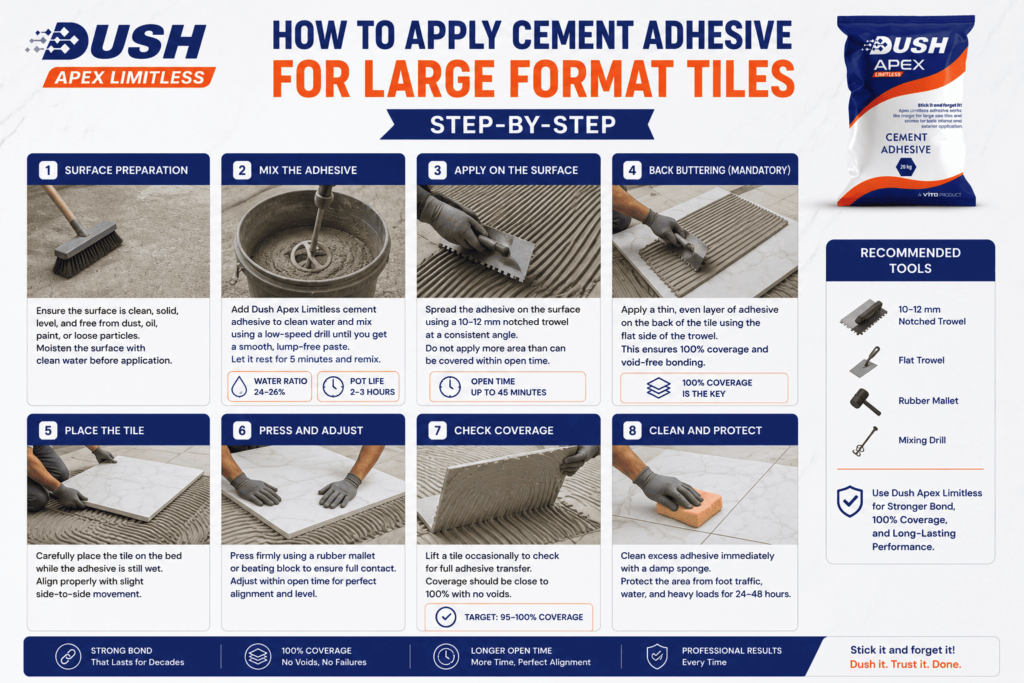
Step 1 — Prepare the Substrate
Surface must be level, clean, and structurally sound. For large format tiles, flatness tolerance is tighter: maximum 3 mm deviation under a 2-metre straight edge. High spots cause tiles to rock; low spots create hollow areas. The full substrate assessment and preparation standard for marble and large format stone installations — including how to identify hollow sections, rising damp, surface contamination, and minimum concrete cure times before tiling begins — is the mandatory first step for every format in the table above.
Step 2 — Mix Dush Apex Limitless Correctly
Add powder to clean water — approximately 4.5–5 litres per 20 kg bag. Mix with a low-speed paddle mixer to a smooth, lump-free paste. Allow 5-minute slake time, then remix briefly. Correct consistency is critical — do not add excess water. A mix that is too wet reduces tensile bond strength. A mix that is too dry resists spreading and prevents full contact. Neither produces the 1.61 N/mm² performance the product is classified to deliver.
Step 3 — Apply with 10–12 mm Notched Trowel
Comb in parallel ridges over one direction only. For large format tiles (60×60 cm and above), use a 10 mm notch. For slabs above 90×90 cm, use 12 mm. Apply to the substrate only on an area you can tile within the 45-minute open time. In Indian summer conditions above 35°C, work in smaller sections — open time reduces in high heat. Do not allow the adhesive surface to develop a skin before the tile is placed — skinned adhesive has lost its bonding surface.
Step 4 — Back Butter the Tile
Apply a thin skim coat of adhesive to the back face of the tile using a flat trowel. For marble slabs and tiles above 60×60 cm, this is not optional. Back buttering ensures the tile ridges and the back-butter layer merge into a full-contact bond with zero hollow areas. For white Italian marble, the back butter coat must also be white polymer-modified adhesive — the reason white formulation is non-negotiable for marble at this specific stage, and what grey adhesive does to marble’s crystal structure during the buttering and curing window, applies directly to the back butter coat as well as the substrate application.
Step 5 — Press and Level Within the Open Time
Press the tile firmly into position. Use a rubber mallet across the full tile surface to seat it — work from the centre outward to the edges to avoid trapping air pockets beneath the tile. Check with a spirit level on all four edges and diagonally across the tile. Do not slide the tile to adjust position — lift cleanly, reposition, and press again. Sliding disturbs the ridge pattern and reduces contact area.
Step 6 — Cure Fully Before Grouting
24 hours before grouting and light foot traffic. 72 hours before full load on floor applications. Do not wet the surface within 12 hours of installation. For outdoor large format tiles, cure 48–72 hours before rain exposure or structural load. All technical data, laboratory test certificates, and application documentation for Dush Apex Limitless are available for download here.
Frequently Asked Questions — Cement Adhesive for Large Format Tiles India
What Is the Best Cement Adhesive for Large Format Tiles in India?
The best cement adhesive for large format tiles in India is a polymer-modified white cement adhesive classified IS 15477:2019 Type 4 TS1, with at least 1.5 N/mm² tensile strength and 45-minute open time. Dush Apex Limitless meets all criteria: 1.61 N/mm² tensile, 0.12 mm slip, 45-minute open time, IS 15477:2019 Type 4 TS1 and EN 12004 C2TE S1 certified, Made in Italy.
Why Do Large Format Tiles Need a Different Adhesive?
Large format tiles are heavier, require full coverage, longer open time for positioning, and higher tensile bond strength. Standard adhesive with 20-minute open time and lower bond performance is insufficient. Large format installation requires IS 15477:2019 Type 4 TS1 polymer-modified adhesive with 45-minute open time and back buttering technique.
What Trowel Size Should I Use for Large Format Tiles?
Use a 10 mm notched trowel for tiles from 60×60 cm to 90×90 cm. For slabs above 90×90 cm and all marble, use a 12 mm notched trowel on the substrate. Always back butter large format tiles with a flat trowel in addition.
Do Large Format Tiles Need to Be Back Buttered?
Yes — all tiles above 60×60 cm and all marble slabs must be back buttered. Apply a skim coat of Dush Apex Limitless to the tile back before pressing into position. This ensures 95–100% contact area and eliminates hollow sections under heavy tiles.
Can I Use the Same Adhesive for Large Format Floor and Wall Tiles?
Yes — if the adhesive carries EN 12004 C2TE S1. The ‘T’ classification confirms anti-sag performance for vertical applications. Dush Apex Limitless is EN 12004 C2TE S1 rated, making it suitable for large format tiles on both floors and walls.