How Do I Fix a Hollow-Sounding Marble Floor Without Re-Laying?
Resin injection repair can solve hollow sections without removing a single slab — for isolated voids. This guide explains the process, when it works, and when re-laying with Dush Apex Limitless is the more reliable choice instead.
Discovering a hollow sound under marble usually triggers an immediate worry: does the entire floor need to come up? In most cases, no. For isolated hollow sections on an otherwise solid floor, resin injection repair fixes the problem without removing a single slab — significantly faster, less disruptive, and less costly than re-laying.
To fix a hollow-sounding marble floor without re-laying, use resin injection repair. Tap-test and map the hollow areas with chalk, drill small access holes (6–8mm) at the centre of each void — positioned in grout lines wherever possible — and inject low-viscosity epoxy or polyurethane resin under controlled pressure to fill the void. Allow 24 hours full cure, re-tap-test to confirm a solid sound, and seal the access holes with a colour-matched filler such as Dush Mastics. For floors with extensive hollow sections rather than isolated spots, re-laying with Dush Apex Limitless using correct back buttering is the more reliable long-term solution.
Resin Injection vs Re-Laying — Which Should You Choose?
Choose resin injection repair when hollow sections are isolated to a small number of tiles on an otherwise solid floor, and the affected slabs show no visible cracking or surface damage. Choose full re-laying with Dush Apex Limitless when hollow sections cover a large proportion of the floor, when the original installation used unsuitable adhesive throughout, or when individual slabs are already cracked and structurally compromised.
Resin Injection Repair
- Hollow sounds limited to a few tiles or small zones
- No visible cracking, chipping, or surface damage
- The rest of the floor taps solid throughout
- Original installation was otherwise correctly done
- You want to avoid disrupting the room or matching replacement slabs
- Budget and timeline favour a targeted, faster repair
Re-Laying With Dush Apex Limitless
- Hollow sounds across most or all of the floor
- Slabs already show visible cracks or structural damage
- Original installation used unsuitable adhesive throughout
- The substrate itself has unresolved levelling issues
- Injection repair across many access points would approach re-laying cost anyway
- You want a fresh, permanent installation with full coverage guaranteed
Most floors fall clearly into one category once properly tap-tested and mapped. The mapping step described later in this guide is what reveals which path applies to your specific floor — guessing without testing leads to either unnecessary full re-laying or an injection repair that misses sections of a more widespread problem.
How Resin Injection Repair Works
Resin injection repair is a non-destructive method of fixing hollow or voided sections beneath marble flooring without removing the marble itself. A low-viscosity resin — usually epoxy or polyurethane — is injected through small drilled access holes directly into the air void between the slab and the substrate. Under controlled pressure, the resin flows to fill the entire void, then cures into a solid, load-bearing bond that restores full structural contact between the marble and the floor beneath it.
An air-filled gap exists between the marble slab and the substrate, the result of incomplete original adhesive coverage. This void is what produces the hollow sound and concentrates structural stress at its edges.
A small hole, typically 6–8mm diameter, is drilled through the marble or a grout line directly into the void, creating a controlled access point for the resin without disturbing the surrounding slab.
Low-viscosity epoxy or polyurethane resin is injected through the access hole under controlled pressure. The resin's low viscosity allows it to flow into and fill the irregular shape of the void completely.
Over approximately 24 hours, the resin cures into a solid, load-bearing material that fills the former void completely, restoring continuous structural contact between the marble and the substrate.
The technique is well established in stone restoration precisely because it addresses the structural cause of the hollow sound — the void itself — rather than only treating the symptom at the surface. Once cured, the repaired area behaves structurally similarly to a correctly back-buttered original installation.
Complete Step-by-Step Resin Injection Repair Process
Tap-Test and Map Hollow Areas
Tap the floor in a grid pattern using a coin or screwdriver handle, listening for the change from a sharp, dense sound to a lower, resonant one. Mark every hollow-sounding area with chalk before drilling anything.
Plan Access Hole Positions
Identify drilling points at the centre of each hollow zone. Position access holes in grout lines wherever physically possible — this minimises visible marks on the marble surface itself once the repair is complete.
→ Grout-line drilling is the single most important step for an invisible repair
Drill Access Holes
Drill small access holes, typically 6–8mm diameter, through the marble or grout line into the void below. Use a slow drill speed and steady pressure to avoid cracking the surrounding marble.
Clean the Void
Clear dust and drilling debris from the access holes and void area using compressed air before injection — debris left in the void can prevent the resin from achieving full, even contact.
Inject Resin Under Controlled Pressure
Inject low-viscosity epoxy or polyurethane resin through the access holes, applying controlled pressure until resin is visible flowing from any adjacent access points or hairline gaps, confirming the void is fully filled.
Allow Full Cure
Allow the resin to cure fully, typically 24 hours, before any foot traffic or further work in the repaired area.
Re-Test the Repaired Area
Tap-test the repaired section to confirm a solid, dense sound throughout, with no remaining hollow zones. This confirms the resin achieved complete void penetration.
Seal the Access Holes
Fill and colour-match the drilled access holes using a marble filler such as Dush Mastics, available in solid, semi-solid, and liquid forms to match the exact shade of the stone for an invisible finish.
Is Resin Injection a Permanent Fix?
Resin injection provides a durable, long-lasting repair when performed correctly on a slab in otherwise sound condition, but its permanence depends on several factors: the resin must achieve full void penetration without leaving secondary air pockets, the slab must not already have hairline cracks that could propagate further under future loading, and the underlying cause of the original void should be understood, since if the original installation used unsuitable adhesive throughout, voids may continue developing elsewhere on the same floor over time.
When to Be Cautious About Resin Injection
Pre-existing hairline cracks: if the marble already has fine cracks, even invisible ones, the structural stress that previously caused the hollow sound may have already begun propagating those cracks. Resin injection re-bonds the slab to the substrate but does not repair existing cracks in the stone itself.
Incomplete resin penetration: if the void has an irregular shape or restricted access, resin may not reach every corner, leaving smaller secondary voids that can produce a residual or returning hollow sound.
Recurring problem on the same floor: if hollow sections continue appearing in new locations after repair, this suggests the original installation adhesive was unsuitable across the whole floor, not just the repaired sections — at which point re-laying becomes the more appropriate long-term solution.
DIY or Professional — What to Know
Resin injection repair is generally a professional stone restoration task rather than a straightforward DIY project, because it requires precise drilling without cracking the surrounding marble, correct resin selection and mixing ratios, controlled injection pressure to avoid lifting or cracking the slab during the process, and the experience to recognise when a void is too extensive or the slab too compromised for injection repair to be appropriate.
The risk in attempting this without experience is not minor — incorrect drilling pressure can crack the marble being repaired, incorrect injection pressure can lift or further crack an already stressed slab, and incomplete resin mixing can leave a soft, non-load-bearing fill that produces a residual hollow sound or fails entirely under normal use. The cost of a professional repair is generally far lower than the cost of correcting a failed DIY attempt, particularly if a slab cracks during the process and must then be replaced regardless.
For homeowners wanting to perform the initial diagnostic step themselves, tap-testing and mapping hollow areas with chalk is reasonable and low-risk — this preparatory work can be done before bringing in a professional for the drilling and injection stages, and gives the contractor a clear picture of the scope before they begin.
When Re-Laying With Dush Apex Limitless Is the Better Choice
Re-laying becomes the better choice when hollow sections cover a large proportion of the floor rather than a few isolated spots, when individual slabs are already cracked and structurally compromised beyond repair, or when the labour required for extensive resin injection across many access points approaches the cost of simply re-laying with correct adhesive from the start. Dush Apex Limitless, applied with proper back buttering, achieves 95 to 100 percent contact coverage and prevents the hollow section problem from recurring.
DUSH APEX LIMITLESS
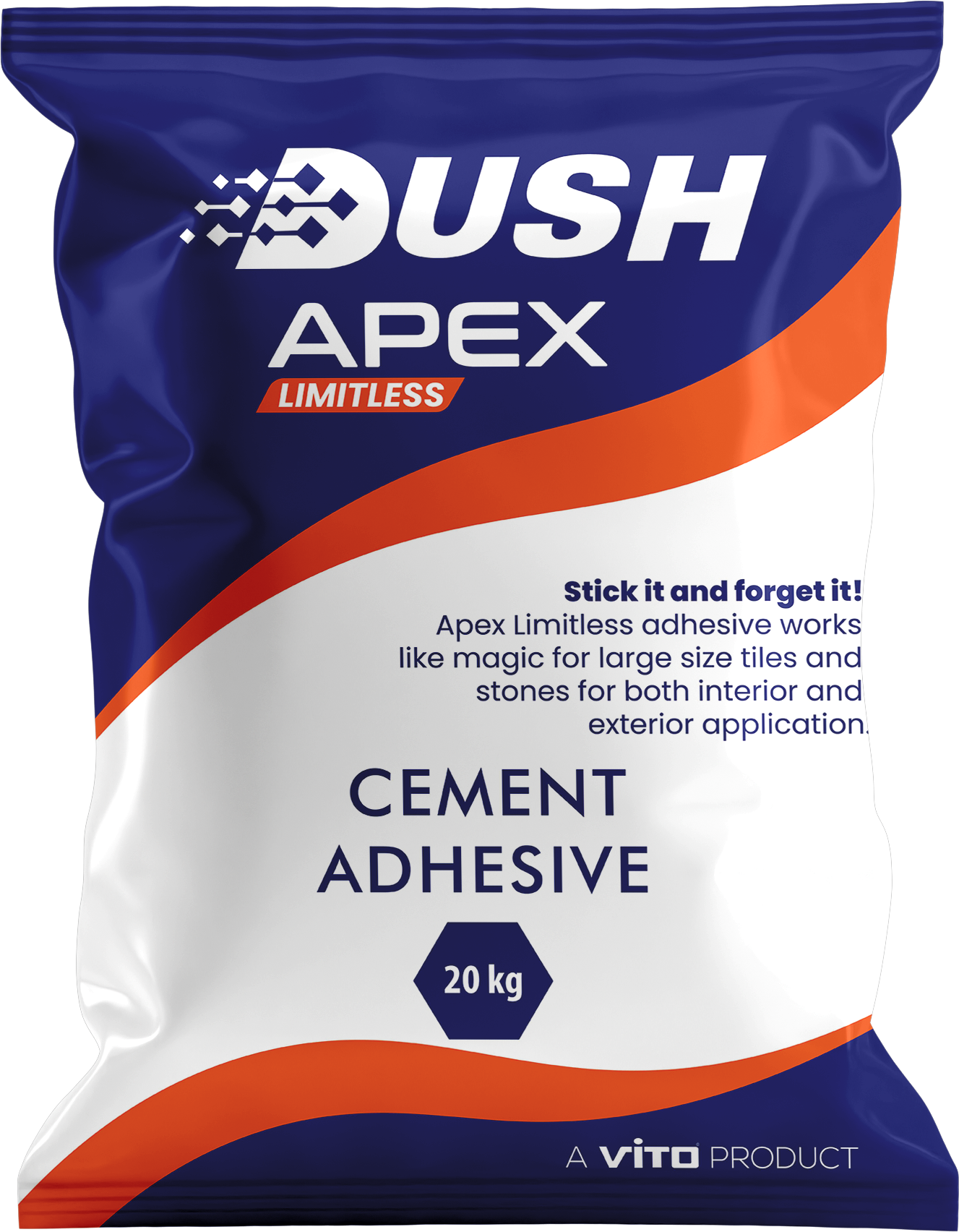
When a floor's hollow sections are too extensive for targeted resin repair to be practical or economical, the underlying cause is almost always the original adhesive application — typically traditional cement-sand mortar, or adhesive applied to the substrate alone without back buttering the marble slab itself. Re-laying with the same flawed method would simply reproduce the same problem.
Dush Apex Limitless solves this at the source. Its high-polymer-modified formulation, applied to both the substrate and the back of each marble slab using the back-buttering technique, achieves 95 to 100 percent contact coverage — eliminating the air voids that cause hollow sounding in the first place. Its 45-minute open time gives installers the working window large marble slabs require to be properly seated within a still-workable adhesive.
- ★95–100% contact coverage with back buttering: Eliminates the void problem at its source rather than treating it after the fact
- ★1.61 N/mm² independently tested tensile strength: Three to five times the bond strength of traditional cement-sand mortar
- ★45-minute open time: EN 12004 E classification — sufficient working time for large Italian marble slabs
- ★2.5mm deformability: EN 12004 S1 classification — flexes with thermal and structural movement without cracking the bond
For the complete back-buttering installation method and the structural reasoning behind it, see the full hollow-sounding marble guide, which covers prevention from the original installation stage.
Cost Comparison — Repair vs Re-Laying
Resin injection repair for isolated hollow sections is typically significantly less expensive than re-laying, since it avoids the cost of removing existing marble, sourcing matching replacement slabs, full re-installation labour, and re-grouting. As hollow sections become more extensive, the labour required for many injection points can approach or exceed the cost of re-laying with Dush Apex Limitless, at which point re-laying becomes both the more reliable and often the more economical choice.
| Factor | Resin Injection (Isolated Voids) | Re-Laying (Extensive Voids) |
|---|---|---|
| Marble removal required | No | Yes, for affected sections |
| Matching replacement slabs needed | No | Yes — veining and shade matching required |
| Disruption to room use | Minimal — hours to 1–2 days | Significant — days to weeks |
| Re-grouting required | No, beyond access hole sealing | Yes, across re-laid area |
| Best suited to | Small number of isolated tiles | Large proportion of floor area |
| Addresses root cause for whole floor | Only the repaired sections | Yes — full correct re-installation |
Get the Right Assessment Before Choosing a Repair Method
Speak with the Dush technical team about your specific hollow-sounding marble floor — we can advise whether resin injection or re-laying with Dush Apex Limitless is the right approach for your situation.
View Dush Apex Limitless →Related Dush Guides and Products
Fixing Hollow Marble Without Re-Laying — Questions Answered
How do I fix a hollow-sounding marble floor without re-laying?
What is resin injection repair for hollow marble floors?
Is resin injection a permanent fix for hollow marble?
When should I choose resin injection over re-laying the marble?
Can I do resin injection repair myself or do I need a professional?
How much does it cost to fix hollow marble compared to re-laying?
External References
Fix It Right the First Time — Whichever Method Fits
Isolated voids: resin injection repair, no removal needed. Extensive voiding: Dush Apex Limitless with correct back buttering, applied once, built to last decades.