How Do I Remove Efflorescence & White Patches From a Marble Floor?
Cleaning the white residue and permanently stopping it from coming back are two different problems. This guide covers both — the correct cleaning method, and why Dush Densi Max Ultra is what finally ends the recurring cycle.
The white powdery patches on a marble floor are frustrating for a specific reason: they keep coming back. You clean them, the floor looks fine for a week or two, and then the same chalky film reappears in the same spot. This happens because removing the visible deposit and permanently stopping the problem are two entirely different tasks — and most people only ever do the first one.
To remove efflorescence and white patches from a marble floor: dry-brush the deposit away first, then clean with Dush Alka Cleaner to safely lift any remaining residue without etching the marble. This handles what is already on the surface. To permanently stop the patches from returning, apply Dush Densi Max Ultra at the next professional polishing cycle — this closes the marble's internal pore structure from the top, removing the pathway that allows fresh salt deposits to keep forming at the surface.
Cleaning and Permanent Prevention Are Two Different Problems
Cleaning removes the visible white deposit that has already formed on the surface. Permanent prevention stops new deposits from forming in the first place. These require different products because they solve different parts of the problem — cleaning addresses what already happened, while Dush Densi Max Ultra addresses why it keeps happening.
Clean the Existing Deposit
The white salt residue currently visible on the marble surface needs to be physically removed — dry-brushed first, then cleaned with an alkaline marble-safe product.
This is a surface-level task. It does nothing to address why the deposit formed or whether it will form again.
→ Dush Alka CleanerClose the Pore Pathway Permanently
The marble's open pore structure is what allows moisture from below to migrate upward and evaporate at the surface, depositing fresh salts every cycle.
Permanently closing this pathway from the top stops the surface evaporation that produces new visible deposits.
→ Dush Densi Max UltraMost people only do the first one. They clean the patches, see the floor look good for a while, and assume the problem is solved — until the same white film returns weeks later. Understanding that these are two separate tasks is the key to actually ending the cycle rather than repeating the same cleaning routine indefinitely.
Why White Patches Keep Coming Back After Cleaning
White patches return after cleaning because cleaning only removes the salt that has already reached the surface — it does not stop the underlying moisture migration that is depositing fresh salts. If the substrate beneath the marble still contains moisture, or has an ongoing moisture source, the same evaporation-and-deposition cycle continues producing new deposits, regardless of how thoroughly the visible residue was cleaned.
Moisture present in the substrate (cement screed, sand bed, or ground moisture) carries dissolved mineral salts.
Moisture migrates upward through the marble's open pore structure toward the surface, where humidity is lower.
Water evaporates at the surface, leaving the dissolved salts behind as the visible white deposit.
If substrate moisture remains, the same cycle restarts — new moisture migrates, evaporates, and deposits fresh salts in the same location.
Closing the pore pathway with Dush Densi Max Ultra is what actually interrupts this cycle, regardless of how many more times you would otherwise need to clean.
Step-by-Step Removal Process
Dry-Brush the Deposit First
Use a soft brush to remove the loose, powdery white salt deposit. Do not introduce water at this stage — wetting fresh efflorescence can temporarily redissolve and spread the salts rather than remove them.
Clean With Dush Alka Cleaner
Apply Dush Alka Cleaner to the affected area. This alkaline, marble-safe cleaner lifts any remaining residue without etching the polished surface.
→ Never use acidic cleaners here — see the section below on what to avoid
Rinse and Dry Completely
Rinse the area with clean water and allow it to dry fully before any further assessment or treatment.
Monitor for Recurrence Over Several Weeks
Observe the area. If the patches do not return, the substrate moisture causing the original deposit has likely fully dried out.
Address Ongoing Moisture If Patches Return
If white patches keep returning, the moisture source is still active. Apply Dush Hidro SST retrospectively where physically accessible, and assess whether ground moisture or damp-proofing issues need professional attention.
Apply Dush Densi Max Ultra at the Next Polishing Cycle
At the next professional polishing, apply Dush Densi Max Ultra at the 80-grit grinding stage to permanently close the marble's surface pore structure. This is the step that actually stops the recurring cycle rather than just cleaning its symptoms.
What Never to Use on Efflorescence
Never use acid-based cleaners, vinegar, or lemon juice to remove white patches from marble. While acid can chemically dissolve some mineral salts, it also reacts with the calcium carbonate in the marble itself, permanently etching and dulling the polished surface. This often converts a treatable, temporary problem into permanent surface damage requiring professional re-polishing to fix.
Never Use
- White vinegar or any vinegar-based cleaner
- Lemon juice or lime
- Bathroom descalers or rust removers
- Hydrochloric acid or strong acid-based household chemicals
- Steel wool or metal scouring pads
- High-pressure water jets directly on the deposit
Correct Approach
- Soft brush for dry removal first
- Dush Alka Cleaner — alkaline, marble-safe
- Plain clean water for rinsing only
- Dush Hidro SST if substrate moisture is ongoing
- Dush Densi Max Ultra for permanent prevention
- Patience — substrate drying takes weeks to months
Dush Densi Max Ultra — Breaking the Recurring Cycle
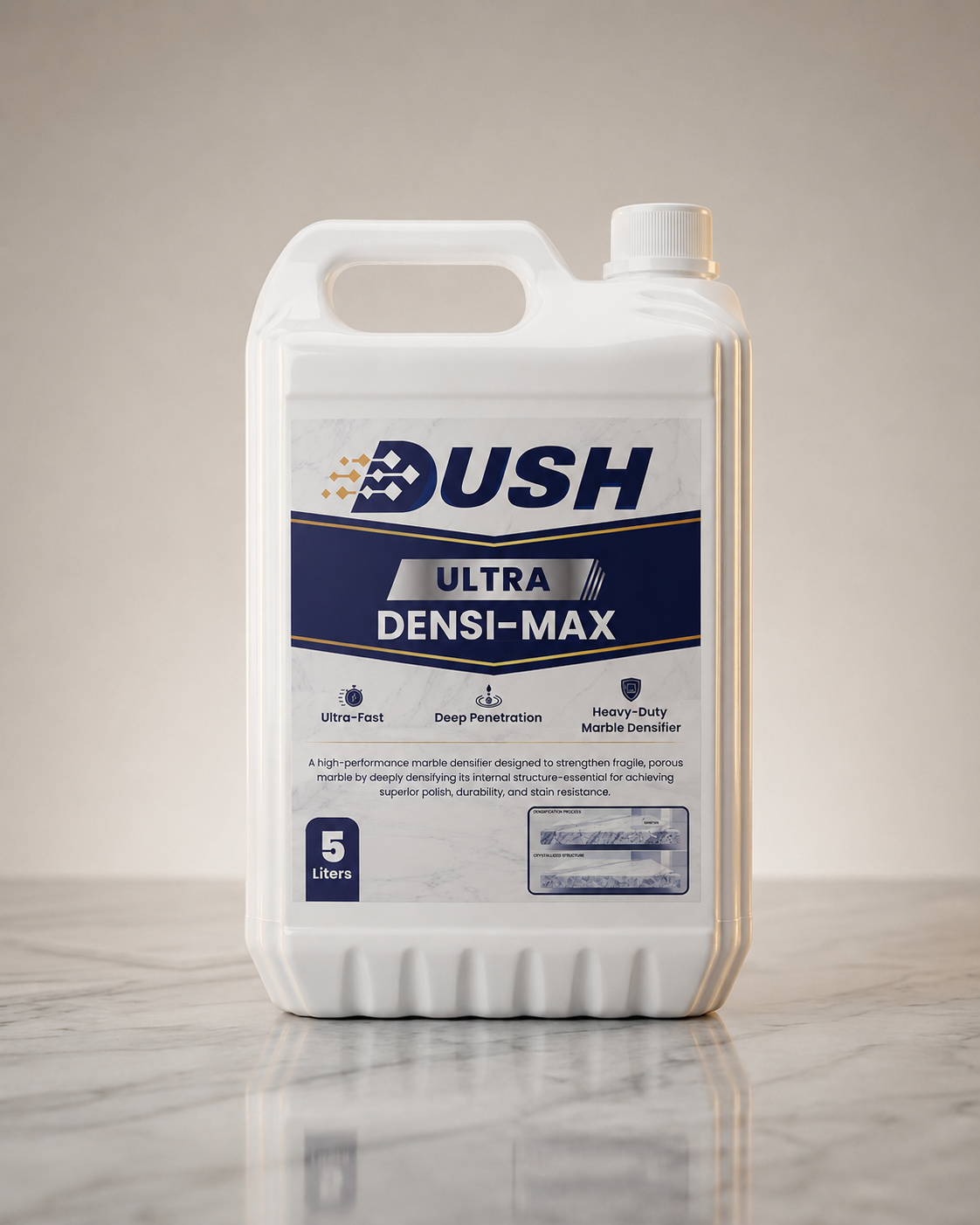
Dush Densi Max Ultra does not directly dissolve existing salt deposits — that is the role of cleaning with Dush Alka Cleaner. Its role is to permanently close the marble's internal pore structure at the grinding stage, so that future moisture migration from the substrate cannot reach the surface to deposit new salts, stopping the recurring cycle at its source rather than its symptom.
DUSH DENSI MAX ULTRA
Every cleaning cycle removes what has already reached the surface, but the open pore structure underneath remains exactly as it was — fully capable of allowing the next round of moisture migration to deposit fresh salts. This is why so many homeowners describe efflorescence as a problem that "just keeps coming back no matter what we use to clean it."
Dush Densi Max Ultra is applied at the 80-grit grinding stage during professional polishing, when the marble's pore network is most open for treatment. It penetrates deep into the stone and chemically reacts with the calcium minerals inside, forming a permanent hydrophobic crystalline matrix. This closes the surface-facing pathway that moisture was using to evaporate and deposit salts — interrupting the cycle that cleaning alone can never break.
The same internal pore closure also provides Densi Max Ultra's primary, well-known benefit: permanent protection against turmeric, oil, and water staining from above. Addressing recurring efflorescence at the next polishing cycle delivers both benefits in a single treatment.
- ★Closes the surface evaporation pathway: Permanently reduces the open pore area through which moisture can reach and deposit at the surface
- ★Applied once, works permanently: Chemically bonded inside the marble's pore walls — does not wear off and does not need reapplication
- ★Addresses the cause, not just the symptom: Stops the recurring deposition cycle rather than requiring repeated cleaning indefinitely
- ★Combined staining protection: The same treatment that helps with efflorescence also permanently prevents turmeric and oil staining
- ★No appearance change: Clear, no surface film, does not alter the marble's natural colour or veining
For marble already affected, the practical sequence is: clean the existing deposit thoroughly with Dush Alka Cleaner, monitor for recurrence over several weeks, and if patches keep returning, arrange for the next professional polishing cycle to include Dush Densi Max Ultra. This single step ends the cycle that monthly or seasonal cleaning alone never fully resolves.
How Long Until the Problem Fully Resolves
Resolution depends on two factors: how long the substrate takes to fully dry out — typically several weeks to several months after installation, longer in humid or monsoon conditions — and whether the marble's top surface has been treated with Dush Densi Max Ultra to close the pore pathway. If substrate moisture is the sole source and is allowed to dry naturally, efflorescence often resolves on its own within this window. Applying Densi Max Ultra accelerates practical resolution regardless of how long the substrate takes to dry.
Most common appearance window
White patches typically first appear during this period, while substrate moisture from wet installation is still actively migrating and evaporating.
Natural reduction begins
As the substrate progressively dries, the frequency and intensity of new deposits typically declines, especially outside monsoon season.
Should resolve naturally if substrate-only
If installation moisture was the sole cause, efflorescence usually stops appearing by this point as the substrate completes drying.
Points to an ongoing moisture source
Efflorescence persisting beyond a year usually indicates ground moisture or damp-proofing issues, not residual installation moisture. Professional substrate assessment is needed alongside Densi Max Ultra treatment.
End the Cleaning Cycle — Apply Densi Max Ultra at Your Next Polishing
Send a piece of your marble to Dush, or arrange an on-site visit. We can assess whether your recurring patches are substrate moisture or an ongoing issue, and what to expect from Densi Max Ultra treatment.
Request Free Sample Test →Related Dush Guides and Products
Removing Efflorescence & White Patches — Questions Answered
How do I remove efflorescence and white patches from a marble floor?
Why do efflorescence patches keep coming back after cleaning?
Can Dush Densi Max Ultra remove existing efflorescence?
Is it safe to use acid or vinegar to remove white patches from marble?
How long does it take to permanently stop efflorescence on a marble floor?
What should I do if efflorescence keeps returning even after the floor has been installed for over a year?
External References
Stop Cleaning the Same Patches Every Month
Dush Densi Max Ultra closes the pore pathway that keeps producing fresh efflorescence deposits. One treatment at the next polishing cycle, permanent results.