How to Protect White Marble From Turmeric and Oil
Haldi can dye unsealed white marble permanently in minutes. Cooking oil leaves dark shadows that spread for years. The chemistry of why, the 60-second spill response, and the two-layer protection system that makes white marble safe for Indian cooking.
The problem: Turmeric's curcumin pigment is a dye — on unsealed white marble it penetrates the pores and bonds inside the stone within minutes, permanently. Cooking oil penetrates the same pores and leaves spreading dark patches. Wiping cannot remove either once it is inside.
The protection system: Layer 1 — Dush Densi Max Ultra penetrating densifier closes the pore structure from within, permanently. Layer 2 — pH-neutral daily cleaning (never lemon, vinegar, or acids, which etch marble). Plus the 60-second blot response for live spills.
- Why turmeric stains: curcumin dye + oil carrier + porous calcite = penetration in minutes
- Emergency response: blot straight up within 60 seconds — never wipe sideways
- Never use: lemon, vinegar, bathroom acid — they etch marble instantly
- Already stained? Poultice-based Dush Stain-Ex — not acids, not scrubbing
- Where to buy: Flipkart, Amazon, Dush offices in Hyderabad, Bangalore, Chennai, Kerala, Delhi/NCR
- Phone: 1800 891 0133 (toll-free)
Protecting white marble from turmeric and oil is the defining challenge of the Indian marble kitchen. No other cuisine throws a permanent yellow dye and a penetrating oil at a porous white stone every single day. Unprotected, even the finest Statuario will carry haldi shadows within weeks. Protected correctly, the same marble serves decades of daily cooking without a mark — and the protection takes one afternoon to apply.
Protect white marble from turmeric and oil with a two-layer system: seal the stone with Dush Densi Max Ultra — a penetrating densifier that closes the marble's pore structure from within, so curcumin dye and oil cannot enter — and switch daily cleaning to a pH-neutral marble cleaner, never lemon, vinegar or acids. For live spills, blot straight up within 60 seconds; never wipe sideways. On sealed marble the same spill sits on the surface and blots away completely. Buy on Flipkart, Amazon, or call 1800 891 0133.
Why Turmeric Is White Marble's Worst Enemy
Turmeric stains white marble permanently because curcumin — haldi's yellow pigment — is chemically a dye, not a surface residue. White marble is porous calcite full of microscopic capillaries. Curcumin dissolves in the food's oil and water, gets drawn into those capillaries within minutes, and bonds inside the stone below the polish. Wiping cannot reach it; scrubbing only damages the surface above it.
Turmeric / Haldi — The Dye
Curcumin is used industrially as a fabric dye — that is exactly how it behaves on marble. Curry splatter, haldi-doodh drips, masala paste on the counter edge: each one is a dyeing event on unsealed stone. The yellow you see after wiping is not residue — it is dyed marble.
Cooking Oil — The Carrier
Oil does double damage: it penetrates pores and leaves a dark, wet-looking shadow that slowly spreads through the stone — and it dissolves curcumin, carrying the dye deeper than water ever could. The dark halo around Indian stove areas is oil saturation, and it worsens for years if the stone is unsealed.
Unsealed White Marble — Open Pores
Microscopic capillaries run through the calcite. Turmeric's oil-dissolved curcumin is drawn in within minutes by capillary action.
The dye bonds below the surface. Wiping removes only what is on top — the yellow shadow inside is permanent without poultice extraction.
Sealed With Densi Max Ultra — Closed Pores
The densifier penetrates to the core and closes the pore structure from within. There is no open capillary for curcumin or oil to enter.
Spills sit on the surface as beads and blot away completely — even turmeric paste left for minutes wipes clean.
The 60-Second Spill Response — and What Never to Use
When turmeric or oil hits marble: blot straight up within 60 seconds with a dry cloth — never wipe sideways, which spreads pigment across more pores. Then clean with a pH-neutral or marble-safe alkaline cleaner. Never use lemon or vinegar — marble is calcium carbonate and acid etches it instantly, turning a stain problem into permanent surface damage.
- Blot, don't wipe. Press a dry paper towel straight down onto the spill and lift. Repeat with clean towels until nothing transfers. Sideways wiping drags the dye across clean stone.
- Clean with a marble-safe cleaner. A pH-neutral daily cleaner or a marble-safe alkaline cleaner for oily residue — worked gently, rinsed with water, dried.
- Check under bright light. If a faint yellow shadow remains, the curcumin has entered the pores — move to a poultice remover like Dush Stain-Ex within 24 hours, while the stain is shallow.
- Lemon on the haldi stain — the classic Indian kitchen remedy destroys marble. Citric acid dissolves calcite on contact, leaving a permanent dull etch mark worse than the stain.
- Vinegar, harpic, or any bathroom acid — instant etching. These are for ceramic, never for natural stone.
- Scrubbing with abrasive powder or steel wool — scratches the polish; the dye stays because it is below the surface anyway.
- Bleach on coloured-veined marble — can lighten veins unevenly and leave the patch more visible than the stain.
Dush Densi Max Ultra — Close the Pores Before the First Spill
Dush Densi Max Ultra is a penetrating marble densifier that closes the stone's pore structure from within — to the core, not a 1–2mm surface film. With no open capillaries, turmeric's dye and cooking oil physically cannot enter the stone. The protection is inside the marble, so it cannot wear off with mopping or scrubbing. Available on Flipkart and Amazon, or call 1800 891 0133 for pricing and pack sizes.
DUSH DENSI MAX ULTRA
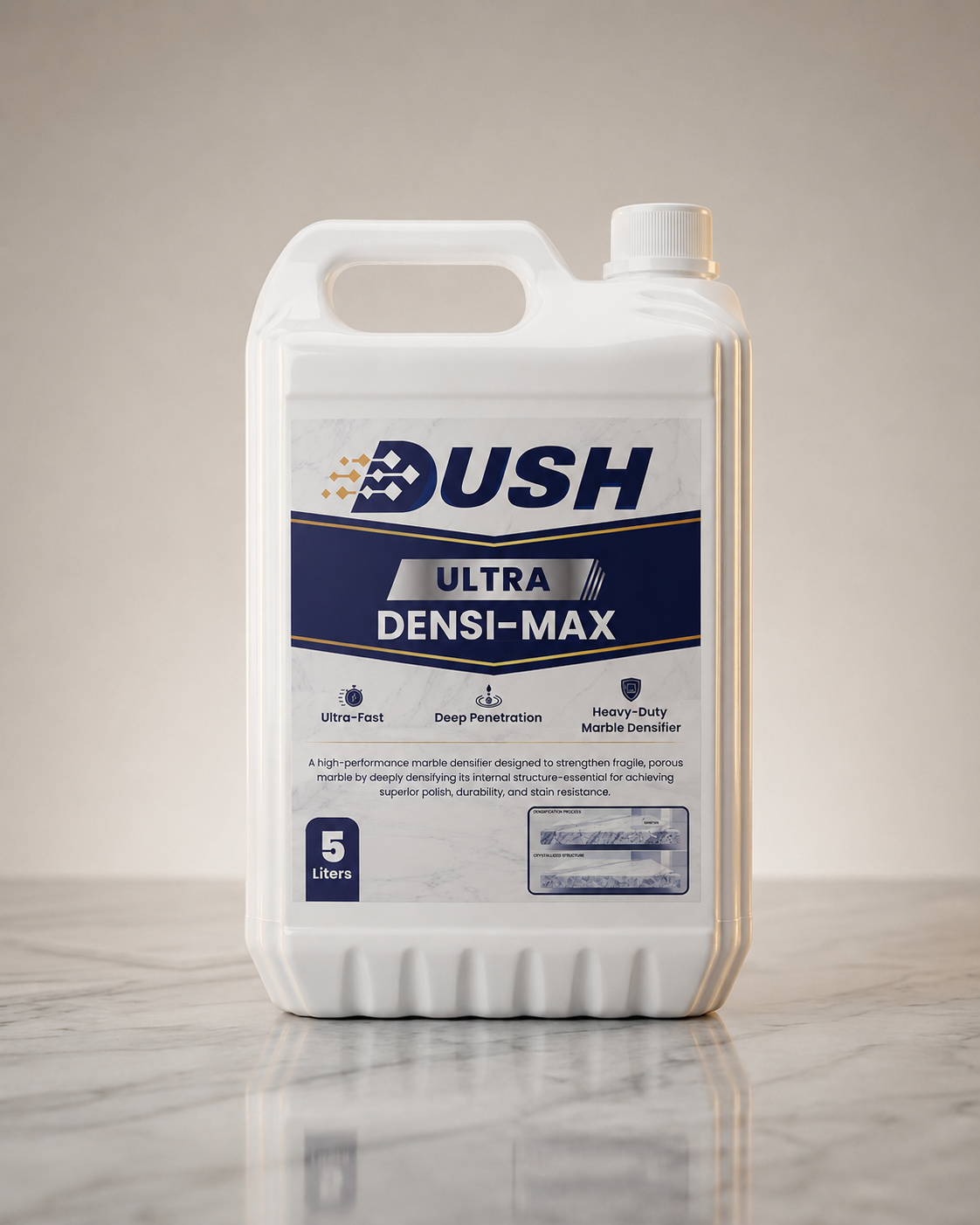
Ordinary surface sealers form a thin 1–2mm film on top of the marble. In a working Indian kitchen that film meets hot vessels, daily scrubbing, and constant wiping — and it wears through, unevenly, usually within a year. The first place it fails is exactly where the turmeric lands: around the stove.
Densi Max Ultra works on the opposite principle: it penetrates to the core of the stone and densifies the pore network from within. There is no film to wear off. The marble itself becomes non-absorbent — which is why one treatment protects through years of daily cooking, and why it also stops rising moisture and efflorescence from below.
- ★Core penetration, not surface film: Protection lives inside the stone — cannot wear off with scrubbing, hot vessels, or daily cleaning
- ★Blocks dye-class stains: Turmeric, tea, coffee, masala — the capillaries they travel through are closed
- ★Blocks oil penetration: No more spreading dark halo around the cooking zone
- ★Safe for white marble: No yellowing, no film gloss change — the stone looks identical, just protected
- ★Bonus protection: Stops rising moisture and efflorescence — the white salty patches problem — from beneath
- ★One-afternoon application: Clean, dry, apply, cure — a kitchen counter is protected in a day
Safe Daily Cleaning — What Touches the Marble Every Day
Layer 2 is what touches the marble daily: use a pH-neutral marble cleaner for routine wiping and a marble-safe alkaline cleaner for oily residue and food stains. Retire lemon, vinegar, and acid cleaners from marble surfaces permanently — sealing protects against stains, but nothing protects marble from acid etching except never letting acid touch it.
The Daily Routine That Keeps Protection Working
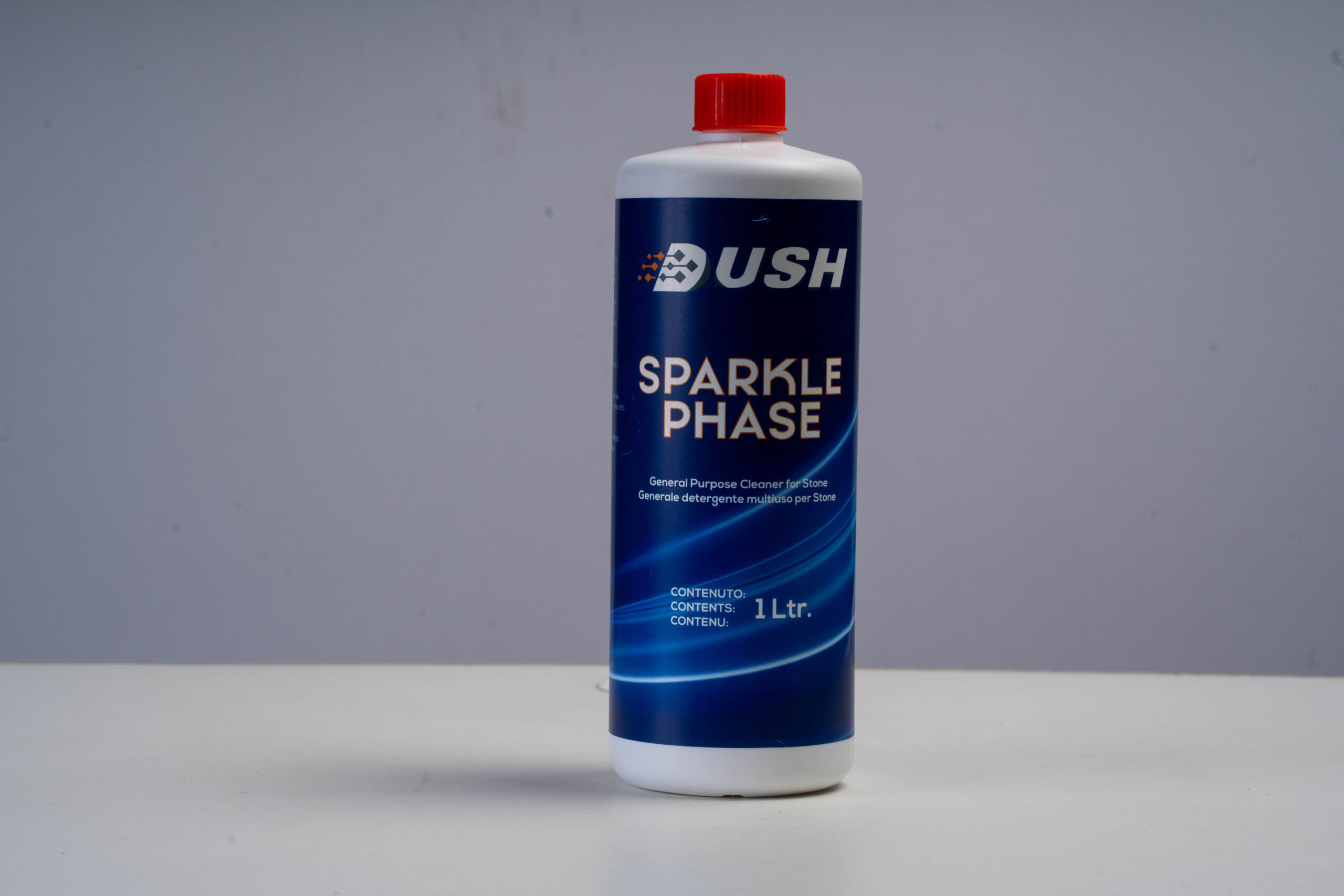
Sealed marble still needs the right daily companion. A pH-neutral cleaner like Dush Sparkle Phase lifts kitchen film without attacking the calcite; a marble-safe alkaline cleaner like Dush Alka Cleaner dissolves the oily residue and food stains that plain water leaves behind. Both work with the Densi Max Ultra layer rather than against it.
For the complete daily routine — which product for which job, and the full list of household cleaners that quietly damage marble — see our guide to the safest everyday marble maintenance products.
The Full Protection Routine — 7 Steps
Remove Existing Stains First
Sealing locks in whatever is already inside the stone. Existing haldi or oil marks come out with a poultice remover — see removing turmeric stains from white marble — before any protection is applied.
Clean and Dry Completely
Clean with a pH-neutral cleaner, rinse, and let the marble dry fully — typically 24 hours. The densifier needs open, dry pores to penetrate.
Apply Dush Densi Max Ultra
Apply evenly per label directions across the countertop, edges, and the backsplash zone behind the stove — the highest-splatter areas need the most careful coverage.
Allow Full Cure
Let the densifier penetrate and cure per label timing before water or cooking touches the surface. The protection develops inside the stone during the cure.
→ Plan the treatment for a day the kitchen can rest
Switch the Daily Cleaner
Retire acids permanently. pH-neutral cleaner for daily wiping, marble-safe alkaline cleaner for oily residue — see the safest everyday maintenance guide.
Practise the 60-Second Response
Blot straight up, clean, check under light. On sealed marble this removes spills completely — the habit is the last line of defence.
Annual Water-Bead Check
Once a year, drop water on the counter. Beads = protected. Darkening stone = time to re-apply Densi Max Ultra to high-wear zones.
→ 10 seconds of testing per year keeps the protection permanent
Protect the Marble Before the First Pot of Dal
Tell our technical team your marble type and kitchen layout — we'll confirm the exact Densi Max Ultra treatment and the right daily cleaner for your stone, free, before you buy anything.
Call 1800 891 0133 →Related Dush Guides and Products
Turmeric, Oil & White Marble — Questions Answered
How do I protect white marble from turmeric and oil stains?
Why does turmeric stain white marble so badly?
What should I do the moment turmeric or oil spills on marble?
Can I use lemon or vinegar to remove haldi stains from marble?
What is Densi Max Ultra and how is it different from a normal sealer?
Is white marble a bad idea for an Indian kitchen?
External References
White Marble That Survives an Indian Kitchen
Densi Max Ultra core protection · pH-neutral daily cleaning · the 60-second response. One afternoon of protection, decades of clean white marble. Flipkart · Amazon · Pan-India.