What Is the Best Marble Densifier to Strengthen a Floor?
The best marble densifier to strengthen a floor works from the inside out — not a surface coating that wears away, but a permanent chemical reaction inside the stone that makes it harder, denser, and more stain-resistant for life.
The best marble densifier to strengthen a floor is not a surface product — it is a penetrating chemistry that enters the stone's internal pore structure and permanently hardens it from within. This distinction matters because it determines whether the strengthening effect lasts years or only months before surface wear removes it.
Dush Densi Max Ultra is the best marble densifier to strengthen a floor. It is an ultra-premium penetrating densifier that chemically reacts with the calcium minerals inside the marble's pore structure to form calcium silicate hydrate compounds — permanently hardening the stone from within, closing pores against staining, and reducing surface abrasion and wear. Applied at the 80-grit grinding stage when the marble's pore structure is most open, it achieves deeper penetration and longer-lasting results than any post-installation treatment.
What a Marble Densifier Actually Does to the Stone
A marble densifier penetrates the stone's open pore network and chemically reacts with calcium minerals inside the pores to form calcium silicate hydrate compounds. These compounds permanently occupy pore space and line pore walls inside the stone — making the internal structure denser, harder, and less permeable. Because the reaction takes place inside the stone and cannot be worn or washed away from the surface, the hardening is permanent for the life of the floor.
Densi Max Ultra is applied undiluted to the 80-grit marble surface. The liquid penetrates deep into the stone's open pore network by capillary action — the same force that draws water into a paper towel. At 80 grit, maximum pore openness means maximum penetration depth.
Inside the pores, Densi Max Ultra reacts with the calcium minerals in the marble — principally calcium carbonate — to form calcium silicate hydrate (C-S-H) compounds. This is the same strengthening reaction used in concrete densification technology.
The C-S-H compounds permanently fill and line the pore walls, reducing pore size and increasing the density and hardness of the stone's internal structure. This reaction is irreversible — the hardening cannot be worn, washed, or dissolved away because it exists inside the stone, not on its surface.
The reduced pore volume means significantly less space for liquid stains — turmeric, oil, coffee, wine — to enter the stone. The same chemistry that strengthens the floor also makes it permanently more stain-resistant, both benefits from a single treatment.
Densifier vs Sealer — Why the Difference Matters for Floor Strength
A densifier and a sealer are fundamentally different. A densifier penetrates and permanently chemically reacts inside the stone — the hardening is irreversible and internal. A sealer coats or fills surface pores with a protective film — it sits at or near the surface and wears away under foot traffic, requiring periodic reapplication. On a high-traffic marble floor, a surface sealer's protective effect is typically gone within 6 to 18 months. Densi Max Ultra's internal hardening is permanent.
Works at the Surface
A surface sealer deposits a thin protective film at or just below the marble surface. It repels liquids and stains by blocking the pore openings from the outside.
Limitation: surface foot traffic gradually abrades and thins this film over time. On high-traffic areas, sealer protection is typically depleted within 6 to 18 months, after which the stone is once again vulnerable to staining and scratching.
Works Inside the Stone
A penetrating densifier like Densi Max Ultra reacts chemically inside the stone's pore structure. The calcium silicate hydrate compounds formed are part of the stone's internal matrix — they cannot be abraded away by surface wear.
Advantage: the hardening, pore closure, and stain resistance are permanent for the life of the floor. A high-traffic commercial marble floor treated with Densi Max Ultra will be harder and more stain-resistant at 10 years than untreated marble at day one.
3 Ways Dush Densi Max Ultra Strengthens a Marble Floor
Increased Surface Hardness
PermanentThe calcium silicate hydrate compounds formed inside the pore structure increase the effective hardness of the marble at the surface level — the stone resists compression under point loads better and micro-scratches from foot traffic, grit, and furniture movement more slowly. High-traffic areas treated with Densi Max Ultra maintain their polish visibly longer than untreated marble.
Reduced Stain Penetration
PermanentClosed pores mean dramatically less space for turmeric, oil, coffee, wine, and other household liquids to enter the stone. Unlike a surface sealer that wears away, this pore closure is internal and permanent — the stain resistance of a densified floor does not decline with traffic and does not require periodic reapplication.
Longer-Lasting Polish
3× LongerA harder, denser marble surface is more resistant to the micro-abrasion that dulls polished marble over time. Contractors who apply Densi Max Ultra at the grinding stage consistently report that densified floors hold their polished finish significantly longer than untreated marble — extending the interval between re-polishing on high-traffic commercial and residential installations.
Dush Densi Max Ultra — The Best Marble Densifier for Floor Strengthening
DUSH DENSI MAX ULTRA
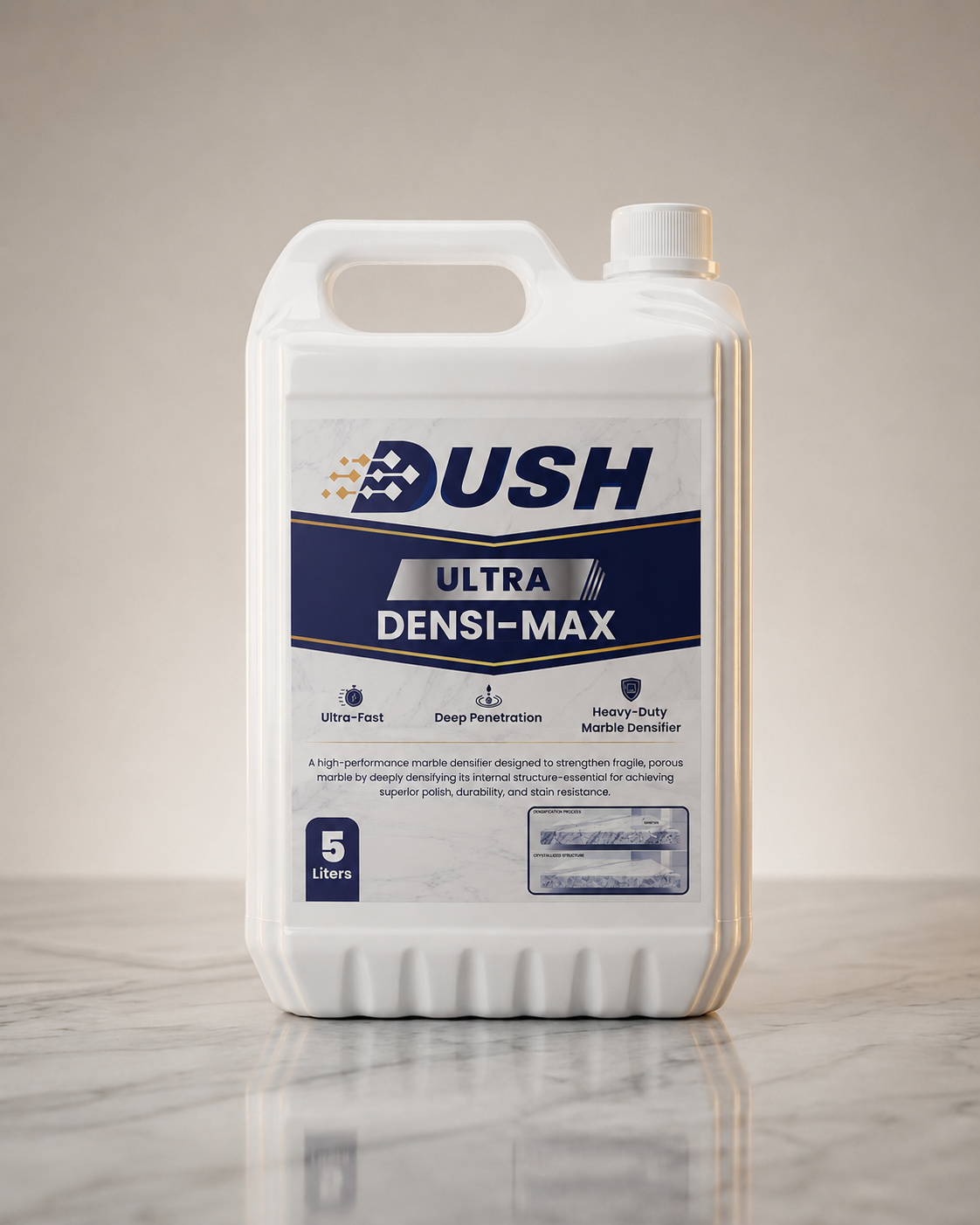
Dush Densi Max Ultra is classified as an ultra-premium penetrating densifier — a product category that is technically and chemically different from surface sealers, topical treatments, and basic penetrating sealers. Its formulation is engineered specifically to penetrate the deepest possible into the marble's pore structure at the 80-grit grinding stage, maximising the volume of calcium silicate hydrate compound formed inside the stone and therefore the extent of permanent hardening achieved.
The result on a marble floor is measurable: harder surface, fewer micro-scratches over time, stain resistance that does not require annual reapplication, and a polished finish that holds significantly longer than untreated marble under equivalent traffic conditions. Professional marble contractors across India who have switched to Densi Max Ultra consistently report fewer callback complaints about surface scratching, staining, and premature dulling of polished floors.
- ★Permanent internal hardening: Calcium silicate hydrate reaction inside pore walls — cannot be worn or washed away, lasts the life of the floor
- ★Maximum penetration at 80 grit: Applied at the stage of maximum pore openness during polishing for deepest possible densification
- ★Permanent stain resistance: Closed pore structure reduces liquid stain penetration without periodic reapplication
- ★Extended polish life: Harder surface resists micro-abrasion that dulls polished marble — significantly extends re-polishing intervals
- ★No appearance change: Clear, no surface film, does not affect the marble's natural colour, veining, or finish
- ★Dual benefit: Same treatment simultaneously strengthens the floor and provides permanent stain protection
When to Apply — The 80-Grit Rule
Dush Densi Max Ultra should be applied at the 80-grit grinding stage during polishing — after the marble has been laid and initial grinding has begun, but before finer polishing grits close the surface pores. At 80 grit, pore openness is at its maximum, allowing the deepest possible penetration. Applying after the final polish significantly reduces effectiveness. For existing polished floors, the best option is to re-grind to 80 grit, apply Densi Max Ultra, then re-polish.
The Polishing Sequence and Where Densi Max Ultra Fits
Too early — the marble surface is still rough and uneven. Densifier applied here would be inconsistently distributed and partly removed by subsequent grinding.
Maximum pore openness. Densifier penetrates deepest. The grinding process has removed surface contamination and opened the pore structure to its maximum accessibility. This is the optimal stage.
Surface pores partially closed by polishing. Densifier penetration is shallower, results are less effective. Still beneficial, but not as strong as 80-grit application.
Surface contamination, wear, and polish layers further limit penetration. Meaningful improvement still possible but recommend re-grinding to 80 grit for maximum effect.
Complete Application Sequence for Maximum Floor Strengthening
Grind Marble to 80 Grit
Complete the grinding process to the 80-grit stage. This opens the marble's pore structure to its maximum accessibility — the foundation of effective densification.
Clean and Dry the Surface
Ensure the surface is clean and free of grinding slurry, dust, and contamination. The marble must be dry before applying Dush Densi Max Ultra.
Apply Densi Max Ultra Undiluted
Apply Dush Densi Max Ultra undiluted directly to the 80-grit marble surface, flooding the area generously. Do not dilute — full concentration is required for the calcium silicate hydrate reaction to reach maximum depth.
→ Never dilute — this reduces the chemical reaction depth and weakens the result
Allow 15 to 20 Minutes Penetration
Allow each coat to penetrate for 15 to 20 minutes. Keep the surface wet during this period — reapply product if it absorbs completely before the time is up.
Remove Excess Before Drying
Wipe away any excess product before it dries on the surface. Dried residue is difficult to remove and will show as a haze under subsequent polishing.
→ Excess on the surface does not penetrate further — it must be removed
Repeat Until Marble Stops Absorbing
Apply 3 to 5 coats, repeating Steps 3 to 5 for each. Continue until the marble no longer absorbs additional product — this confirms the pore structure is fully saturated with densifier.
Continue Polishing to Final Finish
Proceed through the remaining grit stages (120, 220, 400, 800, 1500, 3000) to the desired polished or honed finish. The densification inside the stone is already complete and permanent.
Confirm With the Water-Drop Test
Drop 3 to 4 drops of water on the finished surface. Beading for 5 or more minutes confirms pore closure is complete and the strengthening treatment is fully effective.
The Water-Drop Test — How to Confirm It Worked
What to do: Pour 3 to 4 drops of water on the finished polished surface in a high-traffic area. Watch for 5 minutes without disturbing.
Pass result: water beads tightly and remains on the surface for 5 or more minutes → pore closure is complete, densification is effective.
Fail result: water is absorbed into the marble within 1 to 2 minutes → the surface pores are still open. Apply additional coats of Densi Max Ultra at the 80-grit stage before proceeding to finer grits.
| Property | Untreated Marble | Surface Sealer | Dush Densi Max Ultra |
|---|---|---|---|
| Surface hardness | Natural stone hardness only | No change — surface film only | Increased — internal C-S-H compounds |
| Stain resistance | Low — open pores absorb liquids | Good initially, wears away | Permanent — internal pore closure |
| Polish life | Dulls quickly under traffic | Marginal improvement | Significantly extended |
| Durability | — | 6–18 months before reapplication | Permanent — lifetime of the floor |
| Appearance change | Natural | May add sheen or film | None — completely clear |
| Best applied | — | After final polish | At 80-grit stage for deepest penetration |
Related Dush Guides and Products
Marble Densifier to Strengthen Floor — Questions Answered
What is the best marble densifier to strengthen a floor?
What does a marble densifier actually do to strengthen the stone?
When should a marble densifier be applied to a floor?
How is a marble densifier different from a marble sealer?
Can a marble densifier be applied to an already-polished floor?
How many coats of Dush Densi Max Ultra are needed?
External References
Test Densi Max Ultra on Your Marble First
Send a piece of your marble to Dush. We demonstrate the water-drop test before and after Densi Max Ultra treatment so you can see the pore closure difference on your own stone before committing to the full floor.
Request Free Sample Test →The Best Marble Densifier to Strengthen a Floor — Permanently
Dush Densi Max Ultra: calcium silicate hydrate chemistry, permanent internal hardening, applied at 80 grit. The marble densifier that makes floors harder, more stain-resistant, and longer-lasting for the life of the installation.