How Do I Protect Exterior Marble from Monsoon Damage?
Exterior marble monsoon damage — efflorescence, staining, micro-cracking, and bond weakening — begins with water entering the stone's open pores. Dush Densi Max Ultra permanently closes those pores before monsoon arrives. This guide explains exactly how, and when to apply it.
Protect exterior marble from monsoon damage — this is the question every Indian homeowner with outdoor marble should be asking before June, not after. Monsoon damage on exterior marble is not cosmetic. Sustained water absorption through the stone's open pore structure drives efflorescence, mineral staining, micro-cracking, and bond weakening — damage that compounds season after season if the pores are never sealed.
To protect exterior marble from monsoon damage, apply Dush Densi Max Ultra penetrating densifier to the marble before monsoon season arrives. Densi Max Ultra permanently closes the marble's internal pore structure — the pathway through which monsoon rainwater enters the stone. With pores closed, far less water is absorbed, dramatically reducing efflorescence, mineral staining, micro-cracking, and adhesive bond weakening. One correctly applied treatment provides permanent protection that does not wash out in rain or degrade under UV exposure.
The 4 Types of Monsoon Damage Exterior Marble Suffers
Exterior marble suffers four types of monsoon damage — all driven by the same root cause: water entering the stone's open pore structure. Efflorescence appears as white salt deposits when absorbed moisture evaporates at the surface. Mineral staining creates permanent grey or brown patches as dissolved minerals from the substrate or adhesive travel through the stone. Micro-cracking develops at crystal boundaries under repeated wet-dry cycles. Bond weakening occurs when moisture reaches the adhesive bed through unsealed marble.
Efflorescence
White powdery salt deposits appear on the marble surface as monsoon moisture travels through the stone and evaporates, leaving dissolved minerals behind. Efflorescence worsens each season as the cycle of absorption and evaporation deposits more mineral content at the surface.
Mineral Staining
Dissolved minerals from the substrate, adhesive bed, or mortar are carried upward through the marble by capillary moisture. These minerals deposit within the pore walls, creating grey or brown patches that cannot be removed by surface cleaning — they are inside the stone.
Micro-Cracking
Repeated wet-dry cycles during and after monsoon season cause the marble's crystal structure to expand when wet and contract when dry. Over many seasons, this cycling stress propagates micro-cracks at crystal boundaries — gradually weakening the structural integrity of the stone.
Bond Weakening
On exterior facades, moisture that passes through unsealed marble reaches the adhesive bed. Sustained moisture exposure softens and degrades adhesive bond strength over successive monsoon seasons, contributing to hollow sections and eventually panel detachment — a safety risk on elevated facades.
How Densi Max Ultra Stops Monsoon Damage at Its Source
All four types of monsoon damage begin with the same event — water entering the marble through its open pore structure. Dush Densi Max Ultra stops monsoon damage by permanently closing those pores before rain arrives. The densifier penetrates the marble's internal pore network and chemically reacts with calcium minerals inside, forming hydrophobic compounds that line the pore walls. Water can no longer easily enter the stone, eliminating the root cause of all four damage types simultaneously.
Unsealed Marble — Absorbs Monsoon Rain
Open pore structure draws monsoon rainwater deep into the stone by capillary action. Dissolved minerals travel with the water, depositing inside pore walls and at the surface as moisture evaporates.
Result: efflorescence, mineral staining, micro-cracking, bond weakening — compounding each monsoon season.
Densi Max Ultra Treated — Repels Monsoon Rain
Hydrophobic pore lining prevents monsoon rainwater from entering the stone's internal structure. The root cause of all monsoon damage is removed before it can begin.
Result: no efflorescence, no mineral staining, no wet-dry stress cycling, no moisture reaching the adhesive bed.
Dush Densi Max Ultra — Permanent Pore Closure for Exterior Marble
Dush Densi Max Ultra is an ultra-premium penetrating densifier that permanently closes the internal pore structure of marble, granite, and natural stone. Applied to exterior marble before monsoon season, it chemically reacts with the calcium minerals inside the pore network to form calcium silicate hydrate compounds that line the pore walls with a permanently hydrophobic surface. This is the same treatment that protects interior marble from turmeric and oil staining — applied to exterior marble, it additionally protects against all four types of monsoon damage.
DUSH DENSI MAX ULTRA
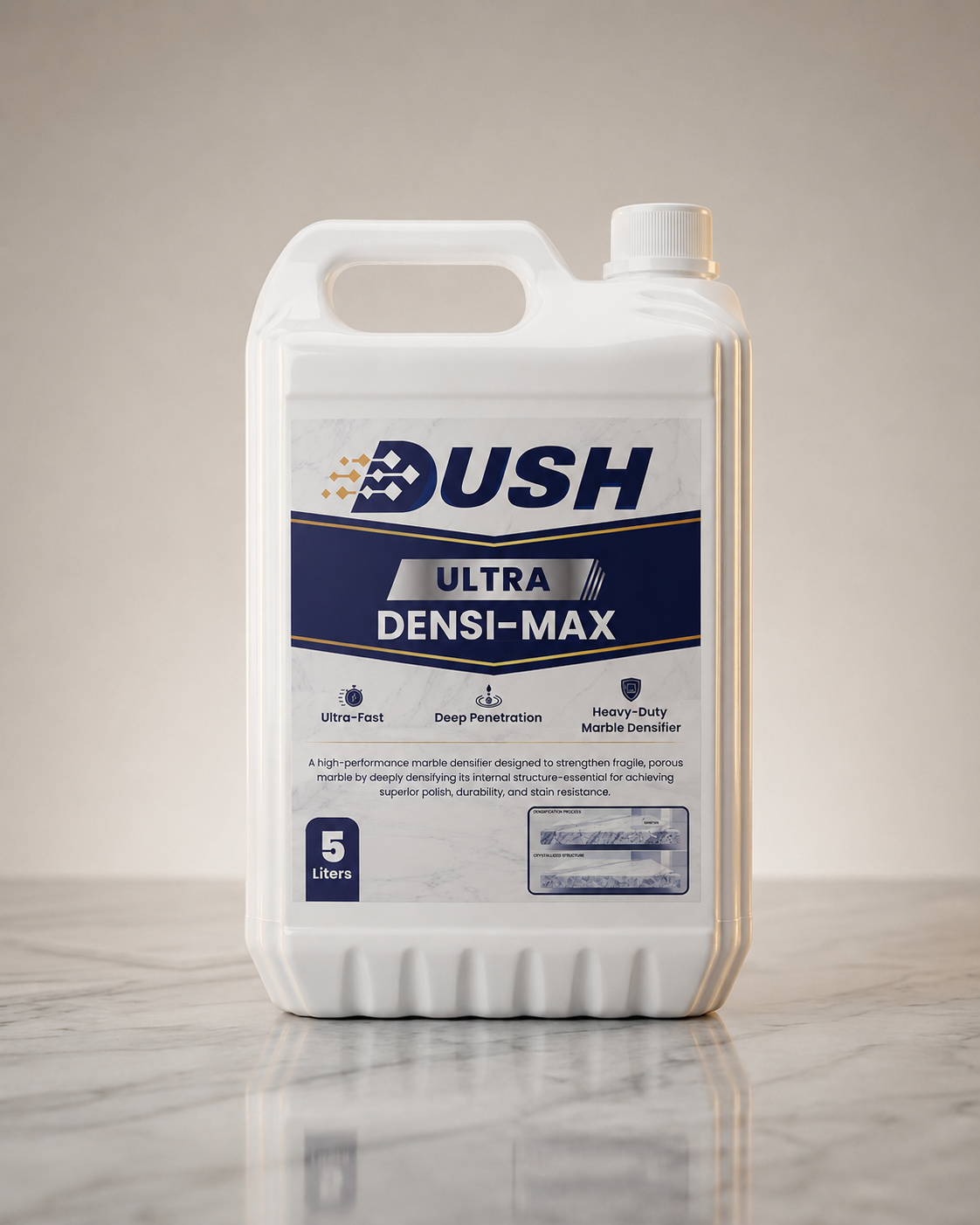
The distinction between a surface sealer and a penetrating densifier like Dush Densi Max Ultra is critical for exterior monsoon protection. A surface sealer forms a film on top of the marble that eventually wears away, washes out under sustained monsoon rain, or degrades under UV exposure — requiring reapplication every season. Densi Max Ultra works entirely inside the stone, forming a permanent chemical bond within the pore structure itself.
Because the hydrophobic pore lining is inside the marble rather than on its surface, it cannot be washed away by rain, abraded by foot traffic on exterior staircases and courtyards, or degraded by the UV radiation that exterior marble receives year-round in India. One correctly applied treatment provides permanent protection — confirmed annually by the simple water drop test before each monsoon season.
- ★Permanent pore closure: Chemical bond inside the marble — cannot wash out in monsoon rain or degrade under UV, unlike surface sealers
- ★Stops all 4 monsoon damage types: Closes the pores that allow efflorescence, mineral staining, micro-cracking, and bond weakening to begin
- ★No appearance change: Clear, no surface film — does not alter the marble's natural colour, veining, or texture
- ★Annual verification: Simple water drop test confirms protection is still active each April before monsoon arrives
- ★Dual benefit: Same treatment protects exterior marble from monsoon rain and interior marble from turmeric, oil, and coffee staining
- ★Works on all natural stone: Marble, granite, sandstone, limestone — any porous natural stone used in Indian exterior applications
When to Apply Densi Max Ultra Before Monsoon Season
Apply Densi Max Ultra to exterior marble at least 72 hours before monsoon rains arrive, to allow sufficient penetration and chemical reaction before sustained water exposure. The optimal window is April to May in most of India — the dry weeks immediately before the monsoon arrives in June. For newly installed marble, apply during the polishing process at the 80-grit grinding stage for maximum penetration depth.
Annual Monsoon Protection Calendar — India
For existing exterior marble that has never been treated — or marble that has previously had a surface sealer applied rather than a penetrating densifier — the dry season before monsoon is the right time for a first application. Clean the marble thoroughly, allow it to dry for 48 hours, then apply Densi Max Ultra in 3 to 5 coats before rain arrives.
Complete Application Sequence for Exterior Marble Monsoon Protection
Clean the Marble Surface
Clean the exterior marble thoroughly to remove dust, organic matter, bird droppings, and any existing efflorescence deposits. Efflorescence should be dry-brushed first, then cleaned. The surface must be completely clean before treatment.
Allow to Dry Completely
Allow the marble to dry completely — at least 48 hours after cleaning during a dry spell. Applying Densi Max Ultra to damp marble significantly reduces penetration depth, as water already in the pores blocks the product from entering fully.
→ The driest the marble is before application, the deeper and more effective the penetration
Apply Dush Densi Max Ultra — First Coat
Apply Dush Densi Max Ultra undiluted to the dry marble surface, working it evenly across the area. Allow 15 to 20 minutes penetration time before proceeding.
Remove Excess Before Drying
Remove any excess Densi Max Ultra from the surface before it dries. Excess product left on the surface creates a hazy residue that is difficult to remove later. Wipe clean with a dry cloth.
→ Timing is important — remove excess while still liquid, not after it has begun to dry
Apply 3 to 5 Coats Total
Repeat the application process until the marble no longer visibly absorbs the product — this saturation point indicates the pore structure has reached capacity and is fully closed. Most exterior marble requires 3 to 5 coats.
Allow 72 Hours Before Rain Exposure
Allow at least 72 hours after the final coat before the treated marble is exposed to monsoon rain. This gives the product time to complete its chemical reaction within the pore structure and develop full hydrophobic performance.
Confirm With the Water Drop Test
Pour 3 to 4 drops of water on the treated marble surface and observe for 5 minutes. Water beading without absorption confirms the pore closure is complete and monsoon protection is active.
The Water Drop Test — Confirming Protection Is Active
How to do the water drop test every April before monsoon
1. Choose a representative spot — a flat section of the exterior marble that receives direct rain. South and west-facing surfaces are highest priority.
2. Make sure the surface is dry — do the test on a dry day, not immediately after rain. Surface dampness will give a false positive.
3. Drop 3 to 4 drops of water — use a dropper or the tip of a wet finger. Watch for 5 minutes without touching the drops.
4. Read the result:
✅ Water beads for 5+ minutes — protection is active. No application needed this season.
❌ Water absorbs within 5 minutes — protection has diminished. Apply Densi Max Ultra before monsoon arrives.
Because Densi Max Ultra works inside the pore structure rather than on the surface, the water drop test is the only reliable way to verify its status — and the result is definitive. A correctly treated marble surface beads water visibly and immediately. An untreated or protection-diminished surface absorbs water with no bead formation. There is no ambiguity in the result.
Protect Your Exterior Marble Before This Monsoon Season
April and May are the right months to apply Dush Densi Max Ultra to exterior marble. One treatment, permanent pore closure, all four monsoon damage types prevented — before the rains arrive.
Request Free Sample Test →Related Dush Guides and Products
Protecting Exterior Marble from Monsoon — Questions Answered
How do I protect exterior marble from monsoon damage?
What monsoon damage does exterior marble suffer?
How does Dush Densi Max Ultra protect marble from monsoon damage?
When should Densi Max Ultra be applied before monsoon season?
Does Densi Max Ultra change the appearance of exterior marble?
Is one application of Densi Max Ultra enough for multiple monsoon seasons?
Can Densi Max Ultra be applied to marble that already has monsoon staining?
External References
Protect Exterior Marble from Monsoon — This Season and Every Season
Dush Densi Max Ultra: permanent pore closure, applied once before monsoon, verified annually by the water drop test. The complete protection system for exterior marble in India.