How Do I Stop Water Absorption in Exterior Natural Stone?
Stop water absorption in exterior natural stone permanently — Dush Densi Max Ultra penetrates the stone's internal pore structure and forms a hydrophobic crystalline matrix that capillary action cannot overcome, regardless of surface wear or outdoor exposure.
Stop water absorption in exterior natural stone — this is the starting point for protecting any exterior marble, granite, limestone, or sandstone installation from the full range of outdoor damage that water entry causes. Every other problem — efflorescence, staining, biological growth, surface spalling — begins with water getting into the stone's pore network. Close the pores, and the chain of damage stops before it starts.
To stop water absorption in exterior natural stone, apply Dush Densi Max Ultra penetrating densifier to the stone surface. Densi Max Ultra penetrates the stone's internal pore structure and reacts with the calcium and silicate minerals inside, forming a permanent hydrophobic crystalline matrix that lines the pore walls. This significantly reduces capillary suction — the mechanism that draws water into stone — permanently, from within the stone itself, unaffected by surface wear or outdoor exposure.
Why Water Absorption Damages Exterior Natural Stone
Exterior natural stone absorbs water through its open pore network by capillary action. In outdoor conditions, every rain event draws water into the stone, where it saturates the pores, carries dissolved minerals and pollutants deeper into the stone, then evaporates — leaving deposits behind and placing repeated mechanical stress on the pore walls. Over time this wet-dry cycle causes efflorescence, progressive staining, biological growth, and in cold climates, freeze-thaw spalling where frozen water expansion fractures the stone from within.
Efflorescence
Water entering exterior stone dissolves mineral salts from the stone itself, the mortar bed, or the substrate beneath it. As the water evaporates at the surface, these dissolved salts are deposited as white crystalline powder — efflorescence. The more freely water can move through the stone, the more salt is deposited with each wet-dry cycle.
Progressive Staining
Rainwater carries iron compounds, organic pollutants, and atmospheric deposits. When this water is absorbed into open stone pores, it carries these contaminants with it. As the water evaporates, the contaminants remain inside the stone, progressively darkening and staining the surface from within — stains that cannot be cleaned because they are inside the stone, not on it.
Biological Growth
Algae, moss, and lichen colonise exterior stone surfaces that retain moisture. A stone that absorbs water readily and releases it slowly provides the consistently damp pore surface these organisms require to establish and spread. Reducing water absorption directly reduces the available habitat for biological growth — stone that dries quickly after rain does not support persistent colonisation.
Freeze-Thaw Spalling
Water expands by approximately 9 percent when it freezes. In stone with high water absorption, the water trapped in pores during cold periods expands on freezing and fractures the pore walls from within — a process called spalling. Repeated freeze-thaw cycles progressively break down the stone surface, creating pits and flaking. Relevant for exterior stone in north India hill stations and colder regions.
Surface Sealer vs Penetrating Densifier for Exterior Stone
A surface sealer creates a film on top of the stone that wears away under outdoor conditions — UV radiation, foot traffic, and cleaning all degrade it, requiring reapplication every 1 to 3 years. A penetrating densifier like Dush Densi Max Ultra forms a hydrophobic matrix inside the stone's pore structure — unaffected by surface wear, UV, or cleaning because it is inside the stone, not on it. For exterior stone, a penetrating densifier provides significantly more durable protection than any surface film.
Surface Sealer — Wears Away Outdoors
Creates a film on the stone surface. UV radiation degrades the film chemistry. Foot traffic and cleaning physically remove it. Rain and temperature cycling lift and crack it at edges.
Result: requires reapplication every 1 to 3 years — and every reapplication requires cleaning, preparation, and product cost.
Dush Densi Max Ultra — Permanent Internal Closure
Penetrates inside the stone and chemically bonds to the mineral structure. No surface film to wear away, lift, crack, or degrade. UV, foot traffic, and cleaning affect only the stone surface — the hydrophobic matrix inside remains intact.
Result: permanent internal pore closure — confirmed by water drop test years after application.
Dush Densi Max Ultra — Permanent Internal Pore Closure for Exterior Stone
Dush Densi Max Ultra is an ultra-premium penetrating densifier that permanently closes the internal pore structure of marble, granite, limestone, sandstone, and other natural stone. Applied to exterior stone, it forms a permanent hydrophobic crystalline matrix inside the pore walls — significantly reducing capillary suction and providing permanent protection against water absorption, efflorescence, staining, and biological growth.
DUSH DENSI MAX ULTRA
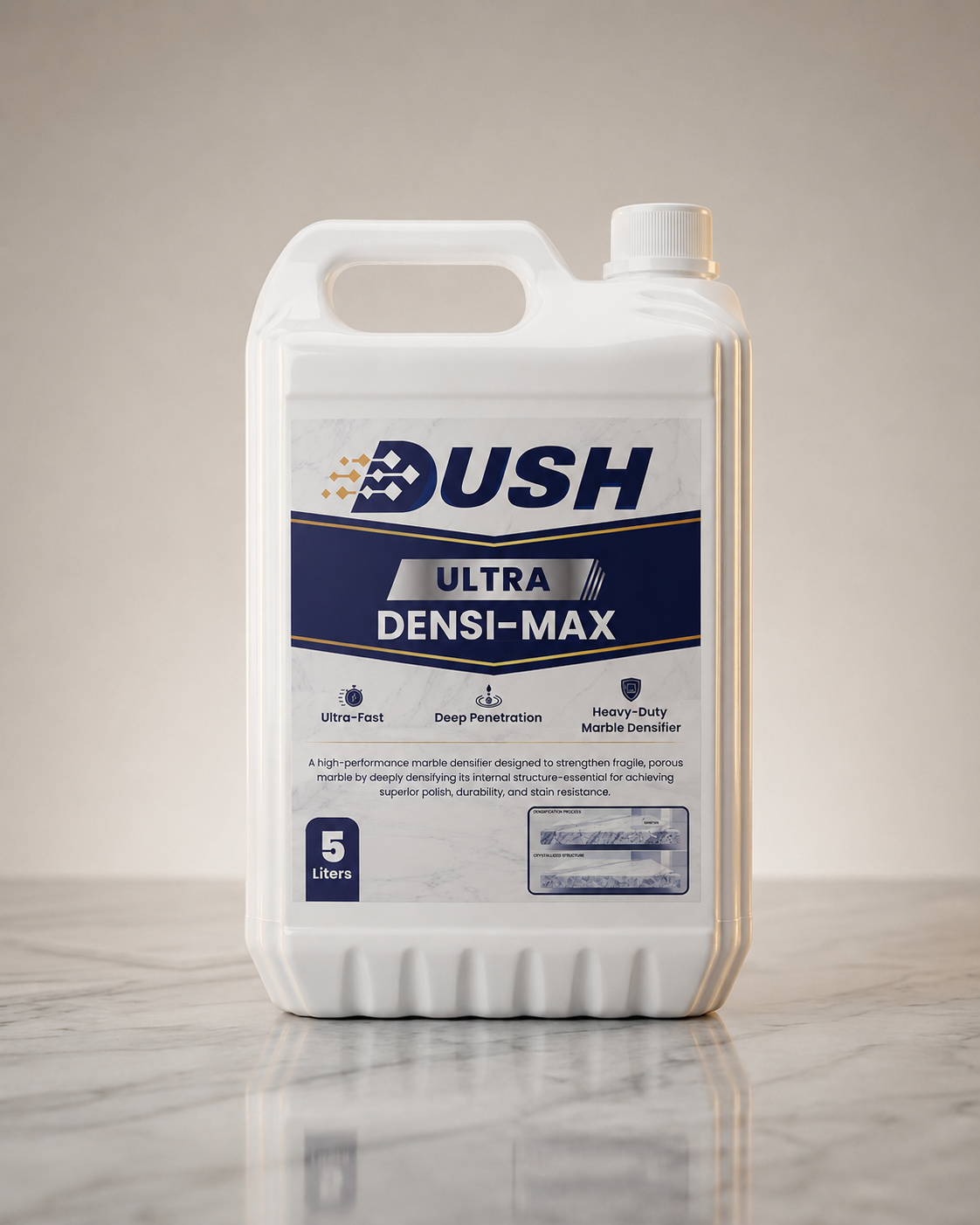
The key distinction between Dush Densi Max Ultra and every surface treatment is where the protection sits. Surface sealers sit on top of the stone — in an exterior environment, everything that happens to the stone surface happens to the sealer first, and outdoor conditions are aggressive enough to degrade any surface film within months to years.
Densi Max Ultra sits inside the stone. After application, the densifier penetrates into the stone's pore network and chemically reacts with the mineral content — it is no longer a separate product but a new chemical compound that is part of the stone itself. No amount of UV radiation, rain, temperature cycling, or surface cleaning can reach it. The water repellency it creates is as durable as the stone it is applied to.
- ★Permanent internal pore closure: Forms inside the stone — not affected by surface wear, UV, cleaning, or outdoor exposure
- ★Stops water absorption by capillary action: Hydrophobic pore walls increase contact angle — capillary suction that draws water into the stone is significantly reduced
- ★Prevents efflorescence: Less water movement through the stone means fewer dissolved salts reaching the surface
- ★Reduces biological growth: Drier pore surfaces inhibit algae, moss, and lichen colonisation after rain
- ★Dual action: The same internal pore closure that blocks outdoor water absorption also provides permanent protection against surface staining from oil, coffee, and other household substances
- ★All exterior stone types: Marble, granite, limestone, sandstone, travertine, and other natural stone varieties
The Chemistry of How Pore Closure Stops Water Absorption
Capillary Action and Contact Angle
Water enters exterior stone by capillary action — the same physical force that draws water up through a paper towel. The capillary pressure driving water into stone pores is governed by the Young-Laplace relationship:
Where γ is the surface tension of water, θ is the contact angle between water and the pore wall, and r is the pore radius. On untreated stone, θ is close to 0° — water wets the pore walls readily and strong capillary suction draws it deep into the stone with every rain event.
Dush Densi Max Ultra chemically changes θ by reacting with the calcium and silicate minerals inside the pore structure to form calcium silicate hydrate (C-S-H) compounds. These compounds line the pore walls with a hydrophobic surface — water no longer wets them in the same way. The contact angle increases significantly, which according to the equation above directly reduces the capillary pressure driving water absorption. With less driving force, far less water enters the stone during rain exposure.
Suitable for All Exterior Natural Stone Types
Marble
Apply at 80-grit stage for new installations or to cleaned surface of existing exterior marble. 3–5 coats typically required.
Granite
Denser structure requires application at 80-grit stage for maximum penetration. Multiple coats until saturation confirmed.
Limestone
Higher porosity than marble — may require additional coats. Excellent results on exterior limestone facades prone to efflorescence.
Sandstone
Highly porous — apply until surface no longer readily absorbs the product. Significant reduction in water ingress and biological growth.
Travertine
Natural void structure requires thorough saturation. Apply multiple coats, removing excess before drying, until the stone is fully treated.
Slate
Layered structure — apply to cleaned surface. Reduces water ingress between layers that causes delamination in wet exterior conditions.
Complete Application Sequence for Exterior Natural Stone
Clean the Stone Surface Thoroughly
Remove all dirt, biological growth, staining, and any previous surface treatments. Existing sealers must be removed before Densi Max Ultra can penetrate effectively — a surface film blocks access to the pore structure.
Allow the Stone to Dry Completely
For exterior stone, allow at least 24 to 48 hours of dry weather before application. Moisture already present in the pores partially blocks penetration of the densifier — the drier the stone, the deeper the product penetrates.
→ Apply before the monsoon season begins, not during it
Apply the First Coat Undiluted
Apply Dush Densi Max Ultra undiluted across the stone surface, ensuring even coverage. Allow 15 to 20 minutes for penetration before assessing absorption.
Remove Excess Before Drying
Remove any product that has not been absorbed before it dries on the surface. Dried excess leaves a white haze that must be removed mechanically — preventing this is far easier than removing it after the fact.
→ Never allow excess to dry on the stone surface
Apply Additional Coats Until Saturation
Repeat the application and excess-removal process until the stone no longer readily absorbs the product between coats. Highly porous exterior stone — sandstone, travertine, limestone — may require 3 to 5 coats to reach saturation.
Allow 24 Hours Full Cure
Allow Dush Densi Max Ultra to cure for a minimum of 24 hours before the stone is exposed to rain or foot traffic.
Confirm With the Water Drop Test
Pour 3 to 4 drops of water on the treated surface. Beading for 5 or more minutes confirms effective internal pore closure and water repellency. Re-test annually to confirm ongoing protection.
💧 The Water Drop Test — Explained
How to do it: Pour 3 to 4 drops of clean water onto the stone surface and watch what happens over the next 5 minutes.
Beading (water forms round droplets): The hydrophobic pore closure is working — water cannot wet the surface and sits as beads. Protection is confirmed.
Spreading and absorbing: The water wets the surface and soaks in — protection is absent or has worn away and application or reapplication of Densi Max Ultra is needed.
For new applications: test 24 hours after the final coat. For ongoing monitoring: test annually, especially before monsoon season.
Test Densi Max Ultra on Your Own Stone Before Committing
Send a sample of your exterior stone to Dush and see the water drop test results before and after Densi Max Ultra application on your specific material.
Request Free Sample Test →Related Dush Guides and Products
Exterior Stone Water Absorption — Questions Answered
How do I stop water absorption in exterior natural stone?
Why does exterior natural stone absorb water and why is it a problem?
What is the difference between a sealer and a densifier for exterior stone water protection?
How does Dush Densi Max Ultra stop water absorption in exterior stone permanently?
Can Dush Densi Max Ultra be used on all types of exterior natural stone?
How long does Dush Densi Max Ultra protection last on exterior stone?
External References
Stop Water Absorption in Exterior Stone — Permanently
Dush Densi Max Ultra closes the pore structure from within. No surface film to wear away. No reapplication every 2 years. Permanent internal protection for all exterior natural stone.