Why Is My Bathroom Marble Turning Dark or Patchy?
Dark, patchy bathroom marble is water absorption made visible — and the water is coming from two directions at once. How to diagnose which one you have, why the patches keep coming back, and the two-product fix for installed marble and renovations.
The problem: Marble is porous calcite — water inside its pores makes the stone look darker, like a wet riverbank stone. In bathrooms, water enters from above (shower spray, wet floors) and from below (rising moisture from the permanently damp screed under the marble). Patchiness = uneven absorption where protection has worn or the stone is more porous.
The diagnosis: dark areas that fade back when the bathroom dries = surface absorption. Permanent patches spreading from grout lines and edges = rising moisture from beneath.
- Marble already installed: Dush Densi Max Ultra — penetrating densifier, closes the pore structure from within, stops surface absorption and rising moisture
- New installation / renovation: Dush Hidro SST — six-side sealer applied to every face of the slab before laying; cannot be applied retrospectively
- Related symptom: white powdery deposits with the patches = efflorescence, carried by the same rising moisture
- Never use: acid bathroom cleaners on marble — they etch the surface permanently
- Where to buy: Flipkart, Amazon, Dush offices in Hyderabad, Bangalore, Chennai, Kerala, Delhi/NCR
- Phone: 1800 891 0133 (toll-free)
Bathroom marble turning dark or patchy is the most common wet-area stone complaint in India — and the most misunderstood. Owners scrub harder, change cleaners, blame the marble quality. But the darkness is not dirt and not a defect: it is water, sitting inside the stone's pores, visible through the polished surface. And in a bathroom, that water has two ways in — only one of which you can see.
Bathroom marble turns dark or patchy because of water absorption. Marble is porous calcite — water in its pores makes the stone look darker. Water enters from above (shower spray, wet floors) and from below (rising moisture through the slab from the permanently damp bedding). Patchiness appears where protection has worn or the stone is naturally more porous. The fix: marble already installed → Dush Densi Max Ultra penetrating densifier. Renovating or installing new → Dush Hidro SST six-side sealer on every slab before laying. Call 1800 891 0133 for the right combination.
Water Attacks Bathroom Marble From Two Directions
Bathroom marble absorbs water from two directions: from above, through shower spray, wet feet and standing water on the surface — and from below, as rising moisture travels up through the stone from the cement screed and bedding, which in a bathroom stays damp for years. Surface sealing alone cannot stop the second path — which is why marble sealed only on top still darkens from within.
From Above — Surface Absorption
Shower spray, wet feet, standing water and daily washing load the top face of the marble with moisture, day after day.
Where surface protection has worn — the shower approach, the threshold, around the wash basin — pores drink the water and the stone visibly darkens. This darkening typically fades as the bathroom dries.
From Below — Rising Moisture
The cement screed and adhesive bed under bathroom marble stays damp for years — fed by tiny leaks, shower water tracking through grout, and trapped construction moisture.
The slab's unsealed underside absorbs this continuously. Patches from below are permanent, spread slowly, and radiate from grout lines and edges — often with white efflorescence salts.
This two-direction reality is why bathroom marble problems frustrate owners: the visible surface gets all the attention, while the invisible underside — pressed against damp cement 24 hours a day — quietly feeds moisture up into the stone. Any complete fix has to address the direction your marble is actually absorbing from, which is what the next test tells you.
The Dries-Back Test — Which Problem Do You Have?
✓ Patches FADE as the bathroom dries
Diagnosis: surface absorption. Water is entering through the top face where protection has worn.
The stone releases the moisture when dry — protection with Densi Max Ultra stops the cycle and the tone stays even.
✗ Patches are PERMANENT or spreading
Diagnosis: rising moisture. The damp bedding below feeds water up through the slab's unsealed underside continuously.
Look for patches radiating from grout lines and edges, and white powdery efflorescence. The moisture path from below must be closed.
If your patches come with white salty deposits, you are seeing efflorescence — dissolved minerals carried by the same rising moisture and left behind as the water evaporates. The moisture strategy in this guide addresses both; for the full efflorescence treatment see why white salty patches appear on marble.
The 5 Causes of Dark, Patchy Bathroom Marble
Surface Protection Worn Away — or Never Applied
Most bathroom marble in India is installed with no sealing at all, or a surface sealer that daily water and cleaning wore through within a year. The wettest zones lose protection first — which is exactly where the dark patches start.
✓ Fix: Densi Max Ultra core densification — protection inside the stone that daily wet-room use cannot wear off
Rising Moisture From the Permanently Damp Bedding
The screed under bathroom marble stays wet for years. The slab's unsealed underside drinks this moisture continuously — darkening the stone from within regardless of how well the surface is kept.
✓ Fix: Hidro SST six-side sealing before laying (renovations) · Densi Max Ultra densification (installed marble)
Water Tracking Through Grout Lines and Edges
Grout is more porous than marble. Shower water enters through grout lines and slab edges, then spreads sideways under and into the stone — producing patches that radiate outward from the joints.
✓ Fix: seal grout lines along with the stone; edge sealing is built into six-side Hidro SST treatment
Trapped Moisture Under Mats, Buckets and Planters
Anything that sits on bathroom marble traps moisture beneath it — rubber-backed mats are the classic culprit. The covered stone never dries, producing a sharply-outlined dark patch in the exact shape of the object.
✓ Fix: lift and rotate mats and buckets; once the stone is densified, trapped-moisture patches stop forming
Soap Film and Body-Oil Build-Up Mimicking Patchiness
Not all patchiness is absorption — soap scum and body oils build an uneven film that dulls and darkens the surface in traffic patterns. The tell: it improves with proper cleaning, and the water-bead test still passes.
✓ Fix: clean with a marble-safe alkaline cleaner — never acid bathroom cleaners, which etch marble permanently
Densi Max Ultra — Protection for Marble Already on the Floor
For bathroom marble that is already installed, the protection is Dush Densi Max Ultra — a penetrating densifier that goes to the core of the stone and closes the pore structure from within. Surface water stops absorbing, rising moisture stops migrating through, and because the protection is inside the marble rather than a film on top, daily wet-room use cannot wear it off. Available on Flipkart and Amazon, or call 1800 891 0133.
Marble Already Installed
The underside can no longer be reached — so the stone itself is densified from the top down, to the core. Absorption stops in every direction the treatment reaches. This is the working answer for every existing bathroom.
Renovating / Installing New
The one moment every face of the slab is accessible. Six-side Hidro SST sealing before laying blocks rising moisture permanently — then Densi Max Ultra protects the working surface after installation.
DUSH DENSI MAX ULTRA
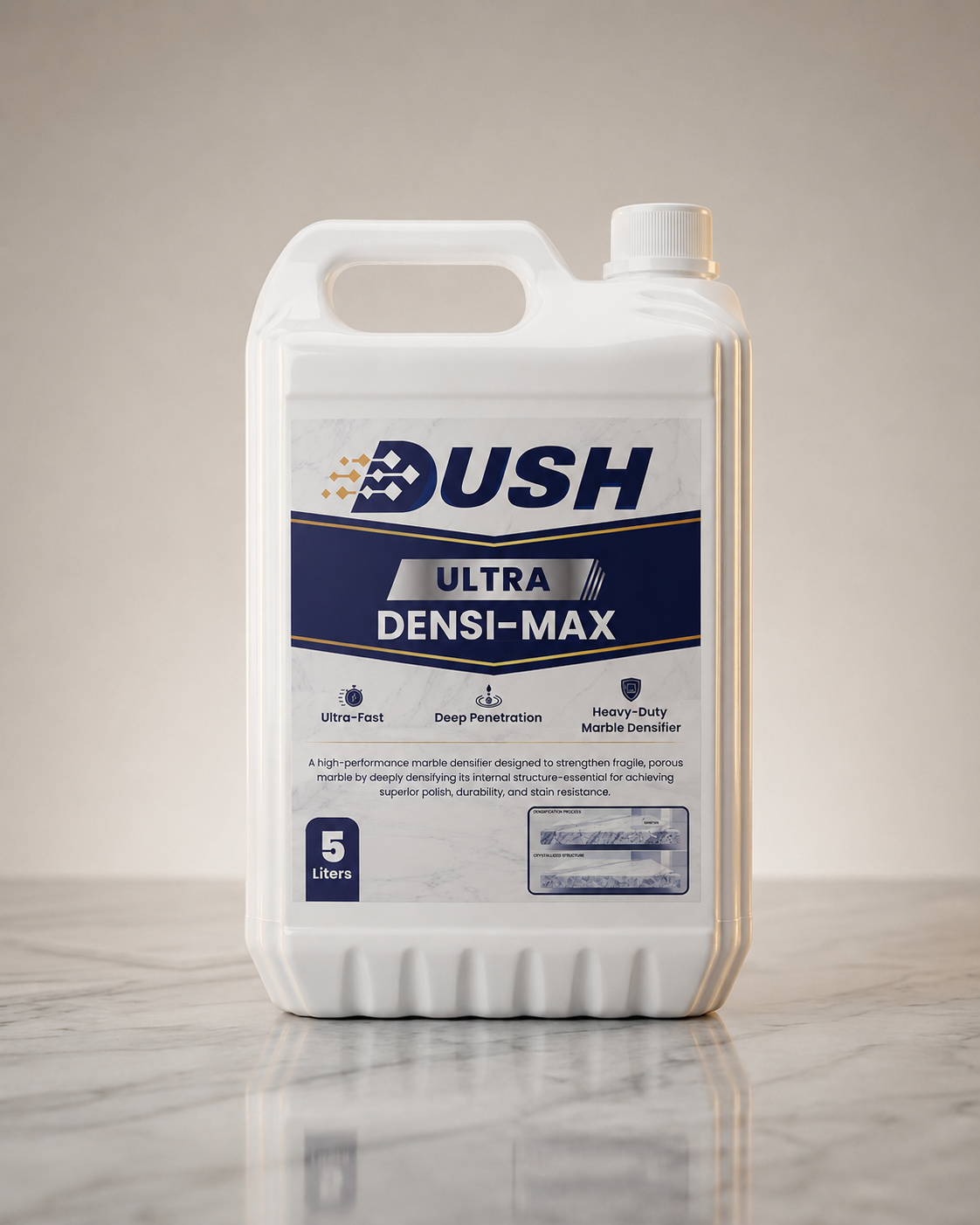
A bathroom is the hardest room a surface sealer can face: water twice a day, cleaning chemicals weekly, bare feet and slippers constantly. Film-type sealers wear through in the wet zone within a year — and the darkening returns exactly where it started.
Densi Max Ultra penetrates to the core and densifies the pore network itself. There is no film to wear away. The stone stops absorbing from above, stops wicking rising moisture from below through the treated depth, and as a direct consequence stops feeding the efflorescence cycle too.
- ★Core penetration, not a surface film: Protection lives inside the stone — wet-room traffic and cleaning cannot wear it off
- ★Stops the wet-look darkening: Pores that cannot fill with water cannot darken — the stone holds its dry tone through shower cycles
- ★Blocks rising moisture: Densified stone resists the upward migration that causes permanent patches and efflorescence
- ★Evens out patchiness: Once absorption stops everywhere, held moisture releases and the tone converges back to uniform
- ★Safe for white and light marble: No yellowing, no gloss change — the stone looks identical, just protected
- ★One-afternoon treatment: Clean, dry, apply, cure — a full bathroom floor protected in a day
Hidro SST — Seal All Six Sides Before the Marble Is Laid
For renovations and new installations, the definitive prevention is Dush Hidro SST — a six-side sealer applied to the top, bottom, and all four edges of every slab before laying. The underside never touches the damp bedding unprotected, so rising moisture is blocked for the life of the installation. This is the one treatment that cannot be applied later — the moment before installation is the only chance.
DUSH HIDRO SST
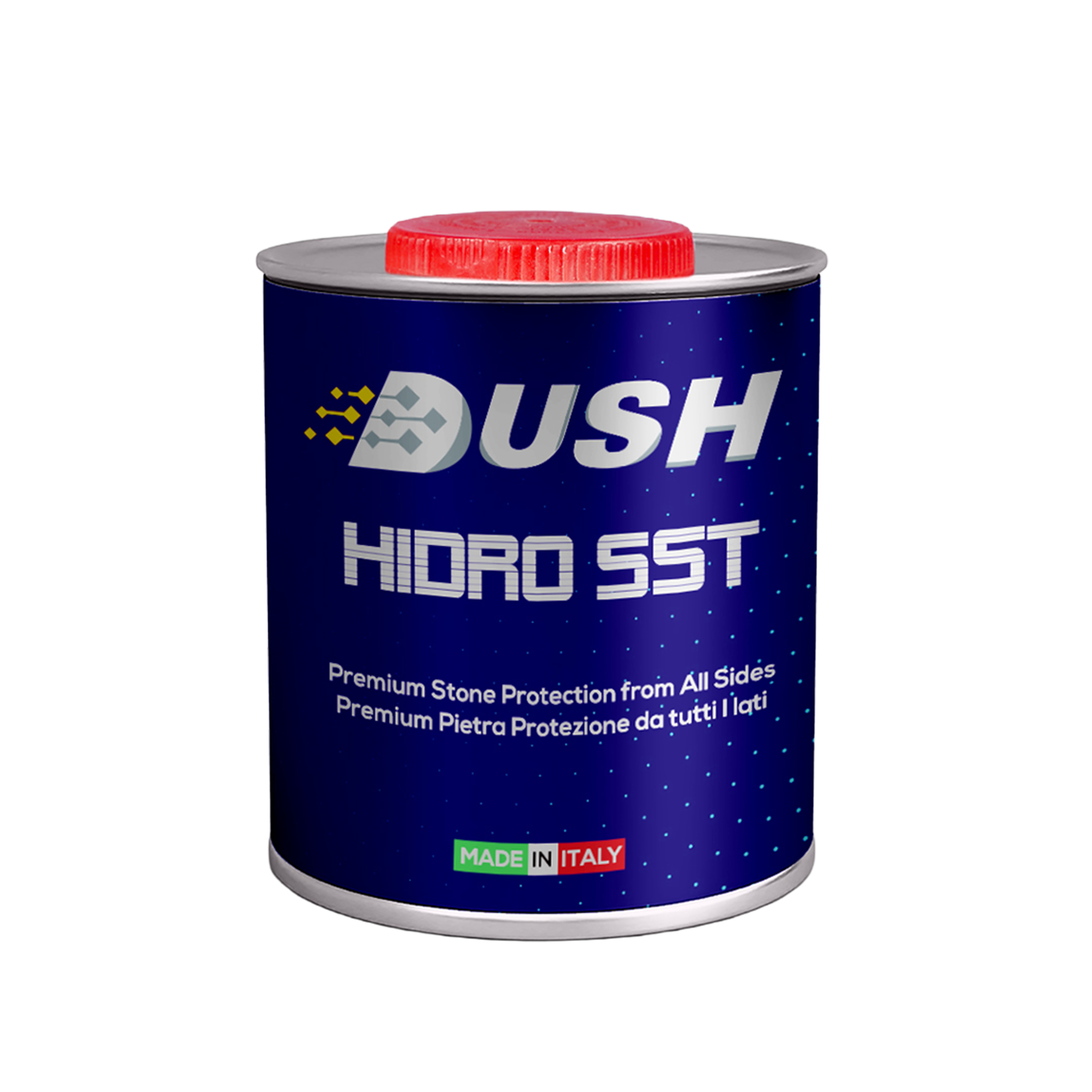
Every slab of bathroom marble spends its entire life with its bottom face pressed against damp cement. The top face gets sealed, polished, and inspected — the bottom face, which absorbs moisture 24 hours a day, is usually never treated at all. That asymmetry is why so much bathroom marble darkens from within during its first two years.
Hidro SST closes all six faces in the workshop or on site, before the slab touches the bedding. Rising moisture meets sealed stone and stops. Combined with Densi Max Ultra on the working surface after installation, the marble is protected from both directions for decades. For the full product mechanism, see what is Hidro SST and how does it work.
- ★All six faces sealed: Top, bottom, and four edges — moisture has no unprotected path into the stone
- ★Blocks rising moisture permanently: The underside never absorbs from the damp bedding — the root cause of permanent patches is removed
- ★Stops efflorescence at the source: No moisture migration means no dissolved salts carried to the surface
- ★The renovation-moment treatment: Cannot be applied after laying — specify it before the bathroom is tiled
- ★Pairs with Densi Max Ultra: Hidro SST below and inside, Densi Max Ultra on the working surface — complete two-direction protection
The Full Fix — 7 Steps
Run the Dries-Back Test
Keep the bathroom dry for 48 hours and watch the patches. Fading = surface absorption. Permanent or spreading from grout lines = rising moisture from beneath.
Dry the Bathroom Aggressively
Ventilate, run the exhaust fan, stop wet mopping for several days. The stone must release held moisture before any protection is applied — sealing over wet stone traps the darkness in.
Rule Out Surface Film
Clean with a marble-safe alkaline cleaner to remove soap and body-oil build-up that mimics patchiness. Never acid bathroom cleaners — marble etches on contact.
Apply Densi Max Ultra to the Dry Floor
Even coverage across the whole floor, with extra care at the shower approach, threshold, and splash zones — the areas that darken first are the areas that need the most complete densification.
Allow Full Cure Before Water
Keep the bathroom dry per label timing. The densification develops inside the stone during the cure — early water exposure interrupts it.
→ Plan the treatment when a second bathroom is available
Renovating? Hidro SST Before Laying
Seal all six sides of every new slab with Hidro SST before installation — the one chance to block rising moisture at the source, permanently.
Annual Water-Bead Check
Drop water on the floor once a year. Beads = protected. Darkening stone = re-apply Densi Max Ultra to the worn zone before the patches return.
→ 10 seconds a year keeps the bathroom marble uniform for decades
Not Sure Which Direction Your Moisture Is Coming From?
Describe your patches to our technical team — where they are, whether they fade, whether white deposits appear — and we'll confirm the diagnosis and the exact product combination before you buy anything.
Call 1800 891 0133 →Related Dush Guides and Products
Dark & Patchy Bathroom Marble — Questions Answered
Why is my bathroom marble turning dark or patchy?
How do I know if the patches are from surface water or rising moisture?
What is Hidro SST and why does six-side sealing matter?
Can dark patches on bathroom marble be reversed?
Why is the marble near my shower darker than the rest of the floor?
Should bathroom marble be sealed before or after installation?
External References
Bathroom Marble That Stays One Even Tone
Densi Max Ultra for installed marble · Hidro SST six-side sealing for renovations · protection from both directions. Flipkart · Amazon · Pan-India delivery.