How Do I Waterproof Sandstone Driveways or Pathways?
Waterproof sandstone driveways or pathways with Dush Densi Max Ultra penetrating densifier — applied directly to the finished surface in multiple coats until the stone stops absorbing. The result is permanent internal pore closure that stops water, oil, and staining from ever entering the stone again.
Waterproofing sandstone driveways or pathways is one of the most impactful things you can do for an outdoor stone surface. Sandstone is dramatically more porous than granite or dense limestone — its open grain structure absorbs water, oil, dirt, and organic matter almost instantly on an untreated surface. A single treatment with the right penetrating densifier closes this vulnerability permanently.
To waterproof sandstone driveways or pathways, apply Dush Densi Max Ultra penetrating densifier in multiple coats to the clean, dry finished surface until the stone stops absorbing the product. Densi Max Ultra penetrates the sandstone's pore structure and chemically reacts with the stone's silicate minerals to form a permanent hydrophobic crystalline matrix inside the pores — closing them from within without any surface film or colour change. This is a one-time permanent treatment that stops water, oil, algae, and staining from penetrating the stone.
Why Sandstone Is So Porous — and What Happens Without Treatment
Sandstone is a sedimentary rock formed from compressed sand grains — and the spaces between those grains form a network of pores significantly larger and more open than granite or polished marble. This natural porosity is what gives sandstone its characteristic warm, textured appearance, but it also means that on a driveway or pathway, water, oil, algae, and staining agents penetrate quickly and deeply without treatment.
Untreated Sandstone — Open Pores
The spaces between sandstone's sand grains form an open pore network. Rain water, vehicle oil, organic matter, and algae enter freely and penetrate deeply — staining the stone from within, promoting moss and algae growth, and carrying dissolved salts that cause efflorescence on the surface.
On a driveway: oil stains from vehicles within seconds, dark patches after rain, moss in shaded areas, white salt deposits after monsoon.
Densi Max Ultra Treated — Pores Closed From Within
Densi Max Ultra penetrates the pore network and chemically reacts with the stone's silicate minerals to form calcium silicate hydrate crystals lining every pore wall. Water, oil, and staining agents can no longer penetrate — they bead on the surface instead.
On a driveway: oil wipes clean before penetrating, water beads and runs off, moss cannot take root, no efflorescence, no dark wet patches.
4 Problems Untreated Sandstone Driveways Develop
Vehicle Oil Staining
Oil drips from parked vehicles penetrate untreated sandstone within seconds — far faster than marble. Once inside the stone's open pore network, oil oxidises and forms a permanent dark stain that standard cleaning cannot reach.
Algae and Moss Growth
Moisture retained inside untreated sandstone's pore network creates the ideal environment for algae and moss. Once established in the pores, biological growth is difficult to fully remove and quickly returns after cleaning without treatment.
Efflorescence and Salt Deposits
Moisture carrying dissolved mineral salts enters the sandstone from below and evaporates at the surface, depositing white salt crusts. On untreated porous sandstone, efflorescence is common after monsoon season and repeated wet-dry cycles.
Dark Wet Patches After Rain
Untreated sandstone absorbs rain water deeply and dries unevenly, creating dark, blotchy patches that persist for hours or days after rain. Over time, repeated wet-dry cycling also loosens surface grains and accelerates surface erosion.
Dush Densi Max Ultra — How It Waterproofs Sandstone Permanently
Dush Densi Max Ultra penetrates sandstone's open pore structure in liquid form and undergoes a chemical reaction with the stone's silicate minerals — forming calcium silicate hydrate (C-S-H) compounds that permanently line the pore walls with a hydrophobic surface. Water and oil can no longer wet the pore walls or be drawn in by capillary action. The treatment is entirely inside the stone, invisible on the surface, permanent, and requires no reapplication.
DUSH DENSI MAX ULTRA
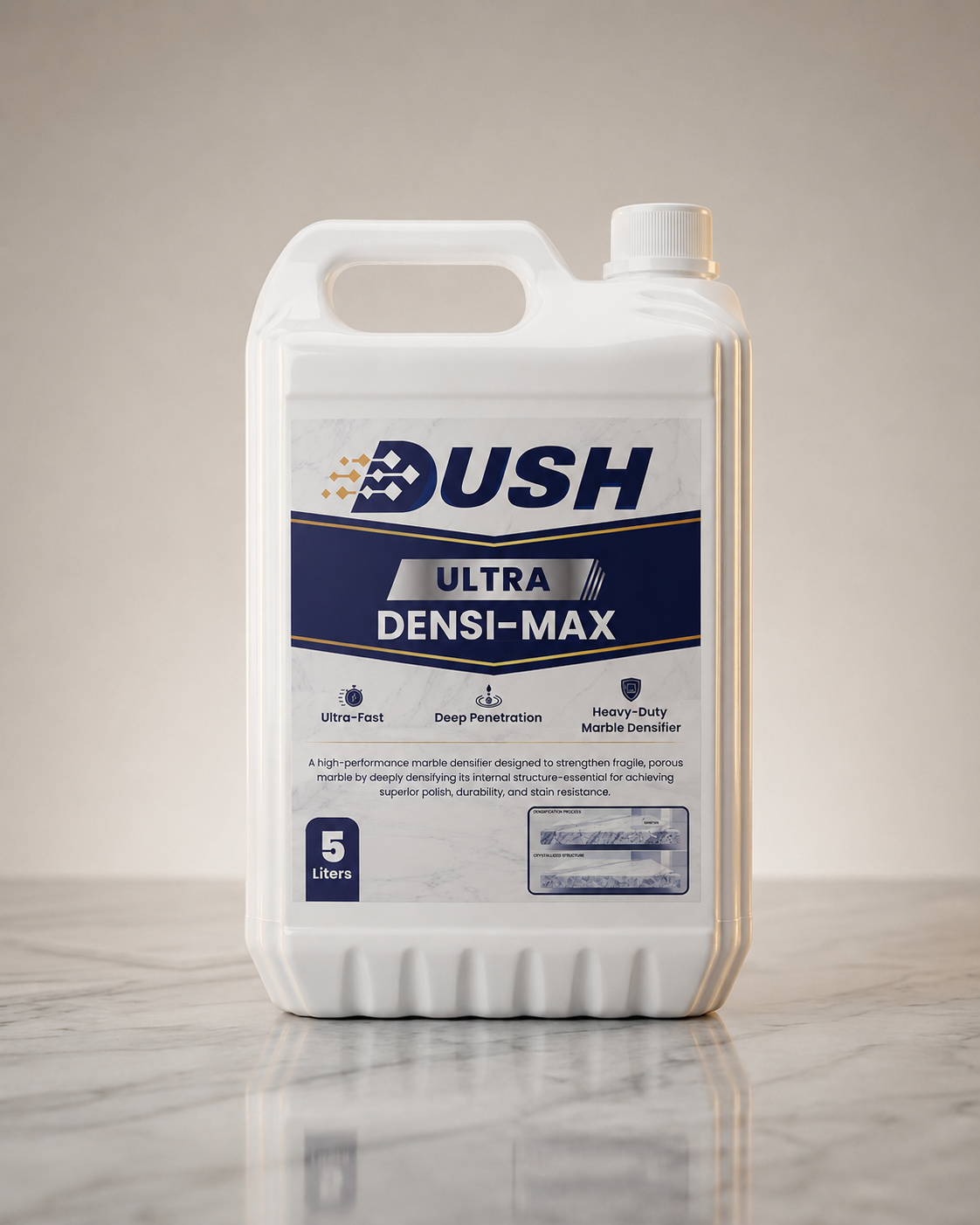
Sandstone's high natural porosity is actually an advantage when applying a penetrating densifier — the open pore structure allows Densi Max Ultra to penetrate deeply and quickly on the first coat, accessing the full depth of the stone's pore network without the need for a grinding stage. The same chemistry that works inside marble pores works inside sandstone's larger inter-grain pores: the silicate compounds in the densifier react with calcium minerals in the stone to form permanent hydrophobic crystalline deposits that line every accessible pore wall.
On sandstone driveways and pathways, the treatment is applied to the finished, installed surface — no grinding required. The high porosity of sandstone means more coats are needed than marble before saturation is reached, but the final result is the same: permanent internal waterproofing that does not wear off, wash away, or require the annual reapplication that surface sealers demand.
- ★Permanent internal waterproofing: Chemically bonded inside the stone's pore structure — does not wear off, wash away, or require reapplication unlike surface sealers
- ★No surface film or colour change: Clear, penetrating product — sandstone looks exactly the same after treatment, no gloss, no darkening, no film
- ★Stops oil, algae, and staining: Hydrophobic pore walls prevent vehicle oil, algae spores, and staining agents from entering the stone
- ★Prevents efflorescence: Closed pore network blocks the moisture pathway that carries dissolved salts to the surface
- ★Suitable for sandstone, marble, and granite: Same product, same chemistry — compatible with the full range of natural stone types
- ★Applied to finished surface: No grinding stage required for sandstone — applied directly to the clean, installed driveway or pathway
How Sandstone Application Differs From Marble Application
The main difference is the application stage. Marble is treated with Densi Max Ultra at the 80-grit grinding stage during polishing — when the surface is maximally open and the densifier penetrates deepest. Sandstone driveways are already installed and finished, so Densi Max Ultra is applied directly to the finished surface. This works well on sandstone because its naturally large inter-grain pores allow deep penetration even without the aid of grinding. More coats are required to achieve saturation on sandstone than on marble at the grinding stage.
Complete Step-by-Step Application Process for Sandstone Driveways
⚠ Clean and Dry the Sandstone First — This Determines Everything
Remove all contamination before treating: Oil, algae, moss, and organic matter in the pores must be removed before applying Densi Max Ultra — the densifier will seal whatever is inside the pores permanently. Use an appropriate stone cleaner and rinse thoroughly.
Allow complete drying: Moisture in the pores competes with the densifier for penetration space. Allow at least 48 hours of dry weather before treating outdoor sandstone — longer for thick or very porous varieties.
Deep Clean the Sandstone
Remove all surface dirt, oil stains, algae, moss, and organic matter. Use an appropriate stone cleaner for oil stains and a biocide treatment for algae and moss if present. Rinse thoroughly and allow to dry fully before proceeding.
Allow 48 Hours of Dry Weather
Allow at least 48 hours without rain before treating. Check the weather forecast — do not apply if rain is expected within 24 hours of treatment, as moisture in the pores or on the surface will prevent proper penetration.
→ Best applied in dry season rather than during or immediately after monsoon
Apply First Coat Undiluted
Apply Dush Densi Max Ultra undiluted to the dry sandstone surface using a wide wiper, brush, or low-pressure roller. Work in manageable sections — approximately 2 to 3 square metres — so you can control penetration time.
Allow Penetration — 15 to 20 Minutes Per Coat
Allow each coat to soak in for 15 to 20 minutes. Watch the surface — the densifier will visibly darken the sandstone as it penetrates. When surface absorption slows, the stone is approaching saturation for that coat.
Remove Excess Before It Dries
Before each coat fully dries on the surface, wipe off any remaining excess with a clean cloth or wiper. Do not allow Densi Max Ultra to dry on the surface — it will leave a white hazy residue that is difficult to remove.
→ Never allow excess to dry on the surface — wipe while still wet
Reapply Immediately and Repeat
Apply the next coat immediately after removing excess from the previous coat. High-porosity sandstone typically requires 4 to 6 coats. Continue until the surface stops absorbing the densifier — this indicates the pore structure is saturated.
Final Excess Removal
Once saturation is confirmed, remove all remaining excess from the surface thoroughly with clean cloths. Check the entire treated area for any pooled or unabsorbed product and wipe clean.
Allow 24 to 48 Hours to Cure
Keep the driveway or pathway free from traffic for 24 to 48 hours while the calcium silicate hydrate compounds form and cure inside the stone. Test with a water drop — 5 or more minutes of beading confirms complete waterproofing.
Penetrating Densifier vs Surface Sealer — Which to Use on Sandstone
For sandstone driveways and pathways, a penetrating densifier like Dush Densi Max Ultra is the better specification than a surface sealer. Surface sealers on outdoor sandstone must withstand vehicle traffic, UV radiation, and monsoon rain — they typically wear away within 1 to 2 years and require reapplication. Densi Max Ultra's protection is inside the stone, unaffected by surface wear, UV, or rain — it is a one-time permanent treatment.
| Property | Surface Sealer | Dush Densi Max Ultra (Densifier) |
|---|---|---|
| Where it works | Surface coating only | Inside the stone's pore network |
| Wears away with traffic | Yes — needs reapplication every 1–2 years | No — inside the stone, unaffected by wear |
| Affected by UV radiation | Yes — degrades under outdoor sun | No — chemical bond inside stone is stable |
| Changes appearance | Often — gloss, darkening, or film visible | No — completely invisible on surface |
| Permanence | 1–2 years outdoor, then reapply | Permanent — no reapplication needed |
| Suitable for vehicle traffic | Limited — peels under tyre stress | Yes — no surface coating to peel |
| Cost over 10 years | High — 5 to 10 reapplications | Low — single treatment, permanent |
Test Densi Max Ultra on Your Sandstone Before Full Treatment
Send a piece of your sandstone to Dush — or request a sample for on-site testing. We can show you the water beading result before you commit to treating the full driveway or pathway.
View Dush Densi Max Ultra →Related Dush Guides and Products
Waterproofing Sandstone Driveways — Questions Answered
How do I waterproof sandstone driveways or pathways?
Why does sandstone need waterproofing more than other paving stones?
Will waterproofing sandstone change its appearance or colour?
How many coats does sandstone require compared to marble?
How long does Densi Max Ultra waterproofing last on sandstone?
Should I use a densifier or a surface sealer on sandstone driveways?
External References
Waterproof Your Sandstone Driveway Permanently
Dush Densi Max Ultra closes sandstone's open pore structure from within — one treatment, no reapplication, no surface film, no colour change. The permanent waterproofing solution for outdoor sandstone.