What Is Stonebed Used for in Marble Installation?
Stonebed is the bedding layer that comes before adhesive — the factory-manufactured compound that replaces site-mixed sand-and-cement mortar, eliminates the staining it causes under Italian marble, and bridges substrate gaps of up to 6 inches that adhesive alone cannot fill.
Stonebed is Dush's answer to one of the oldest problems in marble installation — the bedding layer. Between the structural floor slab and the marble itself sits a layer that most people never think about until it causes the grey staining, salt patches, or hollow sections they cannot explain. Stonebed replaces the traditional sand-and-cement that causes these problems with a factory-controlled compound engineered specifically for marble.
Dush Stonebed is a factory-manufactured, polymer-modified bedding compound used as the structural base layer beneath marble and granite flooring — fully replacing traditional sand-and-cement mortar. It eliminates the moisture transfer, salt rise, and long-term staining that site-mixed mortar causes beneath Italian marble. It also bridges substrate level variations and gaps of up to 6 inches — something adhesive alone physically cannot do, as adhesive is designed for a maximum bed depth of 3 to 12mm, not the 150mm that a 6-inch gap requires.
Where Stonebed Sits in the Marble Installation Sequence
Stonebed is applied at the first stage of marble installation — before adhesive, before the marble slab. It creates the flat, stable, moisture-controlled base that adhesive is then applied on top of. Stonebed is not a substitute for adhesive. They perform different roles at different depths in the installation system.
The base everything is built on. May have significant level variation, especially in older buildings or new construction before the floor has fully levelled.
Fills level variation, provides a flat, uniform, moisture-controlled base. Factory-manufactured to eliminate the grey staining and salt rise that sand-and-cement mortar causes. This layer is where Stonebed works.
Bonds the marble slab to the prepared Stonebed surface. Applied in a thin, controlled layer using a notched trowel. Cannot bridge large gaps — works only on a flat, cured base.
The finished surface. Properly supported from below by Stonebed, properly bonded by adhesive — no hollow sections, no staining from the layers beneath.
Why Traditional Sand-and-Cement Mortar Causes Marble Staining
Traditional sand-and-cement mortar causes marble staining through two mechanisms: grey cement pigments carried upward by capillary action into the marble's crystal structure during curing, creating permanent grey discolouration; and soluble calcium salts generated as the mortar cures, which migrate upward to form white efflorescence patches on the marble surface. Dush Stonebed's factory-modified formulation eliminates both pathways — it does not contain grey iron oxide pigments and its polymer modification controls moisture migration.
Grey Cement Pigment Migration
Grey Portland cement contains iron oxide pigments. The moisture in freshly mixed mortar carries these pigments upward by capillary action through the marble's micro-pore structure during the curing period. By the time the mortar has set, the pigment is fixed inside the stone's crystal network — the marble has a grey or yellowish tone under raking light that cannot be cleaned away.
Salt Rise and Efflorescence
As cement mortar cures, it generates soluble calcium salts. These dissolve into the moisture in the mortar and migrate upward through the marble, evaporating at the surface and depositing white salt crystals — the white powdery patches that appear weeks after installation on marble laid on sand-and-cement beds.
Inconsistent Site Mixing
Site-mixed sand-and-cement mortar varies by mason, water content, sand quality, and conditions on the day. Too much water increases porosity and capillary migration. Too little water reduces workability and contact coverage. Factory-manufactured Stonebed delivers consistent, controlled performance every batch.
Why Adhesive Alone Cannot Fill a 6-Inch Gap
Standard tile adhesive, including high-performance products like Dush Apex Limitless, is designed for a maximum bed depth of 3 to 12mm. A 6-inch gap between the marble and the structural slab is approximately 150mm — fifteen times the maximum adhesive bed depth. Attempting to fill a 6-inch gap with adhesive alone creates an unstable, structurally compromised bed that will crack and compress under normal floor loading. Dush Stonebed is the correct product for bridging large substrate gaps — it is manufactured to be used in thick structural layers, not as a thin bonding layer.
Adhesive Maximum Bed Depth
Dush Apex Limitless and all cement tile adhesives are engineered for 3 to 12mm bed depth. This is the correct application range for reliable bond strength and curing behaviour.
Forcing adhesive into a deep bed changes how it cures — the outer surface skins before the inner material has set, creating an unstable layer that cracks and crumbles under load.
Dush Stonebed Bridging Capacity
Dush Stonebed is a structural bedding compound engineered for use in deep layers. It fills substrate gaps of up to 6 inches, levels uneven floors, and provides the flat, stable surface that adhesive requires.
On old buildings, renovation projects, or substrates with significant level variation, Stonebed is the only correct specification.
This is the precise situation where Stonebed is not optional — it is the only structurally correct solution. The gap between marble and substrate can arise from uneven structural slabs, floors levelled with inadequate screed, or renovation projects laying new marble over old flooring. In all these cases, Stonebed fills the gap properly as a designed structural material, while adhesive remains in its intended role as the bonding layer above it.
Dush Stonebed — Factory-Controlled Replacement for Sand-and-Cement
DUSH STONEBED
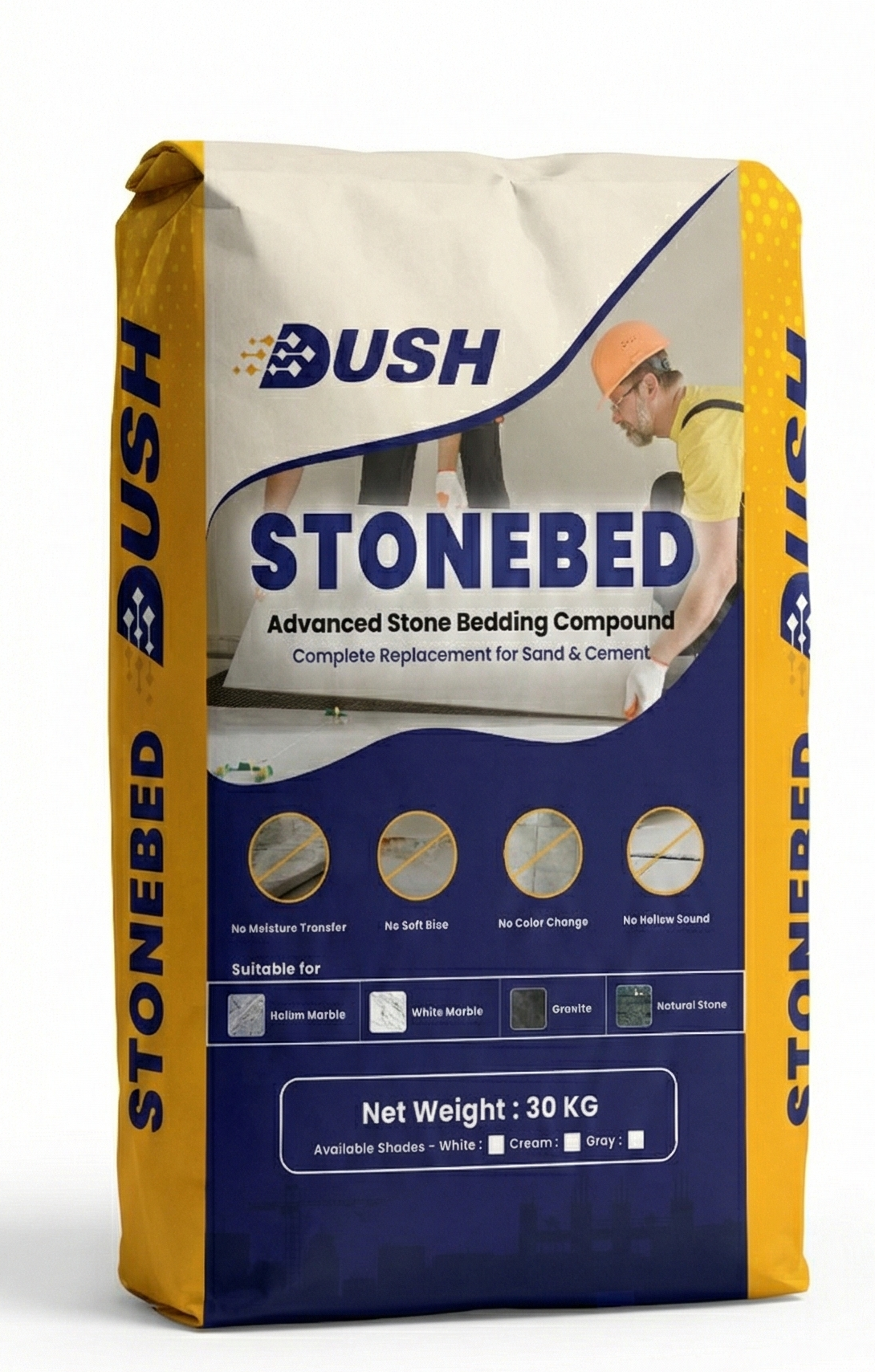
The fundamental difference between Dush Stonebed and site-mixed sand-and-cement is control. Sand-and-cement is mixed on site with whatever water the mason adds, whatever sand is available, whatever grey cement is on hand. Stonebed is manufactured in a controlled factory environment — every bag is the same formulation, the same water ratio, the same polymer modification level, the same colour.
The white and cream formulations are the critical specification for white and light Italian marble. There is no grey iron oxide in these formulations to migrate into the stone by capillary action. The polymer modification controls moisture transport within the curing bed, preventing the salt migration that causes efflorescence. The result is a bedding layer that does not compromise the marble above it — regardless of how deep that layer needs to be.
- ★Eliminates grey staining under white marble: White and cream formulations contain no grey iron oxide — the pigment that site-mixed mortar deposits permanently inside marble's crystal structure
- ★Eliminates salt rise and efflorescence: Polymer modification controls moisture transport within the curing bed, preventing the salt migration that causes white patches on marble weeks after installation
- ★Bridges gaps up to 6 inches: Structural bedding compound — manufactured for use in deep layers, not restricted to the 3 to 12mm bed depth of adhesive
- ★Factory-controlled consistency: Every bag identical — eliminates the variability of site-mixed mortar that changes by mason, water content, and conditions
- ★Available in white, cream, and grey: White and cream for Italian marble and white marble; grey for granite and dark natural stone
- ★30kg and 50kg bags: Suitable for both smaller residential and larger commercial projects
| Property | Traditional Sand-and-Cement Mortar | Dush Stonebed |
|---|---|---|
| Grey pigment migration | Contains iron oxide — permanent staining risk under white marble | White/cream formulations — zero pigment migration |
| Salt rise/efflorescence | Generates soluble salts during cure — white patches on marble | Polymer-modified — controlled moisture transport, no salt rise |
| Consistency | Variable by mason, water, sand, and conditions daily | Factory-controlled — identical every bag |
| Depth capacity | 25–50mm typical — but structurally weak at depth | Up to 6 inches — purpose-built structural compound |
| White marble compatibility | Grey — high risk of discolouration | White and cream formulations available |
| Quality assurance | None — depends entirely on site labour | Italian-formulated factory product with consistent specification |
When to Specify Stonebed vs Adhesive-Only Installation
Specify Dush Stonebed whenever the substrate has significant level variation, the gap between marble and substrate exceeds 12mm, or the project involves white or light Italian marble where grey cement staining from the bed layer is a concern. Adhesive-only installation (Apex Limitless on a flat substrate) is appropriate when the substrate is already level to within 3mm deviation under a 2-metre straight edge and the depth from substrate to marble finish level does not exceed 12mm.
Renovation Over Old Floors
New marble being laid over an old tiled or cement floor often results in large level changes at doorways and transitions. Stonebed bridges these variations before the adhesive layer.
Uneven Structural Slabs
New construction structural slabs often have significant level variation across a room before screed is applied. If insufficient or no screed was laid, Stonebed fills and levels the surface for marble installation.
White and Light Italian Marble
Statuario, Calacatta, Carrara, and other white marble varieties are most vulnerable to grey pigment migration from grey cement beds. White or cream Stonebed is the essential specification to prevent permanent discolouration.
Large Gaps from Services or Structure
Underfloor plumbing, heating, or structural elements may create large variations in the finished floor level. Stonebed fills these gaps structurally before the adhesive and marble are applied.
Complete Installation Sequence Using Dush Stonebed
Prepare the Substrate
Ensure the structural floor slab is clean, sound, and free of loose material, oil, and old adhesive. Remove any contamination that would prevent Stonebed from bonding to the base.
Mix Dush Stonebed
Mix Dush Stonebed powder with clean water to a uniform, workable consistency, following the water ratio on the bag label. Use white or cream formulation for white and light marble — never grey.
→ Colour selection matters — white/cream for Italian marble, grey only for granite and dark stone
Apply, Level, and Compact Stonebed
Apply Dush Stonebed to the substrate at the depth required to bridge level variation and bring the surface up to the required finish level for marble. Compact and level to achieve a flat, uniform surface.
Allow Full Cure
Allow Dush Stonebed to cure fully before applying adhesive. Do not proceed to the adhesive layer on uncured Stonebed — the adhesive bond depends on the Stonebed surface having achieved adequate strength.
Apply Dush Apex Limitless to Cured Stonebed
Apply Dush Apex Limitless to the cured Stonebed surface using a notched trowel. This is the bonding layer — thin, controlled, 3 to 12mm deep.
Back-Butter Each Marble Slab
Apply a skim coat of Dush Apex Limitless to the back face of each marble slab using a flat trowel. Back buttering is required — single-sided application leaves voids under the marble.
→ The Stonebed layer does not replace back buttering — both are required
Seat the Marble Slab
Press the back-buttered marble slab onto the adhesive bed on the cured Stonebed surface. Check level and alignment on all four edges, and seat fully from centre outward using a rubber mallet.
Specify Stonebed on Your Next Italian Marble Project
Speak with the Dush technical team about your substrate conditions — gap depth, marble variety, and floor area. We will confirm whether Stonebed is required and which colour formulation is correct for your stone.
View Dush Stonebed →Related Dush Guides and Products
Dush Stonebed — Questions Answered
What is Stonebed used for in marble installation?
What is the difference between Stonebed and marble adhesive?
Can adhesive alone install marble on a floor with a 6-inch gap?
Why does Stonebed prevent staining better than sand-and-cement mortar?
What sizes does Dush Stonebed come in?
At what stage of marble installation is Stonebed applied?
External References
The Correct Bedding Layer Makes Everything Above It Work
Dush Stonebed: factory-manufactured, polymer-modified, white and cream formulations for Italian marble, 30kg and 50kg, bridges gaps up to 6 inches. The base your adhesive and marble deserve.