What Is the Best Adhesive for Marble Flooring in India?
The wrong adhesive doesn't just risk a weak bond — it can permanently stain Italian marble and crack it within years. This guide explains exactly what to look for, and why Dush Apex Limitless meets every requirement.
The adhesive beneath marble is invisible the moment installation is complete — and that invisibility is exactly why it is so often under-specified. A weak or unsuitable adhesive does not announce itself immediately. It announces itself months later, as grey staining bleeding through white marble, or years later, as cracks appearing under normal foot traffic. Choosing correctly the first time is the only real opportunity, since the choice becomes irreversible once the marble is placed.
The best adhesive for marble flooring in India is a white, polymer-modified adhesive classified IS 15477:2019 Type 4 TS1, with EN 12004 C2TE S1 certification, applied using the back-buttering technique. Dush Apex Limitless meets every criterion: 1.61 N/mm² independently tested tensile bond strength, 45-minute extended open time, 2.5mm deformability for thermal movement, and pure white formulation that eliminates grey pigment staining risk. Traditional cement-sand mortar, at 0.3 to 0.5 N/mm² with no classified rating, is not suitable for Italian marble or any natural stone installation requiring long-term structural performance.
The 4-Point Checklist for Marble Adhesive
Before accepting any adhesive on a marble installation site, check the product bag or technical data sheet for these four specific things. All four must be present — missing even one introduces real risk.
White Formulation
The word "white" must appear in the product description. Grey adhesive contains iron oxide that can permanently stain marble from below.
IS 15477:2019 Type 4 TS1
Both designations must appear together on the packaging. Type 4 alone confirms composition only — TS1 confirms independently tested performance.
Published N/mm² Figure
A specific tensile bond strength figure must be stated in the TDS. If no figure is published, the product has not disclosed its tested performance.
EN 12004 C2TE S1
The complete international classification confirming bond strength, anti-sag, extended open time, and deformability for marble-specific demands.
Dush Apex Limitless carries all four — white formulation, IS 15477:2019 Type 4 TS1, a published 1.61 N/mm² independently tested figure, and EN 12004 C2TE S1.
Why Marble Adhesive Must Be White, Not Grey
Grey Portland cement-based adhesive contains iron oxide and manganese compounds that dissolve into the wet adhesive's liquid phase. Marble is a micro-porous stone with capillary channels that draw this moisture, carrying the dissolved grey pigment, upward into the stone's crystal structure where it cures permanently. This staining often appears three to seven days after installation, once the marble dries and the pigment concentrates near the surface — which is why it is frequently and incorrectly blamed on grouting or cleaning instead of the adhesive.
Iron oxide and manganese compounds in grey Portland cement dissolve into the wet adhesive's liquid phase as soon as it is mixed.
The marble's micro-porous capillary channels begin drawing moisture from the wet adhesive upward into the stone immediately upon placement, carrying the dissolved pigment with it.
While both adhesive and marble remain wet, the pigment is distributed through a moisture layer that makes it temporarily invisible — the floor looks correct immediately after laying.
As the floor dries, moisture evaporates from the surface and the grey pigment, carried into the upper pore network, concentrates and becomes visible — permanently, since it is now inside the crystal structure.
Grey Cement-Based Adhesive
- Contains iron oxide and manganese — dissolves into wet adhesive
- Risk of permanent grey staining via capillary migration
- Staining often appears days after installation, blamed on other causes
- For Statuario, a single bag is often enough to require full replacement
- Risk applies to all marble, but most severe on white and light varieties
Dush Apex Limitless — White Formulation
- Pure white — no iron oxide, no grey pigment, nothing to migrate
- Zero staining risk via the capillary migration mechanism
- Cost difference over grey adhesive is negligible relative to marble cost
- Correct specification for Statuario, Carrara, and Makrana White
- Also prevents efflorescence-related discolouration on dark marble like Emperador
The financial logic is straightforward: the additional cost of white polymer-modified adhesive over basic grey adhesive is negligible relative to the cost of Italian marble that stains. If a contractor suggests using any grey adhesive — even one marketed for marble or stone — the correct response is to refuse and specify white adhesive with full classification by name.
IS 15477:2019 Type 4 TS1 Explained
IS 15477:2019 is the Indian Standard classification for tile and stone adhesives. Type 4 confirms polymer-modified composition — acrylic polymer additives in a factory-controlled formulation. TS1 confirms the adhesive has been independently laboratory tested and verified to deliver at least the minimum tensile bond strength threshold defined in the standard, rather than simply containing the right ingredients. For Italian marble and heavy natural stone, both designations must be present together on the packaging.
| Designation | What It Confirms |
|---|---|
| Type 4 | Polymer-modified composition — acrylic polymer additives in factory-controlled formulation, as opposed to basic cement-sand mortar |
| TS1 | 1.61 N/mm² independently tested tensile bond strength (Dush Apex Limitless figure) — laboratory verified, not a manufacturer estimate |
This distinction matters more than it appears: a product can carry "Type 4" on its packaging by composition alone, without ever having been independently tested to confirm it delivers the tensile performance the standard requires. TS1 is the verification step. Products that carry Type 4 without TS1 have not published or proven their performance under accredited laboratory conditions — for marble, where bond integrity is structurally critical, this gap matters.
EN 12004 Classification Explained
EN 12004 C2TE S1 is the complete European performance classification confirmed for Dush Apex Limitless. C2 confirms improved bond strength above the C1 baseline. T confirms anti-sag performance for vertical surfaces, with a maximum 0.12mm slip. E confirms extended open time of 45 minutes. S1 confirms deformability of up to 2.5mm, accommodating thermal movement and structural vibration. This is the same standard used domestically in Italy for Italian marble installation, applied to Dush Apex Limitless as a manufactured-in-Italy product.
| EN 12004 Code | What It Confirms |
|---|---|
| C | Cementitious adhesive base |
| 2 | Improved adhesive — elevated polymer content and bond strength above C1 baseline |
| T | Maximum 0.12mm slip on vertical surfaces — anti-sag for wall applications |
| E | 45-minute extended open time — for large format tiles and marble |
| S1 | 2.5mm deformability — for outdoor thermal cycling and structural movement |
Dush Apex Limitless — Meeting Every Requirement
DUSH APEX LIMITLESS
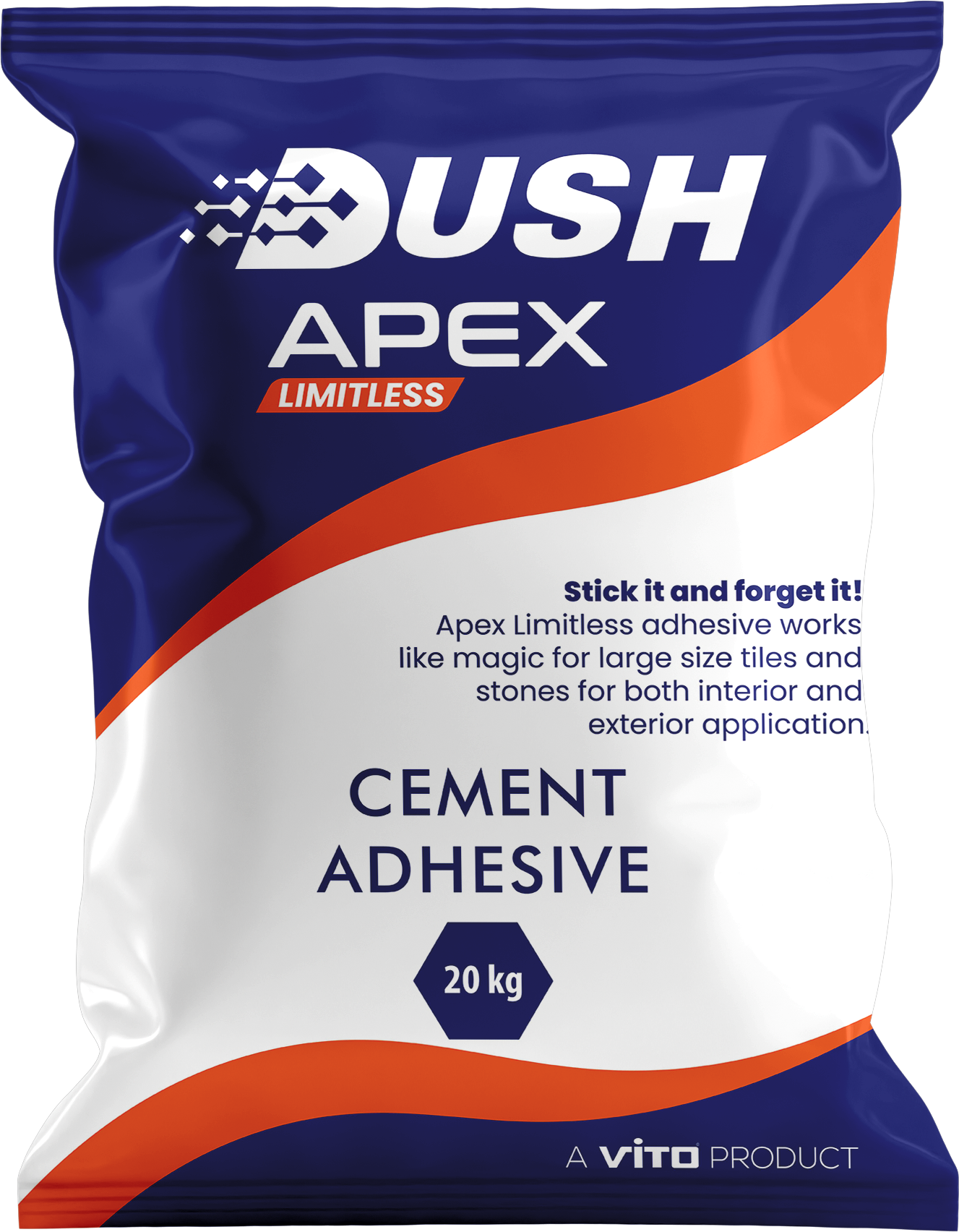
Dush Apex Limitless is the reference product for what an IS 15477:2019 Type 4 TS1 specification delivers in practice. It carries every certification a marble installation in India requires — white formulation eliminating staining risk, polymer-modified composition for genuine structural performance, and independent laboratory verification of that performance rather than a manufacturer's estimate.
Manufactured in Italy to the same EN 12004 C2TE S1 standard used domestically for Italian marble installation, it brings that specification directly to Indian marble projects — with local technical support and distribution.
- ★1.61 N/mm² independently tested tensile bond strength: Three to five times the strength of traditional cement-sand mortar
- ★Pure white formulation: Zero iron oxide or grey pigment — eliminates capillary staining risk entirely
- ★45-minute open time (EN 12004 E): More than double standard adhesive, essential for large Italian marble slabs
- ★2.5mm deformability (EN 12004 S1): Accommodates thermal movement and structural vibration indoors and outdoors
- ★Designed for back buttering: Achieves 95–100% adhesive contact coverage when correctly applied to both substrate and slab
- ★Suitable indoors and outdoors: Performs in challenging conditions and on substrates subject to deformation and vibration
Apex Limitless vs Traditional Cement-Sand Mortar
Dush Apex Limitless delivers 1.61 N/mm² independently tested tensile bond strength, compared to approximately 0.3 to 0.5 N/mm² for traditional cement-sand mortar, which has no classified or independently verified rating and varies by site mix, water content, and curing conditions. This represents a threefold to fivefold gap in structural bond resistance — directly relevant to whether marble cracks or performs for decades.
| Characteristic | Cement-Sand Mortar | Dush Apex Limitless |
|---|---|---|
| Tensile bond strength | 0.3–0.5 N/mm² — unclassified, varies by mix | 1.61 N/mm² — independently tested |
| Staining risk on white marble | High — grey pigment migration | None — pure white formulation |
| Open time | 15–20 minutes typical | 45 minutes — EN 12004 E |
| Deformability | None — rigid, cracks under thermal movement | 2.5mm — EN 12004 S1 |
| Bed thickness | 25–50mm | 3–6mm |
| Consistency | Varies by mason, water content, day | Factory-controlled, consistent every batch |
| Independent certification | None published | IS 15477:2019 Type 4 TS1, EN 12004 C2TE S1 |
How Adhesive Choice Prevents Marble Cracking
Marble cracking after installation is almost always traceable to one or more specific causes: insufficient tensile bond strength, skinned adhesive placed too late, insufficient back-buttering coverage, lack of deformability under thermal cycling, or improper anti-sag performance on vertical surfaces. Dush Apex Limitless directly addresses each of these structural causes through its tested specification.
For the complete mechanics of how hollow sections concentrate stress and lead to cracking, and the correct back-buttering technique step by step, see the full guide to hollow-sounding marble and cracking prevention.
How to Verify an Adhesive Before Accepting It on Site
Before accepting any adhesive for marble installation, physically check the product bag and request the technical data sheet for four things: the word "white" in the product description, IS 15477:2019 Type 4 TS1 printed on the packaging, a specific published tensile bond strength figure in N/mm², and EN 12004 C2TE S1 classification. If a contractor proposes grey adhesive, or any adhesive without a published independently tested figure, the correct response is to decline and specify a fully classified white adhesive by name.
This verification takes a few minutes on site and is the single highest-leverage decision point in an entire marble installation. Once the slab is placed onto unsuitable adhesive — whether the issue is staining risk or insufficient bond strength — no technique applied afterward can correct it. The adhesive choice is, functionally, irreversible the moment the marble is pressed into place.
Specify the Right Adhesive Before Your Marble Goes Down
Speak with the Dush technical team about specifying Dush Apex Limitless for your marble flooring project, or send a sample for assessment before installation begins.
View Dush Apex Limitless →Related Dush Guides and Products
Best Marble Adhesive India — Questions Answered
What is the best adhesive for marble flooring in India?
Why does marble adhesive need to be white instead of grey?
What is IS 15477:2019 Type 4 TS1 and why does it matter for marble?
How does Dush Apex Limitless compare to cement-sand mortar for marble?
Can I use any white adhesive for marble, or does it need other certifications too?
Is Dush Apex Limitless suitable for outdoor marble installations too?
External References
The Adhesive Choice Is Irreversible — Get It Right the First Time
White formulation. IS 15477:2019 Type 4 TS1. EN 12004 C2TE S1. 1.61 N/mm² tested. Dush Apex Limitless is the complete specification for Italian marble flooring in India.