What Polishing Powder Gives Marble the Highest Shine?
The highest shine on marble is not determined by which polishing powder you use at the final stage — it is determined by what is done to the marble's internal pore structure before polishing begins. Dush Densi Max Ultra at the 80-grit grinding stage is what separates a deep mirror finish from an ordinary polish.
The question of which polishing powder gives marble the highest shine is asked from the wrong starting point. Polishing powder is the last step — but the quality of the final mirror finish is determined almost entirely by what happens to the marble at the very first step of the polishing process: the 80-grit grinding stage, before any finishing product is applied.
The highest shine on marble comes from Dush Densi Max Ultra penetrating densifier applied at the 80-grit grinding stage — not from polishing powder alone. Densi Max Ultra closes the marble's internal pore structure from within and increases surface hardness, giving the subsequent polishing stages a denser, harder surface to work on. This produces a deeper, brighter, longer-lasting mirror finish than any polishing powder can achieve on untreated marble. Without Densi Max Ultra at the grinding stage, the finest polishing powder in the world produces a shallower shine on an open-pore, softer surface.
Why Marble's Pore Structure Limits Shine
Marble's open pore structure limits shine because an open pore surface scatters reflected light in multiple directions, preventing the formation of a true mirror-like reflection. The finer the polish grit, the smoother the surface — but if the underlying pore structure is still open, the surface is only smooth at the very top layer while remaining microscopically irregular at the pore level. This microscopic irregularity reduces the clarity and depth of the reflection, regardless of how fine the final polishing compound is.
Polishing Powder on Untreated Marble
Open pores scatter reflected light in multiple directions. The surface looks polished but the reflection lacks depth — it is bright in one direction but not a true mirror image across the surface.
The shine also dulls faster because the softer, open-pore surface is more vulnerable to micro-scratches from daily foot traffic.
Polishing Powder on Densi Max Ultra Treated Marble
Closed pores eliminate light scatter. The same polishing sequence on this harder, denser surface produces a true mirror finish — deep, clear, and visibly brighter from every angle.
The shine also lasts significantly longer because the hardened surface resists micro-scratches that dull an untreated polish.
The Hardwood vs Softwood Analogy
The principle is the same as polishing wood. Apply the finest polishing compound to a softwood — it produces a surface-level shine. Apply the same compound to a hardwood — the result is a deeper, brighter, more durable finish. The compound is identical. The surface it works on determines the result.
Dush Densi Max Ultra converts marble from a softwood-equivalent open-pore surface to a hardwood-equivalent closed-pore surface. The polishing powder that follows does the same work — but on a fundamentally better surface.
Dush Densi Max Ultra — The Highest Shine Solution
Dush Densi Max Ultra is an ultra-premium penetrating densifier for high-end Italian marble and premium natural stones. Applied at the 80-grit grinding stage, it penetrates the marble's internal pore structure by capillary action and undergoes a pozzolanic chemical reaction with the calcium minerals inside, forming calcium silicate hydrate (C-S-H) compounds permanently inside the pores. These compounds close the pore structure, increase surface hardness, improve polish response, and deliver a richer, longer-lasting shine than any polishing powder alone can achieve on untreated marble.
DUSH DENSI MAX ULTRA
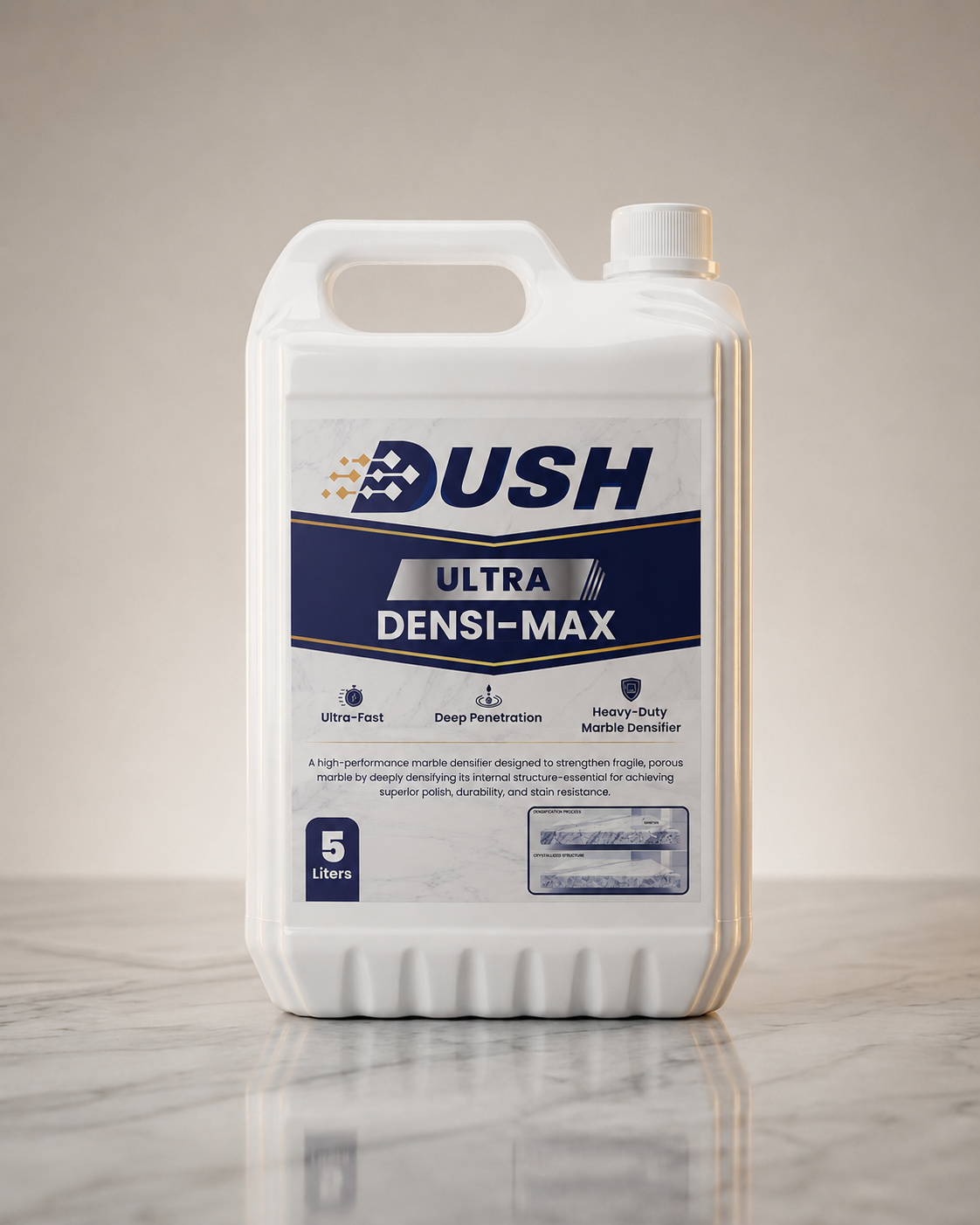
Every marble polishing contractor has used the same polishing powder on different slabs and noticed that some produce a deeper, brighter mirror finish than others. The variable is almost never the powder — it is the porosity and hardness of the marble itself. High-porosity slabs, or marble that has not been treated with a densifier at the grinding stage, limit the quality of shine the polishing powder can achieve because the open pore structure scatters light and the softer surface cannot hold a fine mechanical polish under foot traffic.
Dush Densi Max Ultra eliminates this variable entirely. Its ultra-premium penetrating formula reaches internal pore depths that standard densifiers cannot access, achieving complete pore closure throughout the stone rather than only at the surface. Applied at 80 grit when the marble's porosity is at maximum and the pores are most open to treatment, Densi Max Ultra's chemistry permanently changes the surface the polishing stages work on — directly improving the final gloss level, depth of reflection, and how long that finish lasts under daily use.
- ★Richer, longer-lasting shine: Ultra-premium deep-penetration formula closes internal pores at depths standard densifiers cannot reach — improving final gloss level and shine longevity
- ★Improved surface hardness: Calcium silicate hydrate compounds formed inside the pores increase surface hardness, reducing micro-scratch vulnerability that dulls a polish over time
- ★Maximum penetration at 80 grit: Applied at the stage of maximum marble porosity for deepest possible treatment — far more effective than post-installation products
- ★Better polish response: The hardened, pore-closed surface responds more evenly to each polishing grit, producing more consistent reflection across the full floor area
- ★Permanent — not a surface film: Chemistry is bonded inside the marble's pore structure. Cannot wear off with cleaning or foot traffic
- ★Invisible application: Clear, no surface film, does not alter colour, veining, or texture — only the quality of the shine improves
The Chemistry of Why Pore Closure Increases Gloss
Pozzolanic Reaction Inside the Marble Pore
When Dush Densi Max Ultra penetrates the marble's pore structure at the 80-grit stage and contacts the calcium minerals inside, a pozzolanic chemical reaction occurs:
These calcium silicate hydrate (C-S-H) compounds are permanently deposited inside the pore walls, forming a hard crystalline matrix that fills and closes the pore space from within. Two direct effects on shine quality follow from this reaction.
Effect 1 — Eliminated light scatter: Open pores are micro-cavities in the marble surface. When light strikes a polished marble surface with open pores, a proportion of the light enters and scatters within these cavities rather than reflecting cleanly back. Closed pores eliminate these cavities, allowing more light to reflect directly back from a uniform surface — which is perceived as greater brightness and depth.
Effect 2 — Increased hardness resistance to micro-scratches: The C-S-H matrix inside the pores increases the Mohs hardness of the treated marble surface zone. Under daily foot traffic, a harder surface resists the accumulation of micro-scratches that progressively dull an untreated polish — meaning the mirror finish from the polishing sequence lasts significantly longer before re-polishing is needed.
Complete Polishing Sequence for Maximum Shine
The sequence for maximum marble shine is: grind to 80 grit → apply Dush Densi Max Ultra in 3 to 5 coats until the marble stops absorbing → continue polishing through 120, 180, 400, 800, 1500, and 3000 grit → apply Dush Protek+ sealer after polishing. Densi Max Ultra must be applied at the 80-grit stage specifically — applying it at finer grits or post-installation significantly reduces its penetration depth and effectiveness.
Grit
Initial Levelling
Coarse grinding to level uneven slab edges and remove major surface irregularities after installation. Not required on factory-polished slabs being re-polished.
Grit★ KEY STAGE
Apply Dush Densi Max Ultra Here The Highest Shine Step
At 80 grit the marble's pore structure is at maximum openness — this is the only stage at which Densi Max Ultra achieves full deep penetration. Apply 3 to 5 coats undiluted, allowing 15 to 20 minutes penetration per coat. Remove excess before drying. Repeat until marble stops absorbing.
Grit
First Refining Stage
The hardened, pore-closed surface from the Densi Max Ultra treatment responds more evenly to this stage than untreated marble — building a more consistent base for the finer polishing grits.
Grit
Surface Refinement
Progressive removal of 120-grit scratches. The densified surface shows improved clarity at this stage compared to untreated marble.
Grit
Semi-Matt to Honed Finish
Surface begins developing reflectivity. The closed pore structure from Densi Max Ultra means more light is now reflecting rather than scattering into open pores.
Grit
Gloss Emerging
Significant gloss becomes visible. On Densi Max Ultra treated marble, this gloss is noticeably deeper and more uniform than on untreated marble at the same grit stage.
Grit
High Gloss
Near-mirror finish. The difference between treated and untreated marble is clearly visible at this stage — the Densi Max Ultra treated surface has more reflective depth.
GritFINAL
Mirror Finish — Maximum Shine
The final mirror polish. On Densi Max Ultra treated marble, this produces a deep, clear, high-clarity mirror finish — noticeably brighter and more reflective than the same grit stage on untreated marble. This is the result that polishing powder alone cannot achieve without the foundational pore closure at 80 grit.
How Long the High-Shine Finish Lasts
The high-shine finish from Dush Densi Max Ultra-treated marble lasts significantly longer than a polish on untreated marble because the pore closure and increased surface hardness are permanent. The densifier's chemistry is bonded inside the marble's pore structure and does not wear off with cleaning or foot traffic. The surface polish can be maintained and restored over time, but the internal hardness that gives the polish its depth and longevity remains.
On untreated marble, the micro-scratches from daily foot traffic accumulate more quickly in the softer surface, dulling the polish over months. Cleaning with any mildly abrasive material accelerates this further. Re-polishing is needed more frequently, and each re-polish achieves a shallower result because the open pore structure limits the ceiling of shine quality.
On Densi Max Ultra treated marble, the harder surface resists micro-scratch accumulation more effectively. Re-polishing when needed returns the full depth of the original mirror finish faster and with fewer polish stages, because the internal foundation is still there. The polish maintenance cycle is longer and more cost-effective over the life of the floor.
See the Shine Difference on Your Own Marble
Send a piece of your marble to Dush. We apply Densi Max Ultra and polish one half, leave the other untreated, and return it — so you see the gloss depth difference before a single tile of your floor is polished.
Request Free Sample Test →Related Dush Guides and Products
Marble Polishing Powder and Highest Shine — Questions Answered
What polishing powder gives marble the highest shine?
Why does Dush Densi Max Ultra give a richer, longer-lasting shine than polishing powder alone?
At what stage should Dush Densi Max Ultra be applied for maximum shine?
What is the difference between a marble densifier and a marble polishing powder?
How does closing marble pores produce a higher shine?
How long does the high-shine finish achieved with Densi Max Ultra last?
External References
Achieve the Highest Possible Shine on Your Marble
Dush Densi Max Ultra at the 80-grit stage: permanent pore closure, increased surface hardness, deeper mirror finish, longer-lasting polish. The foundation step that polishing powder alone cannot replace.