Why Does My Marble Floor Keep Losing Its Shine After Polishing?
Marble losing its shine after polishing is one of the most common complaints in Indian homes — and polishing again only delays the same outcome. This guide explains exactly why it keeps happening and how Dush Densi Max Ultra closes the root cause permanently.
Marble losing its shine is not a marble quality problem and it is not a polishing quality problem. It is a pore structure problem. Every marble slab has an open network of micro-pores, and as long as those pores remain open, the polished surface is vulnerable to the everyday stresses that dull it — foot traffic, spills, and cleaning. Polishing restores the surface; it does not close the pores. Without closing the pores, the same processes that dulled the floor the first time will dull it again at the same rate.
Marble floors keep losing their shine after polishing because polishing alone does not seal the open pore structure that allows micro-scratching, acid etching, and stain absorption to dull the surface again. The permanent solution is Dush Densi Max Ultra applied at the 80-grit grinding stage during polishing — it chemically closes the marble's internal pore structure from within, making the polished surface significantly more resistant to the everyday stresses that cause shine loss, so the polish lasts far longer between maintenance cycles.
The 4 Causes of Marble Shine Loss
Marble loses its shine through four main mechanisms: micro-scratching from foot traffic and cleaning; acid etching from household liquids including lemon juice, vinegar, and cleaning products; stain absorption through the open pore network; and surface film buildup from incorrect cleaning products. In Indian homes, micro-scratching and acid etching are the two most common causes — and both are directly linked to the marble's open pore structure.
Micro-Scratching
Fine particles of grit, sand, and dust tracked onto the marble by foot traffic act as micro-abrasives on the polished crystal surface. Each individual particle scratch is invisible, but thousands of them accumulate over weeks into a visible overall haze. The softer the marble, the faster this accumulates. Marble polished to a high gloss is particularly sensitive — the higher the gloss, the more visible even fine abrasion becomes.
Acid Etching
Marble is calcium carbonate. Any acidic liquid — lemon juice, vinegar, tomato, cola, cleaning products, and even some mineral waters — reacts with the calcium carbonate at the marble surface and permanently dissolves the polished crystal layer. This leaves a flat, dull mark that cannot be cleaned away — it must be physically re-polished to remove. Etch marks are most common near kitchens and dining areas.
Stain Absorption
Marble's open pore network draws liquids in by capillary action. Pigmented liquids — turmeric, coffee, tea, oil — are absorbed into the stone and change the light reflection properties of the surface from within. Absorbed stains cannot be wiped from the surface because they are inside the stone. They make the marble appear dull and discoloured in the affected areas.
Surface Film Buildup
Many common floor cleaning products leave a residue film on marble that builds up over time and creates a hazy, flat appearance over the polished surface. Detergents, soap-based cleaners, and wax-based floor polishes are the most common culprits. Unlike the other three causes, this type of shine loss is often reversible with correct pH-neutral cleaning — but the underlying pore vulnerability remains.
Why Polishing Alone Cannot Solve the Problem
Polishing restores the optical quality of the marble surface by physically removing the damaged layer and re-establishing the crystal structure that reflects light. It does not close the open pore network underneath. Once polished, the marble's pore structure is just as open as it was before — meaning foot traffic, spills, and etching begin degrading the new polished surface at exactly the same rate as before. Without closing the pores, polishing is a maintenance cycle, not a solution.
Polish Only — The Recurring Cycle
Polish restores the surface. Open pores remain. Micro-scratching, etching, and absorption begin degrading the surface again immediately. Six to twelve months later the floor looks dull again. Polish again. Repeat indefinitely.
Root cause never addressed. The maintenance cycle never ends and the floor never looks consistently good.
Polish + Densi Max Ultra — Closed Pores
Polish restores the surface. Densi Max Ultra applied at the 80-grit stage permanently closes the pore structure. Micro-scratching, etching, and absorption are significantly slowed. The polished surface lasts years instead of months.
Root cause addressed. The cycle lengthens dramatically — maintenance becomes an occasional task rather than an annual necessity.
How to Tell If Your Marble Has Etching or Scratching
Hold a light source at a low angle to the dull area and look at the surface carefully. Etch marks appear as flat, dull patches with no directionality — the surface texture is unchanged but the reflective quality is gone. Scratch damage appears as fine directional lines or a general haze of micro-lines, densest in traffic pathways. Both require re-polishing to repair, but identifying which you have guides the re-polishing approach and helps explain the source of the problem.
Etch Marks — What to Look For
Appear as flat, dull patches with clear edges. The surface is smooth to the touch in the affected area — the texture has not changed, only the optical quality.
No directional pattern. Often roughly circular or irregular in shape — the shape of the spill that caused them.
→ Most common near kitchen, dining table, bathroom basin
Scratch Haze — What to Look For
Appears as a general haze or loss of reflective depth across the whole surface, densest in traffic pathways. Individual lines may be visible under low-angle light.
Follows the pattern of movement across the floor — worst near entry points, corridors, and kitchen areas.
→ Most common in high-traffic pathways and near entry points
Surface Sealer vs Penetrating Densifier — the Critical Difference
A surface sealer sits on top of the marble and wears away with foot traffic and cleaning — it is temporary protection that must be reapplied. Dush Densi Max Ultra is a penetrating densifier — it penetrates the marble's internal pore structure and chemically bonds with the calcium minerals inside, permanently closing the pore network from within. It cannot be worn away by foot traffic or cleaning because it is inside the stone, not on top of it.
Surface Sealer
Sits on top of the marble surface as a thin film. Provides initial protection but foot traffic, cleaning, and mopping gradually wear this film away over months.
Once worn through, the marble is unprotected again — and the film may leave a hazy residue as it wears unevenly.
→ Requires regular reapplication — protection diminishes over timeDush Densi Max Ultra
Penetrates into the marble's internal pore structure and chemically bonds with calcium minerals inside, forming a permanent hydrophobic crystalline matrix within the pores.
Cannot be worn away by foot traffic or cleaning — the protection is inside the stone, not on the surface.
→ Permanent protection — does not diminish with use or cleaningDush Densi Max Ultra — Closing the Root Cause of Shine Loss
Dush Densi Max Ultra is an ultra-premium penetrating densifier applied at the 80-grit grinding stage during marble polishing. It penetrates deep into the pore structure and chemically reacts with the calcium minerals inside, forming a permanent hydrophobic crystalline matrix that closes the pores from within. With the pore structure closed, micro-scratching abrades a denser surface, acid etching has a reduced pathway into the stone, and liquid absorption is significantly slowed — the polished surface lasts far longer.
DUSH DENSI MAX ULTRA
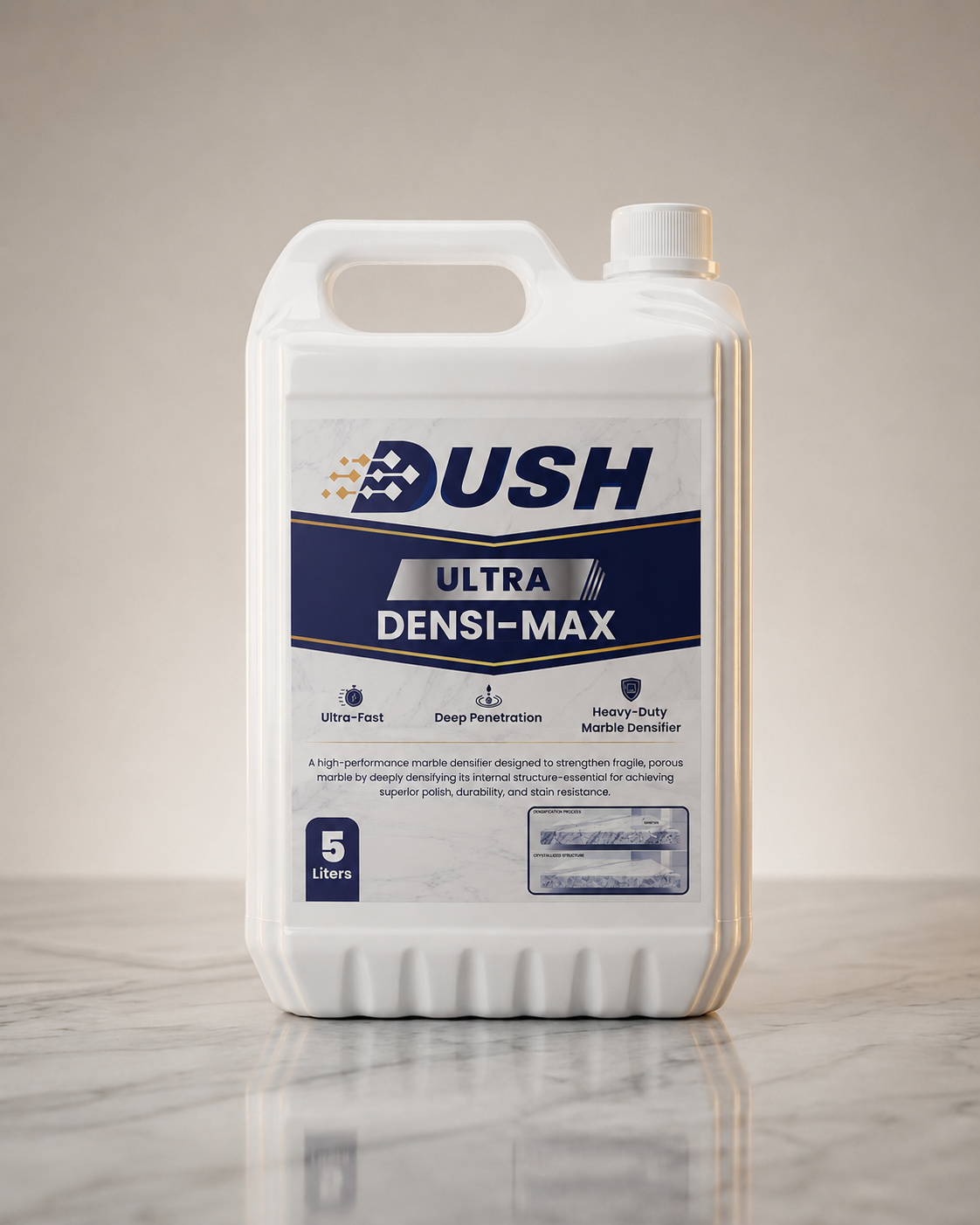
The reason marble loses its shine is that the polished crystal surface sits on top of an open pore network — and everything that dulls marble, from grit to acid to pigmented liquids, uses that pore network to degrade the surface faster. Dush Densi Max Ultra addresses this directly by closing the pore network itself, not by adding a protective film on top.
Applied at the 80-grit grinding stage — when the pore structure is most open — the densifier penetrates deeply into the stone and permanently alters the pore walls from hydrophilic (water-attracting) to hydrophobic (water-repelling). This single change reduces the rate at which all four causes of shine loss operate: micro-scratching has a harder, denser surface to abrade; acid etching has less pore pathway into the stone; stain absorption is significantly slowed; and surface film has less to grip on.
- ★Permanent pore closure: Chemically bonds inside the marble — cannot be worn away by foot traffic, cleaning, or mopping the way surface sealers can
- ★Applied at maximum penetration depth: 80-grit stage gives deepest possible pore access before final polishing partially closes the surface
- ★Makes polished marble shine last far longer: Slows all four mechanisms of shine loss simultaneously — scratching, etching, absorption, and film buildup
- ★No surface film, no appearance change: Clear, no haze, does not affect the marble's natural colour, veining, or depth of polish
- ★Dual protection: Same treatment that extends polished shine also provides permanent protection against turmeric, coffee, and oil staining
- ★Tested on your own marble first: Dush tests on the client's actual marble before purchase — no surprises on premium stone
Correct Application Sequence for Lasting Marble Shine
Grind to 80 Grit
Begin the polishing process and grind the marble surface to 80 grit. This is the stage of maximum pore openness — the correct point to apply Densi Max Ultra for the deepest possible penetration.
Apply First Coat of Dush Densi Max Ultra
Apply Dush Densi Max Ultra undiluted to the 80-grit surface. Allow the product to penetrate for 15 to 20 minutes per coat.
→ Do not dilute — full-strength application achieves maximum penetration depth
Remove Excess Before Drying
Remove excess Densi Max Ultra before it dries on the surface. Do not allow the product to form a film on the marble — any excess left on the surface will dry hazy and must be removed.
Repeat for 3 to 5 Coats
Repeat the application until the marble stops absorbing the product — this indicates the pore structure is saturated. Typically 3 to 5 coats depending on the marble's porosity and variety.
→ More porous marble varieties absorb more coats — keep applying until absorption stops
Continue Polishing Through Remaining Grits
Proceed through the remaining polishing grit stages to the desired final finish — honed, semi-polished, or high-gloss mirror finish.
Confirm With the Water Drop Test
Pour 3 to 4 drops of water on the completed surface. Beading for 5 or more minutes confirms the pore structure is permanently closed and the polished shine is now protected.
→ If water soaks in within 1 to 2 minutes, additional coats of Densi Max Ultra are needed
Test Densi Max Ultra on Your Own Marble First
Dush tests every product on the client's actual marble before purchase — so you can see the shine protection difference on your specific stone before committing to the treatment.
Request Free Sample Test →Related Dush Guides and Products
Marble Losing Shine After Polishing — Questions Answered
Why does my marble floor keep losing its shine after polishing?
What causes marble to lose its shine?
Does sealing marble prevent shine loss?
At what stage should Dush Densi Max Ultra be applied to make marble shine last?
How do I know if my marble has lost its shine from etching or from scratching?
Can I restore marble shine without re-polishing the floor?
External References
Stop Polishing the Same Floor Every Year
Dush Densi Max Ultra closes the pore structure permanently at the 80-grit stage — so the polish you invest in this time lasts years, not months.