How Does a Marble Densifier Work?
A marble densifier works from inside the stone — chemically reacting with calcium minerals in the pore structure to form a permanent crystalline matrix that cannot wear away. This guide explains the pozzolanic chemistry, why it is fundamentally different from sealing, and how Dush Densi Max Ultra applies it.
A marble densifier works by permanently changing the stone's internal pore structure through a chemical reaction — not by coating the surface. Understanding this distinction is what separates a correctly specified marble protection system from one that will need to be re-applied every year. The chemistry involved is the same pozzolanic reaction used in high-performance concrete, applied at the micro-scale inside marble's calcium carbonate crystal network.
A marble densifier works by penetrating the stone's open pore structure and chemically reacting with the calcium minerals inside the marble to form calcium silicate hydrate (C-S-H) compounds. These compounds permanently line the internal pore walls with a denser, hydrophobic crystalline matrix — physically narrowing the pores and making their surfaces water-repellent. The result is protection that is built into the stone's structure and cannot be worn away by surface use, cleaning, or chemical exposure. Dush Densi Max Ultra is applied at the 80-grit grinding stage during polishing, when the pore structure is most open for maximum depth of penetration.
What Marble's Pore Structure Looks Like Before Densification
Marble is not solid — it is a crystalline structure of interlocked calcium carbonate minerals with a network of micro-pores between the crystal grains, ranging from 0.1 to 10 micrometres in diameter. These pores are interconnected, forming continuous pathways from the surface of the marble down through the slab. Without treatment, any liquid that contacts the marble surface — turmeric, oil, coffee, water — enters these pore channels by capillary action and becomes increasingly difficult to remove the deeper it penetrates.
Untreated Marble — Open Pore Network
Pores range from 0.1 to 10 micrometres — invisible to the eye but highly effective capillary channels. Any liquid contacting the surface is drawn inward by capillary action immediately.
Oil, turmeric, coffee, and red wine all penetrate within seconds to minutes on unsealed marble. Rising moisture uses the same pore network from below.
Densified Marble — C-S-H Lined Pores
Calcium silicate hydrate crystals grown within and around the pore channels physically narrow them and line the pore walls with a hydrophobic surface that water no longer wets readily.
Capillary suction is dramatically reduced. Liquids bead on the surface or penetrate much more slowly — giving time to wipe away spills before staining occurs.
The marble varieties most commonly used in Indian homes — Italian Statuario, Carrara, Calacatta, and Makrana white — all have relatively open pore structures that absorb liquids rapidly without treatment. This is why turmeric and oil stains on white marble are so common and so difficult to remove: by the time the spill is visible, it has already penetrated several millimetres into the stone.
The Chemical Reaction Inside the Stone
When Dush Densi Max Ultra penetrates marble's pore structure, the silica compounds in the densifier react with the calcium minerals in the stone in a pozzolanic reaction — the same fundamental chemistry that gives high-performance concrete its density and strength. The reaction produces calcium silicate hydrate (C-S-H) crystals that grow within the pore channels, permanently changing both the physical size and the chemical character of the pore walls.
The Pozzolanic Reaction in Marble Pores
Marble's mineral structure is primarily calcium carbonate (CaCO₃). When moisture is present — as it always is in marble — calcium carbonate partially dissociates to release calcium hydroxide (Ca(OH)₂) at the pore wall surfaces. The silica (SiO₂) compounds in Dush Densi Max Ultra react with this calcium hydroxide to form calcium silicate hydrate:
SiO₂ + Ca(OH)₂ + H₂O → C-S-H (calcium silicate hydrate)C-S-H is a dense, low-porosity crystalline compound that grows within and around the existing pore structure. As it forms, it physically narrows the pore channels from the inside and creates pore wall surfaces that are inherently hydrophobic — water no longer wets them in the same way as the original calcium carbonate surface.
This reaction is permanent because the C-S-H crystals are chemically bonded to the calcium carbonate substrate of the marble itself — they are part of the stone's structure, not a coating on top of it. They cannot be dissolved by cleaning agents, worn away by foot traffic, or stripped by surface abrasion under normal use conditions.
This is the fundamental reason a densifier provides permanent protection where a sealer provides temporary protection: the densifier's protection is the stone's structure, not something applied to the stone's surface.
How Densi Max Ultra Penetrates and at What Stage
Dush Densi Max Ultra achieves maximum penetration depth when applied at the 80-grit grinding stage during marble polishing — the stage at which the pore structure is most open before finer grits begin to partially close the surface. Applied in 3 to 5 coats with 15 to 20 minutes penetration time per coat, the densifier penetrates progressively deeper into the pore network as each coat is absorbed. Polishing then continues through the remaining grits with the C-S-H matrix permanently built into the stone below the surface.
The marble is ground to 80 grit. At this stage, surface pores are maximally open — the grinding process has removed the polished surface layer and exposed the internal pore network at its widest. Densi Max Ultra is applied now, not after final polishing.
Each coat penetrates deeper as upper pores begin their C-S-H reaction. 15 to 20 minutes per coat, excess removed before drying. Continue until absorption rate visibly slows — the saturation indicator that the pore network is at capacity.
Polishing continues through the remaining grits to the final finish. The C-S-H matrix is now permanently built into the stone structure below the surface — unaffected by the remaining polishing passes and by all subsequent surface use.
The timing of application at 80 grit is critical and non-negotiable. Applying a densifier after the final polish achieves only surface-level penetration because the polishing process has partially closed the surface pores. Contractors who apply densifier after installation are getting a fraction of the protection depth of the correctly timed 80-grit application.
Densifier vs Sealer — The Fundamental Difference
A densifier and a sealer protect marble through fundamentally different mechanisms. A densifier chemically reacts with the stone minerals inside the pores and permanently becomes part of the stone's structure — it cannot be removed and does not wear away. A sealer creates a physical film or impregnating layer at or just below the surface that blocks pore entry points — it sits on top of the stone structure and eventually wears away, requiring periodic reapplication every 1 to 3 years.
| Property | Surface Sealer | Dush Densi Max Ultra Densifier |
|---|---|---|
| How it works | Film or impregnating layer at surface | Chemical reaction inside stone's pore walls |
| Where protection sits | On the stone — at or near surface | Inside the stone — part of mineral structure |
| Permanence | Wears away — needs reapplication every 1–3 years | Permanent — C-S-H crystals cannot be removed |
| Affected by foot traffic | Yes — surface layer degrades under wear | No — protection is below the surface |
| Strengthens stone | No | Yes — denser pore structure increases hardness |
| Changes appearance | May alter sheen or cause hazing over time | Clear — no change to colour or finish |
| Application timing | After installation, repeated periodically | 80-grit stage during installation — once |
| Moisture from below | Limited — surface film does not address rising moisture | Reduces capillary pathway for rising moisture |
Dush Densi Max Ultra — Ultra-Premium Penetrating Densifier
DUSH DENSI MAX ULTRA
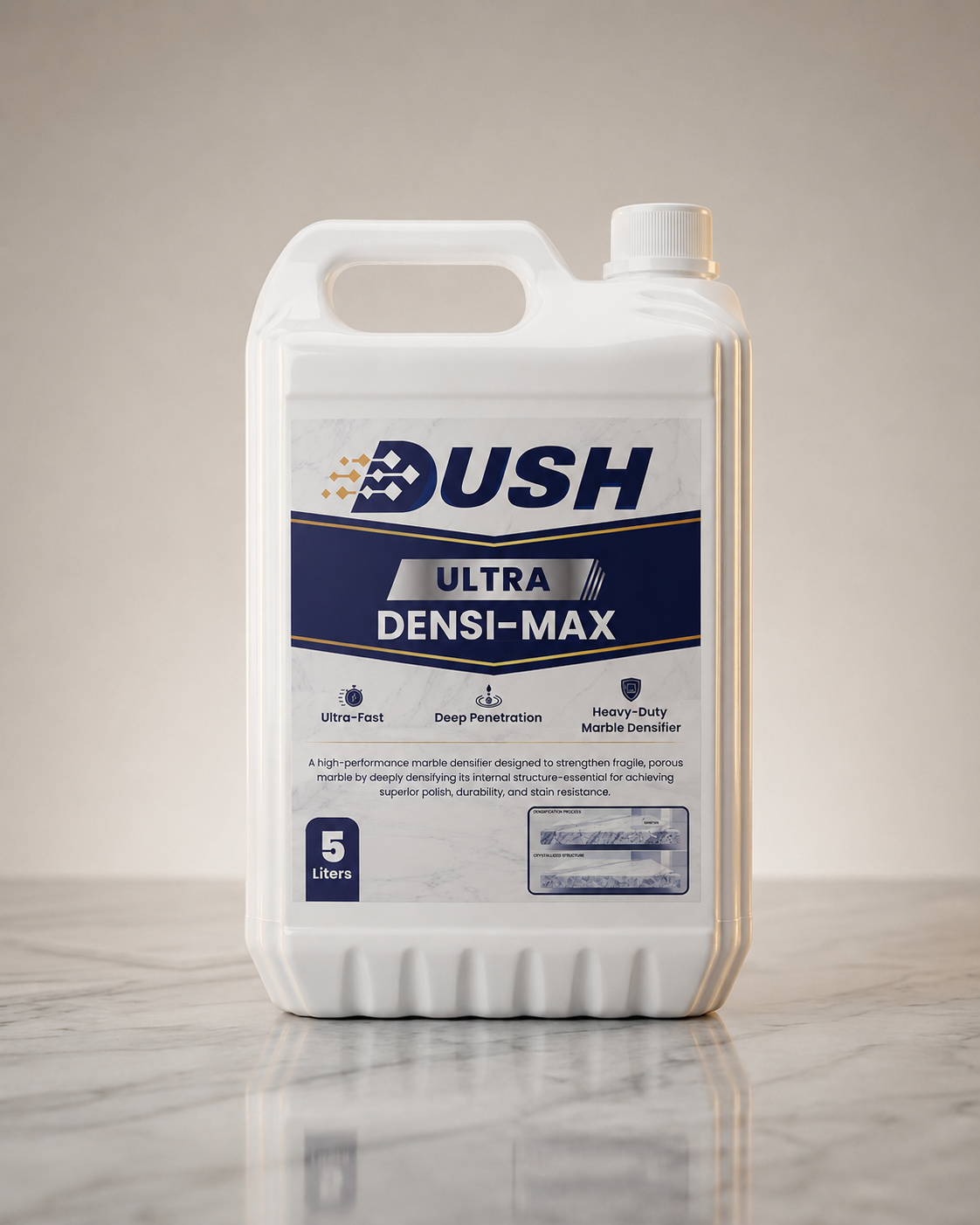
Not all products marketed as densifiers achieve the same depth of penetration or the same quality of C-S-H crystal formation inside the stone. Dush Densi Max Ultra is an ultra-premium formulation engineered to penetrate maximally at the 80-grit stage — deeper than products applied after polishing — and to sustain the pozzolanic reaction long enough for well-formed, structurally sound C-S-H crystals to develop throughout the accessible pore network.
The practical outcome is protection that does not degrade over time. A correctly applied Densi Max Ultra treatment at the 80-grit stage provides the same level of stain resistance, moisture resistance, and capillary suction reduction after five years of floor use as it does at installation — because the protection is inside the stone's mineral structure, not on top of it.
- ★Permanent C-S-H crystal formation: Chemically reacts with calcium minerals inside the pore structure — protection is part of the stone, cannot wear away
- ★Maximum penetration at 80-grit: Applied when pore structure is most open — achieves deeper protection than post-installation densifiers
- ★Reduces capillary suction: Hydrophobic C-S-H pore walls resist liquid penetration from both surface staining and rising moisture from below
- ★Increases surface hardness: Denser pore structure improves the marble's resistance to surface abrasion over time
- ★Clear and invisible: No change to marble colour, veining, or sheen — the stone looks exactly as it should
- ★No reapplication required: Applied once during installation, the protection is permanent under normal use conditions
Correct Application Sequence for Dush Densi Max Ultra
Grind Marble to 80 Grit
Begin the polishing process and grind the marble surface to 80 grit. Do not proceed to finer grits before applying Densi Max Ultra — the 80-grit stage is the window of maximum pore accessibility.
Apply First Coat of Densi Max Ultra
Apply Dush Densi Max Ultra undiluted and spread evenly across the marble surface being treated. The product should begin visibly absorbing into the stone immediately.
Allow 15–20 Minutes Penetration Per Coat
Allow each coat 15 to 20 minutes of penetration time before applying the next. Watch the surface — active absorption is visible as the product draws into the stone.
→ Do not rush this step — penetration time is when the pozzolanic reaction begins inside the pores
Apply 3–5 Coats Until Absorption Slows
Apply additional coats, watching for the absorption rate to visibly slow. When the marble surface holds the product on top rather than drawing it in readily — the pore network is at saturation. This is your stopping signal, regardless of how many coats it took.
Remove Excess Before Drying
Remove any surface excess before it dries. Dried Densi Max Ultra residue on the marble surface produces a hazy film that is difficult to remove after the fact. Wipe clean with a dry cloth.
→ Do not skip this — dried surface residue is harder to remove than getting it off while still wet
Continue Polishing to Final Finish
Proceed through the remaining grit stages — 150, 400, 800, 1500, 3000 and beyond — to the desired polished or honed finish. The densifier's C-S-H matrix is now permanently locked into the stone structure below these surface layers.
Verify With the Water Drop Test
Once polishing is complete, pour 3 to 4 drops of water on the finished marble. Beading for 5 or more minutes confirms the pore closure is complete and the hydrophobic C-S-H matrix is active throughout the stone.
→ This is your quality confirmation — beading is the proof
See the Densification Difference on Your Own Marble
Send a piece of your marble to Dush. We test Densi Max Ultra on your actual stone before you commit — showing you exactly how the water drop test performs before and after treatment on the specific variety you are specifying.
Request Free Sample Test →Related Dush Guides and Products
How a Marble Densifier Works — Questions Answered
How does a marble densifier work?
What is the chemical reaction inside marble when a densifier is applied?
What is the difference between a marble densifier and a marble sealer?
At what stage should a densifier be applied to marble?
How many coats of densifier does marble need?
Can a densifier be applied to already-installed marble that was never treated?
External References
Permanent Protection From Inside the Stone
Dush Densi Max Ultra: pozzolanic C-S-H crystal formation inside marble's pore structure — permanent, invisible, applied once at the 80-grit stage. The chemistry that makes protection last.